
Updated June 2026 · Reviewed by Billy Forte
The Texas driving test evaluates basic vehicle control, safe turns and lane changes, speed and following distance, traffic-sign compliance, and a parking or backing maneuver such as a three-point turn. The examiner watches how smoothly you start, stop, and steer in normal traffic, not advanced stunts, so the skills tested are the everyday fundamentals of safe driving. Knowing the maneuver list in advance is the best way to practice the right things before your appointment.
Applies to first-time Texas driver licensing. Requirements are set by the Texas DPS (and TDLR for driver education) and can change.
Key Facts
- Vehicle control: Smooth starting, stopping, accelerating, and steering.
- Turns and lane changes: Proper signaling, checking, and positioning.
- Speed and spacing: Appropriate speed for conditions and safe following distance.
- Signs and signals: Obeying traffic signs, signals, and right-of-way rules.
- A parking/backing maneuver: Such as parallel parking, backing, or a three-point turn.
- Everyday driving: The test covers normal road skills, not advanced techniques.
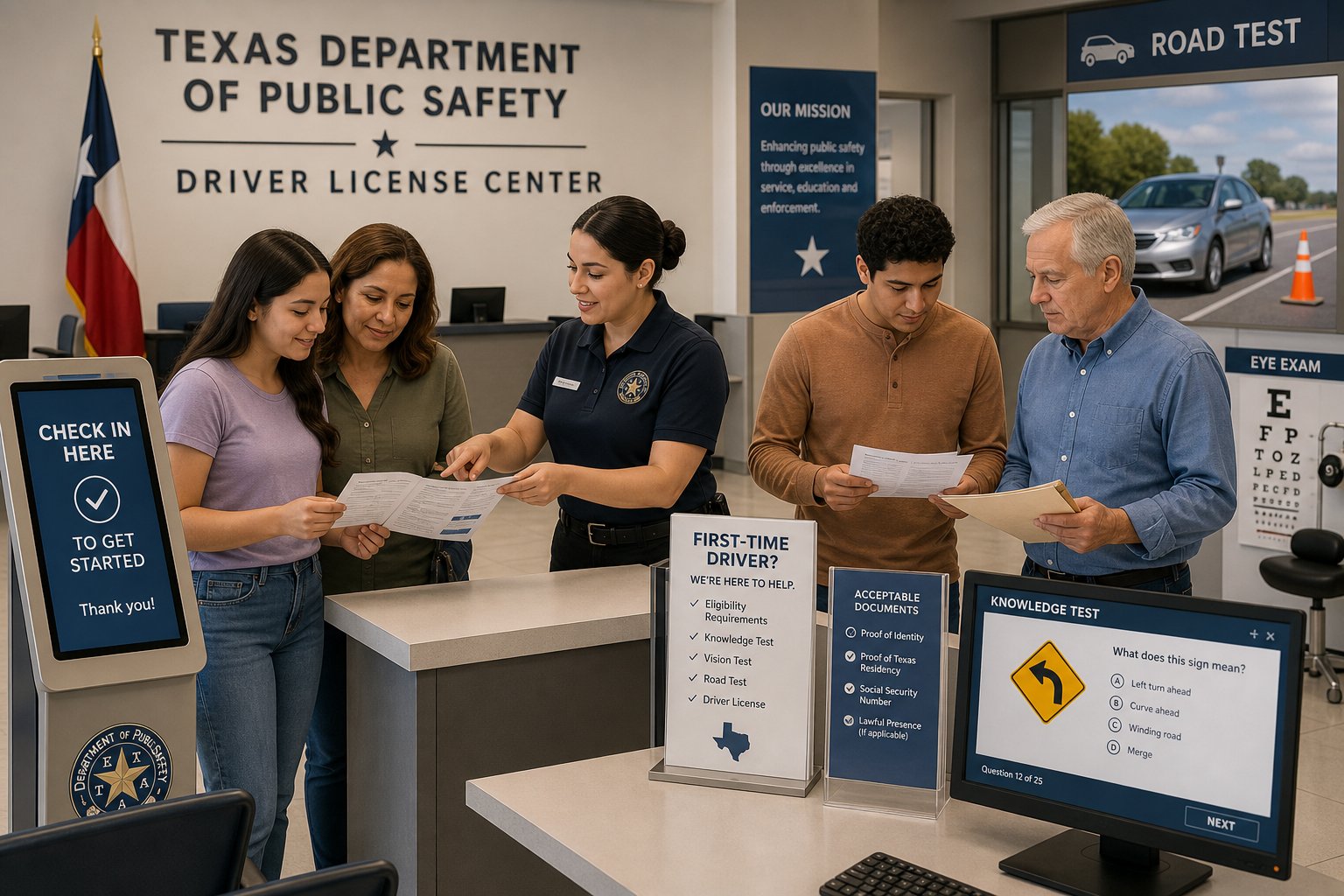
Who Needs To Take The Texas Driver’s License Test
If you are getting your first Texas driver’s license, you usually need to take tests through Texas DPS or meet an approved waiver rule. That includes teens, adults, and many people who have never held a valid license before.
You will likely need the texas drivers license test if you are:
- A teen applying for a learner or provisional license
- An adult with no prior license
- A new Texas resident without a valid out-of-state license Texas accepts
- An adult 18 to 24 applying for a first license
- An adult 25 or older who has never been licensed
For first-time drivers, Texas usually requires a vision test, a knowledge test unless waived, and a road test. The exact path depends on your age and your training records.
One key point matters a lot. Adults 18 and older do not need a learner’s permit before getting a driver’s license in Texas. Some adults still choose to get a restricted license or permit to practice, but it is not required in the same way it is for teens.
Also, Texas treats teen and adult training very differently. Teens must complete teen driver education. Adults age 18 to 24 must complete Adult Driver Education. If you already hold a valid license from another state, Texas may not require the full testing process. Check current rules with TxDPS before your appointment.
What The Texas Written Test Covers And How It Works
The written test is based on the Texas Driver Handbook. It covers traffic laws, road signs, and safe driving rules. Most questions are multiple choice, and the passing score is generally 80%.
You may take the written test at DPS, but some drivers can complete it through an approved course. That matters most for adults 18 to 24.
A major shortcut for adults 18 to 24
If you complete a state-approved Adult Driver Education course, you can often waive the DPS written knowledge test. This is a big benefit. In Texas, the adult course is the ADE-1317 course, and it is different from defensive driving.
Do not mix these up:
- Adult Driver Education (ADE) is for a first license
- Defensive driving / Driver Safety Course (DSC) is for ticket dismissal or insurance discounts
- Impact Texas Adult Drivers (ITAD) is a separate free one-hour video course required by TxDPS for many adult applicants
If you are 18 to 24, you usually need both the ADE course and the ITAD certificate. They are not the same course.
If you want a faster path, using an approved online provider like Driving Logic can help you finish the required classroom portion on your schedule. You still must bring the right certificate to DPS.
Texas Permit And License Steps For Teens Vs. Adults
Texas has different steps for teens and adults. That is where many people get confused.
Teens age 15 to 17
Teens must complete approved driver education and get the proper certificate, often a DE-964 or DEE-964. After that, they can apply for a learner license, practice with a licensed adult, and hold that learner license for at least six months before moving to the road test for a provisional license.
Teens also have extra rules tied to practice hours and age-based limits.
Adults age 18 to 24
Adults 18 to 24 must complete a 6-hour Adult Driver Education course approved by the Texas Department of Licensing and Regulation. You may see the certificate listed as ADE-1317 or ADEE-1317.
This group also needs the free Impact Texas Adult Drivers course through impacttexasdrivers.dps.texas.gov. After that, you can move forward with DPS testing and your license appointment.
Adults 25 and older
Adults 25+ do not have to take Adult Driver Education to get a first license, but they still need to pass the required tests unless they qualify for an exemption. That usually means the vision test, written test, and road test.
For course approval details, you can review information from the Texas Department of Licensing and Regulation.
Required Courses, Documents, And DPS Appointment Prep
Before your DPS appointment, make sure your courses, papers, and car are all ready. Missing one item can force a reschedule.
Common items Texas DPS may require include:
- Proof of identity
- Proof of U.S. citizenship or lawful presence
- Proof of Texas residency
- Social Security number proof
- Current insurance and registration for the vehicle used in the road test
- Your course certificate, if one applies
- Your ITAD or teen Impact Texas certificate if required
Adults 18 to 24 need to pay special attention here. They usually need:
- An approved ADE-1317 certificate
- A valid ITAD certificate dated within the allowed window
- A road-test-ready vehicle
Your car also has to pass a basic inspection. DPS may check the brake lights, horn, mirrors, tires, doors, license plates, and other basic safety items before the test starts.
Schedule through the official Driver License Services system at TxDPS. Then review every document the night before. If you still need the adult course, Driving Logic’s Texas ADE course is built for busy adults who want a flexible online option and a written test waiver benefit.
How The Texas Road Test Works
The road test is the part most people mean when they say texas dps driving test skills. A DPS examiner or approved third-party tester watches how you control the car and follow the rules.
The test usually begins with a vehicle check. If the car has a serious problem, the test may end before you drive. After that, you will drive on public roads and perform common actions that show safe control.
You may be asked to do tasks like:
- Start and stop smoothly
- Turn right and left correctly
- Change lanes safely
- Back up in a straight line
- Obey stop signs and traffic lights
- Control speed and following distance
- Show awareness in school zones
- Make a quick stop when told
Texas testing can vary by location and examiner, so not every route looks the same. Also, parking tasks may differ. Because testing practices can change, confirm the current maneuver list with your local TxDPS office before your appointment.
What Examiners Score During The Driving Test
Examiners score your driving in a few core areas: control, observation, positioning, and signaling. They want to see steady steering, smooth braking, proper lane use, mirror checks, blind-spot checks, and signals given on time.
They also watch for major errors. You can fail for unsafe driving, breaking traffic laws, refusing instructions, causing danger, or getting too many point deductions. Texas guidance commonly notes that drivers who get more than 30 points deducted do not pass.
Practice the basics until they feel boring. That is usually a good sign.
Common Mistakes That Cause Fails And How To Avoid Them
Most road test failures come from a short list of mistakes. The good news is that each one is fixable with focused practice.
Rolling stops are a major problem. Stop fully behind the line or before the crosswalk. Then move only when the road is clear.
Missing mirror and blind-spot checks also hurts many drivers. Use a simple pattern:
- Mirror
- Signal
- Blind spot
- Move when clear
Bad turns are another common issue. Do not swing wide. Do not cut corners. Turn into the correct lane and stay centered.
Speed mistakes matter too. Driving too fast is risky, but driving too slow can also create problems. Match the posted speed when conditions allow, and slow down early for school zones.
Failure to yield often causes point loss or a fail. Watch for pedestrians, oncoming traffic, and cars already in the lane.
Jerky control can cost you points. Practice smooth braking, gentle steering, and calm starts.
If you fail, Texas often allows up to two more retakes within 90 days before a new application may be needed, but confirm current rules with DPS. If you still need the classroom part for a first adult license, complete the approved course first so you can bring your ADE-1317 proof and move through the process with fewer delays.
FAQ
What maneuvers are on the Texas driving test?
Basic control, turns, lane changes, speed and following distance, obeying signs and signals, and a parking or backing maneuver such as a three-point turn.
Is parallel parking on the Texas driving test?
A parking or backing maneuver may be included; the exact maneuver can vary by examiner and site. Practicing parallel parking, backing, and a three-point turn prepares you for the options.
What do examiners look for most?
Smooth, safe, lawful driving: signaling, checking mirrors and blind spots, maintaining safe speed and spacing, and obeying signs and signals.
Do adults take a different driving test than teens?
The road test itself is the same skills exam. The difference is the path to it — adults 18+ need no learner’s permit, and 18–24 complete ADE, which waives the written test.
Conclusion
Once you see the maneuver list, the Texas road test stops feeling mysterious: it is a check of the everyday skills a safe driver uses on any trip. Practice the fundamentals — smooth control, proper signaling and checks, safe spacing, and a parking maneuver — and you will be rehearsing exactly what the examiner scores. Preparation here is steady practice, not last-minute tricks.
Before the road test, adults 18–24 complete the Texas adult driver education course online, which waives the written test and reinforces the rules behind these maneuvers.
Related Articles
- Texas Driving Test: What to Expect and How to Prepare
- What to Do If You Fail the Texas Driving Test
- What Happens After You Pass the Texas Driving Test? Getting Your License
- Texas DPS Vision Test: What to Expect
Sources
Billy Forte is the owner of Driving Logic, a TDLR-approved Texas adult driver education and driver safety course provider. Driving Logic offers the online Texas Adult Driver Education (ADE) course that helps adults qualify for a first Texas driver license and waive the DPS written knowledge test.
This article is general information about Texas adult driver licensing, not legal advice. Requirements, fees, and procedures are set by TDLR and the Texas DPS and can change, so confirm current details with official Texas sources before you enroll or visit a DPS office.