
Updated October 2026 · Reviewed by Billy Forte
The Texas driving test is the road exam DPS gives last, only after you pass every other exam and show proof of insurance. You bring a registered, insured car that matches your license class, and the examiner grades control, observation, positioning and signaling. Your application is not approved if you break the law, refuse instructions, drive dangerously or crash, or lose more than 30 points.
Key Facts
- Order: the driving test comes after the vision and knowledge tests. See where it fits.
- Your car: valid registration and insurance, and it must pass a vehicle check. See the car you bring.
- Insurance: you need not be on the policy, but you cannot be an excluded driver. See insurance rules.
- Grading: four skills plus a list of maneuvers. See how the drive is graded.
- Not approved: a law violation, refusing instructions, dangerous driving or a crash, or over 30 points. See what stops approval.
- Where: a DPS office or a DPS-certified third-party school. See booking the test.
Where the Texas Driving Test Fits
The road test is the final exam. The Texas Driver Handbook says it is given “only after all other exams are passed” and proof of financial responsibility is shown.
Before that, the DPS apply page has you apply, show documents, give thumbprints and a photo, pay the fee and pass the vision exam. Then you pass the written knowledge test. Our guides to the Texas DPS vision test and the Texas written knowledge test cover those two steps.
Two certificates may also come before the drive. Ages 18 to 24 need the six-hour adult course certificate. Applicants 18 and older need an Impact Texas Drivers certificate dated within 90 days of the driving test.
Who Takes the Road Test
DPS form DL-60, “How to Prepare for a Drive Test”, says a drive test is required in these cases:
- You have never been licensed.
- Your license has been expired more than two years.
- You have a medical condition that requires one.
- A license restriction calls for a test.
- A court ordered one.
New residents can be exempt. The DPS Moving to Texas page says adults 18 and older with a valid out-of-state license skip the knowledge and skills exams. DPS also accepts a license not expired over two years.
Booking the Test
You apply for your license before you book the road test. The DPS road test FAQ says so, and it says road tests can be booked “up to 180 days in advance” through the Texas DPS scheduler.
The FAQ also says “The Customer Service Center cannot schedule, reschedule, or cancel road tests.” Use the scheduler for any change. To see how soon offices have open slots, check the DPS wait-times report, explained in our Texas DPS wait time guide.
You can also test with a driving school that DPS has certified. DPS says the program “reduces the time you must wait to take your driving test.” See our guide to Texas third-party driver license testing.
Timing ITAD Around Your Date
The ITAD FAQ says “The ITAD certificate is only valid for 90 days.” It must be done no more than 90 days before the skills exam, and after the six-hour adult course.
So once your road test date is set, count back 90 days. Take ITAD inside that window, and print the certificate. DPS does not accept an electronic copy.
The Car You Bring
You provide the car. The road test FAQ says you must bring “a vehicle with valid registration and insurance.” The handbook adds that the car must match the class of license you are applying for.
Before the drive starts, the examiner checks the car. DL-60 lists what must be in order:
| Vehicle item | What DL-60 requires |
|---|---|
| License plates | Two plates, except single out-of-state or temporary plates; no dealership plates |
| Speedometer and horn | Both working |
| Turn signals | Working on the front and back |
| Registration and insurance | Unexpired; you cannot be listed as an excluded driver |
| License restrictions | Any restrictions on your license must be met |
| Mirror | At least one rearview mirror, inside or outside |
| Doors | Driver and front passenger doors open normally |
| Seat belts and brake lights | Working |
| Wipers and lights | Working headlights, taillights and wipers as weather and time require |
DL-60 says the car must pass this check before the test begins. The handbook also says dealer temporary cardboard tags “may not be used” for driving exams.
Plates on a New or Out-of-State Car
The road test FAQ answers two plate questions. A newly bought car with metal plates but no sticker can be used if both plates are attached and you show the Buyer’s Receipt.
A car registered in another state with no front plate can be used if it meets that state’s registration laws. Bring the papers that show it.
Insurance Rules
The handbook calls insurance “evidence of financial responsibility.” You show it before the driving test.
The road test FAQ makes one point clear. You do not need to be listed on the car’s policy, but “you cannot be listed as an excluded driver.”
The DPS apply page also asks for proof of insurance for each vehicle you own, or a statement that you do not own one. That is part of applying, separate from the test car.
On Test Day
Getting there takes planning if you are not licensed yet. The handbook says a licensed driver must drive the car to the office and exam area.
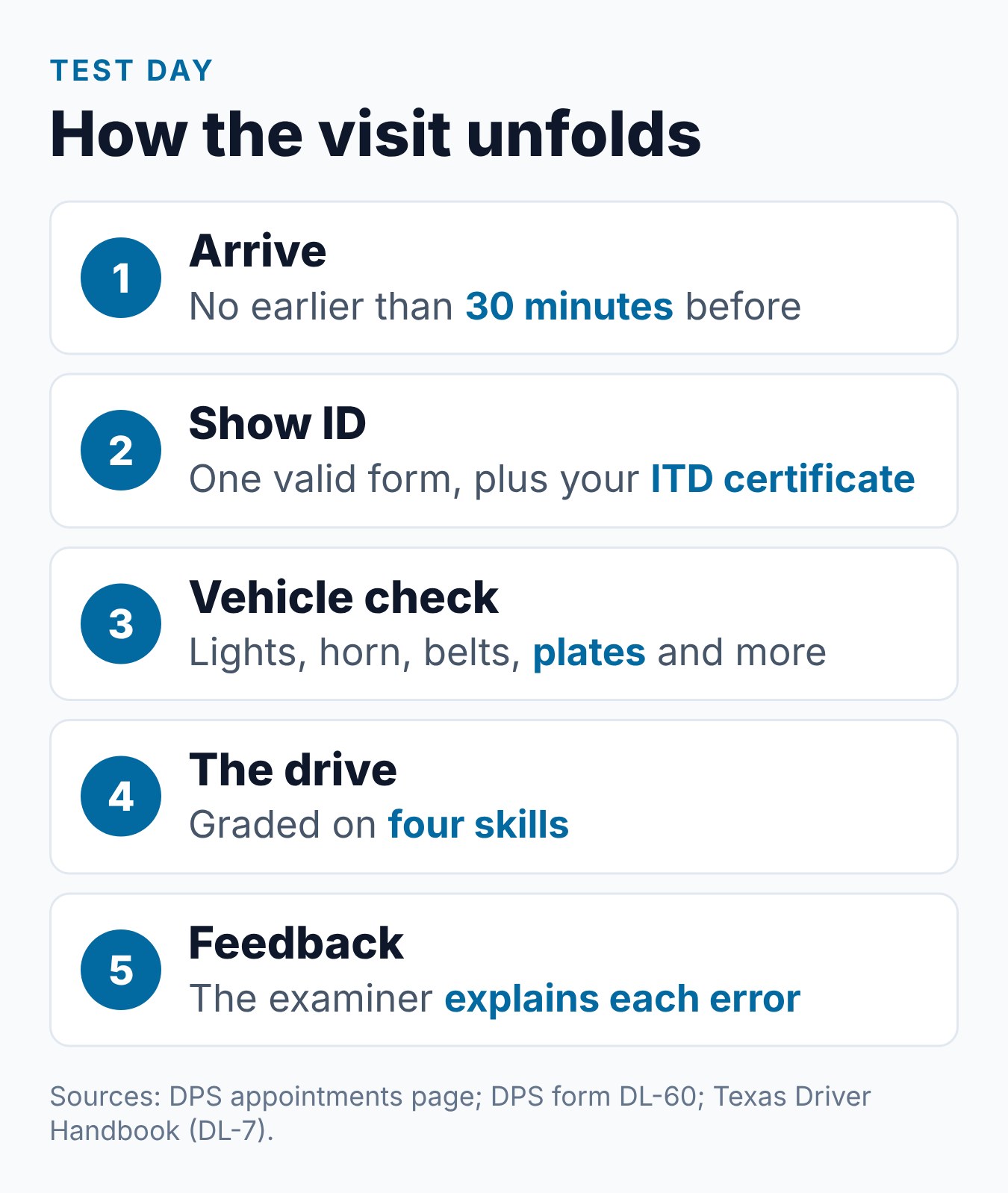
The DPS appointments page says to arrive no earlier than 30 minutes before your slot. It also says appointments are cancelled after 30 minutes.
Separately, DPS requires a printed ITD certificate dated within 90 days of the driving test. DL-60 sets a few more rules for the drive:
- ID. Show one valid form of identification to the examiner before the test.
- Questions. Ask them before you start. Once the test begins, the examiner will not chat.
- Passengers. No pets or unauthorized passengers may ride along.
How the Drive Is Graded
A License and Permit Specialist, or LPS, grades the drive. The handbook names four skills: control, observation, positioning and signaling. They apply to every part of the route.
The handbook also lists maneuvers you may be graded on. They include parallel parking, a quick stop at about 20 mph, backing about 60 feet, stop signs, signals, turns and lane use. A back-up camera is allowed for parking, but automated parking is not.
Our guide to Texas driving test skills and maneuvers explains each item. The handbook does not state how long the test lasts.
What Stops Approval
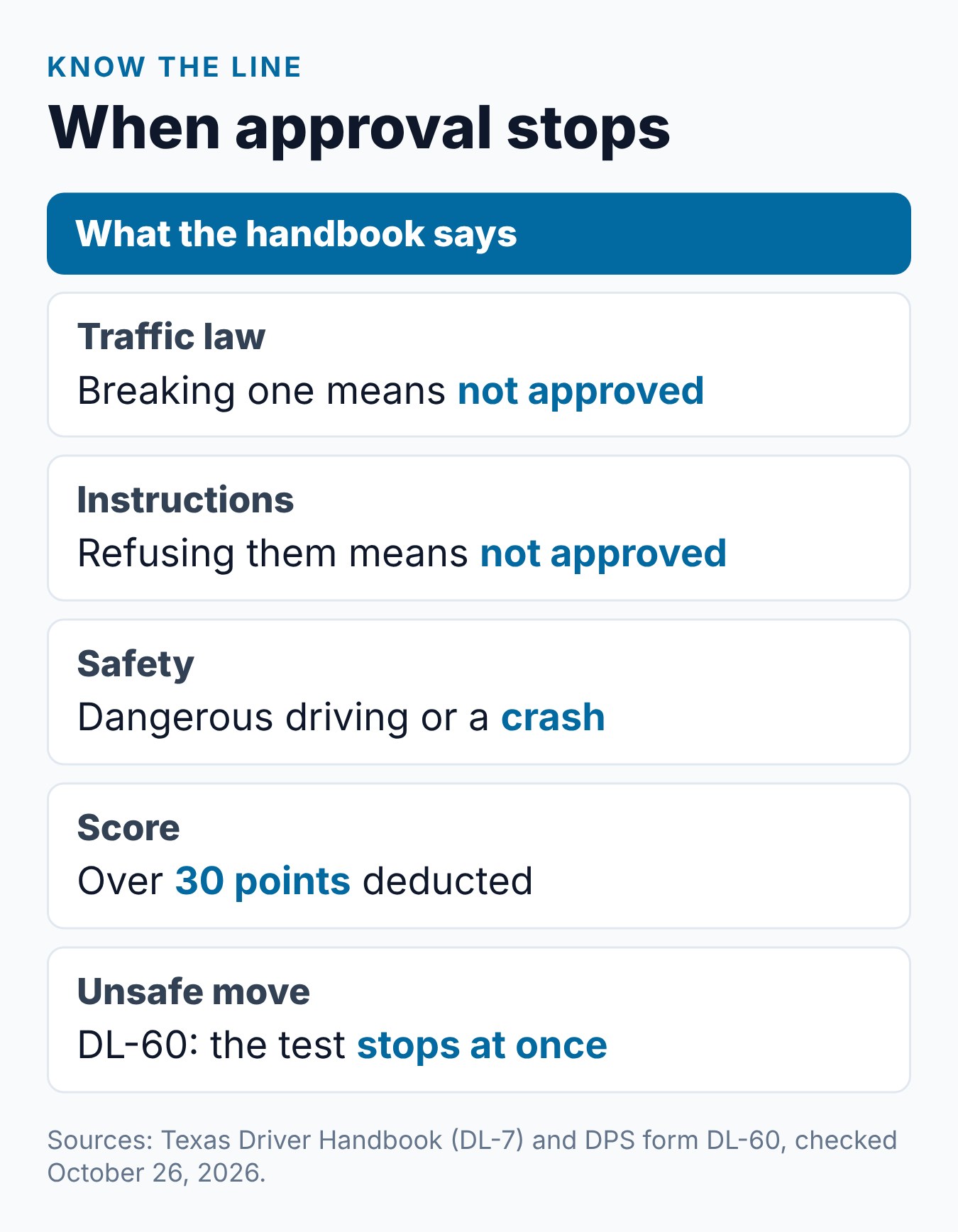
The handbook says your application “will not be approved” if you:
- Violate the law.
- Refuse to follow instructions.
- Drive dangerously or have a crash.
- Have more than 30 points deducted on the driving exam.
DL-60 adds that a dangerous or illegal maneuver stops the test right away, with an automatic fail. DPS does not publish a point value for each error.
Feedback After the Drive
You get feedback either way. The handbook says, “Upon completion of the driving exam, the LPS will explain all driving errors and let you know how to correct those errors.”
DL-60 says you learn whether you passed and hear about your strengths and areas to improve. Write the notes down before you leave.
After the Result
If you pass all your exams, the handbook says you get a temporary license you may use for 45 days or until your card arrives. DPS says the card typically arrives by mail within 2-3 weeks. See what happens after passing the Texas driving test.
If you do not pass, you schedule another driving exam. Texas law allows three attempts per application and fee, and DPS holds the application for 90 days. See what to do if you fail the Texas driving test.
How to Prepare
DPS gives simple advice in DL-60. Review the Texas Driver Handbook, and practice every maneuver on the Driver Safety Checklist before you schedule. Have someone instruct you and point out mistakes.
Use this checklist in the weeks before your test:
- Pass the earlier exams. Vision and knowledge come first.
- Check ITAD timing. The certificate must be dated within 90 days of the test.
- Check the car. Walk through the DL-60 vehicle list a few days ahead.
- Check the insurance. Make sure you are not an excluded driver.
- Practice the list. Work on each handbook maneuver and all four skills.
- Plan the ride. Line up a licensed driver to bring the car.
Texas Driving Test Guides in This Series
Each guide covers one part of the testing process in depth:
- Skills and maneuvers: the four graded skills and each listed maneuver.
- The vision test: the DPS vision scores and HB 647.
- The written knowledge test: topics, the 70 percent pass mark and where the course fits.
- DPS wait times: how to read the DPS report and plan ahead.
- Third-party testing: driving tests at DPS-certified schools.
- After you pass: the temporary license, the card and the REAL ID star.
- If you fail: three tries, the 90-day hold and booking again.
What We Found on the Official Pages
On the DPS pages we checked on October 26, 2026, the handbook was revision January 2026. Its driving exam part gave the four skills, the maneuver list and the four reasons an application is not approved. It did not state a test length.
The road test FAQ was dated November 18, 2020, and it pointed readers to DL-60 for more detail. DL-60 held the vehicle checklist and the rules on passengers and questions.
Common Mistakes to Avoid
Each item comes from the DPS handbook, DL-60 or a DPS page:
- Booking before you apply. DPS says you apply first.
- Driving yourself to the test. If you are not licensed, a licensed driver must bring the car.
- Bringing a car with a dead brake light. The car must pass the check before the test starts.
- Being an excluded driver. The policy cannot exclude you.
- Using the self-parking feature. Automated parking is not allowed.
- Bringing an old ITAD certificate. It must be dated within 90 days.
How Requirements Can Vary
Texas driver license rules come from state law, Texas DPS rules and TDLR rules, and they apply statewide. What you need still depends on your age, whether you hold a license from another state, and which tests you have already passed.
Laws, fees and office procedures can change. Check the Texas DPS and TDLR websites for current rules before you book an appointment or enroll in a course.
Frequently Asked Questions
What should I expect on the Texas driving test?
Expect a vehicle check, then a drive graded on control, observation, positioning and signaling. You may be asked to parallel park, make a quick stop and back up. The examiner explains your errors at the end.
Do I need my own car for the Texas driving test?
Yes. DPS says you must provide a vehicle with valid registration and insurance. It must match the license class and pass the examiner’s check.
Do I have to be on the car’s insurance policy?
No. The road test FAQ says you do not have to be listed, but you cannot be an excluded driver.
What makes you fail the Texas driving test?
The handbook says the application is not approved if you break the law, refuse instructions, drive dangerously or crash, or lose more than 30 points.
Can I take the driving test before the written test?
No. The handbook says the driving exam is given only after all other exams are passed.
Can I bring a passenger or my pet?
No. DL-60 says no pets or unauthorized passengers may be in the car during the test.
Does a driver education course prepare me for the road test?
The six-hour adult course is taught in a classroom or online, and it tests highway signs and traffic laws. No official source says it prepares you for the road test, so practice the handbook maneuvers too.
Conclusion
The Texas driving test comes last, and much of your preparation is setup: a car that passes the check, the right insurance, a current ITAD certificate and the earlier exams passed. Then the examiner grades four skills and explains every error at the end. If you are 18 to 24, the six-hour course comes before all of this, and you can start with Driving Logic’s online Texas adult driver education course.
Related Articles
- Texas Drivers License Test: Skills and Maneuvers Graded
- Texas DPS Vision Test: What to Expect
- Texas DPS Written Knowledge Test: What It Covers and How ADE May Help
- Texas DPS Wait Times: How Far in Advance Do You Need to Book Your License Appointment?
- Texas Third-Party Driver’s License Testing: What It Is and Where to Go
- What Happens After You Pass the Texas Driving Test? Getting Your License
- Failed Texas Driving Test? What to Do Next
Sources
- Texas DPS — Texas Driver Handbook (DL-7, PDF)
- Texas DPS — FAQ: Scheduling a Road Test
- Texas DPS — Apply for a Texas Driver License
- Texas DPS — Driver License Services Appointments
- Texas DPS — Appointment Scheduler
- Texas DPS — Driver License Appointment and Office Wait Times
- Texas DPS — Third Party Skills Testing Program
- Texas DPS — Impact Texas Adult Drivers FAQ
- Texas DPS — Impact Texas Drivers (ITD) Program
- Texas DPS — Moving to Texas
Billy Forte is the owner of Driving Logic, a state-approved driver improvement course provider serving Texas and other U.S. states.
This article is general information, not legal advice. Texas driver license and driver education rules are set by Texas law, Texas DPS and TDLR, and they can change. Check the official DPS and TDLR websites for current requirements before you apply.