
Updated June 2026 · Reviewed by Billy Forte
If you fail the Texas driving test, you do not lose your chance at a license — DPS allows you to retake the road test after addressing what went wrong. Common reasons for a failed test include unsafe lane changes, rolling stops, poor speed control, and incomplete checks, and the examiner’s feedback points you to what to practice. There may be a waiting period or a re-test fee depending on the office, so the practical next step is to confirm the local retake rules and prepare specifically for the skills that caused the result.
Applies to first-time Texas driver licensing. Requirements are set by the Texas DPS (and TDLR for driver education) and can change.
Key Facts
- Retakes are allowed: DPS lets you retake the road test after a failed attempt.
- Know why you failed: The examiner’s notes identify the specific skills to work on.
- Common causes: Unsafe lane changes, rolling stops, speed control, and missed mirror/blind-spot checks.
- Possible wait or fee: A waiting period or re-test fee may apply; confirm with the office.
- Targeted practice: Rehearse the exact maneuvers that caused the result before rebooking.
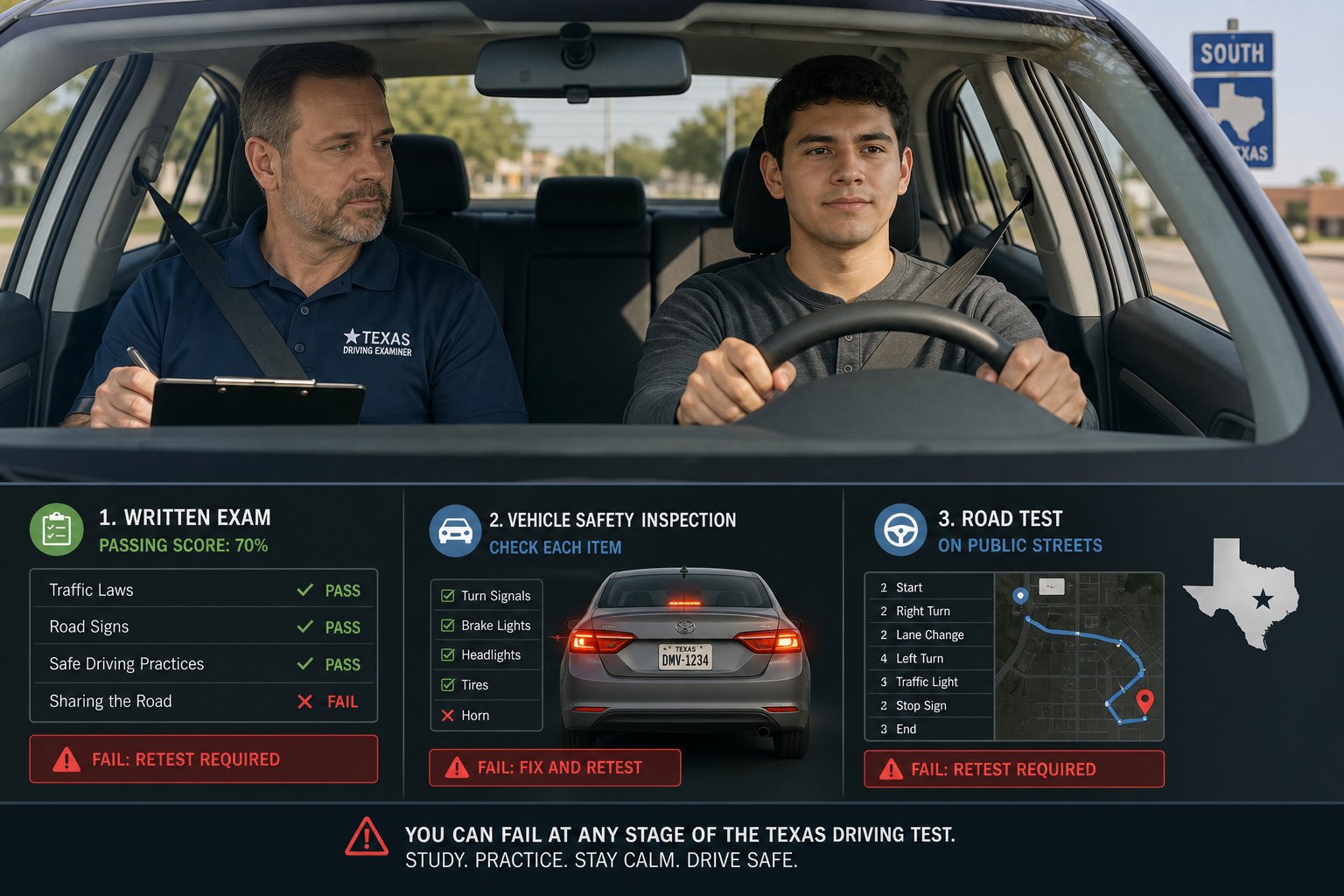
How The Texas Driving Test Is Structured
The Texas driving test has three main parts. First is the knowledge part, unless you have a written test waiver from an approved Adult Driver Education course. Then Texas DPS checks your vehicle. Last comes the road test.
This matters because a fail can happen in more than one place. Some people drive well but show up with a car that does not meet safety rules. Others pass the basics, then lose too many points on the road.
For adults, the process can look different depending on age and course completion. If you are 18 to 24, a state-approved ADE course is required for a first license. That course leads to the ADE-1317 certificate, and it waives the DPS written exam. It is not the same as ITAD, which is a free one-hour course from TxDPS at Impact Texas Drivers.
Also, adults 18 and older in Texas do not need a learner’s permit before getting a driver’s license. That surprises a lot of people.
Written Exam, Vehicle Check, And Road Test Basics
If you do not have the waiver, the written exam tests traffic laws, road signs, and safe driving rules from Texas materials. The usual passing mark is 70%. But for many first-time adult applicants, the smarter path is finishing a TDLR-approved Adult Driver Education course first, because it removes that written test step.
The vehicle check comes before the road test. The examiner may check your:
- Brake lights and turn signals
- Horn
- Windshield wipers
- Mirrors
- Seat belts
- Tires and basic safety condition
If the car is not safe or legal, your test may be delayed or rescheduled.
Then comes the road test on public streets. The examiner watches how you handle lane position, turns, stops, speed, signs, signals, and awareness. In plain terms, you need a strong score with limited mistakes. Texas sources often describe that as about 30 points or fewer deducted on the road test.
What Causes A Failed Texas Driving Test
A failed Texas driving test usually happens in one of two ways. You either lose too many points on smaller errors, or you make one major mistake that causes an automatic fail.
That distinction matters. If you know which kind of fail happened, you can fix the right problem before your next DPS appointment.
Small errors add up fast. One late signal may not end the test. But several weak habits together can push you over the limit. Common point-loss problems include:
- Not checking mirrors often enough
- Forgetting blind spot checks
- Signaling too late
- Stopping too hard or too late
- Drifting in the lane
- Following too closely
- Inconsistent speed control
A lot of people think, “I only made a few mistakes.” But the examiner is scoring each part of your drive. A few errors at every turn can become a fail.
Point Deductions Vs. Automatic Fails
Point deductions are usually for mistakes that are not immediately dangerous. You may still finish the route, but the score may not be high enough to pass. Texas test guidance commonly points to more than 30 points deducted as a failing result.
Automatic fails are different. These are major safety errors or clear traffic law violations. Common examples include:
- Running a red light
- Rolling through or missing a stop sign
- Speeding clearly over the limit
- Unsafe lane changes
- Driving on the wrong side of the road
- Causing another driver to brake or swerve
- Ignoring examiner directions
- Creating a crash risk
If the examiner has to step in, the test is often over.
After a failed Texas drivers license test, ask what hurt your score most. Was it observation, speed control, turns, or stops? That short feedback can save you a lot of wasted practice.
How Retakes Work In Texas
If you fail, you can usually retake the test. Texas guidance says you generally get three attempts within 90 days on the same application. If you fail all three times, or the 90-day period runs out, the application is rejected and you must file a new one and pay the full fee again.
That is the basic answer to what happens after a failed road test in Texas. You are not done. But the clock does matter.
Texas sources also state that there is usually a two-week wait between road test attempts. Retests also require a fee. Since fees and scheduling rules can change, check the current details with TxDPS before you book.
Use the official site for your next DPS appointment at Texas DPS. For course rules and approved providers, check the Texas Department of Licensing and Regulation at TDLR.
Three Attempts, Waiting Periods, And Rescheduling
Here is the simple version:
- Up to 3 attempts on the same application
- Within 90 days of that application
- About 2 weeks between attempts
- Retest fee applies
- New application needed after 3 failed tests or after 90 days
If your test ended because of a vehicle issue, fix that before you reschedule. If you failed for driving errors, do not just book the next slot and hope it goes better. Use the gap well.
Also, make sure your documents are still in order. If you are in the 18 to 24 group, bring proof of the required courses. That may include your ADE-1317 and your ITAD certificate, depending on your licensing step. Keep those two courses separate in your mind: ADE is the state-approved driver education course, and ITAD is the free video course from TxDPS.
Before you reschedule, confirm the current retest rules on the official DPS site.
How To Prepare Smarter For Your Next Test
The best retake plan is simple: find the exact weak spots, then practice those skills on purpose. Do not only drive more. Drive better.
Start with the examiner’s feedback. If they mentioned blind spots, focus on mirror use and shoulder checks. If they marked stops, practice smooth, full stops behind the line. If speed control was shaky, spend time holding a steady speed on the kinds of roads used near the test site.
Use the same car for practice and the test if you can. That helps with pedal feel, mirror position, and turning radius. It also lowers stress.
A smart practice list should include:
- Seat and mirror setup before moving
- Seat belt on before start
- Signals at least 100 feet before turns or lane changes
- Full stops with no rolling
- Mirror checks often
- Shoulder checks for lane changes
- Safe following distance
- Smooth braking and steady speed
Mock tests help a lot. Have another adult give directions without warning. Drive on real roads. Treat every mistake as if it counts.
If you are getting your first license, proper course work helps before you ever reach the road test. A TDLR-approved Texas Adult Driver Education course teaches the rules, signs, and safe driving basics in a clear order. And one major benefit stands out: when you complete the course and get the ADE-1317, you receive the written test waiver. That means you do not need to take the Texas DPS written exam at the office.
That saves time and removes one common failure point. It also helps you show up better prepared for the road test because you have already studied the handbook material in a structured way.
If you still need that step, you can take the approved Texas ADE course through Driving Logic. It is built for busy adults who want flexible online learning on their own schedule.
And if your road test is the only part left, spend your next practice sessions on the exact moves that cost you points most.
FAQ
Can I retake the Texas driving test if I fail?
Yes. DPS allows retakes. Review the examiner’s feedback, practice the skills that caused the fail, and rebook the road test.
How soon can I retake the test?
It depends on the office — there may be a waiting period and a re-test fee. Confirm the local rules when you schedule your next attempt.
What are the most common reasons people fail?
Unsafe lane changes, rolling through stops, poor speed control, and not checking mirrors or blind spots. The feedback sheet shows your specific issues.
Do I have to retake everything if I only failed the road test?
Generally you retake the portion you did not pass. If your written test was waived by ADE and your vision check passed, you focus on the road test.
Conclusion
A failed road test is a setback, not a dead end — Texas lets you retake it, and the examiner’s feedback is essentially a study guide for your next attempt. Confirm any waiting period or fee, then put your practice squarely on the maneuvers that tripped you up. Approached that way, the retake is usually where things click into place.
Solid fundamentals start with good instruction; adults 18–24 complete the Texas adult driver education course online, which waives the written test and reinforces safe-driving rules.
Related Articles
- Texas Driving Test: What to Expect and How to Prepare
- Texas Driving Test: What Maneuvers and Skills Are Tested
- What Happens After You Pass the Texas Driving Test? Getting Your License
- Texas DPS Written Knowledge Test: What It Covers and How ADE May Help
Sources
Billy Forte is the owner of Driving Logic, a TDLR-approved Texas adult driver education and driver safety course provider. Driving Logic offers the online Texas Adult Driver Education (ADE) course that helps adults qualify for a first Texas driver license and waive the DPS written knowledge test.
This article is general information about Texas adult driver licensing, not legal advice. Requirements, fees, and procedures are set by TDLR and the Texas DPS and can change, so confirm current details with official Texas sources before you enroll or visit a DPS office.