
Updated June 2026 · Reviewed by Billy Forte
Texas allows TDLR-authorized third-party providers to administer the driving skills (road) test, which can mean shorter waits than booking the test at a DPS office. You still meet the same requirements — completed courses, the free ITAD video, and your documents — but you take the road test through an approved provider and then complete licensing steps with DPS. It is a scheduling option, not a shortcut around any requirement, so the eligibility rules and paperwork are the same as testing at DPS.
Applies to first-time Texas driver licensing. Requirements are set by the Texas DPS (and TDLR for driver education) and can change.
Key Facts
- What it is: TDLR-authorized providers administer the official road test outside a DPS office.
- Why use it: It can offer shorter wait times than DPS road-test appointments.
- Same requirements: Courses, the free ITAD certificate, and documents still apply.
- Find an approved provider: Use TDLR-authorized third-party testers, not unapproved sites.
- Finish with DPS: Some licensing steps are still completed through DPS after you pass.
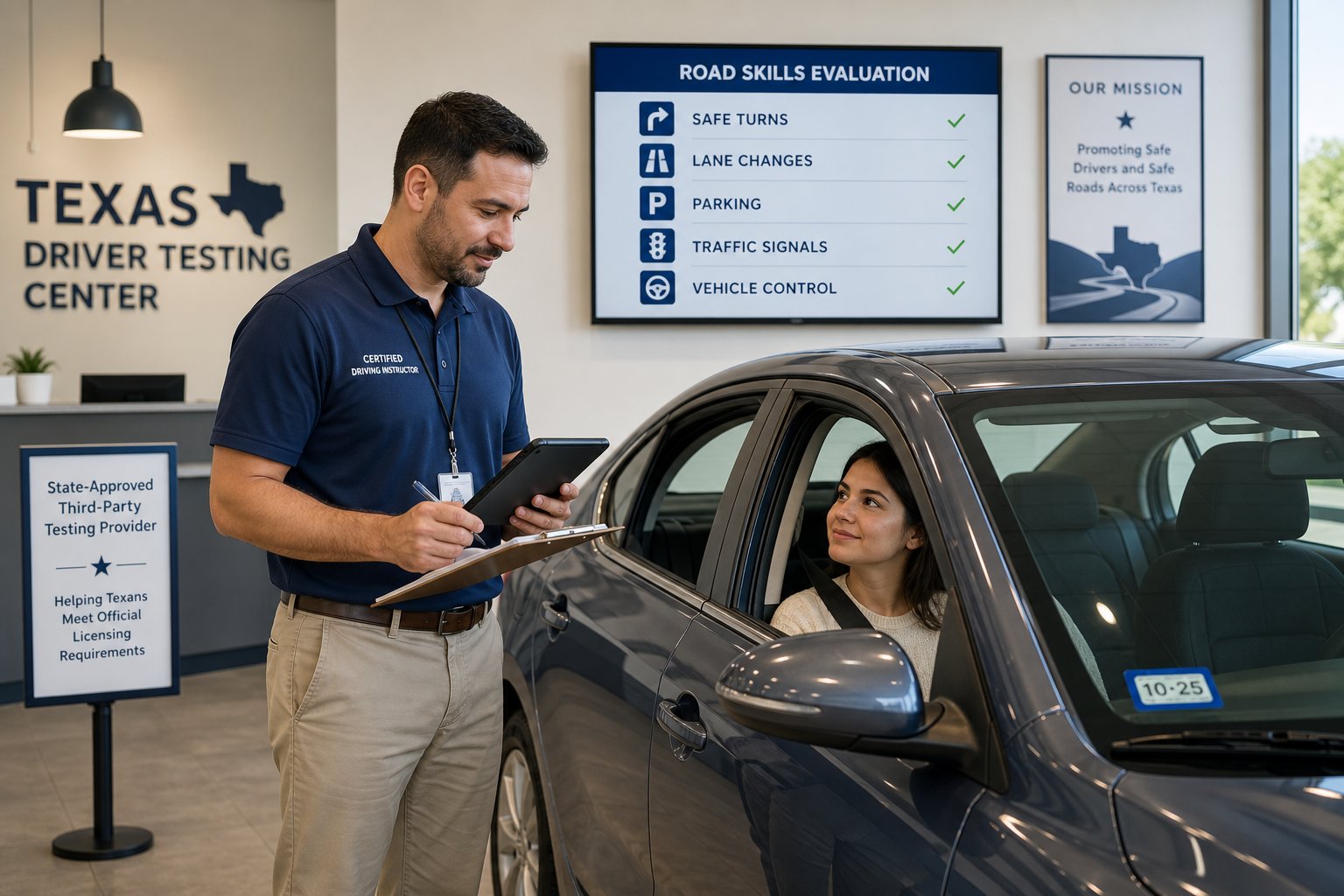
What Texas Third Party Driver License Testing Is And How It Works
Texas lets certain private schools give the road test through the Third Party Skills Testing program. These schools are approved by the Texas Department of Licensing and Regulation and must follow state rules. That is what people usually mean by texas third party driver license testing.
The key point is simple. A third-party school can give the driving test that you might otherwise schedule with Texas DPS. This can help if DPS appointments are hard to get in your area.
But third-party testing does not replace every DPS step. In most cases, you still deal with TxDPS for license issuance, record checks, or other final steps. You may also still need a vision test if DPS requires it.
The test is meant to measure the same safe driving skills Texas expects on a state road test. That includes things like:
- Safe turns
- Lane changes
- Parking
- Stopping and starting
- Obeying signs and signals
- Basic control of the car
For many adults, this works well with Adult Driver Education. If you are 18 to 24, Texas requires both the ADE course and Impact Texas Adult Drivers (ITAD) for a first license. These are not the same course.
And one benefit matters a lot: completing Adult Driver Education waives the DPS written knowledge test. Your ADE completion form, often called ADE-1317, can serve as the written test waiver when you apply for your first license. That can save time before your road test even begins.
To find an approved school, check the TDLR website.
Who Can Use A Third Party Road Test In Texas
Not every driver has the same rules. Texas uses age and license status to decide what you need before a third-party road test.
If you are 16 or 17, you must usually have a valid learner license, complete teen driver education, hold the permit for at least 6 months, and finish Impact Texas Teen Drivers (ITTD) within 90 days of testing. Your school may ask for the DE-964 or DEE-964 certificate.
If you are 18 to 24 and getting your first driver’s license, you usually need:
- A valid restricted license, if required for your status
- Adult Driver Education completion
- Your ADE-1317 or equivalent certificate
- A current ITAD certificate dated within 90 days
This is where many people get mixed up. ITAD is a free, separate one-hour course from TxDPS. It is not the same as ADE. Also, adults 18 and older do not need a learner’s permit before getting a driver’s license in Texas.
If you are 25 or older, Texas does not require Adult Driver Education for a first license, but you may still need a valid restricted license and a current ITAD certificate before the road test. Rules can change based on your case, so confirm with the testing school and TxDPS.
If you want the written test waiver, you can take the Texas Adult Driver Education course from Driving Logic.
Requirements To Bring Before Your Driving Test
Paperwork problems cause a lot of failed appointments. So before you leave, make sure your documents are complete and current.
Most third-party schools will want to see your valid license or permit status first. That may be a learner license, restricted license, or other state-issued document that shows you are eligible for the test.
You may also need:
- Your driver education certificate, if required
- Your ADE-1317 if you completed Adult Driver Education
- Your ITAD certificate or teen Impact Texas certificate dated within 90 days
- Proof the vehicle is insured, if you are using your own car
- Any school-specific identity or school enrollment forms for teen applicants
Ask the school about the vehicle too. Some schools provide a test car. Others require you to bring one that meets state and school rules. The car may need working brake lights, turn signals, a windshield without major damage, and current insurance.
If you are 18 to 24 and want your written test waiver, make sure your ADE paperwork is valid and matches your name exactly. A mismatch can slow your file.
Also remember: third-party testing is for the road test. It does not mean you skip every DPS item. You may still need a DPS appointment later for license issuance, a photo, or a vision step. Check your paperwork twice before you go.
How The Third Party Testing Process Works From Scheduling To Results
The process is usually more direct than waiting for a state road test slot. First, you find a TDLR-authorized school that offers third party testing Texas drivers license services. Then you ask about openings, documents, fees, and whether they provide the car.
Next, you schedule the test with that school. Fees for third-party testing are separate from state license fees, and they can vary by provider. Do not assume all schools charge the same amount. And because Texas DPS fees are set by the state and may change, always verify current state fees at TxDPS.
On test day, you bring your documents and take the road test at the school. The examiner checks your driving skills under the TPST rules. The goal is the same as a DPS test: show that you can drive safely and follow Texas traffic laws.
If you pass, the school will either submit results to DPS or give you the forms and instructions for the next step. That part depends on the school and your license status. Some schools can help send the packet. In some cases, eligible drivers may finish later steps online or by mail through state systems after approval.
If you fail, ask what the retest policy is and what skills need work. Then fix those issues before you schedule again.
How Teens Ages 16–17 Upgrade From Permit To License
Teen drivers have more steps than adults. If you are 16 or 17, you must complete the teen path, not the adult path.
That usually means you need to:
- Hold your learner license for at least 6 months
- Finish the required teen driver education course
- Have the correct DE-964 or DEE-964 certificate
- Complete Impact Texas Teen Drivers (ITTD) within 90 days of the test
A third-party school may give the road test if you meet those rules. After you pass, the school may submit paperwork or help prepare your license packet. Some schools say this can help eligible teens move from permit to license with less DPS office time, though DPS can still require more processing.
Parents should check each school’s list before the appointment. Many teen delays happen because one paper is missing, the ITTD certificate is too old, or the permit has not been held long enough.
Also, do not mix teen and adult programs. Adult Driver Education is for adults seeking a first driver’s license. It is not the teen course, and it is not a defensive driving class for ticket dismissal. That mix-up causes trouble more often than you’d think.
If a teen is close to eligibility, confirm the dates with the school before booking the test.
How to Prepare for Your Texas Road Test
Good driving helps, but good prep matters just as much. Many people lose time over small mistakes, not major unsafe driving.
Start with the basics. Practice in the same type of car you plan to use. Get comfortable with mirrors, braking, smooth turns, lane changes, parking, and full stops. Texas examiners want safe habits, not flashy driving.
Focus on these points:
- Stop fully at stop signs
- Check mirrors before changing lanes
- Use turn signals early
- Keep both hands ready on the wheel
- Watch your speed in parking lots and neighborhoods
- Park with control, not speed
Paperwork is the other half of passing. Bring the right certificate set for your age. If you are 18 to 24, that usually means ADE-1317 plus a valid ITAD certificate. If you completed Adult Driver Education, remember that it gives you a written test waiver, which can remove one DPS hurdle.
It also helps to drive the test area first, if the school allows it. You may notice tricky turns, school zones, or heavy traffic spots.
Finally, ask the school what the check-in process is. Knowing where to park, what to bring, and when to arrive can keep you calm. Calm drivers make fewer mistakes.
What Happens After You Pass And When You Still Need To Visit DPS
Passing the road test is a big step, but it may not be the last one. Your testing school will tell you whether they submit the results directly, help prepare your packet, or send you to Texas DPS for the final issue step.
You may still need DPS for:
- License issuance
- Identity review
- A photo
- A vision test
- Extra document checks
- Any case that cannot be completed through the school process
Some drivers may be able to finish parts of the process online or by mail if eligible, after the third-party school submits the needed record. But not every case qualifies. That is why it is smart to ask the school exactly what happens after a pass result.
If you are 18 to 24 and still need your first license, make sure your ADE-1317 and ITAD certificate are ready for the final DPS step. If you have not taken ADE yet, Driving Logic’s Texas Adult Driver Education course can help you meet the state requirement and get the written test waiver before you book your road test.
For official updates, verify requirements with TxDPS, check Impact Texas at impacttexasdrivers.dps.texas.gov, and use TDLR to confirm that your testing provider is authorized.
FAQ
What is third-party driver’s license testing in Texas?
It’s the official road test administered by a TDLR-authorized provider rather than a DPS office, often with shorter wait times. The requirements are the same.
Does third-party testing skip any requirements?
No. You still need your completed courses, the free ITAD certificate, and your documents. Only the road-test location changes, and some steps still finish at DPS.
How do I find an authorized third-party tester?
Use a TDLR-authorized provider; check current TDLR listings rather than assuming any driving school can administer the official test.
Is third-party testing faster than DPS?
It can be, since these providers often have more road-test availability than busy DPS offices. Waits still vary by provider and area.
Conclusion
Third-party testing is best understood as a faster lane to the same destination: the official road test, given by a TDLR-authorized provider, with identical requirements. It can save weeks if your local DPS office is backed up, as long as you bring the same certificates and documents. Confirm the provider is authorized, finish any remaining steps at DPS, and the only thing you have changed is the wait.
Whichever road-test route you choose, adults 18–24 still complete the Texas adult driver education course online, which waives the DPS written test.
Related Articles
- Texas Driving Test: What to Expect and How to Prepare
- Texas DPS Wait Times: How Far in Advance Do You Need to Book Your License Appointment?
- Texas Driving Test: What Maneuvers and Skills Are Tested
- What Happens After You Pass the Texas Driving Test? Getting Your License
Sources
Billy Forte is the owner of Driving Logic, a TDLR-approved Texas adult driver education and driver safety course provider. Driving Logic offers the online Texas Adult Driver Education (ADE) course that helps adults qualify for a first Texas driver license and waive the DPS written knowledge test.
This article is general information about Texas adult driver licensing, not legal advice. Requirements, fees, and procedures are set by TDLR and the Texas DPS and can change, so confirm current details with official Texas sources before you enroll or visit a DPS office.