
Updated November 2026 · Reviewed by Billy Forte
The cheapest real way to take an approved course is to pick the lowest total price among the providers on FLHSMV’s Approved BDI Course Providers list, and that is what a search for traffic school Florida cheap should lead to. Florida law sets no course price, every approved provider teaches a course of the length FLHSMV sets, and a course that is not on the list earns no credit for a ticket. Here, “traffic school” means the Basic Driver Improvement (BDI) course.
Key Facts
- No state price: Florida law does not set what a provider charges for the course. See what cheap means.
- Six checks: the list, the total, the state fee, the certificate, the reporting and the length. See the checklist.
- One fee is the same everywhere: a $2.50 state assessment that no school can remove. See the state fee.
- Some costs are not the school’s: the civil penalty and the clerk’s election fee. See costs no school can lower.
- A missed date costs more: the 18 percent comes back, plus a fee of up to $18. See the cost of finishing late.
- The state list has no prices: it shows a name, a delivery method and contact details. See what we found.
Traffic School Florida Cheap: What Cheap Means
A low price is only a good price when the course counts. Three facts decide that.
- The state approves the course, not the price. Under section 318.1451, the department approves and regulates the courses of all driver improvement schools. The statute does not set a course price.
- Every approved course is the same length. The department sets the duration of all course types. A lower price does not buy a shorter approved course.
- The list decides credit. A course from a provider that is not on FLHSMV’s list earns no credit for a ticket.
So the search for the cheapest traffic school Florida has one honest answer. It is the lowest total price among approved providers that give the course the way you want to take it.
This article is a price-shopping checklist. A separate article, How Much Is Traffic School in Florida?, explains what the course and the ticket cost.
No official page lists or compares course prices. For that reason this article gives no price, no price range and no provider names. It tells you what to check and where to check it.
Cheap Traffic School Florida: A Six-Point Price Checklist
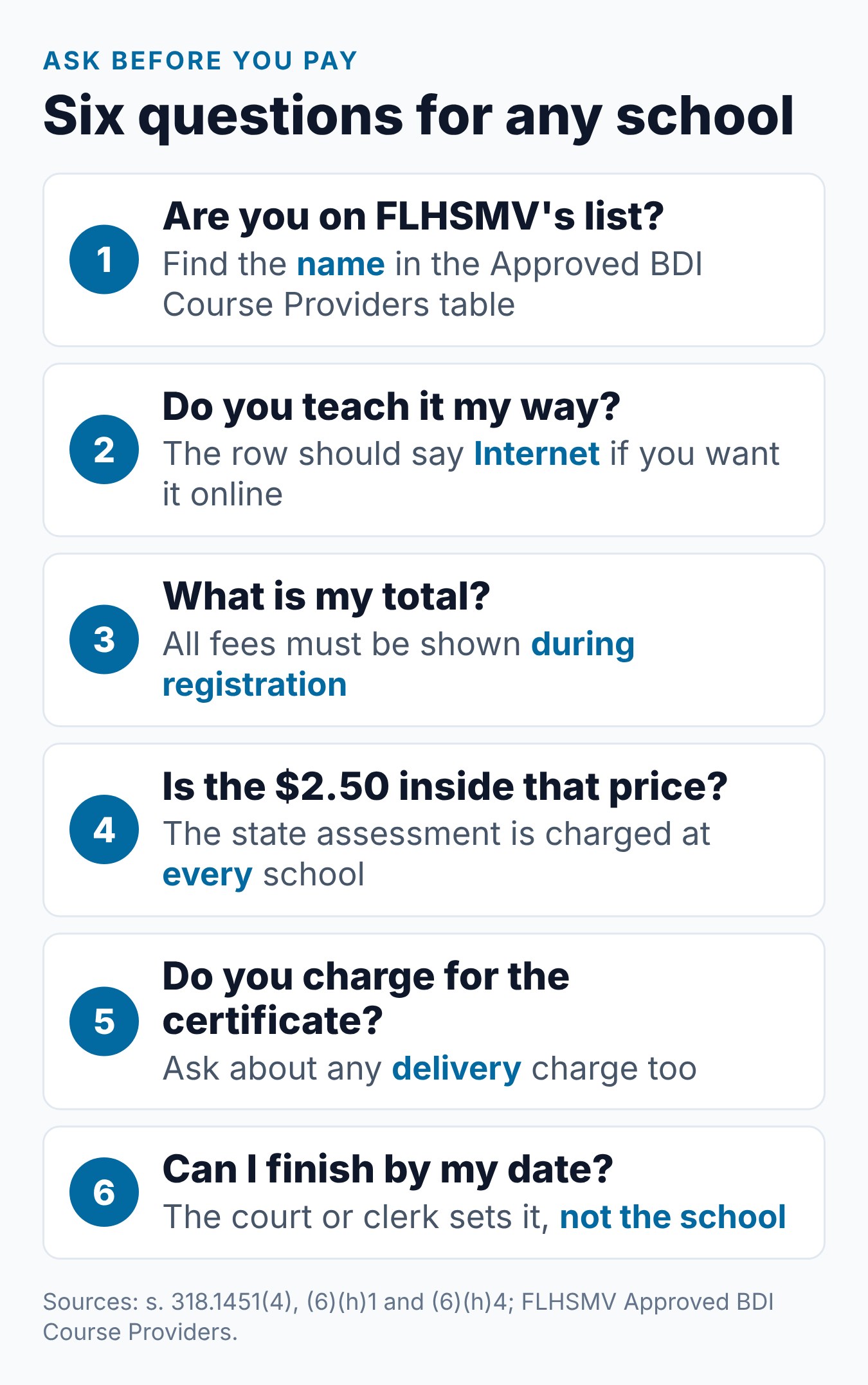
Each check below is tied to its source. Run all six before you pay.
Check 1: The Provider Is on the State List
Start with FLHSMV’s Approved BDI Course Providers list. It has three columns: Name, Delivery Method and Contact Information.
Look for two things:
- The provider’s name. If the name is not there, stop.
- The delivery method you want. A driver looking for a cheap online traffic school Florida accepts should see Internet in that provider’s row.
The list shows no prices. It tells you who is approved, not what they charge.
Check 2: The Total at Checkout
The advertised price and the final price are not always the same number. Florida law deals with that directly.
Section 318.1451(6)(h)1 says a provider must disclose all fees associated with its courses. It also says a provider may not charge any fees that are not disclosed during registration.
Use that rule. Before you enter a card number, ask one question: does the advertised price include the state fee?
Check 3: The State Fee
One charge is the same at every school. Section 318.1451(4) sets an assessment fee of $2.50.
The statute describes it this way:
- It is added to the course fee. It is charged in addition to a regular course fee.
- The school collects it. It is collected from each person who elects to attend a course.
- The state receives it. The provider sends it to the department.
No school can remove this fee. A price that leaves it out is not lower. It is only incomplete.
Check 4: The Certificate
Section 318.1451(6)(h)4 says a provider must issue a certificate to persons who successfully complete the course.
Every approved provider has to issue it. Ask whether any certificate charge or delivery charge is added to the advertised price.
Check 5: The Reporting
Reporting your completion is not an extra. Section 318.1451(6)(f) makes it a legal duty of every approved provider:
- To the state: the provider must send completion information to the department within 5 days.
- To the clerk: the provider must file the completion with the clerk of the circuit court within 3 days after it receives the certificate number.
Because every approved provider has this duty, it is not a reason to pay one school more than another.
Check 6: The Length
Section 318.1451(6)(e) says the department sets the duration of all course types.
That matters when you compare prices. A low price does not mean a shorter approved course. For the cheapest basic driver improvement course Florida allows, compare totals, not hours.
Costs No School Can Lower
Part of what a ticket costs has nothing to do with the school. Shopping for a lower course price does not change these amounts.
| Cost | Can a cheaper school lower it? | Where the rule is |
|---|---|---|
| The school’s own course fee | Yes. Each provider sets it | No statute sets a price |
| State assessment of $2.50 | No. Every school collects it | s. 318.1451(4) |
| Civil penalty on the ticket | No. The election reduces it by 18 percent | s. 318.14(9) |
| Election fee | No. It is paid to the clerk of court | FLHSMV’s BDI page |
| Payback and processing fee after a missed date | No. It follows from the missed date | s. 318.15(1)(b) |
Only the first row is a price you can shop. The other four are the same no matter which approved provider you choose.
The Civil Penalty and the Election Fee
The civil penalty is the fine for the ticket. Under section 318.14(9), electing the course reduces the civil penalty by 18 percent.
The election fee is separate. FLHSMV’s BDI page says drivers must pay an election fee to the clerk of court in the county where the citation was issued. Ask that clerk for the amount.
The Cost of Finishing Late
A cheap course becomes expensive when it is not finished on time. Section 318.15(1)(b) covers a driver who elects the course and does not complete it by the court’s date:
- The 18 percent is paid back.
- A processing fee of up to $18 is added.
- Points are assessed.
So check the finish date before you check the price. A provider’s price does not help if its course cannot be finished by your date.
How the Ticket Election Works, in Brief
Price only matters if you can elect the course. The basics come from section 318.14 and from FLHSMV.
You have 30 days from the citation date to choose the course option, and you tell the clerk of court in the county where the citation was issued. When the election is valid, adjudication is withheld and no points are assessed for that ticket.
Our pillar guide to the Florida Basic Driver Improvement (BDI) course covers who can elect and how.
How to Compare Two Prices Fairly
Two advertised prices can only be compared after you make them the same kind of number. Work through these steps for each provider:
- Find the row. Confirm the provider is on FLHSMV’s list with the delivery method you want.
- Write down the advertised price.
- Ask about the state fee. Is the $2.50 assessment inside that price or added to it?
- Ask about the certificate. Is there a certificate charge or a delivery charge?
- Get the total. The provider must disclose all fees during registration.
- Compare the totals. The lower total is the cheaper course.
Keep one more thing in view. The ticket costs paid to the clerk do not change with the provider, so leave them out of the comparison.
What We Found on FLHSMV’s Provider List
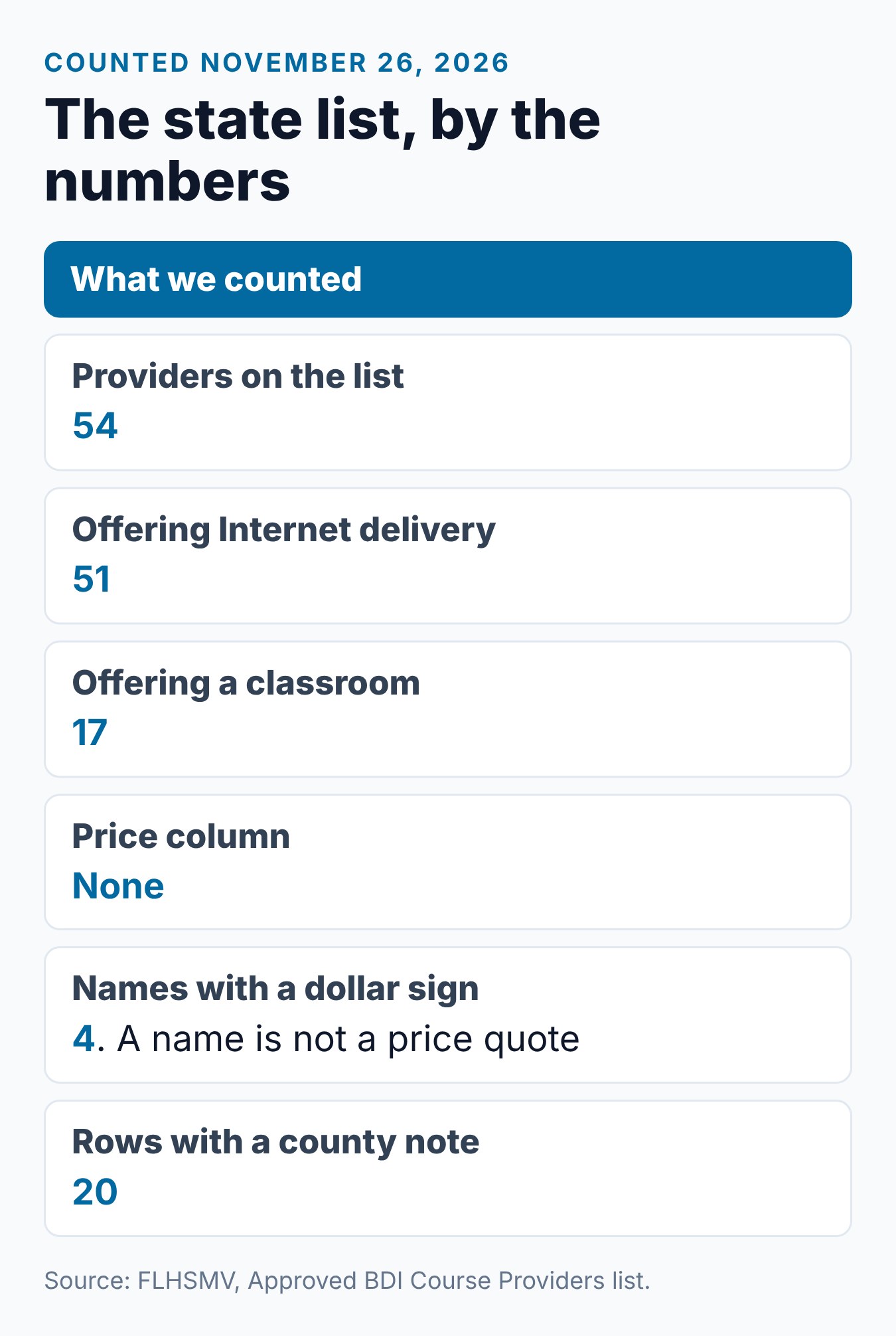
On November 26, 2026, we read FLHSMV’s Approved BDI Course Providers list and counted what it shows. Here is what the list looked like that day:
- 54 providers were listed.
- 51 of the 54 listed Internet delivery. Most of the list can be compared for an online course.
- 17 of the 54 listed a classroom.
- The list had no price column. Its three columns were Name, Delivery Method and Contact Information.
- 4 provider names included a dollar sign. No dollar amount appeared in the other two columns.
- 20 rows carried a county note. Read a provider’s whole row before you compare its price.
One finding matters most to a price shopper. A dollar figure in a school’s name is part of the name, and the state list does not confirm it as a price. The total at checkout is still the number to compare.
The list changes over time. Count it again on the day you choose.
Common Mistakes to Avoid
Each mistake below comes from skipping one of the checks:
- Buying from a provider that is not on the list. That course earns no credit for a ticket.
- Comparing advertised prices instead of totals. Ask what is included first.
- Expecting a school to waive the $2.50. Every school collects it for the state.
- Paying more for reporting. Every approved provider must report to the state and to the clerk.
- Assuming a low price means a short course. FLHSMV sets the length.
- Adding the ticket costs to the comparison. The civil penalty and the election fee are the same with any provider.
- Choosing by price and missing the date. Finishing late costs the 18 percent back and a fee of up to $18, with points.
How Requirements Can Vary
Florida’s election rules, point values and suspension levels come from Florida Statutes and FLHSMV, and they apply statewide. The election fee, the date to finish the course and how proof is filed are set by the Clerk of Court in the county on your ticket, or by the court. A court order sets its own deadline and proof steps.
Laws, fees and clerk practice can change. Check your citation, your clerk’s instructions, any court order and the FLHSMV website before you enroll or file anything.
Frequently Asked Questions
What is the cheapest traffic school in Florida?
No official page names one. FLHSMV’s list of approved providers shows no prices, and Florida law sets no course price. Compare the total at checkout among providers on that list.
Does Florida set the price of traffic school?
No. Section 318.1451 has the department approve and regulate the courses, and it sets a $2.50 state assessment. It does not set what a provider charges for the course.
Is a cheap course shorter than an expensive one?
No. The department sets the duration of all course types. A lower price does not mean a shorter approved course.
What fees must a provider tell me about?
All of them. A provider must disclose all fees associated with its courses and may not charge any fee that was not disclosed during registration.
Can a school waive the $2.50 state fee?
No. The statute says the school collects the assessment from each person who elects to attend a course and sends it to the department.
Does a cheaper course lower my ticket cost?
No. The civil penalty is reduced by 18 percent when you elect the course, whichever approved provider you choose. The election fee is paid to the clerk of court.
What happens if I pick a cheap course and do not finish in time?
Under section 318.15(1)(b), the 18 percent reduction is paid back and a processing fee of up to $18 is added. Points are assessed too.
Conclusion
A cheap course is the lowest total price from a provider on FLHSMV’s approved list, with every fee disclosed before you pay. The state fee, the certificate, the reporting and the course length are the same legal duties at any price, and the ticket costs paid to the clerk do not change with the school. Ask for the total, check your finish date, then choose. When you are ready, see Driving Logic’s florida traffic school course.
Related Articles
- Florida Basic Driver Improvement (BDI) Course: The Complete Guide
- Best Online Traffic School Florida: How to Choose
- FLHSMV-Approved BDI Providers: What It Means and How to Verify Your Course
- Florida Online Traffic School: How to Take the BDI Course
- Florida Online Traffic School Reviews: How to Read Them
- Free Traffic School Florida: Is Any Approved Course Free?
Sources
- Florida Statutes s. 318.1451 — Driver improvement schools
- Florida Statutes s. 318.14 — Noncriminal traffic infractions
- Florida Statutes s. 318.15 — Failure to comply with civil penalty or to appear
- FLHSMV — Basic Driver Improvement (BDI) Approved Course Providers
- FLHSMV — Driver Improvement Schools
Billy Forte is the owner of Driving Logic, a driver improvement course provider serving Florida and other U.S. states.
This article is general information, not legal advice. Election rules, deadlines, fines and penalties depend on your citation, county, court and case facts, and they can change. Use official FLHSMV, Florida Statutes and Clerk of Court sources, and consult a qualified Florida attorney for advice about your own case.