
Updated June 2026 · Reviewed by Billy Forte
A Virginia DMV advisory letter usually means the Virginia DMV is warning you about a problem on your driving record or asking for more information, and you should read it right away and follow every step on the notice. In many cases, it is a DMV notice tied to demerit points, a medical review, or another issue that can lead to more action if you miss a deadline. It is not the same as a suspension, but it can start a control period or lead to stronger DMV action if you ignore it.
This article covers Virginia requirements only.
Key Facts
- Advisory letter: A DMV advisory letter is a warning that should be read before more points are added.
- Course length: Virginia Driver Improvement Clinics are 8-hour DMV-approved courses.
- Online option: Online completion may be allowed if the court or DMV notice accepts it.
- Proof: DMV reporting and court certificate submission are not always the same step.
- No erasure: The clinic does not erase tickets, convictions, or demerit-point history.
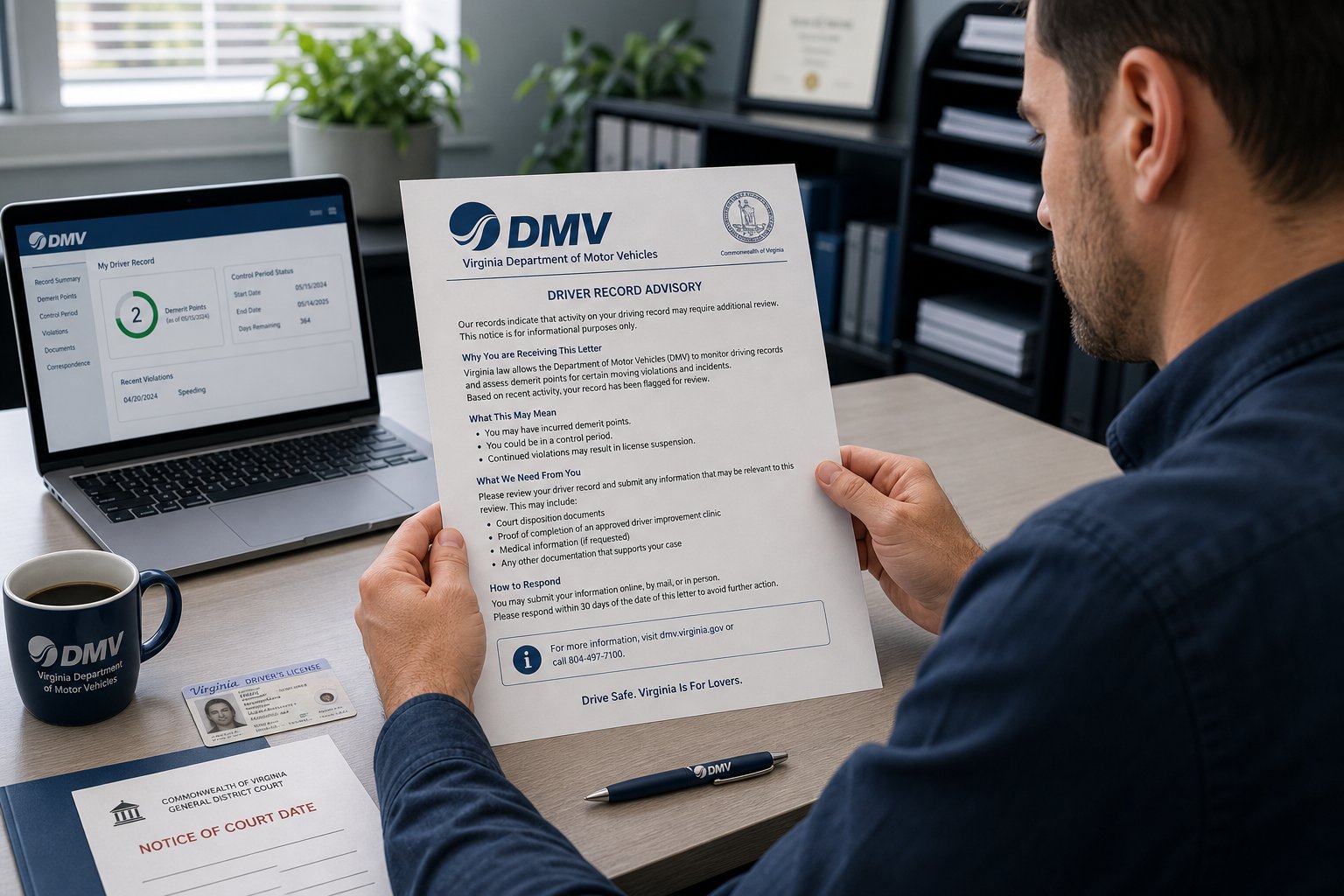
What A Virginia DMV Advisory Letter Is
A Virginia DMV advisory letter is an official warning notice from the Virginia Department of Motor Vehicles. It tells you the DMV sees an issue that needs your attention. In many point cases, it means you have reached a level of demerit points that triggers a warning, but you have not yet been ordered to take a class.
If you need an approved online option, review the virginia dmv advisory letter and compare it with your Virginia DMV notice or court order before enrolling.
That distinction matters. An advisory letter is usually not a punishment by itself. It is a notice that your record is moving in the wrong direction. If your letter is tied to points, it can begin a control period, which is a stretch of time when the DMV watches your record more closely. If you get more convictions during that period, the DMV may send a stronger notice or require more action.
Virginia also uses advisory letters in some medical review cases. In that setting, the letter may ask for forms, updates from a doctor, or other records before the DMV decides what happens next. The DMV says these may be system-generated or custom letters with instructions about pending action or what information is still needed.
So, what should you do first? Read the whole letter, including any small print, dates, and mailing instructions. Then compare it with any court order, ticket, or other DMV notice you have received. The exact rule that applies can depend on your driver record, license status, court, locality, and the facts of your case.
Why The DMV Sends An Advisory Letter
The DMV sends an advisory letter to give you advance notice before a bigger problem develops. It is the DMV’s way of saying, in plain terms, “Pay attention now.”
Common reasons include:
- Too many demerit points from traffic convictions
- A medical review issue
- Missing forms or records the DMV needs
- A periodic review tied to your license status
- A question about whether you still meet driving requirements
If your letter is about points, the message is usually simple: you are building a record that raises concern, and the DMV is warning you before it reaches a mandatory step. That is why many drivers search for virginia dmv notice driver improvement after getting one. They want to know whether the letter means traffic school is required now or only may become required later.
If your letter is about medical review, the notice may explain what a doctor or evaluator must address, what forms must be returned, and when the DMV expects them. The Virginia DMV also warns that it will not send text messages demanding payment for these matters, so any suspicious message should be checked directly with the agency.
The key point is this: the DMV sends an advisory letter so you still have a chance to respond before the matter gets worse. Do not set it aside and hope it clears itself up.
How Virginia’s Driver Point System Triggers Warning Notices
Virginia uses a driver point system tied to traffic convictions. If you are convicted of moving violations, the DMV adds demerit points to your record. Those points stay for a set time based on the offense, while the conviction itself can remain on your record longer.
Virginia also gives safe driving points for years of violation-free driving and for voluntary completion of a DMV-approved Driver Improvement Clinic in allowed situations. That course is the official Virginia DIC, and it is an 8-hour course. For some drivers, taking it voluntarily can help add safe driving points before the record reaches a mandatory clinic threshold.
That is one reason an advisory letter matters. It can be an early sign that you should look closely at your record and decide whether a voluntary course makes sense. But do not assume every course will help every case. Your options can depend on:
- The exact Virginia DMV notice
- Any court order
- Your ticket or citation
- Your driver record and license status
- The court, judge, and locality
- The facts of the offense
What Happens If You Keep Getting Points
If you keep getting convictions after an advisory letter, the DMV may move from warning to mandatory action. That can include an order to complete a Driver Improvement Clinic by a stated completion deadline. In more serious cases, it can lead to probation, suspension, or other restrictions, depending on your record.
An advisory letter is your early warning. A mandatory clinic order is different because it usually requires you to act by a set date. If you do nothing, the consequences can get much worse.
How An Advisory Letter Differs From Suspension, Probation, And Other DMV Actions
An advisory letter is notice. A suspension is a loss of driving privilege. Those are not the same thing.
When you receive an advisory letter, the DMV is telling you there is a concern or a next step. You may still be allowed to drive, but you need to act. When the DMV suspends your license, your driving privilege is taken away for a period or until you meet certain conditions.
Probation sits in the middle. In a DMV probation period, you may still be allowed to drive, but the DMV is watching your record closely. Another conviction or failure to meet a condition can trigger a suspension. A mandatory clinic order is also stronger than an advisory letter because it tells you to complete the Virginia DIC by a deadline, not just to take the warning seriously.
Other DMV actions can include:
- Requests for medical reports
- Testing requirements
- License restrictions
- Periodic reviews
- Notice of pending action
That is why you should read the exact words on your notice. One DMV letter may only warn you. Another may require forms, a course, or proof by a fixed date. If you are eligible and want a flexible option, you can review the online Virginia Driver Improvement Course from Driving Logic and check whether it fits your DMV notice or court order.
Special Rules For Commercial Drivers And Medical Review Cases
Commercial drivers and drivers in medical review cases can face extra rules. The same advisory letter format may look simple, but the issue behind it can be more serious.
For medical review, the DMV may ask for forms from your doctor, vision updates, or other records. The instructions in the letter matter because the DMV may use that information to decide whether to keep your license the same, add restrictions, require more review, or take other action. In these cases, your notice may explain what the provider must address and where to send the paperwork.
For some commercial drivers, the rules can be stricter. Virginia DMV guidance for certain conditions, including TIA or CVA cases, may require a neurological exam, a vision report, a visual field analysis, and an updated DOT medical certificate before return to driving. That is far beyond a simple point warning.
Because of that, do not assume a medical or commercial advisory letter works like a standard point letter. Check the notice line by line. Then compare it with any CDL requirements, medical instructions, and deadlines. Helpful source material is available from the Virginia Department of Motor Vehicles and the Virginia medical review information pages.
What To Do After You Receive A Virginia DMV Advisory Letter
The right first step is simple: read the letter fully and act before the deadline. Do not guess what it means from a friend’s case, because your notice may be based on different facts.
Use this checklist:
- Confirm the issue named in the letter
- Find every deadline and document request
- Check whether it mentions points, medical review, or a clinic
- Compare it with any court order, citation, or payment notice
- Make sure the DMV has your current address
- Contact the Virginia DMV if the instructions conflict or seem unclear
If your letter is tied to points, review whether a voluntary Driver Improvement Clinic could help add safe driving points before you reach a mandatory threshold. Virginia’s official clinic is a DMV-approved provider course that lasts 8 hours. Voluntary completion may help in some situations, but it does not erase a conviction from your history, and it does not guarantee a court result, insurance result, or license result.
If you need an online option, Driving Logic’s Virginia Driver Improvement Course is designed for busy drivers who want to complete the required material on their own schedule. Before you enroll, make sure the course matches your DMV notice, court order, and case details.
For official rules, check the Virginia DMV driver improvement information and the Virginia Judicial System. This article is not legal advice.
Related Articles
- Court-Ordered Driver Improvement Clinic in Virginia: What to Do
- DMV-Ordered Driver Improvement Clinic in Virginia: Points, Notices, and Deadlines
- Virginia Driver Improvement Program: Points, Orders, and Clinics Explained
- How to Submit Your Virginia Driver Improvement Certificate to the Court or DMV
Sources
- Virginia DMV — Driver Improvement Clinics
- Virginia DMV — Demerit Points and Safe Driving Points
- Virginia Judicial System
- Code of Virginia — Motor Vehicles
Billy Forte is the owner of Driving Logic, a state-approved online driver education provider serving Virginia and other U.S. states. Driving Logic offers DMV-approved online driver improvement courses for drivers handling court orders, DMV notices, demerit points, and voluntary safe-driving point credit.
This article is general information, not legal advice. Virginia DMV rules, court orders, deadlines, insurance decisions, and case facts can differ. Use official Virginia DMV and court sources for current requirements, and consult a qualified Virginia attorney for legal guidance specific to your situation.