
Updated June 2026 · Reviewed by Billy Forte
Virginia license suspension for points can happen when demerit points or repeat violations trigger DMV action. This article is for Virginia drivers who need a clear answer before checking a record, taking a course, or responding to a DMV or court notice. You will learn what the rule means, how a Driver Improvement Clinic may fit, and what to verify before your next step.
This article covers Virginia requirements only.
Key Facts
- DMV action: Virginia DMV may act when points or repeat convictions reach certain thresholds.
- Notices matter: A DMV letter, court order, or suspension notice controls your next step.
- Course role: A Driver Improvement Clinic may be required or may help with safe driving points.
- No erasure: A clinic does not remove the underlying conviction.
- Act early: Check deadlines before the notice or suspension date.
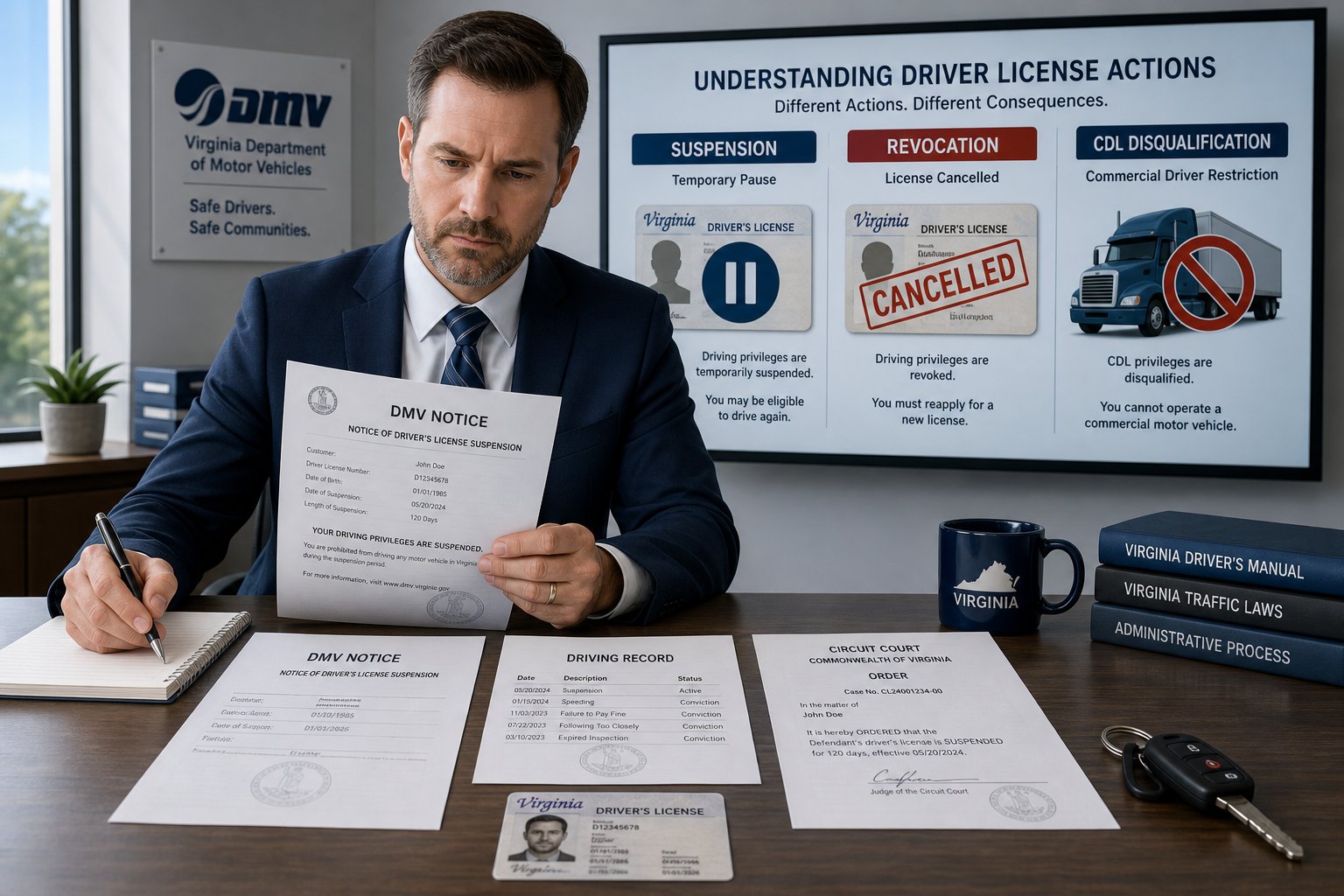
What A Virginia License Suspension Means And How It Differs From Revocation Or Disqualification
A Virginia license suspension is a temporary loss of your driving privilege. That means you cannot legally drive until the suspension period ends and you meet the terms for getting your license back.
If you need an approved online option, review the Virginia Driver Improvement Course and compare it with your Virginia DMV notice, court order, or driver record goal.
This is different from revocation. With revocation, Virginia ends your driving privilege. After the revocation period, you usually must re-apply for a license and may need to pass tests again. The Virginia DMV treats that as more serious than a suspension.
It is also different from disqualification. Disqualification mostly applies to commercial drivers. If you hold a CDL, you can lose your right to drive commercial vehicles for a set time, even if your regular non-commercial privilege still exists.
That difference matters because the next steps are not the same:
- Suspension: wait out the period, complete any required steps, pay fees, and reinstate
- Revocation: wait out the period, then apply again and possibly test again
- Disqualification: regain commercial driving privileges only after the disqualification terms are met
In plain terms, a suspension pauses your right to drive. It does not erase the problem by itself. You still need to check your DMV notice, your driving record, and any court order. The exact rule can depend on your age, the reason for the action, and whether the Virginia Department of Motor Vehicles or a court imposed it.
The Most Common Reasons A Virginia License Can Be Suspended
Virginia can suspend a license for several reasons, and not all of them involve points. Some suspensions start with the Virginia DMV. Others come from a court.
Common reasons include:
- Too many demerit points on your driving record
- DUI or drug-related driving offenses
- Reckless driving, racing, eluding police, or hit-and-run
- Failure to complete a required Driver Improvement Clinic
- Failure to meet certain insurance requirements
- Failure to pay child support
- Certain civil judgments tied to crashes
- A medical condition that affects safe driving
- Providing alcohol to a minor or intoxicated person
One point that surprises many drivers is that a Virginia license suspended points case may begin with the DMV’s driver improvement rules, not just a judge in court. So even if your traffic tickets seem minor on their own, the total point balance can still trigger action.
Another key detail is timing. A suspension can begin after a conviction posts to your record, after a DMV deadline passes, or after a court enters an order. That is why you should read every notice carefully. The notice may tell you the start date, the end date, and what you must do before reinstatement.
If you are unsure why your status changed, check your Virginia driving record and any papers from the Virginia Judicial System or DMV. Those records usually show whether the issue is points, a missed requirement, or a separate offense.
How Virginia’s Demerit Point System Can Trigger Suspension
Virginia uses a demerit point system to track moving violations. Some convictions add points to your driving record, and if you reach certain totals, the DMV can require action or suspend your license.
For drivers 18 and older, the DMV says:
- 12 points in 12 months or 18 points in 24 months: you may be required to complete a Driver Improvement Clinic
- If you do not complete it within 90 days, your license can be suspended until you finish it and pay the reinstatement fee
- 18 points in 12 months or 24 points in 24 months: you can face a 90-day suspension and a required clinic
The official Virginia course is the DMV-approved Driver Improvement Clinic (DIC). It is an 8-hour course. This course is different from the demerit points themselves. Taking it does not erase a conviction from your history. But in some cases, a voluntary clinic can add safe driving points, which may help your point balance before you hit a suspension threshold.
How safe driving points can help before a suspension
Virginia also gives safe driving points for time without violations and for eligible voluntary clinic completion, subject to DMV rules. That matters because safe driving points can help offset future demerit point risk on your record.
For many drivers, the smart move is to act early. If you are eligible, a voluntary 8-hour DIC may help you build safe driving points before your record gets worse. You can review Virginia-approved options, including the online Virginia Driver Improvement Course from Driving Logic, if you need a flexible course that fits around work and family.
Rules can depend on your DMV notice, citation, age, and record. So always confirm what the Virginia DMV requires in your case.
How Long A Suspension Can Last And What Happens If You Keep Driving
The length of a suspension depends on the reason. A point-based suspension from the DMV may last 90 days in the threshold cases listed above, while other offenses can lead to much longer losses of driving privilege.
For example, DUI-related cases often carry longer suspension periods. The Virginia DMV suspension and revocation page and the Code of Virginia control many of those time frames.
What matters most is simple: do not drive while your license is suspended. In Virginia, driving on a suspended license is a separate criminal charge. It is usually a Class 1 misdemeanor, which can bring up to 12 months in jail and a fine of up to $2,500, with harsher outcomes possible in some repeat or DUI-related cases.
That means the original traffic issue and the new charge can stack on top of each other. A short suspension can turn into a much bigger problem if you keep driving.
Your suspension date is not something to guess at. It can depend on:
- The DMV notice date
- The court order
- The offense type
- Your age and license status
- Your prior record
If you have any doubt, verify your status with the Virginia DMV before you get behind the wheel.
What You Need To Reinstate A Suspended Virginia License
To reinstate a suspended Virginia license, you usually must serve the full suspension period, finish all required programs, and pay any reinstatement fees. The exact list depends on why the suspension happened.
Common reinstatement steps may include:
- Wait until the suspension period ends
- Pay all required reinstatement fees to the Virginia DMV
- Complete any required Driver Improvement Clinic
- Meet any court-ordered terms
- Provide proof of legal presence if required by DMV
- File proof of insurance, such as SR-22, in some serious cases
- Complete alcohol or ignition interlock requirements in some DUI cases
If your license has been expired for one year or more during the suspension, the Virginia DMV says you may need to pass the knowledge, road, and vision tests before you can be licensed again.
The key is that reinstatement is not always automatic. Your record has to show that each required step is complete. Requirements can depend on the DMV notice, your ticket or citation, a court order, your driver record, the court, the judge, the locality, and the facts of your case.
When A Driver Improvement Or Traffic School Course May Be Required
Virginia’s official course is the DMV-approved Driver Improvement Clinic, also called a DIC, and it is an 8-hour course. The DMV can require it in several situations.
Examples include:
- Under 18: after any demerit-point or seat belt/child restraint conviction
- Under 18: if not completed within 90 days, suspension until completion plus a reinstatement fee
- Under 18: a second conviction can lead to a 90-day suspension
- Under 18: a third can lead to revocation for one year or until age 18, whichever is longer
- Age 18 to 19: required after any demerit-point or seat belt/child restraint conviction
- Age 18+: required at 12 points in 12 months or 18 points in 24 months
If your notice requires a clinic, finish the exact course the DMV accepts. If you need an online option, Driving Logic offers a Virginia course at MyDrivingLogic.com built for busy drivers who need to complete an approved program on their own schedule.
Special Rules For DUI, CDL, And Younger Drivers
Some drivers face stricter rules than others. In Virginia, DUI cases, CDL cases, and younger drivers often have added penalties or faster license action.
For DUI, a suspension or revocation may be mandatory. The length can increase based on prior offenses, injury, refusal, or other facts. Some drivers also must complete the Virginia Alcohol Safety Action Program or use an ignition interlock device. These cases often involve both court and DMV rules.
For CDL holders, the word to watch is disqualification. A CDL disqualification can block you from driving commercial vehicles even if your non-commercial license remains valid. Offenses such as DUI, leaving the scene of a crash, or using a vehicle in certain felonies can trigger that result under Virginia and federal rules.
For younger drivers, the system is tougher. Virginia DMV requires a Driver Improvement Clinic for many under-18 and age-18-to-19 convictions, even when an older adult driver might not face the same step for a single ticket. Repeated convictions can move from clinic requirements to suspension and then to revocation.
Because these cases turn on details, use the exact wording in your DMV notice and court papers. Check the official rules through the Virginia Department of Motor Vehicles and the Virginia Judicial System.
This information is general only and is not legal advice.
FAQ
Can a Virginia Driver Improvement Clinic remove a ticket from my record?
No. A Virginia Driver Improvement Clinic does not erase a ticket or conviction from your driving record. When eligible, it may add safe driving points that help your overall point balance.
How many safe driving points can I earn from a Virginia clinic?
Eligible drivers may receive 5 safe driving points after completing an approved clinic. Voluntary clinic credit is generally limited to once every 24 months.
Should I follow the DMV notice or the court order?
Follow the document that applies to your situation. A DMV notice, court order, citation, or insurance request may have different instructions and deadlines.
Where should I check my Virginia point balance?
Use your official Virginia DMV driving record. Do not rely only on memory, insurance paperwork, or an old copy of your record.
Conclusion
Virginia License Suspension for Points: What Happens and How to Reinstate depends on your official Virginia DMV record, the specific violation, and any court or DMV notice you received. A Driver Improvement Clinic may help with safe driving points when eligible, but it does not erase the underlying ticket or conviction. Check the official record and deadline before you act.
Take the Virginia Driver Improvement Course online when you are ready to begin.
Related Articles
- Virginia DMV Points System Explained
- What Is a Safe Driving Points Balance in Virginia?
- How to Earn Safe Driving Points in Virginia (And Why the DIC Gives You 5)
- How Many Points Is a Speeding Ticket in Virginia?
Sources
- Virginia DMV — Driver Improvement
- Virginia DMV — Points System
- Virginia DMV — Moving Violations and Points
- Virginia Code § 46.2-494 — Safe Driving Points
- Virginia DMV — Driver Improvement Clinics
Billy Forte is the owner of Driving Logic, a state-approved driver improvement course provider serving Virginia and other U.S. states. Driving Logic offers online driver improvement and driver safety courses for drivers handling DMV notices, court orders, point concerns, and state requirements.
This article is general information, not legal advice. Virginia DMV rules, court orders, deadlines, insurance decisions, CDL rules, and case facts can differ. Use official Virginia DMV and court sources for current requirements, and consult a qualified Virginia attorney for legal guidance specific to your situation.