
Updated June 2026 · Reviewed by Billy Forte
In Florida, demerit points usually stay on your driving record for 3 years, or 36 months, from the date of conviction. The Florida Department of Highway Safety and Motor Vehicles uses that 36-month window to count points for suspension, including the 12-point, 18-point, and 24-point thresholds. Even after that window, some insurers may review a longer driving history, so the best way to confirm what shows on your record is to order your official record from FLHSMV.
This article covers Florida requirements only.
Key Facts
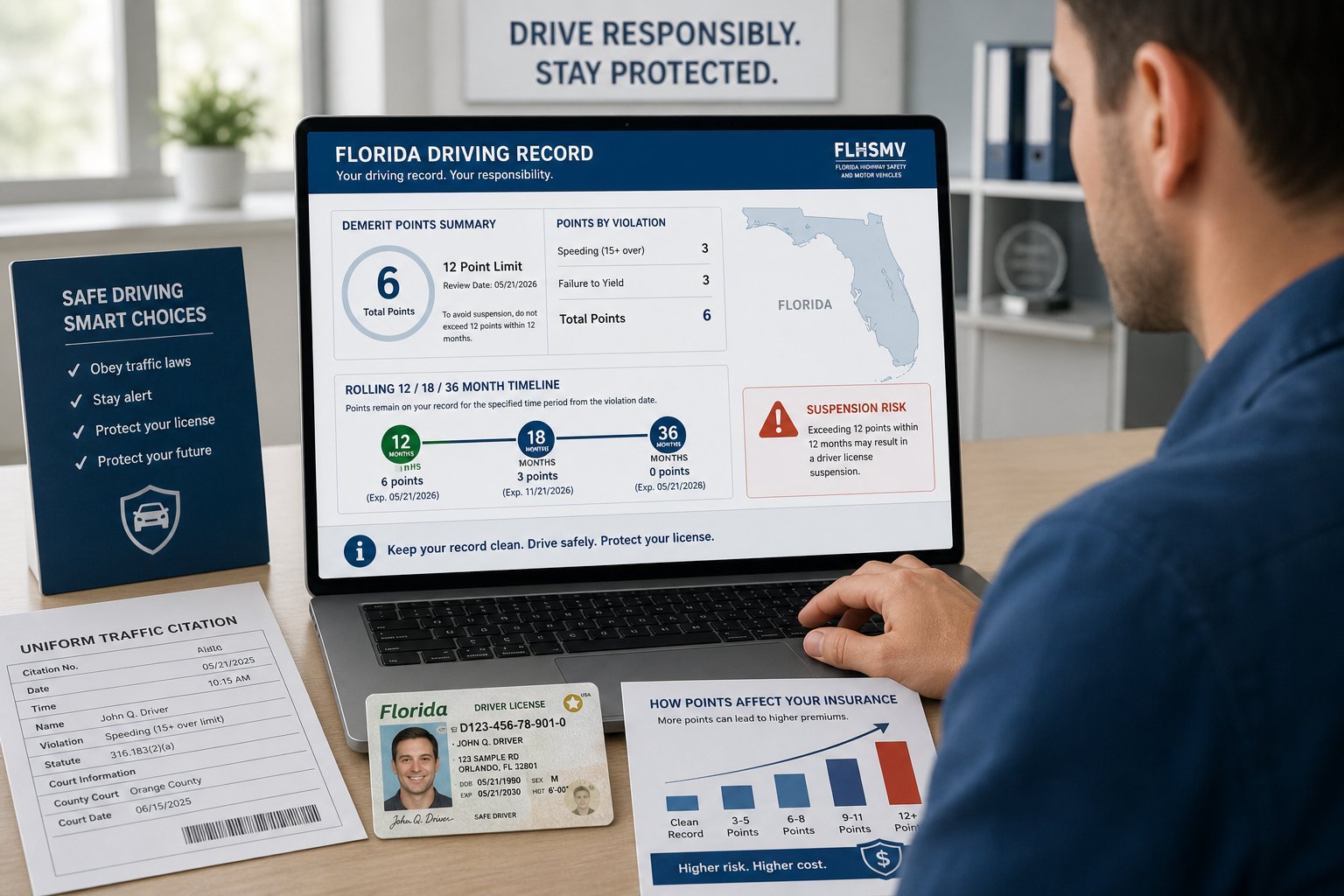
- Point suspension: Florida may suspend a license at 12 points in 12 months, 18 points in 18 months, or 24 points in 36 months.
- Point values: The exact point value depends on the offense listed in Florida law and the final disposition.
- Offense dates: Florida computes point-suspension periods using the offense dates of convictions.
- BDI limit: An eligible BDI election can help prevent points on a current citation, but it does not erase old points.
- Clerk rules: Election deadlines, certificate filing, and court instructions can vary by county and citation.
If your goal is to prevent new points on an eligible current citation, review the Florida Basic Driver Improvement course before your clerk or court deadline.
Florida uses a demerit point system to track many moving traffic violations. When you are convicted of a qualifying offense, the Florida Department of Highway Safety and Motor Vehicles, or FLHSMV, adds points to your driving record. Those points do not all carry the same weight. The number depends on the traffic violation.
The point system matters because Florida uses it to decide when a license suspension can happen. It is not just about one ticket. It is about how many points build up within a set time.
A few basics help make the system easier to read:
- Points are tied to convictions, not just getting a ticket.
- The count usually starts from the date the case is finalized.
- FLHSMV tracks points over rolling time periods.
- Too many points in those periods can trigger a suspension.
That is why the timing of your case matters. If you qualify for a Florida Basic Driver Improvement course, often called traffic school or a defensive driving course, you may be able to keep points from being added in the first place. That is very different from taking a course after points are already on your record.
You can review Florida’s rules through FLHSMV and the court election process under Florida Statute 318.14. The key point is simple: Florida tracks traffic violation points over time, and those points can affect both your license status and how others view your driving record.
How Long Points Stay On Your Florida Driving Record
If you are asking how long do points stay on your license in Florida, the short answer is about 36 months for point-counting purposes. In most cases, Florida uses a 3-year window from the date of conviction to count demerit points toward suspension.
That 36-month rule is the one most drivers need to know first because it is the rule tied to suspension thresholds. If you get several tickets close together, those points can stack up fast inside that period.
Still, there is an important detail. Your driving record is not the same thing as the point-counting window. A citation or conviction may still appear in some record formats even after the points are no longer counted toward suspension. And insurance companies may use their own underwriting lookback periods.
So there are really two practical timelines:
- FLHSMV suspension counting: usually 36 months
- Record visibility: may last longer in some record formats
- Insurance review: may look back further than 3 years
That is why drivers sometimes get confused. They hear that points stay for 3 years, then later still see older violations on a record pull or insurance application. Both can be true.
If your case involved court requirements, payment deadlines, or a judge’s ruling, the timeline may depend on when the case was finalized. To verify what is on your record now, order your official record from FLHSMV instead of guessing from memory.
How Many Points Common Florida Traffic Violations Add
Not every ticket adds the same number of points. Florida assigns points based on the type of offense. For many drivers, the most common issue is speeding, but several other violations can add points quickly.
Common Florida traffic violation points include:
- Speeding less than 15 mph over the limit: 3 points
- Speeding 15 mph or more over the limit: 4 points
- Reckless driving: 4 points
- Passing a stopped school bus: 4 points
- Leaving the scene of a crash with property damage over $50: 6 points
These numbers matter because even a few routine tickets can move you close to a suspension threshold. For example, three separate 4-point violations in a year can put you at 12 points in 12 months.
Florida also has violations that may carry other penalties beyond points. In some cases, court action, required appearances, or other sanctions can apply. So you should always read the citation closely and follow the court or clerk instructions.
If you want the official point schedule, check FLHSMV and applicable laws on Florida Statutes. Point values can be simple on paper, but your eligibility for traffic school or other options can still depend on the citation type, county, court, judge, and your case facts.
When Too Many Points Lead To Suspension
Florida sets clear limits for when too many demerit points can lead to a license suspension. The state uses rolling time periods, not just a calendar year. That means older and newer tickets can overlap in ways drivers do not expect.
The main Florida suspension thresholds are:
- 12 points in 12 months: 30-day suspension
- 18 points in 18 months: 3-month suspension
- 24 points in 36 months: 1-year suspension
Those thresholds come from the state point system used by FLHSMV. Once you reach one of those levels, the state can suspend your driving privilege even if each single ticket seemed minor at the time.
Here is a simple example. If you receive three 4-point violations within one year, you can hit the 12-point threshold. If you add more violations over the next several months, the longer rolling windows matter too.
This is why checking your record is smart after any conviction. It is easy to lose track, especially if tickets happened in different counties or were handled months apart. You can also review local payment and election information through the Florida Clerks of Court.
If a citation requires a court appearance or has a deadline attached, do not miss it. Suspension issues often get worse when a ticket is not handled on time.
How To Avoid Points After A Florida Traffic Ticket
In many cases, the best way to avoid points is to make a timely BDI ticket election if you qualify. In Florida, Basic Driver Improvement, traffic school, and a defensive driving course usually mean the same state-approved 4-hour course.
The key difference is this: electing BDI before the case is closed can prevent points from being added at all, because adjudication is typically withheld. That is not the same as taking a course later after points are already on your record.
If points are already there, a course may help in more limited ways, including a possible up to 4-point reduction in some situations. But that does not erase every record issue, and it is not the same as preventing the points in the first place.
Eligibility is not automatic. It can depend on:
- The type of citation
- Your driving history
- County and court rules
- Judge or clerk requirements
- Whether a court appearance is required
- Whether you elected the option by the deadline
Florida drivers often choose an online course because it is faster to fit into a busy week. If you need a state-approved option, you can review the Florida BDI course at Driving Logic. Before you enroll, confirm your deadline and election steps with your Clerk of Court or court paperwork.
Basic Driver Improvement Course Rules
Florida usually limits a BDI election to once every 12 months and no more than five times in a lifetime. You also generally must choose that option on time, pay what the clerk or court requires, and complete the course by the stated deadline.
That timing is everything. If you miss the election deadline, you may lose the chance to keep points off your record through that ticket.
A few rules drivers should keep in mind:
- The course must be FLHSMV-approved
- Court-ordered and voluntary courses are not always the same thing
- Some citations are not eligible
- A required court appearance can change your options
Because rules can vary by county and case details, always check your citation and the clerk’s instructions first. If you are eligible and want a flexible online option, Driving Logic’s Florida BDI course is built for busy drivers who want to complete the required course on any device and get their certificate fast.
How To Check Your Florida License Points And Driving Record
The most reliable way to see your Florida demerit points is to order your official driving record. That record shows what FLHSMV has on file and helps you confirm whether points are still being counted in the 36-month window.
Do not rely on memory, an old ticket, or what your insurer says. The official record is the best source if you need to know your current status.
You can check your record by using official state resources, including FLHSMV. In some situations, your local Clerk of Court records may also help you confirm how a citation was resolved, especially if you went to court or elected traffic school.
When you review your record, look for:
- The date of conviction or case finalization
- The number of points for each violation
- Whether a BDI election resulted in withheld adjudication
- Any suspension entries or notices
This matters if you are trying to answer how long do points stay on your license Florida records. The record helps you separate three different things: the ticket itself, the points counted for suspension, and what may still appear for history or insurance review.
If you need traffic school to help with a current Florida ticket, check your paperwork first, then choose an approved provider and complete the course before the deadline.
This information is for general education only and is not legal advice.
FAQ
How long do points stay on your Florida driver’s license?
Points from a moving violation conviction remain on your Florida driving record for 3 years from the date of the violation — not the date you paid the fine or were convicted in court.
When does the 3-year point clock start?
The 3-year period starts on the date the traffic violation occurred, not when the ticket was paid or adjudicated. This is the date FLHSMV uses when calculating your point total within the suspension windows.
Can I get points removed early from my Florida license?
No. Florida does not allow early removal of points through courses, appeals, or other means. Points remain on your record for 3 years from the violation date and then drop off automatically.
Does traffic school remove points from my Florida record?
No. Florida traffic school (BDI) withholds adjudication for a new eligible citation — meaning no points are added for that specific ticket. It does not remove or reduce points already on your record from prior violations.
How long does a traffic violation stay on my Florida driving record overall?
While points affect suspension calculations for 3 years, the violation itself may stay on your official FLHSMV driving record for longer — often 5 to 7 or more years depending on the record type. Insurers and employers who pull your driving record may see violations beyond the 3-year point window.
Do Florida traffic violation points affect my insurance longer than 3 years?
Possibly. Insurance companies set their own lookback periods for underwriting — commonly 3 to 5 years but sometimes longer for serious violations. Your insurer may review violations beyond the 3-year point window when setting your rates.
Conclusion
Florida traffic violation points stay on your record for 3 years from the violation date and cannot be removed early. Traffic school prevents new points from being added for eligible citations but has no effect on existing point accumulation. If you are approaching a suspension threshold, acting before the next violation matters most.
Take the Florida BDI course online at Driving Logic
FAQ
How long do points stay on your Florida driver’s license?
Points from a moving violation conviction remain on your Florida driving record for 3 years from the date of the violation — not the date you paid the fine or were convicted in court.
When does the 3-year point clock start?
The 3-year period starts on the date the traffic violation occurred, not when the ticket was paid or adjudicated. This is the date FLHSMV uses when calculating your point total within the suspension windows.
Can I get points removed early from my Florida license?
No. Florida does not allow early removal of points through courses, appeals, or other means. Points remain on your record for 3 years from the violation date and then drop off automatically.
Does traffic school remove points from my Florida record?
No. Florida traffic school (BDI) withholds adjudication for a new eligible citation — meaning no points are added for that specific ticket. It does not remove or reduce points already on your record from prior violations.
How long does a traffic violation stay on my Florida driving record overall?
While points affect suspension calculations for 3 years, the violation itself may stay on your official FLHSMV driving record for longer — often 5 to 7 or more years depending on the record type. Insurers and employers who pull your driving record may see violations beyond the 3-year point window.
Do Florida traffic violation points affect my insurance longer than 3 years?
Possibly. Insurance companies set their own lookback periods for underwriting — commonly 3 to 5 years but sometimes longer for serious violations. Your insurer may review violations beyond the 3-year point window when setting your rates.
Conclusion
Florida traffic violation points stay on your record for 3 years from the violation date and cannot be removed early. Traffic school prevents new points from being added for eligible citations but has no effect on existing point accumulation. If you are approaching a suspension threshold, acting before the next violation matters most.
Take the Florida BDI course online at Driving Logic
Related Articles
- Florida Driver License Points System: Suspensions, Point Values, and BDI Options
- How to Check Points on Your Florida Driver’s License
- How Many Points Is a Speeding Ticket in Florida?
- Florida Traffic Violation Points Chart: How Many Points for Each Offense
Sources
- Florida Statute 322.27 — Driver License Suspension and Point System
- Florida Statute 318.14 — Traffic Infractions and BDI Election
- FLHSMV — Driver Improvement Schools
- FLHSMV — Driver License Check
- Florida Clerks of Court
Billy Forte is the owner of Driving Logic, a state-approved driver improvement course provider serving Florida and other U.S. states. Driving Logic offers FLHSMV-approved online BDI courses for drivers handling traffic tickets, court orders, and state requirements.
This article is general information, not legal advice. Eligibility, deadlines, court acceptance, license consequences, insurance decisions, and filing steps depend on the citation type, county, court, judge, and facts of your case. Use official Florida court and state sources for current requirements, and consult a qualified Florida attorney for legal guidance specific to your situation.