
Updated June 2026 · Reviewed by Billy Forte
A Florida speeding ticket usually adds 3 points to your driving record, or 4 points if you were driving 15 mph or more over the limit. If the speeding happens in a school or work zone, or if the ticket is written as a higher-point violation such as reckless driving or a crash-related offense, the points can be higher under the FLHSMV point system. In many cases, you may be able to elect a Basic Driver Improvement (BDI) course within the deadline so no points are added at all for that ticket.
This article covers Florida requirements only.
Key Facts
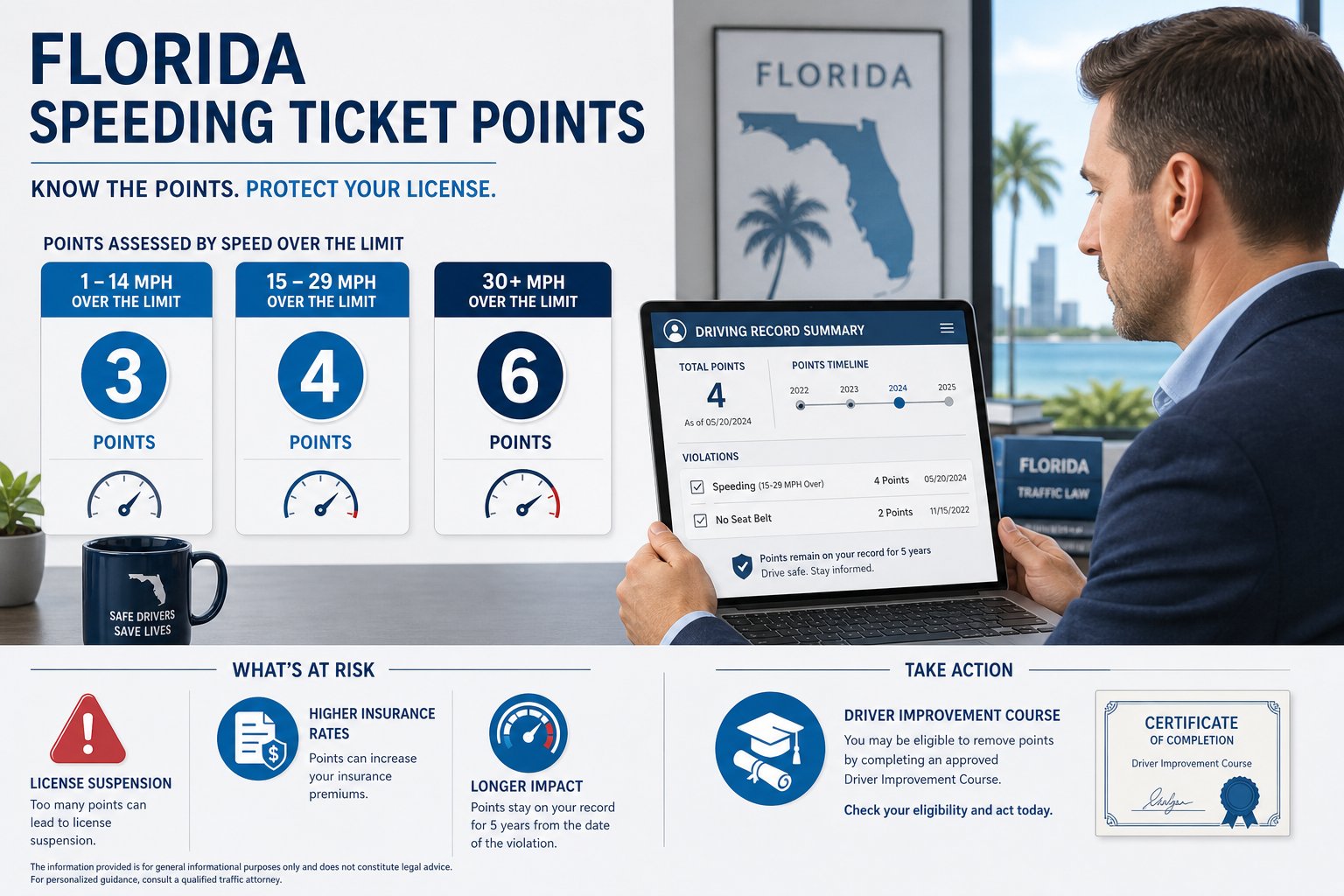
- Point suspension: Florida may suspend a license at 12 points in 12 months, 18 points in 18 months, or 24 points in 36 months.
- Speeding points: Less than 15 mph over is generally 3 points; 15 mph or more over is generally 4 points; speeding resulting in a crash is 6 points.
- Offense dates: Florida computes point-suspension periods using the offense dates of convictions.
- BDI limit: An eligible BDI election can help prevent points on a current citation, but it does not erase old points.
- Clerk rules: Election deadlines, certificate filing, and court instructions can vary by county and citation.
If your goal is to prevent new points on an eligible current citation, review the Florida Basic Driver Improvement course before your clerk or court deadline.
Florida uses a driver license point system run by the Florida Department of Highway Safety and Motor Vehicles (FLHSMV). Each moving violation adds a set number of demerit points to your record. Most common tickets add 3, 4, or 6 points.
The point total matters because too many points in a set time can lead to a license suspension. The main thresholds are:
- 12 points in 12 months = 30-day suspension
- 18 points in 18 months = 90-day suspension
- 24 points in 36 months = 12-month suspension
So, one speeding ticket may not seem serious. But several tickets close together can become a real problem.
Points also stay on your driving record for years. In general, traffic violation points remain visible for at least 3 years, and often longer on your full record. That means insurers, employers, and courts may still see them.
Florida law and court rules also affect what choices you have after a citation. In many non-criminal cases, Florida Statute 318.14 gives you options such as paying the ticket, electing school, or asking for a hearing, depending on the ticket and county process. You can review the law on the Florida Senate website.
The key thing is simple: points do not just affect one ticket. They affect your future risk of suspension, insurance trouble, and a record that follows you for years.
How Many Points A Speeding Ticket Adds In Florida
If you are asking how many points is a speeding ticket in Florida, the usual answer is 3 or 4 points.
Here is the basic breakdown for florida speeding ticket points:
- Less than 15 mph over the speed limit = 3 points
- 15 mph or more over the speed limit = 4 points
- Speeding that causes a crash = 6 points
That is the standard FLHSMV point schedule drivers most often deal with. The exact charge on the citation matters. The officer may write a speed-based violation, but in some cases the ticket may involve another moving offense tied to the same stop.
Some drivers also confuse standard speeding with other road violations. For example, careless driving is commonly a 3-point offense in Florida. But a school zone or work zone citation can carry a different result based on the actual charge and case details.
And there is one major exception worth knowing: if you are eligible and properly elect BDI, the ticket usually does not add points to your record. In Florida, BDI, traffic school, and a defensive driving course usually mean the same FLHSMV-approved 4-hour course for this purpose.
Still, you must follow the rules. Eligibility, deadlines, and court requirements can depend on the citation type, county, court, judge, and your case facts. You can check your county process through the Florida Clerks of Court system.
Common Speeding And Traffic Violations That Carry 3, 4, Or 6 Points
Not every moving ticket carries the same number of points. Florida groups many violations into 3-point, 4-point, or 6-point categories.
3-point violations
Common examples include:
- Speeding less than 15 mph over
- Careless driving
- Too fast for conditions
- Moving violation that causes a crash
- Child restraint violation
- Littering from a vehicle
4-point violations
These are more serious. Examples include:
- Speeding 15 mph or more over
- Reckless driving
- Passing a stopped school bus
- Running a steady red light
6-point violations
These are among the most serious non-criminal point offenses. Examples include:
- Speeding that causes a crash
- Leaving the scene of a crash with more than $50 in property damage
This is why reading the exact citation matters. Two drivers may both say, “I got a speeding ticket,” but one may face 3 points and the other 4 or 6 points based on speed, crash facts, or the cited offense.
For official records and licensing tools, start with FLHSMV. If you want to avoid points and you qualify, a state-approved course through Driving Logic may help you meet the school election requirement online with a flexible schedule.
When Points Can Suspend Your Florida License
Florida can suspend your license if you collect too many points in a set time. The three key thresholds are easy to remember:
- 12 points in 12 months = 30-day suspension
- 18 points in 18 months = 3-month suspension
- 24 points in 36 months = 12-month suspension
These are FLHSMV administrative suspensions. You do not need a huge number of tickets to reach them. A few higher-point violations in a short period can be enough.
Here is a simple example. If you get three speeding tickets at 4 points each within a year, that is 12 points. That can trigger a 30-day suspension. Add more points later, and the penalty grows.
This is also why the age of points matters. Points usually remain on your record for 3 years or more, even though the exact record history can last longer. So old tickets may still matter when employers or insurers review your driving history.
If you already have points, your next ticket deserves extra attention. Paying a citation may be the fastest step, but it may also push you to a suspension threshold. Before you choose an option, check your record and your court notice carefully. Make sure you do not miss any deadline or required appearance.
What To Do After A Florida Speeding Ticket
After a Florida speeding ticket, you usually have 30 days to respond. Your main options are to pay the ticket, elect BDI traffic school if allowed, or contest the citation in court.
Paying the ticket is simple, but it usually means points are added. That can raise your risk of higher insurance costs and future suspension problems.
Electing Basic Driver Improvement is different. If you are eligible and the court accepts the election, you take a 4-hour FLHSMV-approved course and points are not added for that ticket. Florida drivers often call this traffic school or a defensive driving course. For this purpose, those terms usually mean the same thing.
Florida generally allows this election once every 12 months, up to 5 times in a lifetime for eligible citations. But rules can vary with the citation type, county, court, judge, and case facts.
If you want to fight the ticket, you may request a hearing. That can lead to a dismissal, reduced charge, or no change at all. Outcomes depend on the evidence and the court.
Traffic School Vs. Paying The Ticket
If you qualify, traffic school often helps more than simply paying. The main benefit is clear: no points are added to your Florida driving record for that eligible ticket.
Paying without school is faster in the short run. But the points stay with you and may affect later tickets. So the better option often depends on your current record, your deadline, and whether your case allows a school election.
If you need an online option, you can take the Florida BDI course at Driving Logic. The course is built for busy drivers and works on most devices.
How To Check Your Points And What Happens With Out-Of-State Tickets
You can check your Florida points by getting your driving record through FLHSMV. That is the best way to confirm how many demerit points are on your license and whether a recent ticket has posted.
You can use official state tools through FLHSMV driver record services. In some cases, your local Clerk of Court site may also show case status, payments, and school election steps, but your official point history comes from the state record.
Out-of-state tickets can matter too. Florida is part of the Driver License Compact, and many moving violations from other states are reported back to Florida. If that happens, Florida may add points as if the violation happened in Florida.
That means an out-of-state speeding ticket is not always separate from your Florida record. It may still affect your point total and your suspension risk.
A few smart steps can help:
- Check your FLHSMV record after any ticket
- Review the court deadline on the citation
- Confirm whether school is allowed before you elect it
- Keep proof of completion if you take BDI
If you need to complete traffic school online, MyDrivingLogic.com offers a Florida BDI course for eligible drivers with flexible access and fast completion tools.
This article is for general information only and is not legal advice.
FAQ
How many points is a speeding ticket in Florida?
A Florida speeding ticket is worth 3 points if you were driving less than 15 mph over the speed limit. If you were driving 15 mph or more over the limit, it is 4 points. These values are set under Florida’s driver license point system.
Does the speed matter for how many points I get?
Yes. Florida uses a threshold of 15 mph over the speed limit. Below that threshold is 3 points; at or above it is 4 points. The specific speed on your citation determines which applies.
Can I avoid points on a Florida speeding ticket?
If the ticket qualifies under Florida Statute 318.14, you may be able to elect traffic school through the Clerk of Court. Successfully completing the BDI course withholds adjudication, which means no points are added for that citation. You must elect before the deadline — generally 30 days from the citation date.
Will a speeding ticket suspend my Florida license?
A single ticket is unlikely to suspend your license on its own. However, points accumulate. If you reach 12 points in any 12-month period, FLHSMV suspends your license for 30 days. Drivers with multiple violations should check their total point count.
How long does a speeding ticket affect my Florida record?
The points from a speeding ticket stay on your driving record for 3 years from the date of the violation. The ticket itself may appear on your FLHSMV driving record for a longer period.
Are speeding tickets in school zones different?
Florida law may double fines for speeding violations in school zones during school hours, but the standard point values still apply (3 or 4 points depending on speed). Confirm the specific citation details with the Clerk of Court.
Conclusion
A Florida speeding ticket costs 3 or 4 points depending on how far over the limit you were driving. If the ticket qualifies, electing traffic school through the Clerk of Court and completing a BDI course withholds the adjudication — keeping those points off your record.
Take the Florida BDI course online at Driving Logic
FAQ
How many points is a speeding ticket in Florida?
A Florida speeding ticket is worth 3 points if you were driving less than 15 mph over the speed limit. If you were driving 15 mph or more over the limit, it is 4 points. These values are set under Florida’s driver license point system.
Does the speed matter for how many points I get?
Yes. Florida uses a threshold of 15 mph over the speed limit. Below that threshold is 3 points; at or above it is 4 points. The specific speed on your citation determines which applies.
Can I avoid points on a Florida speeding ticket?
If the ticket qualifies under Florida Statute 318.14, you may be able to elect traffic school through the Clerk of Court. Successfully completing the BDI course withholds adjudication, which means no points are added for that citation. You must elect before the deadline — generally 30 days from the citation date.
Will a speeding ticket suspend my Florida license?
A single ticket is unlikely to suspend your license on its own. However, points accumulate. If you reach 12 points in any 12-month period, FLHSMV suspends your license for 30 days. Drivers with multiple violations should check their total point count.
How long does a speeding ticket affect my Florida record?
The points from a speeding ticket stay on your driving record for 3 years from the date of the violation. The ticket itself may appear on your FLHSMV driving record for a longer period.
Are speeding tickets in school zones different?
Florida law may double fines for speeding violations in school zones during school hours, but the standard point values still apply (3 or 4 points depending on speed). Confirm the specific citation details with the Clerk of Court.
Conclusion
A Florida speeding ticket costs 3 or 4 points depending on how far over the limit you were driving. If the ticket qualifies, electing traffic school through the Clerk of Court and completing a BDI course withholds the adjudication — keeping those points off your record.
Take the Florida BDI course online at Driving Logic
Related Articles
- Florida Driver License Points System: Suspensions, Point Values, and BDI Options
- Florida Traffic Violation Points Chart: How Many Points for Each Offense
- How to Check Points on Your Florida Driver’s License
- Careless Driving in Florida: How Many Points and What Happens?
Sources
- Florida Statute 322.27 — Driver License Suspension and Point System
- Florida Statute 318.14 — Traffic Infractions and BDI Election
- FLHSMV — Driver Improvement Schools
- FLHSMV — Driver License Check
- Florida Clerks of Court
Billy Forte is the owner of Driving Logic, a state-approved driver improvement course provider serving Florida and other U.S. states. Driving Logic offers FLHSMV-approved online BDI courses for drivers handling traffic tickets, court orders, and state requirements.
This article is general information, not legal advice. Eligibility, deadlines, court acceptance, license consequences, insurance decisions, and filing steps depend on the citation type, county, court, judge, and facts of your case. Use official Florida court and state sources for current requirements, and consult a qualified Florida attorney for legal guidance specific to your situation.