
Updated June 2026 · Reviewed by Billy Forte
An Indiana speeding ticket usually affects your Indiana BMV driving record for 2 years from the conviction date because that is how long demerit points stay active. The ticket conviction itself may stay visible on your driving record longer, and many insurers may review your history for 3 to 5 years when setting rates. If you complete a BMV-approved Driver Safety Program (DSP), you can earn a 4-point credit that lowers your point total during that period, but it does not erase the ticket or conviction.
This article covers Indiana requirements only.
Key Facts
- Points are time-limited: Indiana BMV points generally stay active for a set period after conviction.
- Conviction visibility may differ: The ticket record can remain visible even after points are no longer active.
- DSP credit: A 4-point credit can reduce active point totals when eligible.
- No deletion: DSP completion does not remove the conviction from the driving record.
- Check your record: Use BMV tools to confirm what appears on your official record.
If you need a BMV-approved online option, review the Indiana Driver Safety Program course and compare it with your ticket, court notice, or BMV requirement.
How Long A Speeding Ticket Stays On Your Indiana Driving Record
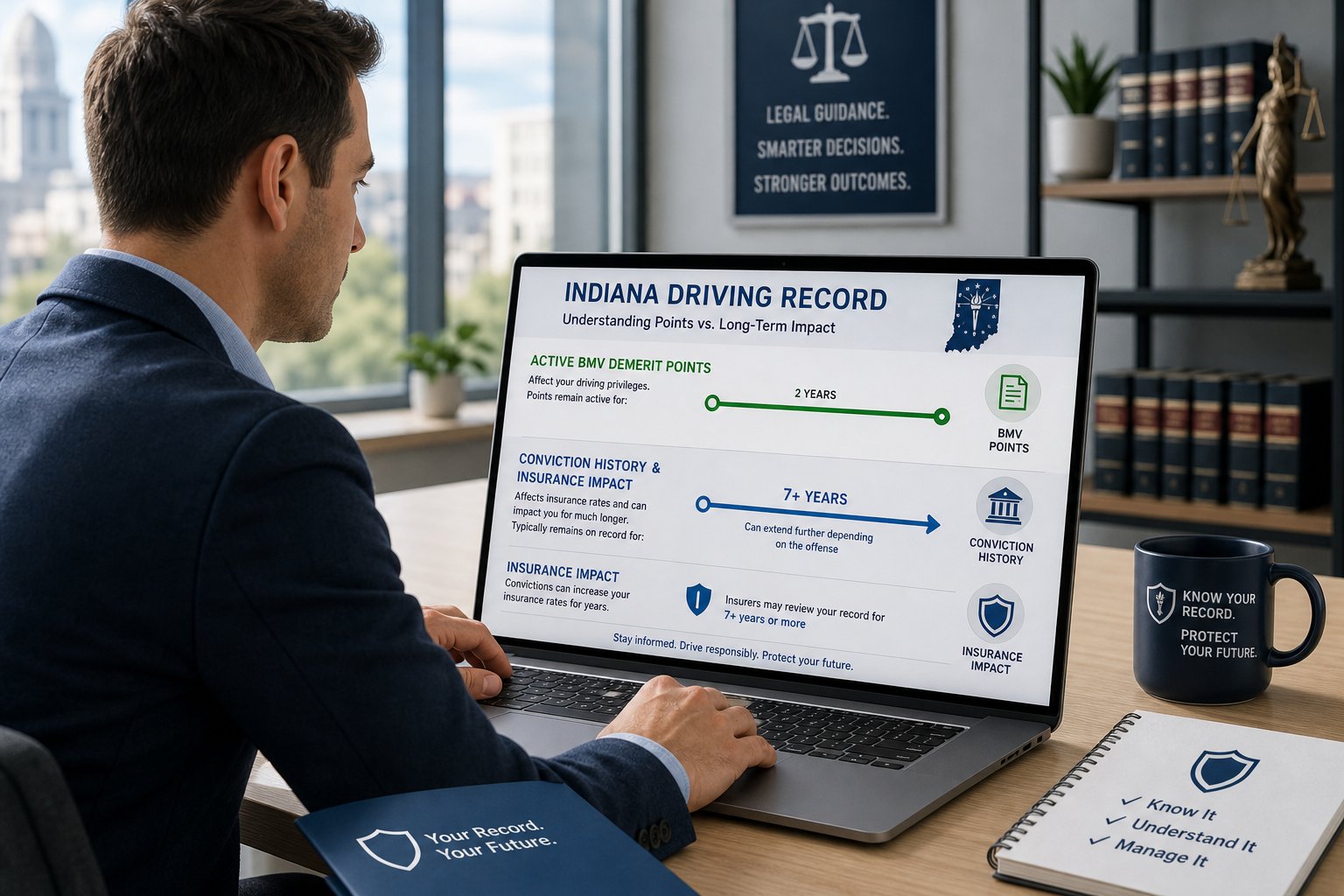
The short answer is 2 years for Indiana BMV points and often longer for the conviction record itself.
Indiana uses a demerit point system for moving violations. For a speeding ticket, those points stay active on your driving record for 2 years from the conviction date, not the date you were stopped. That date matters because a delay in court can shift when the 2-year period starts.
This is where many drivers get confused. They ask, how long does speeding ticket stay on record in indiana, but there are really two parts to that question:
- Demerit points stay active for 2 years
- The conviction entry can remain on your record longer
- Insurance companies may still use the violation in their pricing for 3 to 5 years
So if you are checking your Indiana speeding ticket driving record, do not assume the ticket disappears completely after 2 years. The point impact and the record entry are not always the same thing.
Indiana’s point rules are set by the Indiana Bureau of Motor Vehicles and related state rules in the Indiana Administrative Code. Those official sources are the best place to confirm how the BMV treats a violation on your record.
If you were convicted of speeding, the safest way to think about it is this: the active point effect usually lasts 2 years, but the ticket may matter longer for insurers, employers, or court review in some cases.
How Indiana’s Point System Applies To Speeding Tickets
Indiana assigns demerit points based on how fast you were going over the limit. In many common speeding cases, the point values are:
- 2 points for 1 to 15 mph over
- 4 points for 16 to 25 mph over
- 6 points for 26 mph or more over
Those numbers come from Indiana’s published point schedule through the Indiana BMV. The higher the speed, the higher the point total.
That total matters because Indiana looks at your overall point balance, not just one ticket by itself. A single 2-point speeding ticket may not lead to major trouble. But several tickets close together can push your record into warning or suspension territory.
A key detail here is the 4-point credit from the Driver Safety Program. Indiana allows eligible drivers to complete a BMV-approved Driver Safety Program, often called the DSP, to receive a 4-point credit. The official program is generally a 4-hour course. That credit can reduce your point total, which may help lower suspension risk.
But there is an important limit: the DSP does not remove the conviction, the ticket, or the underlying violation. It only applies a credit against your active points. In Indiana, that can be a meaningful difference if you are close to a warning notice or other BMV action.
You can also review Indiana’s driver-related laws through the Indiana Code.
When A Speeding Ticket Can Affect Your License Or Trigger Driver Safety Requirements
A speeding ticket can affect your license when it pushes your point total high enough or when a court or the Indiana BMV orders extra action.
Indiana can send warning notices, require hearings, place drivers on probation, or suspend driving privileges when point totals rise. Many Indiana traffic sources and BMV materials point to 20 points within 24 months as a serious threshold that can trigger an administrative hearing and possible license suspension.
Some drivers may also see earlier action before they hit 20 points. That depends on the record and the notice involved. Your exact situation can depend on:
- The Indiana BMV notice you receive
- A court order
- The ticket or citation details
- Your prior driver record
- Your current license status
- The local court or judge
- The facts of your case
That is why you should read every document closely and meet all deadlines. Do not ignore a court date, a BMV mailing, or a required appearance.
Indiana may also require a Driver Safety Program in some cases. The DSP can be ordered by a court, required by the BMV, or used by an eligible driver to earn that 4-point credit once every 3 years. If your notice or order says you must complete a program, make sure it is a BMV-approved course and that you follow the exact terms listed.
How Long A Speeding Ticket Can Impact Your Insurance Rates
For insurance, a speeding ticket often matters longer than the 2-year BMV point window.
Many insurers look back 3 to 5 years when they price a policy, although each company uses its own rules. That means your rate may go up even after Indiana demerit points are no longer active. In plain terms, the BMV and your insurer may not treat the same ticket the same way.
A few things can affect how much a ticket changes your premium:
- How fast you were driving
- Whether you have other recent tickets
- Your claims history
- Your age and driving experience
- Your insurer’s underwriting rules
You should also know what a course can and cannot do. Completing the Driver Safety Program may help by reducing your point total with the Indiana BMV. But you should not assume it will cause an insurer to remove the ticket or lower your rate. Insurance treatment varies by company, and no provider should promise a guaranteed discount.
If you are comparing options after a ticket, it helps to separate license risk from insurance risk. The BMV point side usually follows the 2-year rule. Insurance can stretch longer. That is why a single speeding conviction can still cost money after the immediate court issue feels finished.
What To Do After Getting A Speeding Ticket In Indiana
First, read the ticket and all related papers. Then act before any deadline passes.
In Indiana, paying a speeding ticket is often treated as an admission of guilt, which usually leads to a conviction being reported on your record. Contesting the ticket may be an option, but the right path depends on the court, the charge, and your record.
Here are the basic steps to take:
- Check the court date and response deadline
- Read the citation for the exact speed and charge
- Look for any notice from the Indiana BMV
- Decide whether to pay or contest the ticket
- Follow any order for a hearing or course
- Keep copies of all documents
If a court or the BMV requires a course, use a BMV-approved Driver Safety Program. For busy drivers, an online option can be easier to fit into work and family schedules. Driving Logic offers an online Indiana Driver Safety Program through MyDrivingLogic.com that is built for flexible completion on your device.
Before you enroll, make sure the course matches what your notice, court, or case requires. That one check can save time and trouble later.
Can You Remove Or Reduce The Impact Of A Speeding Ticket?
You may be able to reduce the impact of a speeding ticket, but you usually cannot make the event vanish from every record.
In Indiana, possible options can include:
- Contesting the ticket in court
- Asking whether a charge can be reduced
- Seeing whether a local court offers a deferral program
- Completing a BMV-approved Driver Safety Program for a 4-point credit if you are eligible
The most important limit is this: the DSP does not remove the conviction from your record. It lowers your point total by applying a 4-point credit. That can still help a lot if you are trying to avoid crossing the 20-point threshold or dealing with added BMV action.
Because rules can vary by court and by case facts, you need to follow the exact terms on your ticket, court papers, or BMV notice. Do not assume one county handles a speeding ticket the same way as another.
If you need a state-approved course, you can review the online Indiana Driver Safety Program from Driving Logic at MyDrivingLogic.com. It is designed for drivers who need a flexible way to complete a required course.
This information is general education only and is not legal advice.
FAQ
Can a Driver Safety Program remove my speeding ticket?
No. The Indiana DSP does not erase the speeding ticket or conviction. It may provide a 4-point credit when you complete a BMV-approved course and meet the rules.
Can I take the Indiana DSP online?
Yes. Indiana BMV-approved Driver Safety Program providers may offer online courses. Confirm that the course matches your court or BMV requirement before enrolling.
Do I still need to follow my court deadline?
Yes. A course does not replace court instructions or deadlines. Follow the citation, court order, clerk instructions, or BMV notice tied to your case.
Will my insurance change after a speeding ticket?
Maybe. Each insurance company uses its own rating rules. Ask your insurer how a conviction, point credit, or course completion may affect your policy.
Conclusion
How Long Does a Speeding Ticket Stay on Your Record in Indiana? is easier to handle when you know the Indiana BMV point rules, court deadline, and the limits of the Driver Safety Program. The DSP may provide a 4-point credit when eligible, but it does not erase the ticket, conviction, or violation. Review your citation or court notice before you act.
Take the Indiana Driver Safety Program course online when you are ready to begin.
Related Articles
- Indiana Speeding Ticket: Costs, Points, and What to Know
- How Does an Indiana Speeding Ticket Affect Your Car Insurance?
- Indiana BMV Points System Explained
- Indiana Driver Safety Program: The Complete Guide
Sources
- Indiana BMV — Citation Points and Driver Safety Program
- Indiana BMV — Driver Record Points
- myBMV — Indiana BMV Online Services
- Indiana Code and Administrative Rules
Billy Forte is the owner of Driving Logic, a state-approved driver improvement course provider serving Indiana and other U.S. states. Driving Logic offers online driver safety and driver improvement courses for drivers handling BMV notices, court orders, and state requirements.
This article is general information, not legal advice. Indiana BMV rules, court orders, deadlines, provider reporting, insurance decisions, and case facts can differ. Use official Indiana BMV and court sources for current requirements, and consult a qualified Indiana attorney for legal guidance specific to your situation.