
Updated June 2026 · Reviewed by Billy Forte
Indiana speeding ticket cost usually depends on how far over the limit you were, but many drivers pay about $100 to $200 total once the fine and county court costs are added. In general, 1 to 15 mph over often brings 2 Indiana BMV demerit points, 16 to 25 mph over brings 4 points, and 26+ mph over can bring 6 points and a higher risk of a reckless driving charge in some cases. The exact amount is not the same in every court because Indiana counties set different court costs, and your ticket, notice, speed, and case facts can change what you owe.
This article covers Indiana requirements only.
Key Facts
- Total cost varies: Indiana speeding ticket cost depends on speed, county court costs, and citation details.
- Point range: Speeding can add 2, 4, or 6 BMV points based on the violation.
- 20-over tickets: A 20-over ticket may fall in a higher point range than lower-speed tickets.
- Court instructions control: The amount due and deadline come from the citation or court system.
- DSP limit: A DSP credit may lower active points, but it does not erase the ticket.
If you need a BMV-approved online option, review the Indiana Driver Safety Program course and compare it with your ticket, court notice, or BMV requirement.
How Much An Indiana Speeding Ticket Usually Costs
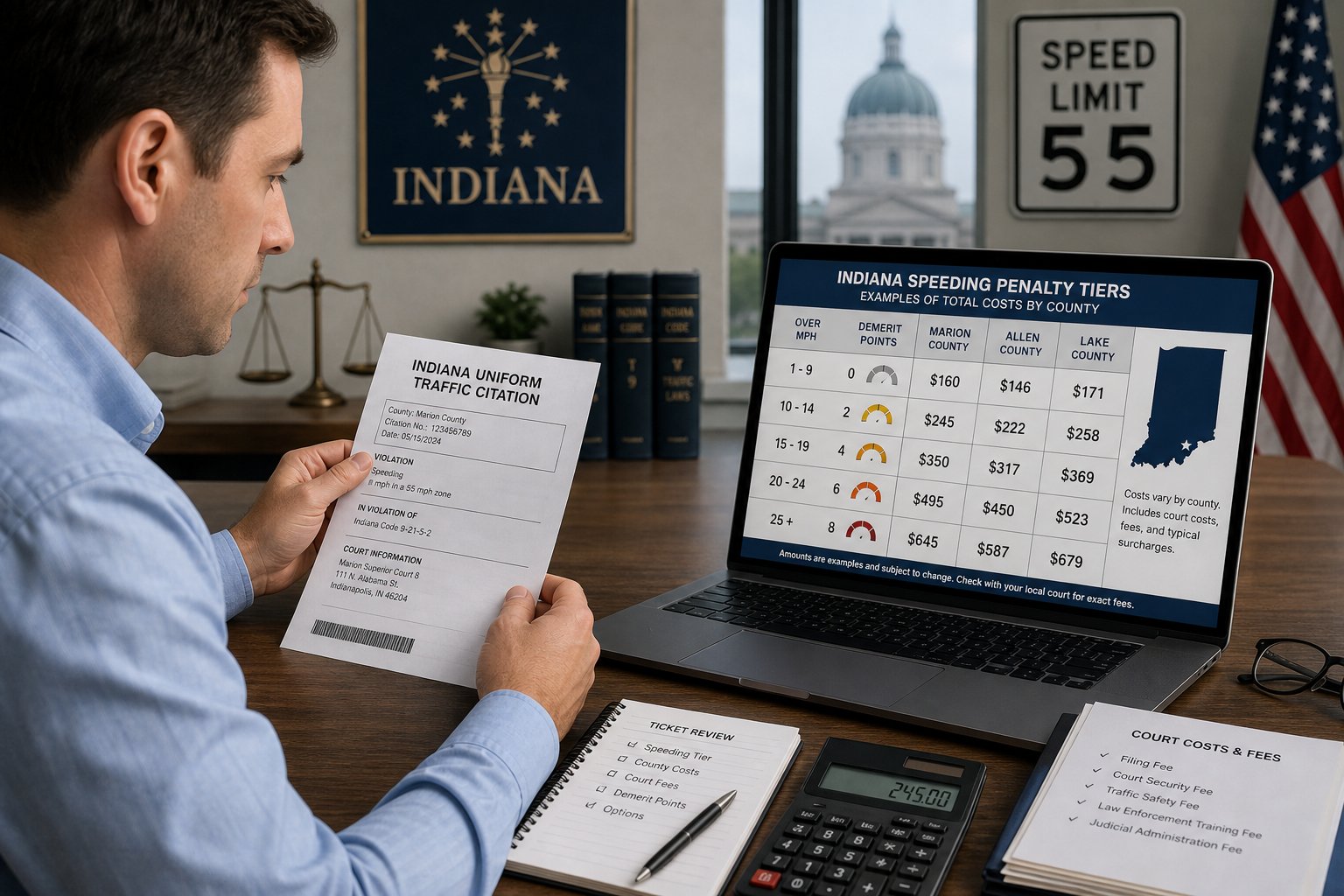
The short answer is this: there is no single statewide flat fee for every speeding ticket.
Most Indiana speeding tickets start with a base fine and then add court costs. That is why two drivers who were both going 20 mph over the limit may not owe the same total in different counties.
A common range for an Indiana speeding ticket cost is about $100 to $200 total. Some local schedules list lower base fines, such as roughly $30 to $74.50 for standard speeding offenses, but the full amount often rises once court costs are added. In at least one Indiana county, a standard passenger-vehicle speeding case can total around $175.
Here is the part most drivers want to know first:
- 1 to 15 mph over the limit: often the lowest fine tier, plus 2 demerit points
- 16 to 25 mph over the limit: usually a higher fine tier, plus 4 demerit points
- 26 mph or more over the limit: often the highest speeding tier, plus 6 demerit points and more risk of a more serious charge depending on the facts
So, how much is a 20 over speeding ticket in Indiana? In many cases, it falls in the middle tier for points, but the money amount still depends on the county and court. That means your citation total may be closer to the low end in one place and much higher in another.
You can confirm official rules and records through the Indiana Bureau of Motor Vehicles and state law sources such as the Indiana General Assembly and the Indiana Administrative Code.
What Changes The Total Price Of A Ticket
The total price of a speeding ticket is not based on speed alone.
First, court costs vary by county and court. That is often the biggest reason one ticket total looks much higher than another. The fine on the charge may look modest, but fees can push the amount up fast.
Second, the place of the violation matters. A ticket in a school zone, work zone, or some local safety area may lead to a higher amount. Local courts may also treat certain road types or local ordinances differently.
Third, the charge written on the ticket matters. A basic speeding citation may stay a Class C infraction, but facts like very high speed, unsafe driving, or extra violations can raise the stakes.
Other things that may affect cost include:
- Your exact mph over the limit
- Whether there was a required court appearance
- Whether the ticket lists added violations
- Whether the court allows payment without a hearing
- Your prior driver record in some situations
This is why it is smart to read the citation closely. Your Indiana BMV notice, court order, ticket, driver record, license status, court, judge, and case facts can all matter. If the ticket says you must appear, do not skip that date. If it gives a payment deadline, do not miss it.
Indiana Speed Limits, Speeding Thresholds, And When Penalties Increase
Indiana uses several common speed limits, and the posted sign controls unless a lower special limit applies.
Common Indiana limits include:
- 25 mph in many residential districts
- 30 mph in urban districts
- 60 mph on some 4-lane state highways
- 65 mph on Indiana Finance Authority highways
- 70 mph on interstates
You can review the statutes on the Indiana General Assembly site for current wording on speed laws and related offenses.
For most drivers, the main penalty jump comes from the number of miles over the limit. Indiana BMV point schedules commonly break speeding into these tiers:
- 1 to 15 mph over: 2 points
- 16 to 25 mph over: 4 points
- 26+ mph over: 6 points
That last tier matters most. At 26 mph or more over, the case can look less like ordinary speeding and more like conduct that raises a reckless driving concern, depending on the facts. Indiana reckless driving can carry much more serious consequences, and in some situations it may be charged as a Class C misdemeanor rather than a simple infraction.
That does not mean every very fast ticket becomes a criminal case. But higher speed gives the officer, prosecutor, and court more reason to treat the matter seriously. And if the speed happened in a work zone, school zone, or with unsafe driving behavior, the risk goes up.
How License Points And Insurance Costs Can Add Up
The ticket price is only part of the cost.
If you are convicted, the Indiana BMV may add demerit points to your driving record. Those points usually stay active for 2 years from the conviction date. That can affect your driving status if you collect too many points in a short time.
For speeding, the common point tiers are:
- 2 points for 1 to 15 mph over
- 4 points for 16 to 25 mph over
- 6 points for 26+ mph over
Insurance can also go up after a speeding ticket. One cited estimate shows average yearly premiums rising from about $1,515 to $2,207 after a speeding violation. Your actual increase depends on your insurer, age, record, vehicle, and where you live.
Indiana also uses a 4-point credit through the BMV-approved Driver Safety Program (DSP). This matters because the credit can reduce the number of points counted on your record. But it does not erase the ticket, remove the conviction, or delete the underlying violation.
The official DSP is a 4-hour course. Whether you can use it, or must use it, depends on the Indiana BMV notice, court order, citation, court, judge, license status, driver record, and case facts. So if you receive instructions from the BMV or court, follow those exact terms.
How To Handle An Indiana Speeding Ticket
You usually have three basic paths: pay it, contest it, or get legal help.
If you pay the ticket, you are often resolving the case as charged. In many situations, that means a conviction is entered and any matching BMV points may follow. Always check the ticket language and the court instructions before you pay.
If you want to contest the ticket, you must follow the court process listed on the citation. Some courts require an appearance on a set date. Others give instructions for requesting a hearing. Missing that step can create more trouble than the ticket itself.
You may also choose to speak with a lawyer, especially if:
- The speed was very high
- The ticket mentions reckless driving
- You hold a commercial license
- You already have points on your record
- The citation requires a court appearance
The key is simple: do not ignore deadlines. Failure to pay or appear can lead to extra fees and license problems.
If you need to act, start by checking the court name, due date, and charge on the citation. Then look for any Indiana BMV notice that came with it. Those documents tell you what is required next.
When Traffic School Or Defensive Driving May Help
Traffic school can help in some Indiana cases, but the benefit depends on the reason you are taking it.
In Indiana, the main official course is the BMV-approved Driver Safety Program (DSP). It is a 4-hour course. If the Indiana BMV or a court allows or requires it, the DSP may give you a 4-point credit on your driving record.
That point credit can be useful if you are trying to lower the total points counted against you. But again, it does not remove the speeding conviction or wipe out the violation itself.
Some drivers also take a course for another reason, such as a possible insurance discount. That depends on your insurer and policy. It is not automatic.
If you need a flexible option, Driving Logic’s Indiana Driver Safety Program online is designed for busy drivers who want to complete the required course on their own schedule from almost any device. Before you enroll, make sure the course matches the requirement listed in your BMV notice, court order, ticket, or court instructions.
That step matters because Indiana requirements can change based on the case and the agency involved.
What Happens If You Ignore The Ticket Or Have Aggravating Factors
Ignoring an Indiana speeding ticket can make things worse.
If you miss a payment deadline or fail to appear in court when ordered, the court may add fees or report the matter in a way that leads to license suspension or other problems. That can turn a manageable ticket into a much bigger issue.
Aggravating factors can also raise the risk level of the case. These include:
- Very high speed, especially 26+ mph over
- Speeding in a school zone or work zone
- Unsafe driving behavior beyond speed alone
- Prior driving issues on your record
- A citation that includes or may be amended to reckless driving
When reckless driving is in play, the case may move beyond a simple infraction. Depending on the facts and charge, a driver may face a Class C misdemeanor and more severe penalties under Indiana law. You can review the current statutes through the Indiana Code.
If your ticket, notice, or court paper says you must appear, show up on time and follow the listed steps. If the Indiana BMV orders a course or sends a notice, respond by the deadline. This article is not legal advice.
FAQ
Can a Driver Safety Program remove my speeding ticket?
No. The Indiana DSP does not erase the speeding ticket or conviction. It may provide a 4-point credit when you complete a BMV-approved course and meet the rules.
Can I take the Indiana DSP online?
Yes. Indiana BMV-approved Driver Safety Program providers may offer online courses. Confirm that the course matches your court or BMV requirement before enrolling.
Do I still need to follow my court deadline?
Yes. A course does not replace court instructions or deadlines. Follow the citation, court order, clerk instructions, or BMV notice tied to your case.
Will my insurance change after a speeding ticket?
Maybe. Each insurance company uses its own rating rules. Ask your insurer how a conviction, point credit, or course completion may affect your policy.
Conclusion
Indiana Speeding Ticket Fines: What Affects the Cost? is easier to handle when you know the Indiana BMV point rules, court deadline, and the limits of the Driver Safety Program. The DSP may provide a 4-point credit when eligible, but it does not erase the ticket, conviction, or violation. Review your citation or court notice before you act.
Take the Indiana Driver Safety Program course online when you are ready to begin.
Related Articles
- Indiana Speeding Ticket: Costs, Points, and What to Know
- 20 Over Speeding Ticket in Indiana: What to Know About Cost and Points
- Indiana Work Zone and School Zone Speeding Tickets: Higher Fines
- How Does an Indiana Speeding Ticket Affect Your Car Insurance?
Sources
- Indiana BMV — Citation Points and Driver Safety Program
- Indiana BMV — Driver Record Points
- myBMV — Indiana BMV Online Services
- Indiana Code and Administrative Rules
Billy Forte is the owner of Driving Logic, a state-approved driver improvement course provider serving Indiana and other U.S. states. Driving Logic offers online driver safety and driver improvement courses for drivers handling BMV notices, court orders, and state requirements.
This article is general information, not legal advice. Indiana BMV rules, court orders, deadlines, provider reporting, insurance decisions, and case facts can differ. Use official Indiana BMV and court sources for current requirements, and consult a qualified Indiana attorney for legal guidance specific to your situation.