
Updated June 2026 · Reviewed by Billy Forte
No. In most cases, an Indiana speeding ticket is a Class C infraction, not a criminal charge, so it does not create a criminal record. It can still add Indiana BMV demerit points, lead to fines and court costs, and raise your insurance costs.
This article covers Indiana requirements only.
Key Facts
- Most speeding tickets are infractions: A normal Indiana speeding ticket is usually not a misdemeanor.
- Criminal issues can differ: Reckless driving or other conduct may create different legal risk.
- BMV points still matter: A noncriminal infraction can still affect your driving record.
- Insurance can still change: Insurers may consider traffic convictions even when they are not crimes.
- Read the charge: The citation language tells you what type of case you have.
If you need a BMV-approved online option, review the Indiana Driver Safety Program course and compare it with your ticket, court notice, or BMV requirement.
Most Indiana Speeding Tickets Are Infractions, Not Misdemeanors
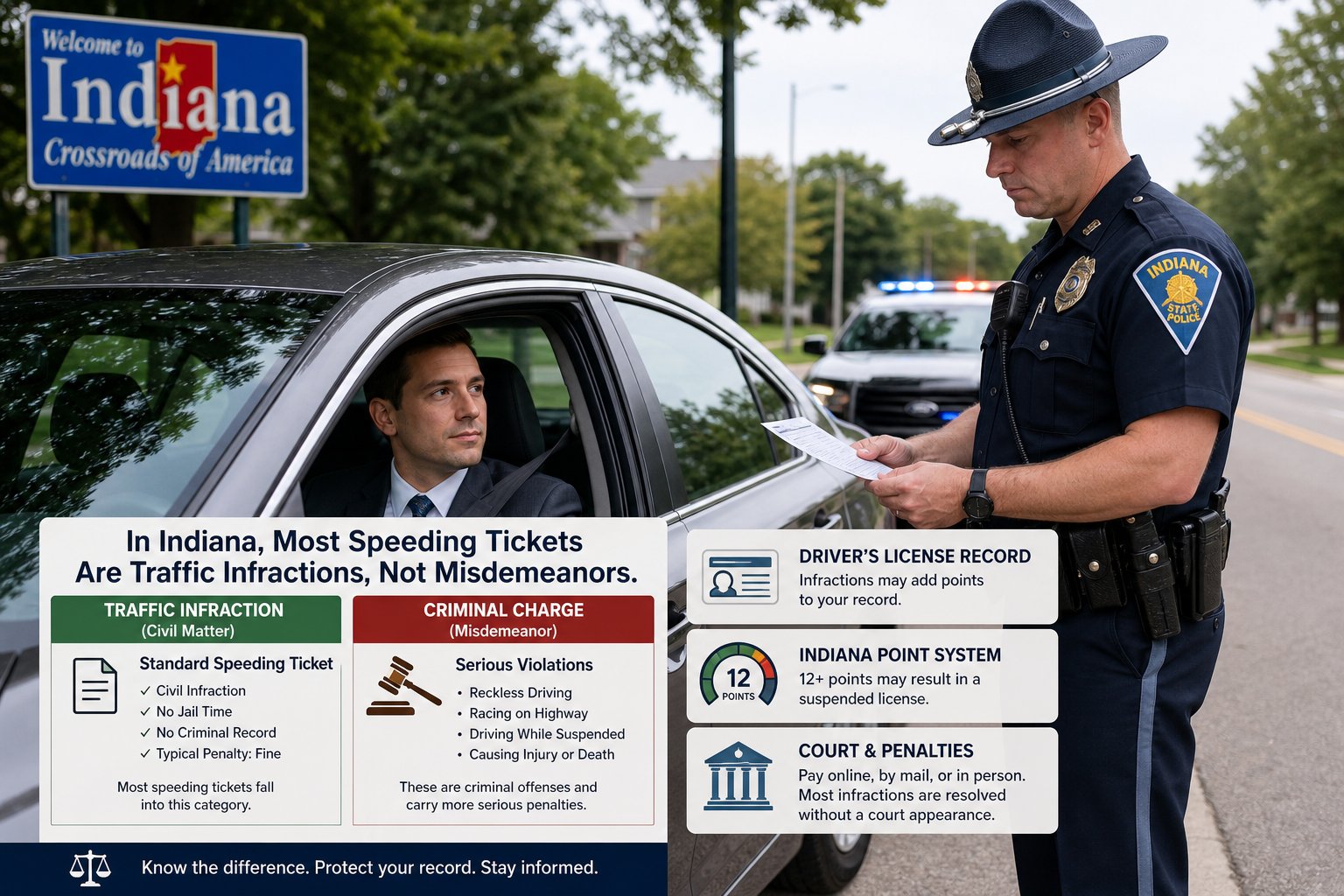
The short answer is simple: most Indiana speeding tickets are not misdemeanors. A normal speeding violation is usually handled as a Class C infraction. That means it is a civil traffic offense, not a crime.
This matters because a standard ticket usually does not create an Indiana speeding ticket criminal record issue in the way a misdemeanor does. You can still owe money and get points. But you are usually not facing jail or a criminal conviction from a basic speeding citation.
Indiana law separates traffic infractions from criminal offenses. Infractions are less severe. They are often resolved by paying the ticket, appearing in court if required, or following court instructions. Even so, an infraction is not minor in a practical sense. It can affect your driving record, insurance price, and license status if you get more tickets later.
The Indiana Bureau of Motor Vehicles tracks traffic violations through its point system. So, while a basic speeding ticket is not criminal, it can still lead to real costs.
If your ticket says speeding and does not include a criminal charge like reckless driving, it is usually an infraction. But always read the citation closely. The exact charge on the ticket matters more than what you call it.
When A Speeding Violation Can Become A Criminal Charge
A speeding case can become criminal when the facts show more danger than ordinary speeding. In Indiana, the key example is reckless driving. Under Indiana Code § 9-21-8-52, reckless driving is a Class C misdemeanor in many cases.
That is a major line. A Class C infraction is civil. A Class C misdemeanor is criminal. A misdemeanor charge can appear on a background check and may matter to employers, especially if your job involves driving.
Indiana also has special rules for some worksite conduct. Under Indiana Code § 9-21-8-56, certain conduct in a highway work zone can lead to more serious penalties depending on what happened and whether workers were present.
So, if you are asking, is a speeding ticket a misdemeanor in Indiana, the honest answer is: usually no, but sometimes a related driving charge can be. The label on the citation and the facts of the stop control the result.
Common Aggravating Factors That Make A Speeding Case More Serious
Some facts can push a case beyond ordinary speeding. Common examples include:
- Reckless operation of the vehicle
- Speeding in a work zone, especially with workers present
- Prior related driving violations
- Driving while impaired by alcohol or drugs
- Causing danger, injury, or property damage
These facts do not always mean the same charge. But they can make the case more serious and may lead to a criminal filing instead of a simple ticket.
Penalties For Speeding In Indiana: Fines, Points, And Possible Suspension
Even when speeding is only an infraction, the penalties can add up fast. You may face fines, court costs, and Indiana BMV points. Your insurer may also raise your rate after a conviction.
Indiana uses a demerit point system. According to Indiana BMV materials, common point values include:
- 2 points for driving 1 to 15 mph over the speed limit
- 4 points for driving 16 to 25 mph over the speed limit
- 6 points for driving 26 mph or more over the speed limit
Point totals matter because too many points can lead to BMV action, including a warning or possible suspension, depending on your record and case facts. Requirements can also depend on your BMV notice, court order, ticket, driver record, license status, court, judge, and the details of the case.
You can review point information in the BMV’s driver record and point resources, and Indiana’s rules are also reflected in the Indiana Administrative Code.
A ticket can also cost you in less obvious ways. Insurance companies often treat speeding as a risk signal. So, even a non-criminal ticket can become expensive over time.
How Indiana Classifies Infractions, Misdemeanors, And Felonies
Indiana sorts violations into infractions, misdemeanors, and felonies. The difference is more than just a label. Each type brings a different level of risk.
An infraction is civil. It does not carry jail time. That is where a standard Indiana speeding ticket usually falls. You may still owe money and get demerit points, but it is not a criminal conviction.
A misdemeanor is a criminal offense. In Indiana, misdemeanors can carry up to one year in jail, depending on the level and the statute involved. A charge like reckless driving can fall into this group.
A felony is more serious. Felonies carry penalties above one year and can apply when driving conduct leads to severe harm or falls under a statute with felony treatment.
This is why drivers often ask about a criminal record. A basic speeding ticket usually does not create one. But a criminal traffic charge can. For jobs that involve delivery, rideshare work, a CDL path, or regular driving, that difference can matter a lot on background checks and insurance reviews.
What To Do After Getting A Speeding Ticket In Indiana
First, read the ticket closely. The charge listed on the citation tells you a lot. Look for the court name, due date, payment options, and whether a court appearance is required.
Next, do not miss deadlines. If the ticket requires action, follow the notice. You should not ignore an Indiana BMV notice, court order, citation, deadline, or required appearance.
Then decide how you want to respond. Common next steps include:
- Paying the ticket if you accept the infraction
- Checking with the court about options listed on the citation
- Reviewing your driver record through the Indiana BMV
- Getting legal help if the charge is criminal or the facts are serious
If the citation mentions reckless driving or another criminal offense, treat it differently from a basic speeding ticket. A criminal case can affect your record in ways a standard infraction does not.
Also keep copies of everything. Save the ticket, court papers, proof of payment, and any BMV notices. Clear records help if questions come up later.
When Traffic School Or A Driving Course May Help
A driving course may help in some Indiana cases, but it does not erase the ticket. Indiana’s official course is the BMV-approved Driver Safety Program (DSP), which is a 4-hour course. When allowed, the DSP gives a 4-point credit that reduces your point total. It does not remove the conviction or the violation from your driving record.
Whether you can or must take a course depends on the Indiana BMV notice, court order, ticket, driver record, license status, court, judge, and case facts. That is why you should check the exact paperwork you received.
If you need a course and want a flexible option, you can take the Indiana Driver Safety Program online at Driving Logic. It is built for busy drivers who want to complete a required course on their own schedule and on almost any device.
Before you enroll, confirm that the course matches what your notice or court requires. If your paperwork says DSP, make sure you take a BMV-approved Indiana DSP provider.
Not legal advice.
FAQ
Can a Driver Safety Program remove my speeding ticket?
No. The Indiana DSP does not erase the speeding ticket or conviction. It may provide a 4-point credit when you complete a BMV-approved course and meet the rules.
Can I take the Indiana DSP online?
Yes. Indiana BMV-approved Driver Safety Program providers may offer online courses. Confirm that the course matches your court or BMV requirement before enrolling.
Do I still need to follow my court deadline?
Yes. A course does not replace court instructions or deadlines. Follow the citation, court order, clerk instructions, or BMV notice tied to your case.
Will my insurance change after a speeding ticket?
Maybe. Each insurance company uses its own rating rules. Ask your insurer how a conviction, point credit, or course completion may affect your policy.
Conclusion
Is an Indiana Speeding Ticket a Misdemeanor or Just a Traffic Infraction? is easier to handle when you know the Indiana BMV point rules, court deadline, and the limits of the Driver Safety Program. The DSP may provide a 4-point credit when eligible, but it does not erase the ticket, conviction, or violation. Review your citation or court notice before you act.
Take the Indiana Driver Safety Program course online when you are ready to begin.
Related Articles
- Indiana Speeding Ticket: Costs, Points, and What to Know
- When Does an Indiana Speeding Ticket Become Reckless Driving?
- Indiana Speeding Ticket: What to Know Before You Pay or Contest It
- Indiana Driver Safety Program: The Complete Guide
Sources
- Indiana BMV — Citation Points and Driver Safety Program
- Indiana BMV — Driver Record Points
- myBMV — Indiana BMV Online Services
- Indiana Code and Administrative Rules
Billy Forte is the owner of Driving Logic, a state-approved driver improvement course provider serving Indiana and other U.S. states. Driving Logic offers online driver safety and driver improvement courses for drivers handling BMV notices, court orders, and state requirements.
This article is general information, not legal advice. Indiana BMV rules, court orders, deadlines, provider reporting, insurance decisions, and case facts can differ. Use official Indiana BMV and court sources for current requirements, and consult a qualified Indiana attorney for legal guidance specific to your situation.