
Updated June 2026 · Reviewed by Billy Forte
Traffic violations can stay on a Virginia driving record longer than the demerit points from those violations count against your point balance. This article is for Virginia drivers who need a clear answer before checking a record, taking a course, or responding to a DMV or court notice. You will learn what the rule means, how a Driver Improvement Clinic may fit, and what to verify before your next step.
This article covers Virginia requirements only.
Key Facts
- Official record: Virginia DMV records are the source for your point balance and license status.
- Record details: A record may show convictions, points, suspensions, and status history.
- Court vs DMV: Court records and DMV records may update on different timelines.
- Course role: Driver Improvement Clinic completion may appear separately from the violation.
- Verify first: Use official DMV or court records before taking action.
What Counts As Reckless Driving In Virginia
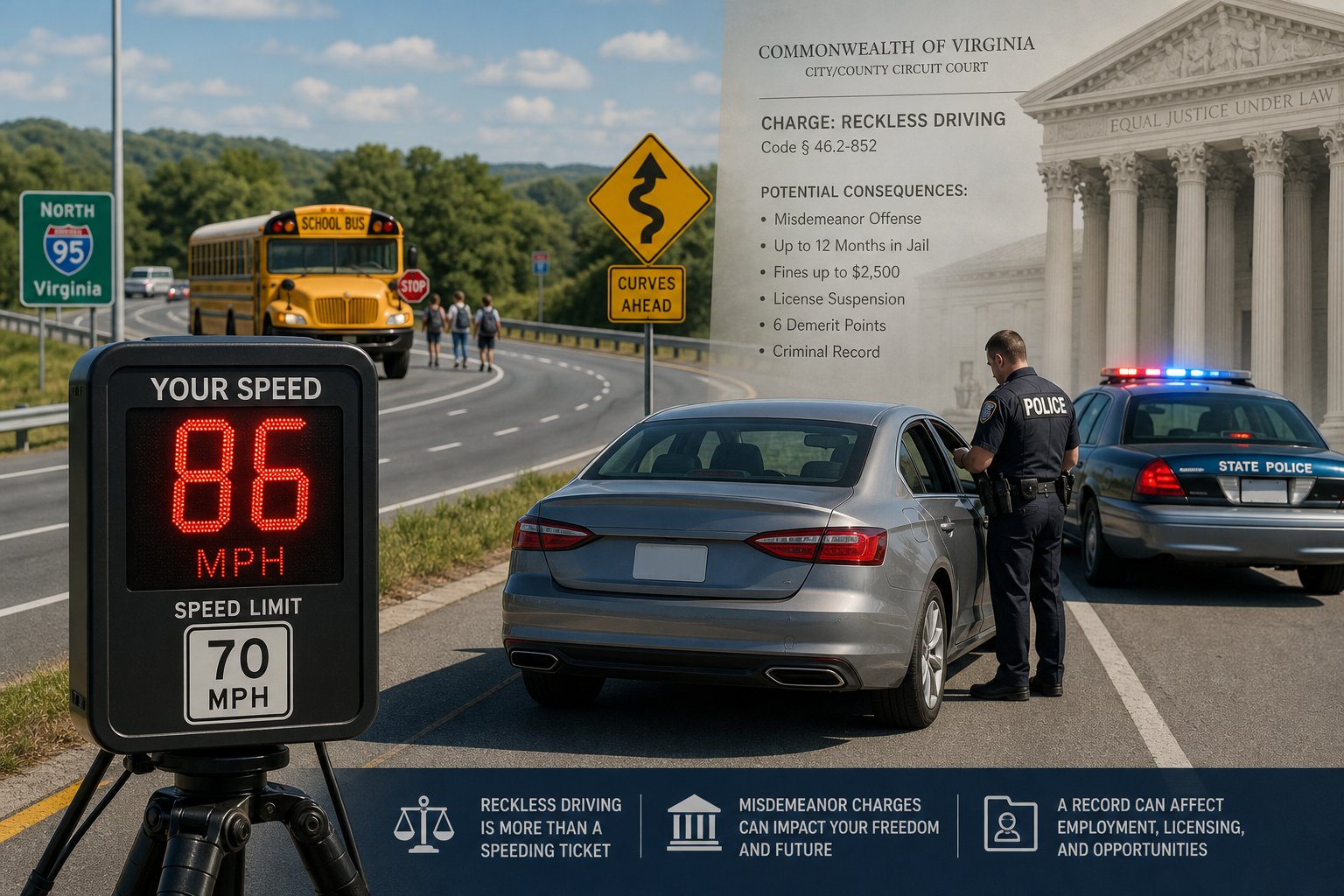
Reckless driving in Virginia is more than a basic speeding ticket. It is usually a Class 1 misdemeanor, which means it is a criminal charge, not just a traffic infraction.
If you need an approved online option, review the Virginia Driver Improvement Course and compare it with your Virginia DMV notice, court order, or driver record goal.
Under the Code of Virginia, one common form of reckless driving is driving 20 mph or more over the speed limit or driving over 85 mph no matter what the speed limit is. That catches a lot of drivers by surprise. A person going 86 in a 70 can still face reckless driving.
Virginia law also allows reckless driving charges for conduct beyond speed. Examples can include:
- Driving in a way that endangers life, limb, or property
- Failing to maintain proper control
- Passing a stopped school bus
- Passing on a curve or hill when unsafe
- Racing or aggressive driving behavior tied to specific statutes
That matters because the answer to how long does reckless driving stay on record in VA depends on the charge ending in a conviction. If the court convicts you of reckless driving, the record impact is much more serious than a normal speeding case.
The exact charge can depend on the ticket, the officer’s notes, the speed reading, the court, the judge, the locality, and the facts of the stop. And if you get a Virginia DMV notice or a court date, do not ignore it. Missing a required court appearance can make things worse fast.
How Long Reckless Driving Stays On Your Virginia Record
A reckless driving conviction stays on your Virginia driving record for 11 years. That is the main DMV retention rule drivers want to know.
This is where many people get confused. In Virginia, the conviction entry and the demerit points do not always last the same length of time. For reckless driving, the conviction remains on the Virginia DMV record for 11 years from the conviction date. But the 6 demerit points tied to that conviction affect your point balance for 2 years.
Virginia also uses different retention periods for other traffic violations. In general:
- 3-point violations stay on the DMV record for 3 years
- 4-point violations stay on the DMV record for 5 years
- 6-point violations, including reckless driving, stay on the DMV record for 11 years
So if you are comparing violations, reckless driving sits in the most serious DMV category most drivers see.
There is another layer too. A reckless driving conviction is also a criminal misdemeanor conviction. If you are convicted, that criminal record issue is separate from the DMV driving record. In general, a conviction is not simply wiped away because DMV points expire.
Insurance can last longer in practice too. Insurers do not always use the same time frame as the Virginia DMV. A company may review prior convictions under its own underwriting rules, and some employers that check driving history may also focus on more than just active point balance.
So the short answer is simple: 11 years on the Virginia DMV record, 2 years of active demerit-point effect, and possible longer insurance or background consequences.
DMV Demerit Points And License Impact
Reckless driving adds 6 demerit points in Virginia. That is the highest regular demerit level in the Virginia DMV system.
Those points matter because Virginia tracks your point balance over time. If you build up too many demerit points, the Virginia Department of Motor Vehicles can require action or move toward license suspension. For example, the DMV explains that high point totals in a set period can trigger warning letters, driver improvement requirements, or suspension-related steps depending on your age, record, and license status.
Here is the key difference:
- The 6 demerit points count for 2 years
- The reckless driving conviction stays on the record for 11 years
That means the point hit is shorter than the record entry itself.
Virginia also has safe driving points. If you complete a Virginia DMV-approved Driver Improvement Clinic, you may earn up to 5 safe driving points if you are eligible. This is the official Virginia course, and it is generally an 8-hour course. Those safe points can help offset your point balance during the retention period, but they do not erase the reckless driving conviction.
That distinction is important. Safe points help the running balance. They do not delete the ticket, remove the conviction, or shorten the 11-year DMV record period.
Requirements can vary based on your Virginia DMV notice, court order, ticket, citation, driver record, license status, court, judge, locality, and case facts. If the DMV or a court orders a course, follow the notice carefully and complete the right program by the deadline.
Criminal Penalties Beyond Your Driving Record
Reckless driving in Virginia can bring criminal penalties beyond points and record time. That is because it is usually charged as a Class 1 misdemeanor.
Under Virginia law, possible penalties can include:
- Up to 12 months in jail
- Up to a $2,500 fine
- Possible license suspension for up to 6 months
You can review the reckless driving statutes through the Code of Virginia and case information through the Virginia Judicial System.
Not every case brings the maximum penalty. Still, the risk is real. Courts often look at facts such as speed, road conditions, prior record, and whether there was a crash or danger to others.
The long-term effects can reach beyond court. A misdemeanor conviction may show up on background checks. Some jobs ask about criminal history. Some employers also review your driving record if driving is part of the work.
Insurance is another major concern. Even when demerit points expire, a reckless driving conviction may still affect underwriting, rates, or eligibility under the insurer’s own rules. That is one reason people ask not just how long does reckless driving stay on record in VA, but also how long the fallout can last. The honest answer is that the DMV timeline is clear, but insurance and job effects can stretch further depending on the company and the record review used.
Can A Reckless Driving Charge Be Reduced Or Dismissed
Yes, a reckless driving charge can sometimes be reduced or dismissed in Virginia. But it depends on the facts, the proof, and the court.
A dismissal may happen if the evidence is weak or if there is a problem with the case. A reduction may happen when the court or prosecutor agrees that a lesser charge fits better. In some cases, reckless driving is reduced to:
- Speeding
- Improper driving
- Another lesser traffic offense
That matters because a lesser offense may carry a shorter DMV retention period and may avoid the criminal misdemeanor result tied to reckless driving.
Still, nothing is automatic. Outcomes can depend on:
- The speed alleged
- Radar or LIDAR evidence
- Your driving history
- The judge and court
- The locality
- Whether there was an accident
- Steps you took after the ticket
One critical point: do not prepay a Virginia reckless driving ticket if the charge allows prepayment, because prepayment is generally treated as a guilty plea. That can create the conviction and its record effects without you appearing to contest it.
If you want to fight the charge or seek a reduction, review your court notice and consider getting legal help fast. A lawyer can assess the facts, the charging statute, and whether there is a realistic basis to challenge the evidence or seek a better outcome.
What To Do After A Reckless Driving Ticket In Virginia
Act fast and read every paper closely after a reckless driving ticket in Virginia. Small mistakes can lead to bigger problems.
Start with the basic facts on the citation or court notice. Check the court date, the charge, and whether a court appearance is required. If you received a Virginia DMV notice, read that too. Your next steps can depend on the ticket, citation, court order, DMV notice, license status, driver record, court, judge, locality, and case facts.
A good checklist is:
- Do not ignore the ticket or court date
- Do not assume it is the same as a normal speeding ticket
- Do not prepay unless you understand the guilty-plea effect
- Get a copy of your Virginia driving record if needed
- Consider speaking with a Virginia traffic or criminal defense lawyer
- Follow any DMV or court deadline exactly
If your goal is to limit harm, timing matters. A fast response may help you prepare documents, understand the evidence, and decide whether to contest the charge.
When A Driver Improvement Course May Help
A Driver Improvement Clinic may help in some reckless driving cases, but it does not erase a conviction. Courts and prosecutors may view course completion as a positive fact in some situations, especially when paired with a decent prior record and good cooperation.
Virginia’s official course is the DMV-approved Driver Improvement Clinic, usually an 8-hour course. If you are eligible, completing it may add safe driving points to help offset your demerit-point balance. It may also satisfy a DMV or court requirement when one is ordered.
If you need an approved online option, you can review the Virginia Driver Improvement Course at Driving Logic. Make sure the course matches the requirement on your notice before you enroll.
Not legal advice.
FAQ
Can a Virginia Driver Improvement Clinic remove a ticket from my record?
No. A Virginia Driver Improvement Clinic does not erase a ticket or conviction from your driving record. When eligible, it may add safe driving points that help your overall point balance.
How many safe driving points can I earn from a Virginia clinic?
Eligible drivers may receive 5 safe driving points after completing an approved clinic. Voluntary clinic credit is generally limited to once every 24 months.
Should I follow the DMV notice or the court order?
Follow the document that applies to your situation. A DMV notice, court order, citation, or insurance request may have different instructions and deadlines.
Where should I check my Virginia point balance?
Use your official Virginia DMV driving record. Do not rely only on memory, insurance paperwork, or an old copy of your record.
Conclusion
How Long Do Traffic Violations Stay on a Virginia Driving Record? depends on your official Virginia DMV record, the specific violation, and any court or DMV notice you received. A Driver Improvement Clinic may help with safe driving points when eligible, but it does not erase the underlying ticket or conviction. Check the official record and deadline before you act.
Take the Virginia Driver Improvement Course online when you are ready to begin.
Related Articles
- Virginia DMV Points System Explained
- What Is a Safe Driving Points Balance in Virginia?
- How to Earn Safe Driving Points in Virginia (And Why the DIC Gives You 5)
- How Many Points Is a Speeding Ticket in Virginia?
Sources
- Virginia DMV — Driver Improvement
- Virginia DMV — Points System
- Virginia DMV — Moving Violations and Points
- Virginia Code § 46.2-494 — Safe Driving Points
- Virginia DMV — Driver Improvement Clinics
Billy Forte is the owner of Driving Logic, a state-approved driver improvement course provider serving Virginia and other U.S. states. Driving Logic offers online driver improvement and driver safety courses for drivers handling DMV notices, court orders, point concerns, and state requirements.
This article is general information, not legal advice. Virginia DMV rules, court orders, deadlines, insurance decisions, CDL rules, and case facts can differ. Use official Virginia DMV and court sources for current requirements, and consult a qualified Virginia attorney for legal guidance specific to your situation.