
Updated June 2026 · Reviewed by Billy Forte
After you finish a Virginia DMV-approved Driver Improvement Clinic, the provider usually reports your completion to the Virginia DMV, but if a court ordered the course, you often must also send or deliver your certificate to the court clerk by the date on your court order or notice. Most online providers issue the official DIC 552B certificate of completion, which you can download and print for court or insurance use while the DMV report is processed. If your deadline is close, do not assume DMV reporting alone will satisfy a court, because courts, judges, and local clerks may require paper proof, a copy, or a specific filing method.
This article covers Virginia requirements only.
Key Facts
- Certificate step: Confirm whether your certificate goes to DMV, court, or both.
- Course length: Virginia Driver Improvement Clinics are 8-hour DMV-approved courses.
- Online option: Online completion may be allowed if the court or DMV notice accepts it.
- Proof: DMV reporting and court certificate submission are not always the same step.
- No erasure: The clinic does not erase tickets, convictions, or demerit-point history.
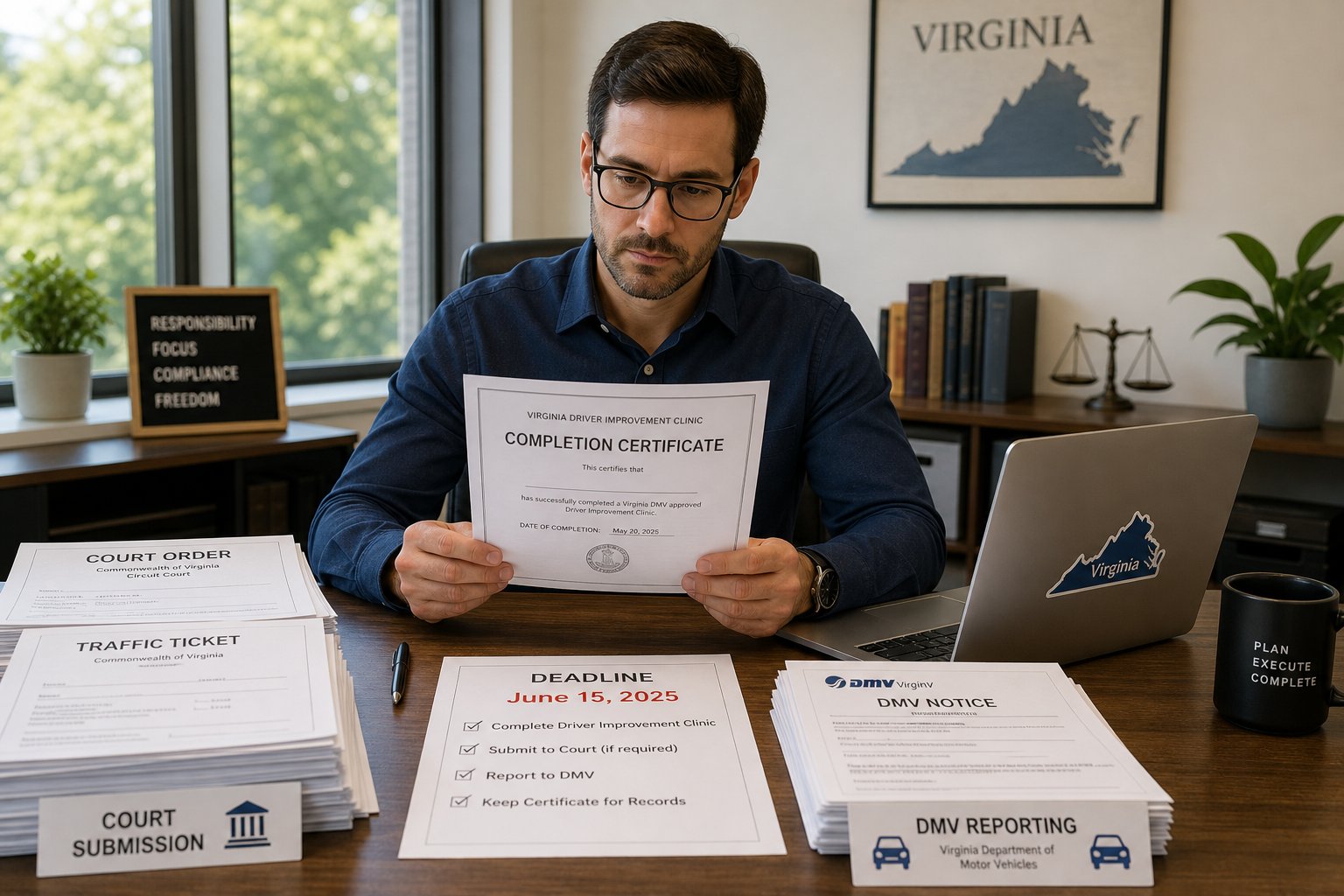
Who Needs To Submit A Driver Improvement Certificate In Virginia
You may need to submit proof of completion in Virginia for three main reasons: a court order, a DMV notice, or your own voluntary course for safe driving points or insurance. The key point is simple: the Virginia DMV and the court are not always the same audience. A provider may report to DMV, but a court may still want you to submit proof yourself.
Court-Ordered, DMV-Required, And Voluntary Completions
If a judge ordered the clinic, follow the court order exactly. That order may come from a traffic case, deferred finding, plea agreement, probation term, or another court process. In many of those cases, you must give proof to the clerk of court by the stated completion deadline.
If the Virginia Department of Motor Vehicles required the course, your DMV notice controls. DMV-required clinics can happen after point issues, probation, a control period, or another driver improvement action. In those cases, the DMV-approved provider usually reports completion directly to DMV.
If you took the clinic on your own, you may be trying to earn safe driving points. Virginia allows point credit in some cases, but not every completion qualifies for every benefit. For example, a course taken only for an insurance discount may have different rules.
Your next step is to read every paper tied to your case:
- your court order
- your DMV notice
- your ticket or citation
- any clerk or judge instructions
Those details can change what you must submit, where you must send it, and when it is due.
How Certificate Submission Works In Virginia
In Virginia, the reporting process usually has two parts. First, the school reports your completion to the Virginia DMV. Second, if a court or insurer wants proof, you send the certificate yourself.
Virginia’s official course is a DMV-approved Driver Improvement Clinic, often called a DIC. For most non-commercial drivers, that clinic is an 8-hour course. When you complete it through an approved provider, the provider generally sends the record to DMV electronically, often within about 24 business hours, though delays can happen on weekends, holidays, or if your record details do not match.
When The DMV Reports Completion Vs. When You Must Send Proof Yourself
The DMV report is important, but it does not mean every court gets automatic notice. That is where many drivers get stuck. They finish the course, see their certificate in the provider portal, and assume the court can already see it.
Usually, the provider handles DMV reporting for:
- DMV-required clinic completions
- many court-ordered completions, as a DMV record matter
- voluntary completions that may qualify for safe driving points
But you often must send proof yourself when:
- a Virginia court ordered the clinic
- your insurance company wants the certificate
- a local office or clerk asks for a paper copy
Most providers also give you a downloadable certificate, often the DIC 552B for online completion. Save that file right away. If your name, license number, or completion date is wrong, contact the provider fast so the DMV record can be corrected before your deadline gets closer.
How To Submit Your Certificate To A Virginia Court Or Clerk
If a Virginia court ordered your clinic, submit the certificate the way the court told you to. Do not guess. The right method depends on the court order, the clerk’s office, the locality, and sometimes the judge.
Common court submission methods include:
- mailing the certificate to the clerk’s office
- hand-delivering it at the clerk window
- following a local court upload or filing process, if allowed
Before you send anything, check the court paperwork for the case number, mailing address, and due date. If the order says to file proof by a certain day, do not assume the date means mailing it that day. The clerk may need to receive it by then.
When you mail a certificate, include enough detail so the clerk can match it to your case. That often means your full name, case number, and contact information. Keep a copy of everything you send.
Also, some courts may have rules about whether they accept an online clinic in your case. That is why it helps to confirm court acceptance before you enroll, especially if your charge, license status, or local court practice makes the issue less clear.
If you completed your course with submit driver improvement certificate virginia, log in to your account, download the certificate, print it clearly, and then submit it exactly as your court directs. That extra check can prevent a missed filing, a return trip, or a notice that says your proof was not accepted.
What To Check Before You Submit So It Is Accepted
Before you submit anything, make sure the certificate is the right document and the details are correct. Small errors can cause a delay, and a delay can matter if you are near a court or DMV deadline.
Start with the certificate itself. For an online Virginia clinic, the proof is usually the official DIC 552B. If a court or DMV office wants a printed copy, it should be clear, readable, and not changed in any way.
Check these items carefully:
- your full name matches your record
- your driver’s license number is correct
- the completion date is correct
- the provider name is listed
- the clinic is DMV-approved
- the court accepts that clinic type, if court-ordered
Virginia materials also note printing standards for official certificates. If you present a paper copy, use plain white 8.5″ x 11″ paper and do not alter the form. Avoid handwritten edits, cut-off margins, or faded print.
Next, check timing. Your required filing date may depend on your DMV notice, court order, citation, driver record, license status, or the facts of your case. Missing the deadline can lead to serious results, such as loss of a deferred outcome, a probation problem, added DMV action, or a failure to satisfy the order.
If the provider says it reported your completion but DMV has no record after a reasonable wait, contact the provider first. Ask them to confirm the transmission and verify the personal data used for reporting. Then, if needed, review current instructions from the Virginia DMV Driver Improvement Program or your court clerk.
Special Cases: Commercial Drivers, Probation, Control Periods, And Insurance Discounts
Some Virginia drivers have extra rules. The biggest examples are commercial drivers, drivers in a probation or control period, and drivers taking a course for an insurance discount.
If you hold a CDL or got the offense in a commercial motor vehicle, a regular non-commercial online course may not count. Virginia uses separate rules for commercial driver improvement clinics. If your notice or order points to a commercial requirement, confirm that you are taking the correct clinic before you start.
Probation and control periods also need close attention. Under the Virginia DMV driver improvement system, new violations during these periods can lead to more penalties or suspension action. If DMV or a court asks for proof tied to restricted privileges or another condition, submit the exact documents requested and keep copies.
Insurance is different again. Many companies, especially for some older drivers, may offer a discount for an accident-prevention or driver improvement course. But the insurer usually does not get automatic notice from DMV or the provider. You normally send the certificate to the insurance company using the method they list.
One more detail matters here: safe driving points and insurance discounts are not the same thing. A clinic taken only for insurance may not qualify for DMV safe driving point credit. And a court-assigned clinic does not automatically mean an insurer will apply a discount.
If you still need to complete your Virginia course, you can take the submit driver improvement certificate virginia. It works on most devices, lets you move at your own pace, and gives you quick access to your completion certificate once you finish.
Not legal advice. Requirements can depend on your court order, DMV notice, ticket, driver record, license status, court, judge, locality, and case facts. Check official instructions from the Virginia Judicial System and the Virginia Department of Motor Vehicles.
Related Articles
- Court-Ordered Driver Improvement Clinic in Virginia: What to Do
- DMV-Ordered Driver Improvement Clinic in Virginia: Points, Notices, and Deadlines
- Virginia Driver Improvement Program: Points, Orders, and Clinics Explained
- Can I Take the Virginia Driver Improvement Course Online If It’s Court-Ordered?
Sources
- Virginia DMV — Driver Improvement Clinics
- Virginia DMV — Demerit Points and Safe Driving Points
- Virginia Judicial System
- Code of Virginia — Motor Vehicles
Billy Forte is the owner of Driving Logic, a state-approved online driver education provider serving Virginia and other U.S. states. Driving Logic offers DMV-approved online driver improvement courses for drivers handling court orders, DMV notices, demerit points, and voluntary safe-driving point credit.
This article is general information, not legal advice. Virginia DMV rules, court orders, deadlines, insurance decisions, and case facts can differ. Use official Virginia DMV and court sources for current requirements, and consult a qualified Virginia attorney for legal guidance specific to your situation.