
Updated June 2026 · Reviewed by Billy Forte
A Virginia driving record shows license status, convictions, points, suspensions, and other DMV history depending on the record type ordered. This article is for Virginia drivers who need a clear answer before checking a record, taking a course, or responding to a DMV or court notice. You will learn what the rule means, how a Driver Improvement Clinic may fit, and what to verify before your next step.
This article covers Virginia requirements only.
Key Facts
- Official record: Virginia DMV records are the source for your point balance and license status.
- Record details: A record may show convictions, points, suspensions, and status history.
- Court vs DMV: Court records and DMV records may update on different timelines.
- Course role: Driver Improvement Clinic completion may appear separately from the violation.
- Verify first: Use official DMV or court records before taking action.
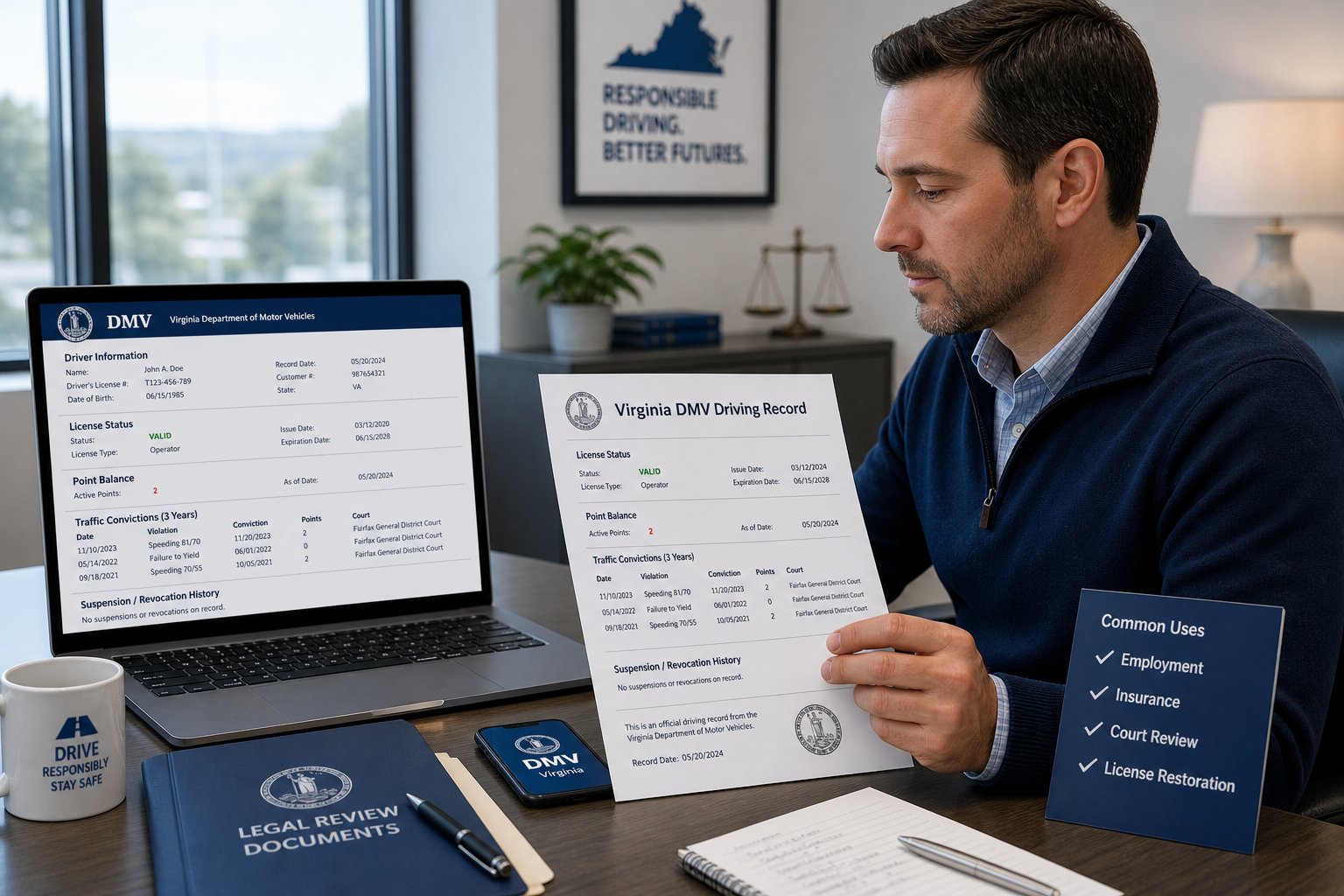
What A Virginia Driving Record Is And When You May Need One
A Virginia driving record is your official driving history from the Virginia Department of Motor Vehicles. It is often called a driver transcript. It shows what the DMV has on file about your license and driving history for a set period.
If you need an approved online option, review the Virginia Driver Improvement Course and compare it with your Virginia DMV notice, court order, or driver record goal.
For most drivers, the record matters because it pulls several facts into one place. It can show whether your license is valid, whether you have any license suspension or revocation history, and whether you have traffic convictions or crashes listed.
You may need a Virginia DMV driving record for several common reasons:
- Traffic court or a lawyer review after a ticket or charge
- Employment for jobs that involve driving
- Insurance questions after a crash or renewal
- School or military paperwork
- License restoration matters in some court cases
If you got a notice from Virginia DMV or a court, your record can help you understand the issue faster. But the record does not replace the notice. Requirements can depend on the Virginia DMV notice, court order, ticket or citation, driver record, license status, court, judge, locality, and case facts.
In Virginia, the record also helps you see how points work. That includes demerit points from convictions and your safe driving points balance. Those are related, but they are not the same thing. Knowing that difference makes the rest of the record much easier to read.
What Information Appears On A Virginia Driving Record
A Virginia record usually shows your identity details first, then your driving history. The exact layout can vary by transcript type, but the main categories are similar.
You will often see:
- Name, address, and license number
- Current license status
- Traffic convictions
- Crash history
- Suspensions, revocations, cancellations, or reinstatement dates
- Point balance information
The most important line for many drivers is the license status section. That tells you if your privilege to drive is valid, suspended, revoked, or otherwise limited. If there was a prior suspension, the record may also show action dates.
Your convictions section lists traffic offenses reported to DMV. Look for the offense name, conviction date, and court-related entry details. A conviction can affect both your driving history and your demerit points.
Virginia also tracks a safe driving points balance. This is where many people get confused. Safe driving points are credits for safe driving and certain DMV-approved actions. Demerit points come from traffic convictions. So if you see a positive safe driving balance, that does not mean a conviction disappeared. It means your point balance reflects credits under Virginia’s system.
If you completed a Driver Improvement Clinic, that may appear as a course completion entry. Virginia’s official course is the DMV-approved Driver Improvement Clinic (DIC), and it is an 8-hour course. When it appears on the record, it is useful for proving completion to a court, employer, or other party that asked for your DMV history.
Types Of Virginia Driving Records And Official Vs. Unofficial Copies
Virginia DMV offers different transcript types for different uses. The right one depends on why you need it.
Common types include:
- Driver/Personal Use record, which can show up to 11 years
- Driver/Employment/School/Military record, often up to 7 years
- Driver/TNC record for rideshare use, often up to 7 years
- Driver/Insurance record, often a 5-year summary
- Driver/Habitual Offender Restoration record, which can show up to 11 years
An official copy comes from Virginia DMV. That is the one courts, employers, and insurers are usually looking for when they ask for a driving record. An unofficial copy is usually a third-party summary, a screenshot, or a copy passed along by someone else.
You may also hear people ask about an informal record versus a certified Type 3A record. In plain terms, an informal copy is for review and information. A certified record is an official DMV-issued copy with certification for formal use. If a court, employer, or agency asks for a certified transcript, confirm the exact record type they want before you order it.
How to read the point balance section
Read the point balance line carefully. If it shows a positive safe driving balance, that means you have earned safe driving points under Virginia rules. If a conviction is listed elsewhere, that conviction still remains part of the history shown for that transcript period.
For formal use, ask what the requester needs first. Then order the matching DMV transcript instead of guessing.
How To Request Your Virginia Driving Record
You can request your record from Virginia DMV in several ways. The main options are online, by mail, and in person. The best choice depends on how fast you need it and whether you need an official or certified copy.
If you only need to review your own history quickly, online is often the easiest path. If you need a certified copy for a court or another formal purpose, confirm the DMV process and the exact record type first through the official DMV channel.
Virginia DMV provides transcript services through its records process. Official details can change, so use the DMV’s current record request page before you submit anything: Virginia DMV driver transcript services.
If another party wants your record, such as an employer or insurer, that request may require a legal purpose and your signed release. That is one reason the correct record type matters so much.
Online, By Mail, And In Person Options
Online: Virginia DMV offers online transcript access for eligible requests. This is usually the fastest option for your own record.
By mail: You can request a record by mail using the DMV process and any required request form or written request. The mailing address published by DMV for customer records is available through official DMV resources.
In person: You can visit a DMV customer service center with valid identification and request the record there.
Each method has a different use case. Online works well for speed. Mail may help if you need to submit paperwork. In-person requests can be useful if you want same-day handling and have questions about identity or record type.
Fees, Delivery Times, And Eligibility Details
Virginia DMV record fees are commonly listed around $8 online and $9 by mail or in person, with extra cost possible for a certified copy. Because fees can change, check the current amount on the Virginia DMV website.
Delivery time also depends on the method:
- Online: usually immediate access
- In person: often same day
- By mail: depends on processing and mail time
You can request your own record. Other parties, like employers, schools, insurers, or Transportation Network Companies, may need your permission and a valid legal reason.
When you order, match the transcript to the purpose. For example, employers often want an employment-use transcript, while insurers often want a shorter insurance record. If a court asks for a certified copy, do not assume a personal review copy will work.
How Your Record Can Affect Traffic School, Employment, And Insurance
Your record can affect court outcomes, hiring decisions, and insurance costs because it shows a history of risk. People reviewing it usually focus on recent convictions, crashes, point activity, and any suspension history.
For traffic school or court matters, judges and prosecutors may review your DMV history when deciding what options are available. A clean or lighter record can help. But requirements depend on the notice, court order, citation, license status, court, judge, locality, and case facts. If a notice or court tells you to complete a course, follow that instruction and any deadlines.
In Virginia, the official course is the DMV-approved Driver Improvement Clinic. It is an 8-hour course. If you are eligible or required to complete one, the completion may appear on your record. That can matter when a court, DMV, or employer wants proof that you finished the course.
For employment, companies often request a record to review your driving risk. This is common for delivery, fleet, CDL, rideshare, and government roles. They usually want an official DMV transcript, not a third-party summary.
For insurance, carriers may use your recent driving history to help set rates. A crash or conviction can matter. A clean history can also matter.
If you need to complete the Virginia course online, you can review the state-approved option from Driving Logic here: Virginia Driver Improvement Course online.
Not legal advice.
FAQ
Can a Virginia Driver Improvement Clinic remove a ticket from my record?
No. A Virginia Driver Improvement Clinic does not erase a ticket or conviction from your driving record. When eligible, it may add safe driving points that help your overall point balance.
How many safe driving points can I earn from a Virginia clinic?
Eligible drivers may receive 5 safe driving points after completing an approved clinic. Voluntary clinic credit is generally limited to once every 24 months.
Should I follow the DMV notice or the court order?
Follow the document that applies to your situation. A DMV notice, court order, citation, or insurance request may have different instructions and deadlines.
Where should I check my Virginia point balance?
Use your official Virginia DMV driving record. Do not rely only on memory, insurance paperwork, or an old copy of your record.
Conclusion
Your Virginia Driving Record: Types, Contents, and How to Read It depends on your official Virginia DMV record, the specific violation, and any court or DMV notice you received. A Driver Improvement Clinic may help with safe driving points when eligible, but it does not erase the underlying ticket or conviction. Check the official record and deadline before you act.
Take the Virginia Driver Improvement Course online when you are ready to begin.
Related Articles
- Virginia DMV Points System Explained
- What Is a Safe Driving Points Balance in Virginia?
- How to Earn Safe Driving Points in Virginia (And Why the DIC Gives You 5)
- How Many Points Is a Speeding Ticket in Virginia?
Sources
- Virginia DMV — Driver Improvement
- Virginia DMV — Points System
- Virginia DMV — Moving Violations and Points
- Virginia Code § 46.2-494 — Safe Driving Points
- Virginia DMV — Driver Improvement Clinics
Billy Forte is the owner of Driving Logic, a state-approved driver improvement course provider serving Virginia and other U.S. states. Driving Logic offers online driver improvement and driver safety courses for drivers handling DMV notices, court orders, point concerns, and state requirements.
This article is general information, not legal advice. Virginia DMV rules, court orders, deadlines, insurance decisions, CDL rules, and case facts can differ. Use official Virginia DMV and court sources for current requirements, and consult a qualified Virginia attorney for legal guidance specific to your situation.