
Updated June 2026 · Reviewed by Billy Forte
Yes, you may want to take a Virginia Driver Improvement Clinic before court if you have a reckless driving charge, but you should check with a Virginia traffic attorney first because the value depends on your charge, record, court, judge, and case facts. In Virginia, the official course is a DMV-approved Driver Improvement Clinic, and it is usually an 8-hour course that some attorneys suggest as a mitigation step to show the court you took the charge seriously. Taking the course on your own does not dismiss the charge, reduce it, or erase it from your record, but voluntary completion can add 5 safe driving points on your Virginia DMV record if you are eligible, no matter how the court case ends.
This article covers Virginia requirements only.
Key Facts
- Reckless-driving caution: A clinic may be useful background, but it does not resolve a reckless-driving charge.
- Course length: Virginia Driver Improvement Clinics are 8-hour DMV-approved courses.
- Online option: Online completion may be allowed if the court or DMV notice accepts it.
- Proof: DMV reporting and court certificate submission are not always the same step.
- No erasure: The clinic does not erase tickets, convictions, or demerit-point history.
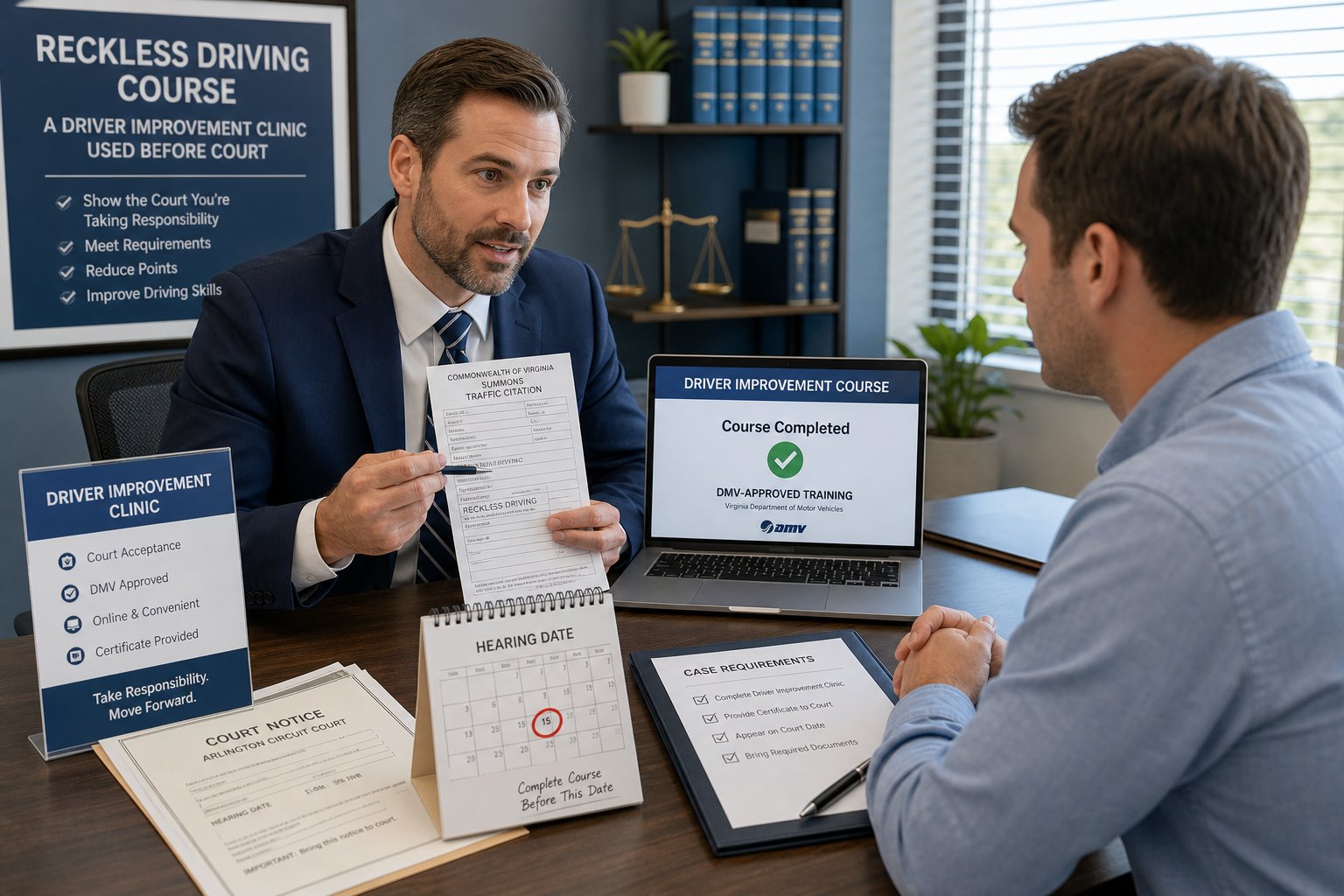
What A Reckless Driving Course Is And When It Is Required
In Virginia, there is not a special statewide course officially called a reckless driving course. The course most people mean is the Virginia DMV-approved Driver Improvement Clinic, often called a DIC. It is the standard Virginia course used when a driver gets a court order, a DMV notice, or wants to complete a class on their own.
That matters because people often search for a reckless driving course when they really need to know whether a Driver Improvement Clinic will help in a reckless driving case. In Virginia, it can sometimes help as a mitigation step. Some Virginia traffic attorneys suggest taking the clinic before the court date in certain reckless driving cases.
The reason is simple. Voluntary completion may show the court that you took the charge seriously and made an effort to improve your driving habits. That can matter more in some courts than others.
But there are limits:
- It does not guarantee a court outcome of reckless driving
- It does not guarantee a reduced charge
- It does not remove the charge from your record
- It does not replace a required court appearance
- It does not override a court order or DMV notice
A clinic may also be required in other ways. For example, the Virginia Department of Motor Vehicles may send a DMV notice that requires completion by a stated completion deadline. A judge may also order the clinic as part of the case. If that happens, you must follow the exact terms in the notice or order.
Requirements can depend on your:
- ticket or citation
- driver record
- license status
- court and judge
- locality
- case facts
If you have a reckless driving charge in Virginia, the key question is not just “Should I take a course?” The better question is whether a DMV-approved provider and timing before court make sense for your exact case.
How These Courses Differ From Defensive Driving And Driver Improvement
In Virginia, the main official course is the Driver Improvement Clinic, not a separate statewide reckless driving class. That is why the terms can get confusing. People may say reckless driving course, defensive driving, or driver improvement, but they do not always mean the same thing.
A general defensive driving course usually focuses on safer habits, hazard awareness, and crash prevention. In many states, that can be a broad traffic school option. Virginia, but, uses the DMV-approved Driver Improvement Clinic as its formal program for eligible drivers.
If you are dealing with driver improvement clinic reckless driving Virginia questions, the main point is this: for Virginia drivers, the clinic is the course that usually matters. It is the recognized option when you need to satisfy a Virginia requirement or complete a class voluntarily for possible mitigation.
A Driver Improvement Clinic may be used in several situations:
- after a court order
- after a Virginia DMV notice
- on a voluntary basis before court
- for safe driving point credit, if eligible
What it does not do is act like a magic fix for a reckless driving charge. A reckless driving case is still handled by the court under Virginia law. The clinic is only one fact the judge may consider.
So if you are comparing terms, remember this simple rule: in Virginia, ask whether the course is a Virginia DMV-approved Driver Improvement Clinic. That is more useful than asking whether it is called defensive driving or a reckless driving course.
Common Course Formats, Lengths, And State Approval Rules
In Virginia, the official Driver Improvement Clinic is generally an 8-hour course. That is the key number most drivers need to know. If a provider offers something shorter and claims it meets Virginia’s DIC rules, you should verify that carefully with the Virginia DMV and your court documents.
Approval matters as much as length. To count in Virginia, the course should come from a DMV-approved provider. If a course is not approved, the court or DMV may not accept it.
You can confirm provider status through the Virginia Department of Motor Vehicles. The Virginia DMV explains driver improvement requirements and approved clinics on its site at dmv.virginia.gov.
The exact requirement can vary. You may need to check:
- the court order
- the DMV notice
- the wording on the ticket or citation
- any stated completion deadline
- whether the court wants proof filed in a certain way
This is especially important in reckless driving cases. Some courts may welcome proof that you completed a clinic before trial. Others may give that fact less weight. And if the court orders a class after the hearing, the order controls.
A practical rule helps here: do not assume any traffic school will count. Virginia uses specific approval rules. Before you enroll, make sure the program is the right Virginia course for your situation.
If you want an online option, reckless driving course offers a Virginia driver improvement course built for flexible scheduling and fast completion, but you should still confirm that it matches your exact Virginia requirement.
Online Vs In-Person Reckless Driving Courses
Virginia may allow online or classroom formats for a Driver Improvement Clinic, but acceptance depends on the exact requirement. That is the first thing to understand. An online course can be convenient, but convenience does not replace the need to match the court order, DMV notice, or local court practice.
For many busy drivers, online is easier. You can work on the course from home, use a phone or computer, and fit the hours around work or family needs. That is why online learning is often the practical choice.
Still, there are cases where you should check before enrolling. For example:
- a judge may expect a certain type of proof
- a court order may contain specific wording
- a DMV notice may set exact terms
- your attorney may prefer one option over another
If you have a reckless driving charge and are thinking of taking the course before court, ask a Virginia traffic attorney whether voluntary completion helps in your court. That is especially useful if your case facts are serious, your speed was very high, your record is poor, or your license status raises extra issues.
The Virginia Judicial System and local courts handle reckless driving cases, and local practice can differ. You can review court information through the Virginia Judicial System.
The best format is the one that satisfies the real requirement. Fast is good. Accepted and documented is better.
What You Will Learn In A Reckless Or Aggressive Driving Class
A Virginia Driver Improvement Clinic teaches safer driving habits and the risks that come with poor choices behind the wheel. In a reckless driving context, that matters because the course shows attention to behavior, judgment, and consequences.
Course topics often include:
- traffic laws and common violations
- crash risk factors
- speed and stopping distance
- space management
- alcohol, drugs, and driver impairment risks
- distracted driving
- attitude and decision-making on the road
Some programs also cover aggressive behavior, stress, and how fast bad choices can grow into dangerous situations. That does not turn the course into legal defense. It simply means the clinic is meant to improve driving knowledge and judgment.
In a Virginia reckless driving case, a judge may see voluntary completion as a sign that you made a positive step. But the educational value is also real. A charge for reckless driving often comes from conduct the court sees as more serious than an ordinary traffic ticket.
Virginia reckless driving law appears in the Code of Virginia, and the state treats reckless driving as more serious than a simple infraction. The Code is available through the Virginia General Assembly.
So while people often search for a reckless driving course, the better way to think about it in Virginia is this: the clinic teaches safer behavior, and that may help show the court you responded responsibly.
How A Reckless Driving Course Can Affect Points, Court Requirements, And Insurance
A voluntary Virginia Driver Improvement Clinic can add 5 safe driving points to your Virginia DMV record if you are eligible. That is one clear benefit. These are safe driving points, not the same thing as removing a reckless driving charge or wiping out demerit points tied to a conviction.
That difference matters a lot. Drivers often assume a course will erase the problem. In Virginia, taking the clinic voluntarily does not:
- remove the charge from your record
- guarantee a lower charge
- guarantee fewer penalties
- cancel a required court appearance
- erase a conviction if one occurs
What it may do is help as a mitigation fact. Some Virginia traffic attorneys suggest it before court because it can show initiative and responsibility. The judge may consider that along with your speed, record, driving history, and the full case facts.
If the court orders a clinic, follow the exact court order and completion deadline. If the Virginia DMV sends a DMV notice, follow that notice. Missing a deadline can create more problems.
Insurance is separate. An insurer may review a charge, conviction, or driving history under its own rules. A course does not guarantee lower rates or prevent an increase.
If you are unsure whether to enroll before court, ask a Virginia traffic attorney first. That step is most useful when the case is active and the possible benefit depends on your exact facts.
How To Choose The Right Course And Complete It Without Delays
The right course is the one that matches your exact Virginia requirement. Start there. Do not choose based only on price, speed, or a generic claim that it is a traffic school.
Use this checklist before you enroll:
- Confirm it is a Virginia DMV-approved provider
- Check whether you need it for a court order, DMV notice, or voluntary use
- Review your ticket or citation for exact wording
- Check your completion deadline
- Ask your attorney if voluntary completion makes sense before court
- Make sure the format meets the requirement
- Keep your certificate of completion
For busy drivers, online learning can save time. If you need a flexible option, Driving Logic’s Virginia Driver Improvement Course is built for mobile access, flexible scheduling, and quick certificate delivery.
Also, do not wait until the last minute. Delays happen when drivers pick the wrong course, miss a filing requirement, or overlook the exact deadline in a court order or DMV notice.
If your goal is to complete the Virginia course with less stress, verify the requirement first, then enroll with an approved provider and save your proof.
This information is general and not legal advice.
Related Articles
- Court-Ordered Driver Improvement Clinic in Virginia: What to Do
- DMV-Ordered Driver Improvement Clinic in Virginia: Points, Notices, and Deadlines
- Virginia Driver Improvement Program: Points, Orders, and Clinics Explained
- How to Submit Your Virginia Driver Improvement Certificate to the Court or DMV
Sources
- Virginia DMV — Driver Improvement Clinics
- Virginia DMV — Demerit Points and Safe Driving Points
- Virginia Judicial System
- Code of Virginia — Motor Vehicles
- Code of Virginia § 46.2-862 — Reckless driving by speed
Billy Forte is the owner of Driving Logic, a state-approved online driver education provider serving Virginia and other U.S. states. Driving Logic offers DMV-approved online driver improvement courses for drivers handling court orders, DMV notices, demerit points, and voluntary safe-driving point credit.
This article is general information, not legal advice. Virginia DMV rules, court orders, deadlines, insurance decisions, and case facts can differ. Use official Virginia DMV and court sources for current requirements, and consult a qualified Virginia attorney for legal guidance specific to your situation.