
Updated June 2026 · Reviewed by Billy Forte
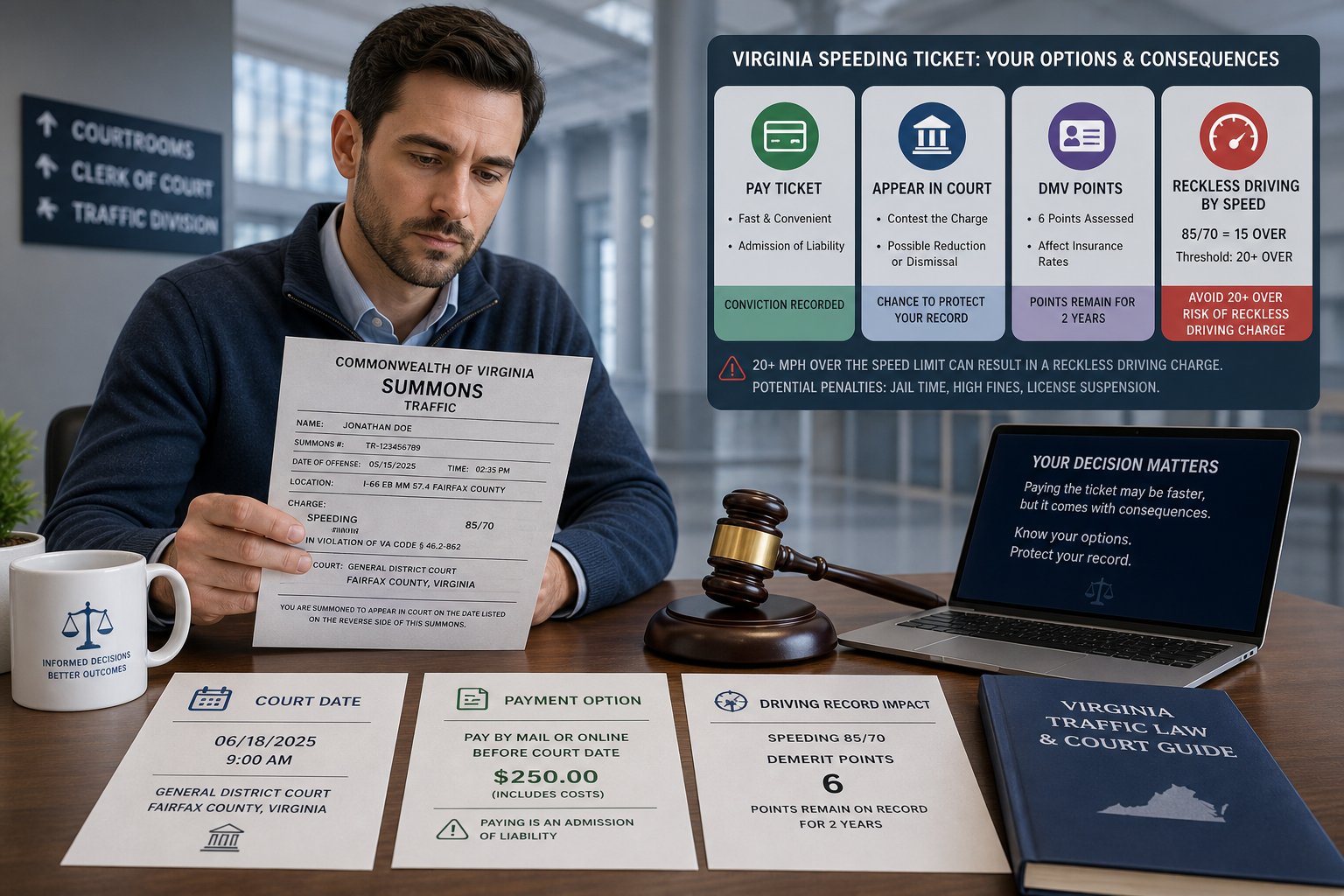
Before you pay a Virginia speeding ticket, understand that prepayment usually means admitting guilt to the charge listed on the ticket. This article is for drivers deciding whether to prepay, appear in court, or ask for guidance before taking action. You will learn what payment means, what court may involve, and when a driver improvement course may be relevant.
This article covers Virginia requirements only.
Key Facts
- Prepayment: Paying a prepayable ticket usually admits guilt to that charge.
- Court option: Going to court may let you ask questions or respond to the charge.
- Points: A conviction can add Virginia DMV demerit points.
- Risk factors: CDL status, high speed, and insurance concerns matter.
- DIC role: A clinic may be relevant, but it does not guarantee a court result.
If your court, DMV notice, or personal record goal allows a course option, review the Virginia driver improvement course before your deadline.
How Virginia Speeding Tickets Work Before Your Court Date
A Virginia speeding ticket usually starts with a Uniform Summons. That paper shows the charge, the court, and the date you must respond.
Some speeding tickets are prepayable. That means you may pay before the court date instead of appearing. But prepayment is not just a convenience. In Virginia, it is the same as a guilty plea for that charge through the court process. The Virginia Judicial System and local General District Court sites make this point clear in their payment instructions.
That one fact answers a lot of the virginia speeding ticket pay or court question. If you prepay, you give up the chance to explain the facts in person, ask for a lower speed, or request some other result the judge may allow.
You also need to know that not every speed is just a simple traffic infraction. Under the Code of Virginia reckless driving law, driving 20 mph or more over the limit or over 85 mph can be charged as reckless driving by speed. That is much more serious than a routine ticket.
Before your date, check:
- whether the ticket is prepayable
- the exact court date and court name
- the charge on the summons
- whether your speed is close to the reckless driving threshold
- your current DMV points and recent record
These details shape whether paying is low risk or whether court is worth your time.
When Paying The Ticket Usually Makes Sense
Paying usually makes more sense when the case is low risk and you are willing to accept the result. That often means a lower speed, a fairly clean record, and no major concern about work or insurance.
For example, if the charge is for a small amount over the limit and it is clearly prepayable, some drivers decide that the time spent going to court is not worth it. The Virginia DMV assigns point values to convictions, and lower-level speeding offenses can mean fewer demerit points than more serious speeds.
Paying may be the practical choice when:
- your speed is on the low end
- you do not hold a CDL
- you do not have recent tickets
- you do not need to ask for a reduction
- you understand that fines, court costs, and insurance effects can still follow
But be careful. Prepaying means you are not contesting the officer’s speed reading, the posted limit, or the charge. You are also not asking the court to consider good facts, like a long clean record.
So, should i fight virginia speeding ticket cases that seem minor? Not always. If the charge is routine, the ticket is prepayable, and the likely impact is limited, paying can be a reasonable option. Just make that choice with clear eyes, because once you prepay, you usually lose the chance to seek a better outcome in court.
When Going To Court Is The Smarter Move
Going to court is often the smarter move when the ticket could hurt you beyond one fine. That includes higher speeds, record concerns, job concerns, or cases where a reduction would matter a lot.
If you appear in General District Court, you keep the chance to respond to the charge. In some cases, you may ask the judge to consider your driving record, the facts of the stop, or steps you took after the ticket. Some drivers also hire a Virginia traffic lawyer, especially when the speed is high or the case may affect a license, clearance, or work status.
Court may be worth considering when:
- your speed is close to reckless driving
- you already have DMV points
- your insurance costs are a big concern
- you drive for work
- you hold a commercial driver’s license
- this is your first offense and you want the court to hear that
You are not promised a better result by showing up. Courts differ by locality, and outcomes depend on the judge, the officer, your record, and the case facts. Still, if the downside of a conviction is large, keeping your chance to be heard can matter a lot more than the time saved by prepaying.
Reckless Driving, DMV Points, And Other High-Risk Situations
If your speed hits Virginia’s reckless driving threshold, court is usually the key issue, not convenience. Under Virginia law, 20+ mph over the limit or over 85 mph can be charged as reckless driving by speed, a Class 1 misdemeanor. That can carry up to 12 months in jail, up to a $2,500 fine, a license suspension, and 6 DMV points, according to the Code of Virginia.
That is why high-speed cases are different. A reckless conviction can create criminal-record issues, not just traffic-record issues.
Other high-risk cases include:
- a CDL holder trying to protect work options
- a driver with prior tickets or existing demerit points
- a case where a reduction could avoid major insurance damage
- a court notice that requires a personal appearance
If you are in one of these groups, do not treat the ticket like a basic mail-in fine. Check the summons and the court rules closely.
How To Pay A Virginia Speeding Ticket: Online, Phone, Mail, Or In Person
If your ticket is prepayable, Virginia courts often allow several payment methods. The exact options can vary by court, so always verify with your local General District Court.
Many drivers pay online through the Supreme Court of Virginia payment system. Some courts also allow phone payment. Others accept mail or in-person payment at the clerk’s or accounting office.
Common payment options include:
- Online: through the statewide court payment portal for eligible cases
- Phone: available in some courts
- Mail: usually by check or money order, often with a copy of the summons
- In person: at the court office during business hours
Do not assume every court uses the same rules. Some local courts post their own steps and deadlines, such as Fairfax General District Court and other court pages within the Virginia Judicial System directory.
Also, never treat payment as a neutral act. If you pay a Virginia speeding ticket, you are usually accepting guilt on that charge. Before you choose a payment method, first confirm that paying is the result you actually want.
Deadlines, Prepayment Rules, And What Happens If You Miss A Payment Or Court Date
Deadlines matter a lot in Virginia traffic cases. A prepayable ticket still has a deadline, and missing it can create more trouble than the original ticket.
Many Virginia courts require prepayment no later than the business day before court. Some courts give a specific hour. Because local practice differs, check the summons and your court’s official page, not a third-party site.
If you miss payment or do not appear when required, the judge may proceed in your absence. That can mean a conviction without your side being heard, plus fines, court costs, and in some courts an added fee for being tried in absence. Local court pages such as Henrico General District Court and Fairfax explain that these rules can apply.
After court, you may get a window to pay what you owe. That period varies by court. If you still do not pay, the case can lead to collection action and possible effects on your driving privileges through the Virginia DMV.
Check all of these items right away:
- the court date on the summons
- whether the offense is prepayable
- the last day and time to prepay
- any warning about required appearance
- any later payment deadline after court
If the court or DMV sends a notice, read it and respond by the stated deadline.
What To Expect In Virginia Courts And Whether A Driving Course Can Help
In Virginia, traffic cases are usually heard in General District Court. On your court date, cases are called, and you may enter a plea or present facts for the judge to consider.
What happens next depends on the charge, the court, and your record. Judges may look at the speed alleged, your prior driving history, work needs, and whether you took steps to show responsibility before court. One step that may matter in some cases is completing a Virginia DMV-approved Driver Improvement Clinic, also called a DIC.
A Virginia DIC is an 8-hour course approved by the Virginia DMV. In some situations, completing the course before court may help as mitigation. In other cases, a judge may order it, or the DMV notice may make it relevant. But the effect is not automatic. It can depend on the DMV notice, court order, ticket, driver record, license status, court, judge, locality, and case facts.
The course does not guarantee a court result, a reduction, or point removal from your history. Still, it can be one factor the court considers.
If you need a Virginia DMV-approved option that fits a busy schedule, you can review the online Virginia Driver Improvement Course from Virginia driver improvement course. Because the course is online, many drivers can complete it on their own time and have proof ready before court if that is useful in their case.
This information is general only and is not legal advice.
Where A Virginia Driver Improvement Course May Fit
A Virginia driver improvement course can matter after a speeding ticket, but it has a limited role. Virginia DMV-approved clinics are 8-hour courses. When you complete a clinic voluntarily and meet DMV rules, you may receive 5 safe driving points once every 24 months.
That does not erase the ticket. It does not remove the conviction from your driving record. It also does not guarantee a court result, an insurance discount, or a change in how a judge handles your case.
The course is most useful when your goal is to improve your DMV point balance, satisfy a DMV requirement, or comply with a court order that specifically allows or requires driver improvement. If you are using the course for a court case, follow the court’s instructions first. If you are using it for DMV safe points, confirm that the provider is approved and that your timing fits DMV rules.
You can review the Virginia driver improvement course if your ticket, court order, DMV notice, or personal record goal makes a course appropriate.
FAQ
Can a Virginia driver improvement course help after a speeding ticket?
It may help with DMV safe driving points when eligible, or satisfy a court or DMV requirement. It does not erase the ticket or guarantee a court result.
Should I check my court paperwork first?
Yes. Your citation, court notice, DMV notice, and deadline control what you need to do next.
Does the course remove a conviction?
No. A Virginia driver improvement clinic does not remove a conviction from your DMV record.
Related Articles
- Virginia Speeding Ticket: Costs, Points, and What Happens Next
- When Does a Speeding Ticket Become Reckless Driving in Virginia?
- Virginia Speeding Ticket Fines: What Affects the Cost?
- Virginia Speeding Ticket for CDL Holders: Higher Stakes and Federal Rules
Sources
- Virginia DMV — Driver Improvement Clinics
- Virginia DMV — Demerit Points
- Virginia Courts — Pay Traffic Tickets and Other Offenses
Billy Forte is the owner of Driving Logic, a state-approved driver improvement course provider serving Virginia and other U.S. states. Driving Logic offers DMV-approved online driver improvement courses for drivers handling DMV notices, court orders, and state requirements.
This article is general information, not legal advice. Virginia DMV rules, court orders, deadlines, insurance decisions, CDL rules, and case facts can differ. Use official Virginia DMV and court sources for current requirements, and consult a qualified Virginia attorney for legal guidance specific to your situation.