
Updated June 2026 · Reviewed by Billy Forte
The Texas DPS vision test is a quick screening of your visual acuity given at your driver-license appointment, generally requiring at least 20/40 vision with or without corrective lenses. You read an eye chart, and if you wear glasses or contacts you can use them — a restriction simply gets noted on your license. If your vision does not meet the standard, DPS may require a report from an eye specialist rather than denying you outright, so the screening is a checkpoint, not a pass-or-fail trap.
Applies to first-time Texas driver licensing. Requirements are set by the Texas DPS (and TDLR for driver education) and can change.
Key Facts
- Quick acuity screening: A short eye-chart check at your DPS appointment.
- General standard: Typically at least 20/40 visual acuity, with or without corrective lenses.
- Glasses and contacts allowed: You may wear them; a corrective-lens restriction is noted on the license.
- If you don’t meet it: DPS may request an eye specialist’s report rather than refusing a license.
- Part of every visit: The vision test applies even when the written test is waived by ADE.
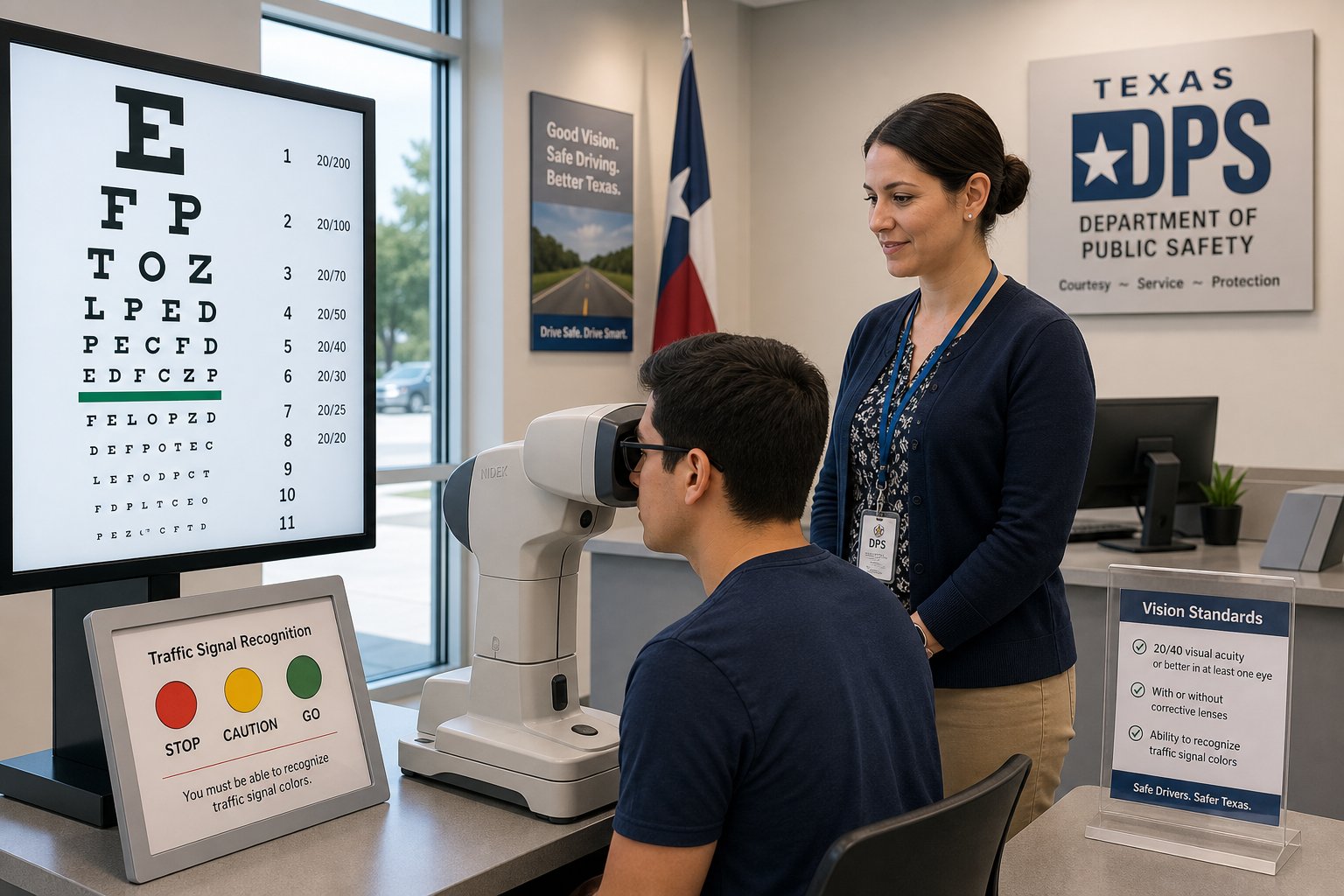
What The Texas DPS Vision Test Checks
The texas dps vision test is not a long medical exam. It is a quick screening done as part of the license process at Texas DPS.
And yes, all license applicants must pass a vision screening when DPS requires in-person testing. That matters for first licenses and for some renewals done at the office.
Texas DPS mainly checks three things:
- Visual acuity, or how clearly you see letters or symbols
- Whether corrective lenses help you reach a safe level
- Color recognition for original applicants
Visual acuity is the main part. DPS may check each eye by itself and then both eyes together. The goal is simple: can you see well enough to drive safely?
If your sight is not strong enough without correction, DPS may let you test with glasses or contacts. If you pass only with them, your license will usually show a corrective lenses required restriction.
For first-time applicants, DPS may also check basic color vision. This is not about naming every shade. It is about seeing traffic signal colors well enough to drive.
In some cases, DPS may also note concerns about your side vision or general eye condition if it affects safe driving. If staff see a problem, they can ask for more review from an eye specialist.
If you are 18 to 24 and getting your first Texas license, remember the vision screening is only one step. You may also need Adult Driver Education, your ADE-1317 certificate, and the free Impact Texas Adult Drivers (ITAD) course from TxDPS. Those are separate items, and ADE can waive the DPS written test.
Texas Vision Requirements For A Driver License
Texas uses specific standards for licensing. These rules decide whether you pass with no restriction, pass with restrictions, or need more review.
For two-eyed vision, the general standards are:
- 20/40 or better in each eye and both eyes together without lenses: no vision restriction
- Worse than 20/40 uncorrected: you may be referred for more review
- 20/50 or better with corrective lenses in the best eye or both eyes: license may be issued with a corrective lenses restriction
- 20/60 to 20/70 with corrective lenses in the best eye or both eyes: license may be limited to corrective lenses, daytime only, and 45 mph maximum
- Worse than 20/70 in the best eye with no better correction possible: you may fail
Texas also has rules for one-eyed vision. If your best eye is 20/25 or better, you may qualify without restriction. If not, DPS may use more review and compare your case to the two-eye standard.
A very important line is this: if your vision is worse than 20/200 even with correction, Texas treats that as blind for licensing purposes.
These rules explain why one person leaves with no note on the license, while another leaves with a restriction. Restrictions are not punishments. They are safety limits based on what you can see.
Because state policies can change, check current licensing details with Texas DPS before your appointment.
What The Eye Chart Looks Like And How The Test Is Given
Most people picture a wall chart with rows of letters. That is close to what Texas DPS uses.
The test is usually a simple chart-based acuity screening, much like a Snellen eye chart used in clinics. You stand or sit at a set distance and read the smallest line you can see.
DPS may test:
- Your right eye
- Your left eye
- Both eyes together
If you wear glasses or contacts for driving, use them during the test unless DPS tells you otherwise. The point is to measure the vision you actually use on the road.
For original applicants, staff may also check color recognition. This is usually basic. They want to know if you can recognize signal colors and similar traffic cues.
The test itself is short. There is no need to study like you would for a road signs quiz. But you do want to show up with the correction you normally wear and with eyes that are rested, not strained from a late night.
If you are also applying for your first adult license, remember the vision test is separate from classroom or online course work. In Texas, Adult Driver Education is for a first license, while a Driver Safety Course is for ticket dismissal. They are not the same thing.
And if you complete a state-approved ADE course, you can get the ADE-1317 certificate, which can serve as a written test waiver for eligible adults.
How To Prepare Before Your DPS Appointment
A little prep can make the Texas DPS visit much easier.
First, if you already wear glasses or contacts, make sure your prescription is still working well. If your vision has gotten worse, or if your lenses are old, get an eye exam before your DPS appointment.
Here are the best ways to prepare:
- Bring your usual glasses or contacts
- Wear the same correction you use for driving
- Rest your eyes before the appointment
- Cut back on heavy screen time right before you go
- Bring required license documents so your trip is not wasted
If you are getting a first Texas license and you are 18 to 24, also check your education steps. You may need:
- A state-approved Adult Driver Education course
- Your ADE-1317 certificate
- The free ITAD certificate from Impact Texas Adult Drivers
That part matters because ADE is not ITAD. ADE is the driver education course. ITAD is a separate one-hour state video course. For many adults, finishing ADE also means a written test waiver, which can save time at DPS.
You can also review program rules with the Texas Department of Licensing and Regulation, which oversees approved driver education providers.
If your first license is the goal, and you want an online option, Driving Logic offers a Texas ADE course that fits a busy schedule.
Glasses, Contacts, And Vision Restrictions To Know
If you need help seeing, Texas DPS lets you take the test with glasses or contacts. That is normal.
But there is a catch: if you only meet the standard with correction, your driver’s license will likely say corrective lenses required. That means you must wear them when you drive.
Some drivers also get extra restrictions. If your corrected vision falls in the 20/60 to 20/70 range in the best eye or with both eyes, DPS may add limits such as:
- Daytime driving only
- 45 mph maximum
- Other restrictions the agency believes are needed
These limits are based on safety. Lower visual acuity can make night driving, speed judgment, and hazard detection harder.
Contacts and glasses are both accepted. The main issue is not which one you use. The issue is whether your corrected vision meets the state standard.
If you switch from glasses to contacts, or from contacts to glasses, that does not usually create a problem by itself. Still, your correction should be current and comfortable. A poor prescription can lead to a failed screening even when your eyes could have passed with the right lenses.
If you know your vision is close to the limit, get checked before your appointment. That one step may help you avoid a referral and a second trip.
What Happens If You Fail The Texas DPS Vision Test
Failing the screening does not always mean the end of the process. Often, it means Texas DPS needs more proof about your eyesight.
One common result is a referral to an eye specialist. DPS may give you Form DL-63, Explanation for Eye Specialist, and ask a licensed eye doctor to complete it.
That can happen if:
- Your vision is below the standard at DPS
- Staff think lenses might improve your result
- There is a concern about an eye condition or safe driving ability
After the eye exam, DPS may let you return for a retest. If new glasses or contacts improve your vision enough, you may still get licensed, often with restrictions.
In harder cases, DPS may limit your driving. That can include corrective lenses, daylight only, or speed limits.
If your best eye remains worse than 20/70 and no further improvement is possible, DPS may deny the license.
So the key point is this: a failed office screening often leads to the next step, not the final answer. The next step is usually medical review.
If you are still working through first-license steps, it helps to reduce other DPS tasks where you can. A state-approved course from Driving Logic can help eligible adults earn the ADE-1317 and use the written test waiver benefit before the driving test.
Special Cases For Renewals, Seniors, And Changing Vision
Vision issues do not only matter for first-time applicants. They can also affect renewals and later license updates.
If you renew in person, Texas DPS may require another vision screening. That is especially important if your sight has changed since your last license.
For older drivers, age alone does not decide the result. What matters is whether you still meet the vision standard. But vision changes become more common with age, so DPS may look more closely at:
- Need for corrective lenses
- Whether daytime-only driving is safer
- Specialist reports about eye disease or reduced vision
- Whether a new driving test is needed
If you have had cataracts, glaucoma, macular problems, diabetes-related eye changes, or another condition that affects sight, do not guess about your status. Get an updated exam before renewal.
And if your vision changed a lot between renewals, be ready for new restrictions or a request for medical paperwork.
For adults getting a first license, keep the Texas process straight. Adults 18 and older do not need a learner’s permit first. If you are 18 to 24, you usually need ADE and ITAD, and they are different courses. ADE is the education course for a first license, and ITAD is the free state video requirement from TxDPS.
If you want a flexible online option, you can take the Texas Adult Driver Education course through Driving Logic. It works well for busy adults and can help you qualify for the written test waiver with your ADE-1317 certificate.
Always verify current DPS rules, forms, and fees at TxDPS, since the state can update them.
FAQ
What does the Texas DPS vision test check?
Your visual acuity, screened with an eye chart at your appointment. It confirms you can see well enough to drive safely, generally to a 20/40 standard.
What is the Texas vision requirement?
Generally at least 20/40 visual acuity, with or without corrective lenses. Confirm current standards with DPS, as specific cases can differ.
Can I wear glasses or contacts for the test?
Yes. You may wear corrective lenses; if you need them to meet the standard, your license carries a corrective-lens restriction.
What happens if I don’t pass the vision test?
DPS may ask for a report from an eye doctor or specialist. Meeting the standard with treatment or corrective lenses can still allow licensing, sometimes with restrictions.
Conclusion
The vision test is the simplest checkpoint in the process — a brief acuity check you can pass with glasses or contacts if you need them. The key things to know are the general 20/40 standard and that falling short usually means a specialist’s report, not an automatic denial. Bring the corrective lenses you normally drive with, and the screening is over in moments.
The vision test stays in person, but adults 18–24 can simplify the rest by taking the Texas adult driver education course online, which waives the written test.
Related Articles
- Texas Driving Test: What to Expect and How to Prepare
- Texas DPS Written Knowledge Test: What It Covers and How ADE May Help
- Texas Driving Test: What Maneuvers and Skills Are Tested
- What Happens After You Pass the Texas Driving Test? Getting Your License
Sources
Billy Forte is the owner of Driving Logic, a TDLR-approved Texas adult driver education and driver safety course provider. Driving Logic offers the online Texas Adult Driver Education (ADE) course that helps adults qualify for a first Texas driver license and waive the DPS written knowledge test.
This article is general information about Texas adult driver licensing, not legal advice. Requirements, fees, and procedures are set by TDLR and the Texas DPS and can change, so confirm current details with official Texas sources before you enroll or visit a DPS office.