
Updated June 2026 · Reviewed by Billy Forte
Texas PTDE takes as long as the licensing milestones require, and the binding factor is not the classroom but the 6-month learner’s permit holding period. The 32 classroom hours can be completed online in a few weeks at a teen’s own pace, but the permit must be held at least six months before a provisional license, so most families’ timelines run at least that long. Behind-the-wheel practice happens across that period, which is one more reason the concurrent method is popular.
Applies to Texas teen driver education and licensing (ages 14–17). Requirements are set by TDLR (driver education) and the Texas DPS (licensing) and can change.
Key Facts
- Classroom is quick: The 32 hours can be done online in a few weeks, depending on pace.
- 6-month permit hold sets the floor: The learner’s permit must be held at least six months before a provisional license.
- Age gates: Coursework can start at 14, permit at 15, provisional license at 16.
- Practice spans the period: Supervised behind-the-wheel hours are logged across the permit-holding window.
- Concurrent helps: Starting driving right after the permit uses the 6-month period efficiently.
What PTDE Is And Who Can Use It In Texas
Parent Taught Drivers Ed, often called PTDE, is a Texas teen driver education option that lets a parent or another qualified adult teach the course at home instead of using a driving school. It is for teens under 18. It is not the same as Adult Driver Education, which is a separate course for adults 18 and older.
In Texas, the program is overseen by the Texas Department of Licensing and Regulation, also called TDLR. TDLR approves the course providers and the PTDE process. The actual permit and license come from TxDPS, not TDLR.
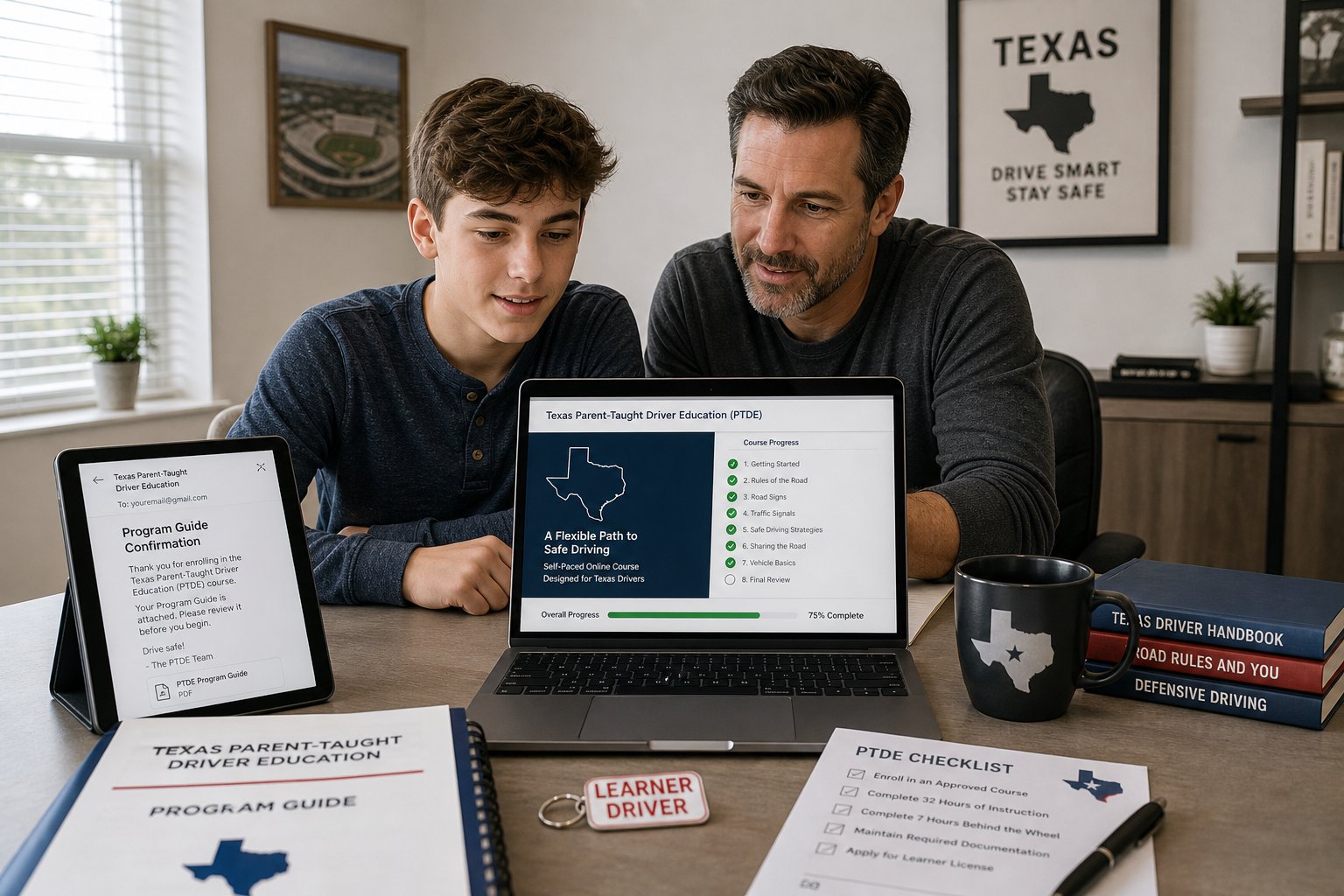
A teen can usually start coursework at age 14. But the teen must be at least 15 to apply for a learner license. To use PTDE, you must first buy the PTDE Program Guide from TDLR. That packet costs $20. As of January 2026, TDLR sends it by email only. There is no physical packet mailed to your home.
PTDE works well for busy families because the class work is online and flexible. With a provider like Driving Logic, your teen can log in from almost any device and work in short sessions. That makes it easier to move through the classroom part without waiting for a scheduled class.
Still, PTDE is not a shortcut around Texas rules. Your teen must finish the required course steps, practice driving hours, paperwork, and the permit holding period before getting a provisional license.
The Minimum Time Required By Texas Law
If you are asking how long does PTDE take Texas families at minimum, the shortest real answer is about 6 months after the learner license is issued. That is because Texas requires a teen to hold the learner license for at least 6 months before applying for a provisional license. The teen also must be at least 16 years old.
The course itself has two big parts:
- 32 hours classroom instruction
- Behind-the-wheel practice and observation completed over time
The classroom part can move pretty fast. Many families finish it in a few weeks because it is online and broken into modules. But the full Texas PTDE timeline is not based on classroom time alone.
A few rules shape the minimum timeline:
- Your teen can begin class at 14
- Your teen must be 15 to get the learner license
- Your teen must hold that permit for 6 months
- Your teen must be 16 to get the provisional license
That means even a very motivated family cannot finish everything in just a month or two. The legal clock matters more than the online class speed.
There is also a key document step. After the first part of the course, the teen gets the DE-964E, which is the partial completion certificate used for the permit. Later, after the full course is done, the teen gets the DE-964, which is the full completion certificate needed for the provisional license process.
So the shortest path is possible, but only if you start on time, move steadily, and avoid delays.
A Step-By-Step PTDE Timeline From Signup To License
Here is the most common PTDE timeline from start to finish.
First, buy the PTDE Program Guide from TDLR. This must happen before starting PTDE. Again, the guide costs $20 and is sent by email only. You will use the guide for forms, rules, and setup.
Next, confirm the parent instructor is eligible. Then enroll in a TDLR-approved course such as the Texas teen course from Driving Logic.
After signup, your teen starts the classroom lessons. The first big milestone is finishing the early part of the course that leads to the DE-964E. That certificate is used when applying for the learner license with TxDPS.
Once the learner license is issued, the 6-month clock starts. This is why many families choose the concurrent method. It lets the teen begin driving practice sooner while still finishing classroom lessons.
From there, your teen keeps working through:
- The rest of the 32 classroom hours
- Required behind-the-wheel lessons
- Supervised practice over several months
- Night driving practice
- Driving logs and forms
Near the end, your teen must complete Impact Texas Teen Drivers, also called ITTD. This is a free, 2-hour TxDPS course. It is separate from PTDE. It does not replace any PTDE classroom hours.
After all course work is done, the driving log is complete, and the teen has the DE-964, you can schedule the road test with TxDPS or an approved third-party tester if allowed. For most families, the total time from start to license is 6 to 12 months.
What Can Delay Your PTDE Completion
Most delays come from a few common issues. The biggest one is starting late. If your teen is close to 15 or 16, every week matters.
Another delay is waiting too long to buy the PTDE Program Guide. Since TDLR requires that packet before starting, the course should not begin first. Families also lose time when they pause the online lessons for weeks at a time.
Here are the most common slowdowns:
- Not ordering the TDLR packet first
- Slow progress through the 32 classroom hours
- Irregular behind-the-wheel practice
- Trouble finishing night driving hours
- Limited Texas DPS appointment slots
- Waiting too long to take ITTD
- Missing forms or incomplete logs
The permit holding rule is another factor. Even if your teen finishes class quickly, the learner license must still be held for 6 months. That is why a fast course alone does not guarantee a fast license.
ITTD can also trip families up. The course is free and only two hours, but it is a separate TxDPS step. If the certificate is not done at the right time, it can create another delay before the road test.
A simple weekly driving routine helps a lot. Two or three short practice drives each week are often better than long gaps followed by a rushed weekend. Small steps keep the timeline moving.
Parent Instructor Requirements And Responsibilities
PTDE only works if the parent instructor qualifies under Texas rules. The instructor is often a parent, but it can also be another approved adult if the rules are met. The exact standards come from TDLR and the PTDE Program Guide.
In general, the instructor should have:
- A valid Texas driver license
- Several years of driving experience
- A record that meets PTDE eligibility rules
- The ability to supervise and teach safely
The parent instructor has real duties. This is not just giving the teen the car keys.
You are responsible for:
- Making sure the teen follows the course order
- Supervising behind-the-wheel lessons
- Tracking practice time correctly
- Keeping the driving log up to date
- Using the right forms from the PTDE guide
- Helping prepare permit and license paperwork
You also need to understand the certificate names. The DE-964E is for partial completion after the first course stage and is used for the learner license. The DE-964 is the full completion certificate used later for licensing.
If you are the instructor, it helps to set a routine. Pick fixed days for class work and fixed days for driving. That makes PTDE much easier to manage.
And one more important point: PTDE is a teen program. If the student is 18 or older, the correct course is Adult Driver Education, not PTDE.
Block Vs Concurrent Method: Which Timeline Works Best
Texas PTDE usually gives families two pacing options: block and concurrent. The difference matters if your main goal is finishing as soon as the law allows.
With the block method, your teen completes the classroom work first before moving into in-car training. Some families like this because it keeps school-style learning separate from driving practice. But it often slows the overall timeline.
With the concurrent method, your teen starts driving practice after the early classroom stage needed for the permit. That means the permit holding period, classroom work, and driving hours can overlap.
Here is the simple version:
- Block method: easier to organize, but often slower
- Concurrent method: more flexible, and usually faster
For busy families, concurrent is often the better fit. It lets your teen begin supervised driving sooner, and it gives you more time to spread practice across the 6-month permit period.
That matters because driving hours are easier to finish when you start early. You can fit practice into normal life:
- School pickups
- Weekend errands
- Evening drives
- Light rain or night practice when safe
If your teen wants the shortest realistic path to a provisional license, concurrent usually works best. It does not remove the legal 6-month wait, but it helps you use that time well instead of wasting the first part of it on class alone.
What To Do After You Get Your PTDE Packet And Handbook
Once you get your PTDE Program Guide from TDLR, read it before doing anything else. Make sure the parent instructor qualifies. Then choose a TDLR-approved online course and enroll with the correct information.
Next, help your teen start the first lesson right away. The goal is to reach the early course milestone that produces the DE-964E. That document is needed for the learner license step with TxDPS.
After that, keep the process simple and steady:
- Set a weekly lesson schedule
- Start a folder for forms and logs
- Track all driving time carefully
- Plan regular day and night practice
- Watch the permit issue date closely
- Save the DE-964E and later the DE-964
- Complete ITTD near the road test window
This is also the best time to choose a course platform that fits a busy schedule. Driving Logic is built for flexible online use, which helps families move through lessons in short sessions instead of losing time waiting for a classroom. If you are ready to begin, you can start with the Texas PTDE/TDE course from Driving Logic.
The main idea is simple: do not rush, but do not drift. If you start with the right packet, keep good records, and practice every week, your teen can stay on a steady path from permit to provisional license.
FAQ
How long does parent taught drivers ed take in Texas?
The 32 classroom hours can be finished in a few weeks, but the learner’s permit must be held at least 6 months before a provisional license, so the practical minimum is around six months.
Can my teen finish faster by studying quickly?
Studying quickly shortens the classroom phase, but it cannot shorten the 6-month permit holding period, which is the main timeline driver.
When can the timeline start?
Coursework can begin at 14. The learner’s permit is available at 15, and the provisional license at 16 after the 6-month hold.
Does concurrent or block change the total time?
Both must respect the 6-month permit period. Concurrent often feels faster because driving practice overlaps the classroom rather than following it.
Conclusion
The honest timeline answer is that the studying is fast but the calendar is not: the six-month permit period sets the minimum, regardless of how quickly your teen finishes the classroom hours. Plan around that window, start the supervised driving as soon as the permit is issued, and use the time to build real experience. Treated that way, the waiting period becomes practice time rather than dead time.
Get the classroom hours done early through a TDLR-approved Texas parent-taught drivers ed course online so the permit clock can start sooner.
Related Articles
- Texas Parent Taught Drivers Ed (PTDE): The Complete Guide
- Texas PTDE: Concurrent vs Block Method — Which Should Your Family Choose?
- How Texas Parent Taught Drivers Ed Works Online: Step-by-Step
- Texas Parent Taught Drivers Ed Cost: What to Expect
Sources
Billy Forte is the owner of Driving Logic, a TDLR-approved Texas driver education provider. Driving Logic offers the online Texas parent-taught and teen driver education course that helps Texas teens complete the 32-hour classroom requirement and work toward a learner’s permit and provisional license.
This article is general information about Texas teen driver education and licensing, not legal advice. Requirements, fees, and procedures are set by TDLR and the Texas DPS and can change, so confirm current details with official Texas sources before you enroll or visit a DPS office.