
Updated June 2026 · Reviewed by Billy Forte
When a Texas teen starts driving, parents should understand a few basics before talking to an insurer: a teen with a learner’s permit is typically covered under a parent’s policy, and once the teen is licensed, insurers generally expect them to be added to a policy. Texas requires drivers to carry at least the state minimum liability coverage, and adding a teen usually raises the premium because new drivers are higher-risk. This guide focuses on the questions parents should ask insurers rather than promising any specific rate, since costs and discounts vary by company and situation.
Applies to Texas teen driver education and licensing (ages 14–17). Requirements are set by TDLR (driver education) and the Texas DPS (licensing) and can change.
Key Facts
- Permit stage: A teen on a learner’s permit is typically covered under a parent’s existing policy.
- When licensed: Insurers generally expect a licensed teen to be added to a policy.
- State minimums: Texas requires at least the state minimum liability coverage; confirm current amounts.
- Costs rise: Adding a new teen driver usually increases the premium.
- Ask, don’t assume: Discounts and options vary by insurer — ask about good-student and driver-ed considerations.
- Confirm details: Verify coverage rules with a licensed agent or the Texas Department of Insurance.
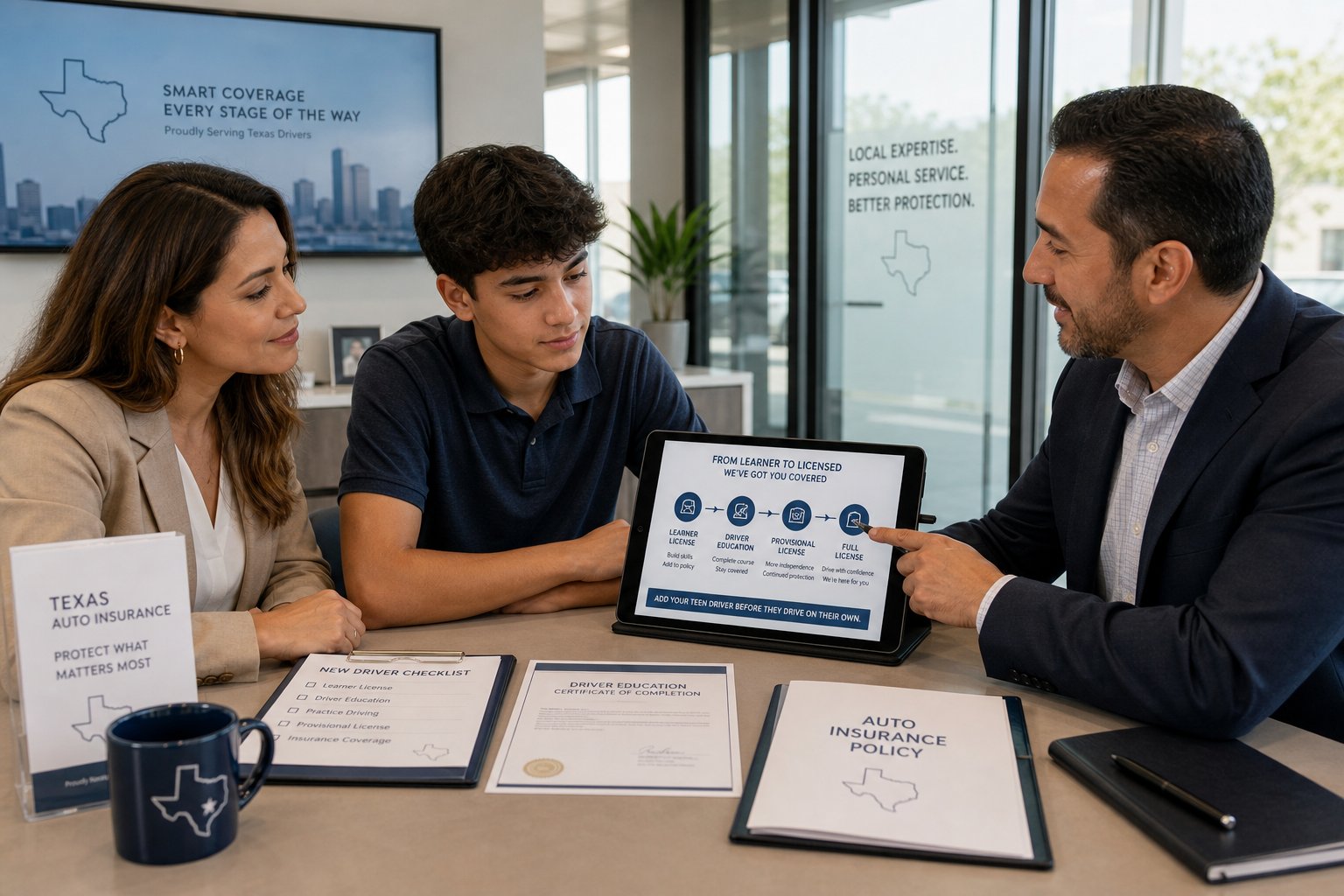
When A Teen Driver Must Be Added To Insurance In Texas
For texas teen driver insurance, timing matters. And the right time to call your insurer is before your teen starts driving your car.
In many cases, a teen with a learner license is covered under the parent’s auto policy while practicing. Insurers often treat that teen as a student or unlicensed household driver. But “often” is not the same as “always.” Coverage rules vary, so you should confirm this with your insurance company.
Ask these questions:
- Is my teen covered with a learner permit?
- Do you need to list my teen now as a household driver?
- When do you require formal policy changes?
- Does coverage change once my teen gets a provisional license?
- Do you need proof of driver education?
Texas uses the graduated driver license (GDL) system. That means a teen under 18 moves from a learner license to a provisional license before a full, unrestricted license. Once your teen becomes licensed, most insurers want that teen formally added to the policy unless a separate policy is set up.
That is also when rates usually rise. A newly licensed teen has little or no driving record, and insurers price that risk into the policy.
If your teen is in PTDE or another approved teen course, keep your paperwork organized. The Texas Department of Licensing and Regulation (TDLR) approves driver education providers, while Texas DPS (TxDPS) handles licensing. For teens under 18, PTDE and TDE are teen driver education paths. ADE is for adults 18 and older, so it is not the same thing.
A few Texas course facts matter here. The PTDE Program Guide comes from TDLR, costs $20, and as of January 2026 it is delivered by email only. Also, the DE-964E is the partial completion certificate used for the learner permit stage, while the DE-964 is the full completion certificate used when applying for the provisional license.
And don’t mix up ITTD with the main course. Impact Texas Teen Drivers (ITTD) is a free, two-hour course from TxDPS, separate from PTDE or TDE. You can verify current requirements at TDLR, TxDPS, and Impact Texas Teen Drivers.
Texas Minimum Coverage Rules And What They Mean For Teen Drivers
Texas requires drivers to carry minimum liability coverage of 30/60/25. That means:
- $30,000 for injuries to one person
- $60,000 for injuries per accident
- $25,000 for property damage
This is the legal minimum. It is not full protection.
These limits pay for other people’s injuries or damage when your teen causes a crash. They do not pay for your teen’s injuries. They also do not fix your own car unless you carry collision coverage.
That matters because teen drivers are more likely to crash than older drivers. One bad wreck can go past the state minimum fast. Medical bills and repair costs add up in a hurry.
So ask your insurer:
- Are my current liability limits high enough for a teen driver?
- What would higher limits cost?
- Should I add uninsured or underinsured motorist coverage?
- What deductible makes sense for my budget?
Some families choose higher liability limits for peace of mind. That does not mean everyone needs the same setup. But it is smart to compare the cost of stronger coverage before your teen starts driving alone.
Texas teen driving rules also affect risk. Under the GDL system, teens with a provisional license must follow restrictions, including limits on midnight driving and a passenger limit, unless an exception applies. If a teen breaks those rules and has a crash, that can create bigger problems with claims, tickets, and future premiums.
Insurance companies do not all price risk the same way. Premiums, coverage options, and discount rules vary. So the best move is simple: confirm the details with your insurer, in writing if possible.
How Adding A Teen Affects Car Insurance Costs In Texas
Adding a teen usually raises your premium. Sometimes a lot.
National data often shows increases around 70% to 80% when a teen is added to a family policy. Some estimates put the increase at $2,300 or more per year. Other reviews show around $300 a month in added cost in some cases. Texas figures vary by city, car, driving history, and insurer, but teen coverage is rarely cheap.
Why the jump? Insurers see new drivers as higher risk. Teens have less experience, more distraction risk, and more nighttime crash risk.
A few things change the price:
- The teen’s age and license status
- The vehicles on the policy
- Your ZIP code
- Coverage limits and deductibles
- Grades and driver education completion
- Any claims or tickets in the household
If your teen has only a learner license, the cost impact may be smaller at first. But once the teen gets a provisional license, most insurers re-rate the policy.
This is why it helps to ask for a quote before the license appointment. You do not want sticker shock later.
Good questions include:
- How much will my premium rise now?
- How much will it rise after a provisional license?
- Which car is cheapest to assign to my teen?
- Can you rate my teen on one vehicle only?
- Which discounts can lower the increase?
For car insurance for teen drivers Texas families often find the cheapest option is not the flashiest car or the lowest state minimum. A safe, older vehicle usually costs less to insure. A sports car or newer SUV with expensive repair parts usually costs more.
You cannot avoid every increase. But you can control some of the pieces that drive the price.
Parent Policy Vs Separate Policy: Which Option Makes More Sense?
For most families, adding a teen to the parent policy costs less than buying a separate policy. That is the usual rule.
Why? Family policies often get better rates, better discounts, and easier coverage matching. A stand-alone teen policy is often expensive because the driver is young and has little experience.
Still, a separate policy can make sense in some cases. For example, a teen may need separate coverage if the car is titled only in the teen’s name. Also, minors often cannot enter insurance contracts on their own, so a parent may still need to be involved.
Ask your insurer:
- Is it cheaper to add my teen to my policy?
- Does car ownership change the policy setup?
- If my teen has their own car, can it stay on my policy?
- Are there multi-car or multi-driver discounts?
There is also a practical side. Keeping the teen on your policy can make billing, proof of insurance, and claims simpler. One policy is easier to track than two.
But cost should not be your only test. Look at coverage quality too. A cheaper separate policy with low limits may leave your family exposed after a serious crash.
If your teen is leaving for college without a car, ask if the insurer offers a distant-student discount. Some do.
And review who has access to which cars. Some insurers may let you assign the teen to one vehicle. In some cases, you may ask about excluding the teen from other cars on the policy. Rules differ, and exclusions can limit coverage in important ways, so confirm the effect before making changes.
The bottom line: compare both setups, but expect the parent policy to win on price most of the time.
How To Lower Texas Teen Driver Insurance Rates
You may not be able to make teen insurance cheap. But you can often make it less painful.
Start with the car. Insurers usually charge less for an older, safe, modest-value car. Fancy trim, high horsepower, and costly parts push rates up.
Then review your policy choices:
- Raise deductibles if you can afford more out of pocket
- Ask to rate the teen on one car only
- Review whether full coverage still makes sense on a low-value car
- Ask about telematics or usage-based programs
- Bundle auto with home or renters if available
Be careful with low coverage. Saving a little now can cost much more after a bad crash.
Also, call your insurer at each stage of the licensing process. Rates may change at the learner stage, at the provisional license stage, and again later when the teen gains more driving history.
If your teen is still working through Texas driver education, choose an approved course and keep completion records. For teens under 18, Parent Taught Drivers Ed (PTDE) and instructor-led TDE meet the teen education path. ADE is separate and is only for adults 18+.
If you need a flexible option, Driving Logic’s Texas PTDE/TDE course is built for busy families who want online access on any device and a simple path through the required material.
Discounts, Driver Education, And Defensive Driving Programs
Discounts can help, but you have to ask for them. They are not always automatic.
Common options include:
- Good student discounts for strong grades
- Driver education discounts after approved course completion
- Telematics discounts for safe driving habits
- Away-at-school discounts for teens at college without a car
Texas requires driver education for drivers under 18. Completing PTDE or TDE may help with discounts at some insurers, but not all. Confirm the exact rule with your company.
Remember the paperwork. DE-964E is for the learner permit stage. DE-964 is for the provisional license stage. And ITTD is separate from the main course. It is a free two-hour program from TxDPS, not part of PTDE itself.
You can review official state information at TDLR, TxDPS, and Impact Texas Teen Drivers.
What Parents Should Know About Accidents, Liability, And Safe Driving Habits
A teen crash can become very expensive, very fast. That is why safe habits matter just as much as the insurance card.
If a crash happens, focus on safety first. Call 911 if needed. Exchange information, take photos, and report the claim to your insurer as soon as you can.
Parents should understand the liability risk too. If your teen causes a serious crash, the costs can go past minimum limits. That can leave your family paying the difference.
Talk with your teen often about basic rules:
- Wear a seat belt every trip
- Do not use the phone while driving
- Never drive after drinking or using drugs
- Follow speed limits
- Limit peer passengers
- Avoid late-night driving when possible
These are not small issues. They are some of the biggest crash factors for teens.
Texas also has teen driving restrictions under the GDL system. A teen with a provisional license must follow state rules on nighttime driving and passenger limits unless a listed exception applies. Those rules come from TxDPS, and parents should review them with the teen before solo driving starts.
One more smart move: set house rules stricter than the law if needed. For example, some families ban phone use completely, limit passengers for longer than the state requires, or restrict driving after dark.
Insurance helps after a crash. Safe habits help prevent one. Families need both.
FAQ
When does a Texas teen need to be on a car insurance policy?
A permit holder is typically covered under a parent’s policy; once licensed, insurers generally expect the teen to be added. Confirm the specifics with your insurer.
How much does adding a teen driver cost?
It usually increases the premium because new drivers are higher-risk, but the amount varies widely by insurer and circumstances. Ask each insurer for a quote rather than assuming a figure.
What should parents ask insurers?
Ask how and when to add the teen, what coverage levels they recommend versus the state minimum, whether a parent policy or separate policy fits, and what factors affect the rate.
Does completing driver education affect insurance?
Some insurers consider driver education or good-student status, but policies vary. Ask your insurer what they offer rather than assuming a specific discount.
What’s the Texas minimum coverage?
Texas requires at least the state minimum liability coverage. Confirm the current required amounts with the Texas Department of Insurance or your agent.
Conclusion
Insuring a teen driver in Texas is less about chasing a promised discount and more about asking the right questions: when to add the teen, what coverage makes sense beyond the state minimum, and how a parent versus separate policy compares. Because rates and discounts vary by insurer and situation, the most useful step is a direct conversation with a licensed agent. Going in informed helps parents make a sound decision for their family.
While you sort out coverage, your teen can complete the TDLR-approved Texas parent-taught driver education course online toward their license.
Related Articles
- How to Get a Texas Driver’s License at 16: The Complete Teen Guide
- Texas Provisional License Restrictions: Complete Rules for 16-Year-Old Drivers
- When Do Texas Teen Driving Restrictions End?
- Texas Graduated Driver License (GDL) System: The Three Stages Explained
Sources
Billy Forte is the owner of Driving Logic, a TDLR-approved Texas driver education provider. Driving Logic offers the online Texas parent-taught and teen driver education course that helps Texas teens complete the 32-hour classroom requirement and work toward a learner’s permit and provisional license.
This article is general information about Texas teen driver insurance, not legal or financial advice. Coverage rules, rates, discounts, and eligibility vary by insurer and individual circumstances, so confirm current details with a licensed insurance agent or the Texas Department of Insurance before making decisions.