
Updated June 2026 · Reviewed by Billy Forte
Texas Parent Taught Drivers Ed (PTDE) is a TDLR-approved option that lets a qualifying parent or adult teach the behind-the-wheel portion while the teen completes 32 hours of classroom instruction through an approved online course. You start by buying the PTDE Program Guide from TDLR ($20, delivered by email since January 2026), then complete Module 1 to earn the DE-964E certificate for a learner’s permit at 15, and finish the course and required driving to qualify for a provisional license at 16. This guide walks the whole path from program guide to provisional license so families know each step before they begin.
Applies to Texas teen driver education and licensing (ages 14–17). Requirements are set by TDLR (driver education) and the Texas DPS (licensing) and can change.
Key Facts
- What PTDE is: A parent or qualifying adult teaches the driving; the teen completes a 32-hour TDLR-approved classroom course.
- Program Guide first: Buy the PTDE Program Guide from TDLR for $20 — delivered by email since January 2026, no physical packet.
- Two certificates: DE-964E (after Module 1) is used for the learner’s permit; DE-964 (full completion) is used for the provisional license.
- Ages: Teens can start coursework at 14, get a learner’s permit at 15, and a provisional license at 16.
- Permit holding period: The learner’s permit must be held at least 6 months before the provisional license.
- Parent eligibility: The instructor needs a valid Texas license held 3+ years, a clean record, and must be a parent/guardian or a qualifying adult 25+.
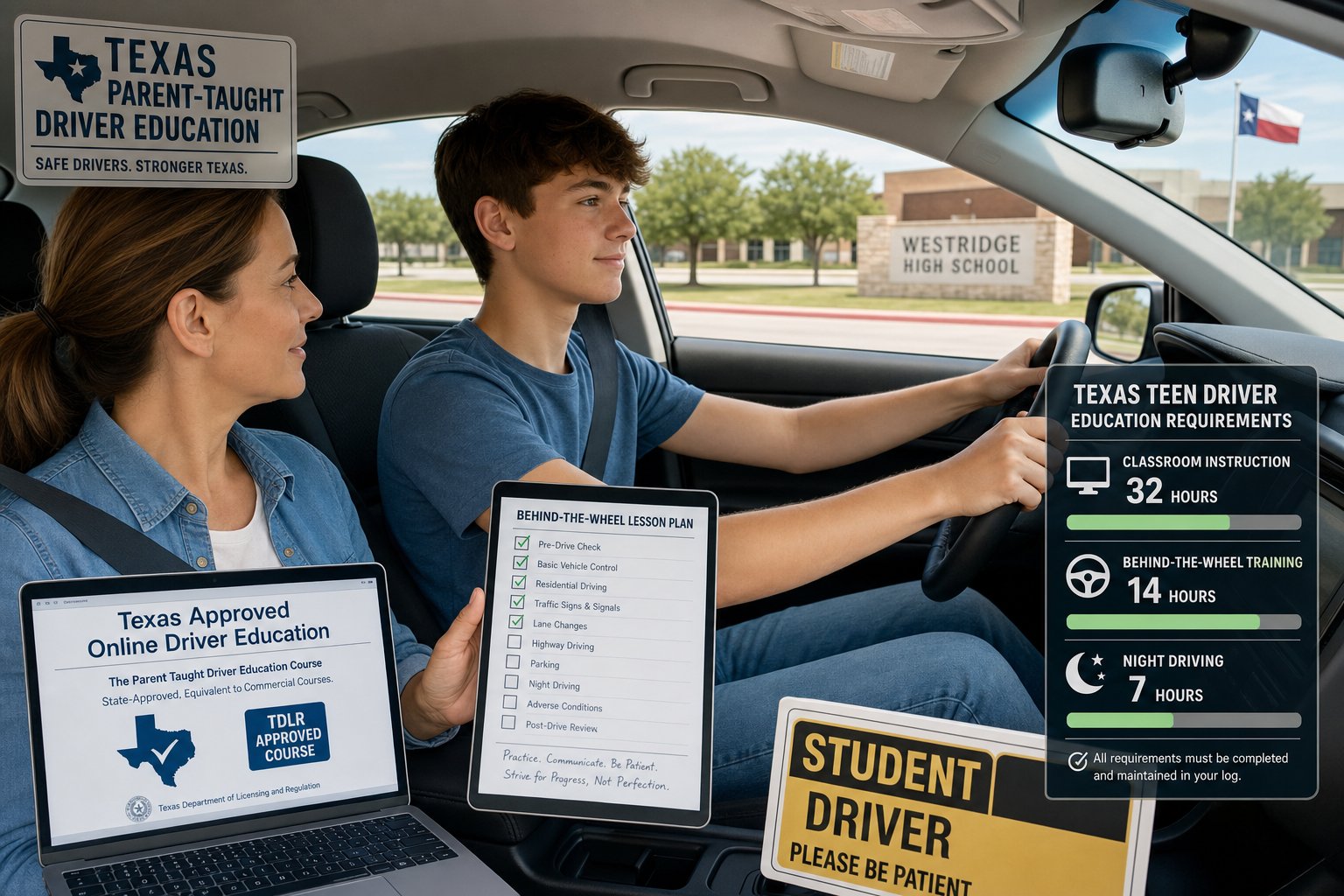
What Texas Parent-Taught Drivers Ed Is And Who It’s For
Parent taught drivers ed Texas is a state-approved path for teens, not adults. It gives families a way to handle teen driver education without using a commercial driving school instructor for every lesson. The teen still completes a TDLR-approved course, and the state still requires the same training hours.
In simple terms, PTDE has two parts:
- 32 hours of classroom instruction through an approved course
- Behind-the-wheel training taught by a parent or other qualified adult
That behind-the-wheel work includes both practice and teaching time. Texas also requires a set amount of supervised driving, including night driving.
PTDE is for first-time drivers ages 14 to 17. A teen may start the course at age 14. But the teen must be 15 before getting a learner license.
This is different from Adult Driver Education (ADE). ADE is a separate program for adults age 18 and older. PTDE and regular teen driver education, often called TDE, are only for teens under 18.
PTDE and commercial TDE lead to the same end result. The teen earns the same type of completion record and follows the same state licensing path with Texas DPS. The main difference is who teaches the driving lessons:
- PTDE: a parent or qualified adult teaches driving
- Commercial TDE: a driving school instructor teaches driving
In both cases, the teen works toward the same final certificate type: DE-964. That matters because families sometimes think PTDE gives a “less official” result. It does not. The end certificate is the same standard Texas uses for teen driver education.
Who Can Teach And Who Qualifies To Enroll
The student must usually be a Texas teen between 14 and 17 who is working toward a first license. PTDE is built for teens who need a learner license first and then a provisional license.
The instructor must meet Texas rules. In many cases, that instructor is a parent or legal guardian. Texas also allows a qualifying adult age 25 or older to teach behind-the-wheel under current law, even if that person is not a licensed driving school instructor.
The instructor should have:
- A valid Texas driver license
- At least 3 years of licensed driving experience
- A clean enough driving record to qualify
- A clean enough criminal record to qualify
TDLR sets the program rules, and the instructor is named through the PTDE paperwork. If the adult does not meet the state rules, that person cannot serve as the PTDE instructor.
This is one reason the PTDE Program Guide matters so much. It is not just a booklet. It is the required setup step that tells Texas who will teach the course.
If your family is trying to move fast, check instructor eligibility first. That avoids wasted time. Many delays happen because people sign up for a course before they order the guide from TDLR or before they confirm the instructor can legally teach.
And one more point: PTDE is not a shortcut around the rules. You may have more schedule freedom, but you still must meet the same state training standards for teen driver education in Texas.
How To Start Parent-Taught Drivers Ed In Texas
Starting PTDE the right way matters. Texas expects families to complete the required setup before the training begins. If you skip steps, you can create problems later when it is time to visit DPS.
The process is not hard, but the order matters. First, get the state paperwork. Then choose an approved course. After that, the teen can begin the classroom part and start working toward the permit.
Get TDLR Approval
Before starting PTDE, you must get the PTDE Program Guide from the Texas Department of Licensing and Regulation. This packet costs $20. As of January 2026, TDLR sends it by email only. There is no mailed paper packet anymore.
This step is required before training starts. The guide includes the official program materials and the instructor designation information tied to the PTDE process. Families often call this getting “TDLR approval,” even though TDLR is really approving the program setup and instructor path.
Do not skip this part. If you begin a course first, you may have a record problem later.
Choose A State-Approved Course And Begin Training
After you get the PTDE Program Guide, enroll in a TDLR-approved teen driver education course. The teen completes the classroom part through that approved provider.
A common first milestone is Module 1, often called the first 6 hours. After that part is complete, the teen may qualify for the paperwork needed for the learner license step. The partial completion certificate is DE-964E.
If you want a flexible option, Driving Logic offers a Texas-approved PTDE/TDE course built for busy families who want to work on any device and move at a steady pace. You can Driving Logic.
The key is simple: use a state-approved course, keep your records, and follow the state order from packet to permit to full completion.
The Full Step-By-Step Process From Permit To License
The Texas PTDE path works best when you treat it like a checklist. Each step unlocks the next one.
- Buy the PTDE Program Guide from TDLR. This is required first. The cost is $20, and it is emailed by TDLR.
- Enroll in a TDLR-approved course. The teen starts the classroom instruction.
- Complete Module 1. This is the first part of the course, often the first 6 hours.
- Get the DE-964E. This is the partial completion certificate. It is used for the learner license step.
- Go to Texas DPS with the required documents. DPS handles the permit and license process, not TDLR. Use Texas DPS for current document rules.
- Keep going with the course. The teen finishes the rest of the 32 hours classroom requirement.
- Complete behind-the-wheel and supervised driving. The instructor logs the required driving hours.
- Get the full DE-964. This is the full completion certificate for teen driver education.
- Complete ITTD. The teen must take the free 2-hour Impact Texas Teen Drivers course within the required time before the road test.
- Take the road test and apply for the provisional license. The teen must meet age and permit-holding requirements set by DPS.
Two training paths may be used during PTDE:
- Concurrent method: classroom and driving happen at the same time
- Block method: classroom is completed first, then driving follows
Many families like the concurrent method because it keeps the lessons practical. A teen studies a rule, then practices it soon after. But both methods are allowed when done correctly.
Also, remember the certificate names. DE-964E is not the final course certificate. It is only for partial completion after Module 1. The final certificate is DE-964, and that is the one used for the provisional license step.
How Long The Course Takes And What Teens Must Complete
Texas sets limits on how fast teen driver education can move. That means there is no true one-day or weekend path for PTDE.
The state generally limits:
- Classroom work to 2 hours per day
- Behind-the-wheel instruction to 1 hour per day
Because of those limits, many teens finish in about 3 to 6 months. Some move a bit faster. Some take longer. It depends on schedule, consistency, and how quickly the family completes the driving log.
To finish PTDE, the teen must complete all required parts. That usually includes:
- 32 hours of classroom instruction
- 44 hours of supervised driving
- Night driving hours within that total
- The free ITTD course
- The road test and DPS licensing steps
The driving portion is where many families slow down. Bad weather, sports, school, and work schedules can stretch the timeline. A smart way to finish faster is to plan driving days in advance and keep the log updated the same day. Waiting to rebuild the log later is a headache.
If speed matters, choose a course that is easy to use and easy to return to from any phone, tablet, or computer. That is where a provider like Driving Logic’s Texas PTDE/TDE course can help. It lets busy families work in short sessions without losing progress.
One last reminder: PTDE is for teens only. Adults 18 and older need Adult Driver Education, which is a separate Texas course with different rules. Mixing those up can waste time, so make sure you enroll in the teen course that matches your age and license goal.
FAQ
How does parent taught drivers ed work in Texas?
A qualifying parent or adult teaches the behind-the-wheel driving while the teen completes a 32-hour TDLR-approved classroom course. It starts with the PTDE Program Guide from TDLR and ends with a provisional license.
How do I start PTDE in Texas?
Buy the PTDE Program Guide from TDLR ($20, emailed since January 2026), enroll in a TDLR-approved online course, and complete Module 1 to earn the DE-964E certificate for a learner’s permit.
What age can my teen start?
Teens can begin the coursework at 14, apply for a learner’s permit at 15 (with the DE-964E), and apply for a provisional license at 16 after holding the permit for 6 months.
What’s the difference between DE-964E and DE-964?
DE-964E is the partial certificate issued after Module 1 and used for the learner’s permit. DE-964 is the full-completion certificate used for the provisional license.
Who can be the parent instructor?
An instructor with a valid Texas license held 3+ years and a clean driving and criminal record, who is the teen’s parent or guardian or a qualifying adult 25 or older under current Texas law.
Is PTDE the same as adult driver education?
No. PTDE is for teens under 18. Adult Driver Education (ADE) is a completely separate course for adults 18 and older.
Conclusion
PTDE rewards families who want lower cost and a flexible schedule, but it works best when you understand the sequence up front: program guide, Module 1 and the DE-964E for the permit, the 6-month holding period, then full completion and the DE-964 for the provisional license. Knowing where the certificates and age milestones fall keeps the process from stalling. Start with the program guide and a TDLR-approved course, and each step leads naturally to the next.
The simplest place to begin is a TDLR-approved Texas parent-taught driver education course online, which includes the DE-964E and DE-964 certificates your teen needs.
Related Articles
- How Texas Parent Taught Drivers Ed Works Online: Step-by-Step
- Texas PTDE Program Guide Packet: What It Is, How to Get It, and Why You Need It
- Who Can Teach Parent Taught Drivers Ed in Texas? Parent Eligibility Requirements
- How Long Does Texas Parent Taught Drivers Ed Take to Complete?
Sources
Billy Forte is the owner of Driving Logic, a TDLR-approved Texas driver education provider. Driving Logic offers the online Texas parent-taught and teen driver education course that helps Texas teens complete the 32-hour classroom requirement and work toward a learner’s permit and provisional license.
This article is general information about Texas teen driver education and licensing, not legal advice. Requirements, fees, and procedures are set by TDLR and the Texas DPS and can change, so confirm current details with official Texas sources before you enroll or visit a DPS office.