
Updated November 2026 · Reviewed by Billy Forte
Yes, you can take the Florida drug and alcohol course in Spanish when a provider teaches it in that language, and FLHSMV’s list of approved TLSAE providers marks some of them “Additional Languages Available.” Driving Logic’s courses are offered in Spanish as well as English. The exams are a different matter: since February 6, 2026, FLHSMV gives all driver license knowledge and skills exams in English only.
Key Facts
- Spanish is up to the provider: the state list marks some providers for more languages but does not name them. See the provider list.
- The law is silent on language: section 322.095 does not mention it. See what the law says.
- Who takes it: first-time license applicants who are 18 or older. See who needs the course.
- Exams in English: all knowledge and skills exams have been in English only since February 6, 2026. See the exam rule.
- Adults test in person: the online exam option is for applicants under 18. See what it means for adults.
- Ask first: confirm the course language with the provider before you pay. See what to ask.
Florida Drug and Alcohol Course in Spanish: The Basics
Most people call it the drug and alcohol course. Its official name is Traffic Law and Substance Abuse Education, or TLSAE.
It is a first-time driver course. Adults who have never had a license take it before they apply for one in Florida.
The agency in charge is the Florida Department of Highway Safety and Motor Vehicles, or FLHSMV. Many people call it the DMV. In Florida, the agency’s name is FLHSMV.
FLHSMV approves the courses. It does not teach them. Private providers do, and each provider decides which languages it teaches in.
That is why the language question has two parts. One part is the course, which a provider may teach in Spanish. The other part is the state’s exams, which follow a state rule.
What the Approved Provider List Shows
FLHSMV publishes a list of approved TLSAE course providers. It has three columns:
- Name.
- Delivery Method.
- Contact Information.
The Delivery Method column shows how each provider teaches. The labels on the list are Internet, Classroom and App.
There is no language column. Language appears only as a short note beside the delivery method of some providers.
Most of those notes read “(Additional Languages Available).” The note does not name a language. The list does not say Spanish beside any provider.
So treat the note as a lead, not an answer. Call or write to the provider and ask. A provider with no note may also teach in Spanish.
The List Also Comes in Spanish
FLHSMV’s page has a “Language | Idioma” switch. It leads to a Spanish version of the provider page.
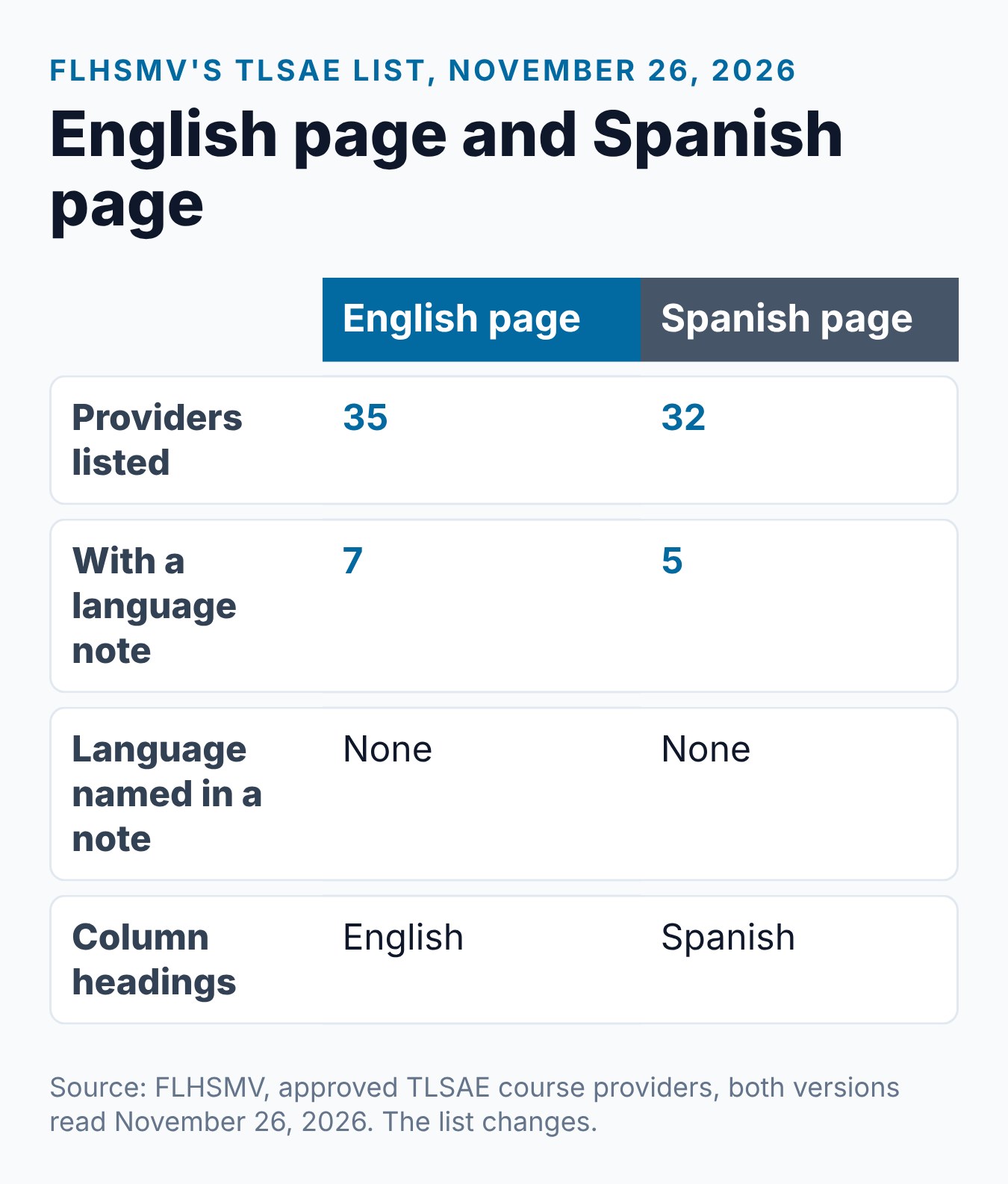
On the Spanish page, the column headings are in Spanish. The language notes beside the providers stay in English.
The two versions did not match on the day we read them. The English page listed more providers than the Spanish page. Check the English page before you decide that a provider is not approved.
What the Law Says
The course comes from section 322.095, Florida Statutes. The statute does not mention language. It does not require English, and it does not require Spanish.
It does set the frame for every approved course:
- Approval. The Department of Highway Safety and Motor Vehicles must approve the courses. That includes courses that use communications technology as the delivery method.
- Certification first. Before offering a course, the provider must obtain certification from the department that the course complies with the section.
- Full course. Each provider must ensure its schools conduct the approved course fully, to the required time limits.
- Reporting. Providers submit completion information through the department’s Driver Improvement Certificate Issuance System within 5 days.
The statute also lists what the curriculum must teach. A course in any language covers the same ground:
- The body and mind. The physiological and psychological consequences of the abuse of alcohol and other drugs.
- The costs. The societal and economic costs of alcohol and drug abuse.
- The driver. The effects of alcohol and drug abuse on the driver of a motor vehicle.
- The law. The laws of this state relating to the operation of a motor vehicle.
- Risky habits. Speeding, reckless driving, and running red lights and stop signs.
- Devices. The results of the use of electronic devices while driving.
These topics are the same for a student who reads English and a student who reads Spanish.
Who Needs the Course
The statute states the rule in one sentence. Each applicant for a driver license who is 18 years of age or older must complete a traffic law and substance abuse education course.
It gives two exceptions:
- Licensed elsewhere. The applicant has been licensed in another jurisdiction.
- School driver education. The applicant has satisfactorily completed a Department of Education driver education course.
FLHSMV’s provider page describes the course as a 4-hour course. It must be completed before applying for a license in Florida.
FLHSMV names one more substitute. Driver Education Licensing Assistance Program (DELAP) courses offered by some county school boards may count instead.
Teens follow a different path. Since August 1, 2025, first-time applicants under 18 take a 6-hour course called DETS. Our guide on what TLSAE is explains the adult course in full.
The Exam Rule: English Only
A provider may teach in Spanish. The state’s exams do not follow the provider.
FLHSMV announced the rule in a news release dated January 30, 2026. Beginning Friday, February 6, 2026, all driver license knowledge and skills examinations are administered exclusively in English.
The release covers a lot of ground:
- All classifications. The change applies to all driver license classifications.
- Oral exams. It includes exams administered orally.
- Translation. Language translation services are no longer permitted for knowledge or skills examinations.
- Paper exams. Printed exams in languages other than English were removed.
The release also describes the old practice. Before that date, knowledge exams for most non-commercial driver license classifications were offered in multiple languages.
The Jacksonville tax collector’s office posted the same announcement. Some websites still show an older list of exam languages. Go by the release, and confirm with FLHSMV or your tax collector office before test day.
What the Rule Means for Adults
An adult’s first exam is the Class E Knowledge Exam. FLHSMV’s exam page states that Class E knowledge examinations are available in English only.
The same page gives the testing options. The exam can be taken in person at a service center. The online option is for applicants under the age of 18.
So an adult takes the knowledge exam in person and in English. Plan for both.
Each Step and Its Language
An adult’s path to a first license has several steps. The language rule changes from step to step.
| Step | Language |
|---|---|
| The TLSAE course | Set by the provider; the statute is silent |
| The Class E Knowledge Exam | English only |
| The Class E Driving Skills Test | English only |
| An interpreter or translation service in an exam | Not permitted |
| The course’s own final test | No official page says |
| The completion certificate | No official page says |
The last two rows are open questions. We make no claim about them. Ask the provider if the language of the course test or of the certificate matters to you.
The Knowledge Exam in Brief
FLHSMV’s exam page gives the numbers. The Class E Knowledge Exam has 50 multiple-choice questions. A customer must answer 40 correctly, which is 80 percent, to pass.
The questions cover three areas:
- Florida traffic laws.
- Safe driving practices.
- Identifying traffic controls.
FLHSMV names two study tools. One is the Official Florida Driver License Handbook. The other is the Class E Knowledge Practice Test.
Our guide to the permit test for adults covers the exam step by step.
How a Course in Spanish Still Helps
The exams are in English. A course in Spanish is still worth asking about.
The course teaches ideas, not vocabulary. How alcohol and drugs affect a driver and what the law expects are easier to learn in your first language.
Then build the English you need for the exam:
- Make a word list. Write the English terms from each lesson next to the Spanish ones.
- Read sample questions in English. The practice test shows how questions are worded.
- Learn the signs by their English words. Words such as stop, yield and one way appear on road signs.
- Leave time. Give yourself days, not hours, between the course and the exam.
A course in Spanish gets you the knowledge. English practice gets you through the exam.
Steps for an Adult Who Prefers Spanish
These steps follow the official rules in order.
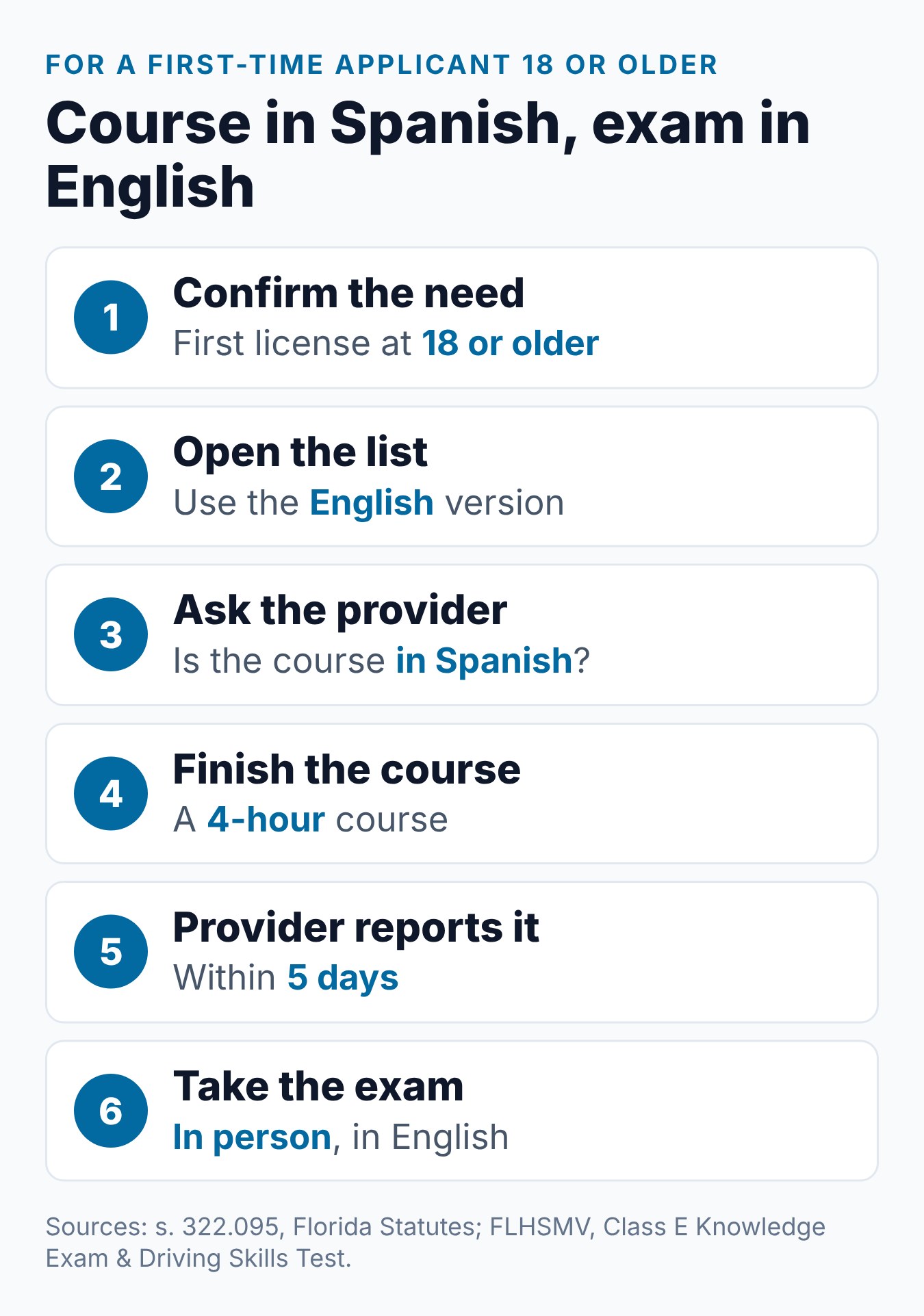
- Confirm you need the course. It applies to first-time applicants who are 18 or older.
- Open the English provider list. It had more providers than the Spanish version when we read it.
- Ask about Spanish. Contact the provider and confirm the language before you pay.
- Finish the course. FLHSMV describes it as a 4-hour course.
- Let the provider report it. Completion goes to the department within 5 days.
- Practice in English. Use the handbook and the practice test.
- Take the exam in person. The Class E Knowledge Exam is given in English.
Step 5 is the provider’s job, not yours. Our guide on how the online course works covers the course itself.
Questions to Ask Before You Pay
Ask the provider:
- Is the whole course taught in Spanish?
- Is it online, in a classroom or in an app?
- What language is the course test in?
- How and when will you report my completion?
Ask FLHSMV or your tax collector office:
- Is the knowledge exam still given in English only?
- What do I need to bring to take the exam in person?
Keep a note of who answered and on what date. Exam policy changed in 2026, and offices update their practice.
What We Found on the Official Pages
On November 26, 2026, we read both versions of FLHSMV’s TLSAE provider page, section 322.095 and the Class E exam page. We looked for every statement about language. Here is what stood out:
- The English list had 35 providers. 34 showed Internet as a delivery method, 12 showed Classroom and 2 showed App.
- 7 carried a language note. Six read “(Additional Languages Available)” and one read “(Other Languages Available).”
- None of the notes named a language. The word Spanish did not appear beside any provider.
- The Spanish version of the page was behind. It listed 32 providers, and 5 of them carried a language note.
- The statute is silent. Section 322.095 does not use the word language.
The fourth finding is the one that surprised us. A reader who uses only the Spanish page sees a shorter list than a reader who uses the English page.
These counts are a snapshot. The list changes as FLHSMV approves providers.
Common Mistakes to Avoid
- Expecting a Spanish exam after a Spanish course. The exams are in English only.
- Reading the language note as a promise of Spanish. The note does not name a language.
- Relying only on the Spanish version of the list. The English version had more providers.
- Planning to bring an interpreter. Translation services are not permitted in the exams.
- Looking for an online exam as an adult. The online option is for applicants under 18.
- Taking the teen course by mistake. DETS is for applicants under 18. TLSAE is for adults.
How Requirements Can Vary
Florida’s course and license rules apply statewide, but some details depend on where you live. Driver license services are often handled by your county tax collector’s office, and each office sets its own appointment process and hours. Some county school boards also offer driver education programs, such as DELAP courses, that can count instead of DETS.
FLHSMV can update course rules, forms, documents, and fees. Check FLHSMV and your county office for current requirements before your appointment.
Frequently Asked Questions
Can I take the Florida drug and alcohol course in Spanish?
Yes, when the provider teaches it in Spanish. FLHSMV’s list marks some providers “(Additional Languages Available)” but does not name the languages, so ask the provider.
Does Florida law say what language the course must be in?
No. Section 322.095 does not mention language. It requires FLHSMV to approve the courses and lists what the curriculum must cover.
Is the Florida knowledge exam offered in Spanish?
No. Since February 6, 2026, FLHSMV gives all driver license knowledge and skills exams in English only.
Can I bring an interpreter to the exam?
No. FLHSMV’s January 30, 2026 release says language translation services are no longer permitted for knowledge or skills examinations.
Can an adult take the knowledge exam online?
FLHSMV’s exam page gives the online option to applicants under the age of 18. Adults take the exam in person at a service center.
Who has to take the TLSAE course?
Each driver license applicant who is 18 or older. The statute exempts applicants licensed in another jurisdiction and those who completed a Department of Education driver education course.
Is the Spanish version of FLHSMV’s provider list complete?
Not on the day we read it. On November 26, 2026, the English page listed 35 providers and the Spanish page listed 32.
Conclusion
Florida law does not set a language for the drug and alcohol course, so a Spanish course depends on the provider you choose. The state’s exams are another matter, because the knowledge exam and the driving test have been in English only since February 6, 2026. Learn the material in the language you know best, then practice for the exam in English. To see the course, visit Driving Logic’s online Florida TLSAE course page.
Related Articles
- Florida Drug and Alcohol Course (TLSAE): The Complete Guide for Adults
- Florida TLSAE Course Online: How to Take It and What It Covers
- How to Get an FLHSMV-Authorized TLSAE Course in Florida
- What Is the Florida TLSAE? Traffic Law and Substance Abuse Education Explained
- Florida Drug and Alcohol Course Test: What to Expect
Sources
- FLHSMV — TLSAE Approved Course Providers
- FLHSMV — TLSAE Approved Course Providers (Spanish version)
- Florida Statutes s. 322.095 — Traffic law and substance abuse education program
- FLHSMV news release, January 30, 2026 — Driver License Exams to Be Administered in English Only
- Jacksonville Tax Collector — FLHSMV Announces Driver License Exams to Be Administered in English Only
- FLHSMV — Class E Knowledge Exam & Driving Skills Test
- FLHSMV — Driver Education Courses
Billy Forte is the owner of Driving Logic, a state-approved driver improvement course provider serving Florida and other U.S. states.
This article is general information, not legal advice. Florida licensing requirements, course rules, documents, and fees are set by FLHSMV and Florida law and can change. Use official FLHSMV and Florida statute sources for current requirements before you enroll in a course or visit a driver license office.