
Updated November 2026 · Reviewed by Billy Forte
Yes, the TLSAE course is required in Florida for each driver license applicant 18 or older, unless the applicant has been licensed in another jurisdiction or has completed a Department of Education driver education course. So the answer to “is the TLSAE course required in Florida” depends on your age and license history. First-time drivers under 18 take the 6-hour DETS course instead.
Key Facts
- Who must take it: adults 18 or older who have not been licensed before. See who must take it.
- A second group: some drivers under 21 after a .02 to .05 alcohol suspension notice. See the hardship case.
- Who is exempt: people licensed in another jurisdiction and people who finished Department of Education driver education. See the exemptions.
- Under 18: DETS, not TLSAE, since August 1, 2025. See teens and DETS.
- When: before you apply for the license. See timing.
Required or Not, by Situation
Start here. Find the line that fits you, then read the section that explains it.
| Your situation | TLSAE required? | Source |
|---|---|---|
| 18 or older, never licensed anywhere | Yes | FLHSMV TLSAE page; FLHSMV Class E exam page |
| 18 or older, licensed in another state or country | No | s. 322.095(1) |
| 18 or older, finished Department of Education driver education | No | s. 322.095(1); FLHSMV Driver Improvement Schools |
| Under 18, never licensed | No; DETS is required instead | FLHSMV DETS page and DETS FAQ |
| Under 21, reinstating on a hardship after a .02 to .05 suspension notice | Yes | FLHSMV TLSAE page |
A short note on the table: “licensed elsewhere” has a wrinkle when you no longer have the license. The exemptions section explains it.
Who Must Take the TLSAE Course
The rule is in s. 322.095(1), Florida Statutes. Each driver license applicant who is 18 or older must complete the course, with two exceptions covered below.
The Florida Department of Highway Safety and Motor Vehicles (FLHSMV) puts the same rule in its own words. Its TLSAE page says drivers over 18 who have never held, or do not have in their possession, a driver license from any other state, country or jurisdiction must complete a 4-hour TLSAE course before applying for a Florida license.
FLHSMV’s Class E Knowledge Exam & Driving Skills Test page says it a third way. Customers must complete a TLSAE course before applying if they have never been issued a driver license in any state or country.
So the main group is simple. If you are 18 or older and this is your first license anywhere, the course is required.
Two FLHSMV Pages, Two Wordings
The two FLHSMV pages do not use the same words. The Class E exam page talks about people who have never been issued a license in any state or country.
The TLSAE page is wider. It also covers people who do not have another license in their possession.
For most readers this makes no difference. It matters only if you once held a license elsewhere and can’t show it now. In that case, follow the exemptions section and ask the office before you sign up.
Drivers Under 21 After an Alcohol Suspension
There is one more group, and it has nothing to do with a first license. FLHSMV’s TLSAE page names drivers under 21 who received a notice of suspension for driving with a blood alcohol level of .02 to .05.
Those drivers must complete a TLSAE course to reinstate their license on a hardship. FLHSMV says a hardship license is restricted to business or employment purposes only.
So in this case the course is tied to getting back a restricted license, not to a first application. The TLSAE page is the official source for this rule.
Who Is Exempt
The statute names two exemptions. FLHSMV adds detail on the second.
1. Licensed in another jurisdiction. Under s. 322.095(1), an applicant who has been licensed in another jurisdiction does not have to take the course.
Note the wording on FLHSMV’s TLSAE page, though. It covers drivers who have never held, “or do not have in their possession,” a license from elsewhere.
If you were licensed in another state or country but no longer have that license, the official pages read for this article do not say what proof the office accepts. Ask the driver license office before you pay for a course you may not need.
2. Department of Education driver education. The same subsection exempts an applicant who has satisfactorily completed a Department of Education driver education course offered under s. 1003.48.
FLHSMV’s Driver Improvement Schools page says the Driver Education Licensing Assistance Program (DELAP) and high school driver education classes teach the drug and alcohol training. It says a successful DELAP student is exempt from taking the TLSAE.
The TLSAE page adds that DELAP courses offered by some county school boards may substitute for the requirement. It tells you to contact the local school board for more information.
Under 18: DETS Instead
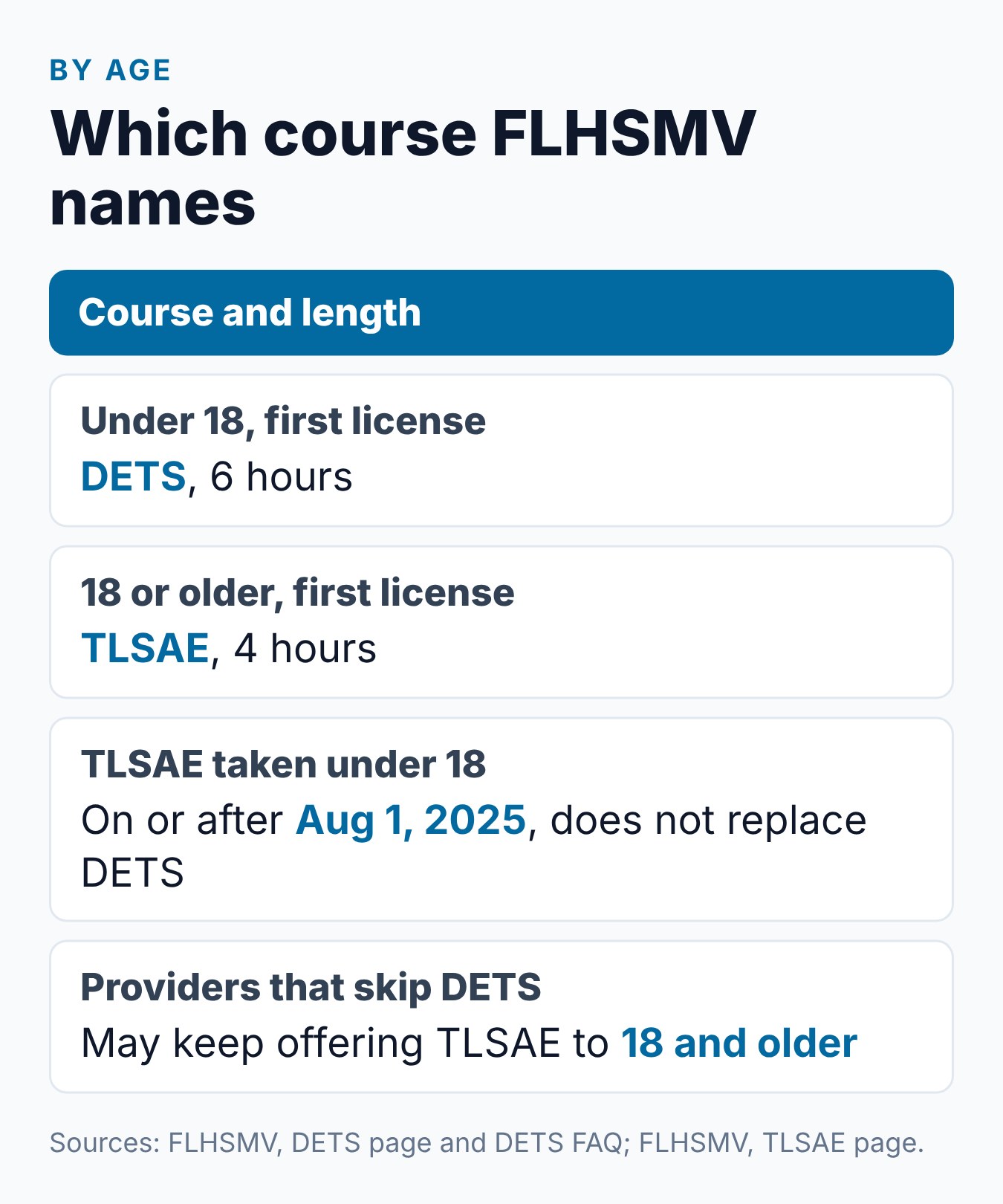
Teens follow a different rule since August 1, 2025. FLHSMV’s DETS page says people under 18 who have never held a license from any other state, country or jurisdiction must complete a 6-hour Driver Education Traffic Safety (DETS) course before applying.
The DETS FAQ closes a gap. Someone under 18 who completes a TLSAE course on or after August 1, 2025, will need to take DETS. The exception is a student enrolled in an FDOE Traffic Safety Classroom 1900300 or 1900310 course or a DELAP course.
TLSAE did not go away. FLHSMV says course providers that do not wish to conduct DETS may keep offering their approved TLSAE course to people 18 and older.
When You Must Finish It
The course comes first. FLHSMV’s TLSAE page says to complete it before applying for a license in Florida.
You also do not carry proof yourself. The provider reports your completion to FLHSMV, and the Driver Improvement Schools page says the completion can be seen at all driver license issuing offices. A physical certificate is not required, and FLHSMV does not accept paper certificates for any licensing purpose.
Under s. 322.095(12), the provider has up to 5 days to send your completion, free of charge to you. So leave a gap between finishing the course and your office visit. How that record reaches the counter is covered in the guide to what the office sees.
What “Required” Means in Practice
Only some courses meet the requirement. Under s. 322.095(2) and (3), the course must be one the department has approved and certified.
The law also sets the length. Under s. 322.095(9), a course has at least 4 hours of content, and up to 30 minutes of breaks do not count toward it.
The approved providers appear on FLHSMV’s TLSAE page. Check that list before you start, because a course that is not on it does not meet the requirement.
What the course teaches is a separate question. What Is the Florida TLSAE? explains the course and its topics. The pillar guide, linked below, covers the whole course from start to finish.
Where TLSAE Fits in a First License
For an adult, TLSAE is the first step, not the last. After it, the Class E Knowledge Exam page lists the knowledge exam: 50 multiple-choice questions, with 40 correct needed to pass.
FLHSMV says the knowledge exam is available in English only. Online testing is for applicants under 18, so adults take it in person at a service center.
The full adult path, from course to card, is in the pillar guide linked below.
Do You Need TLSAE? Four Questions
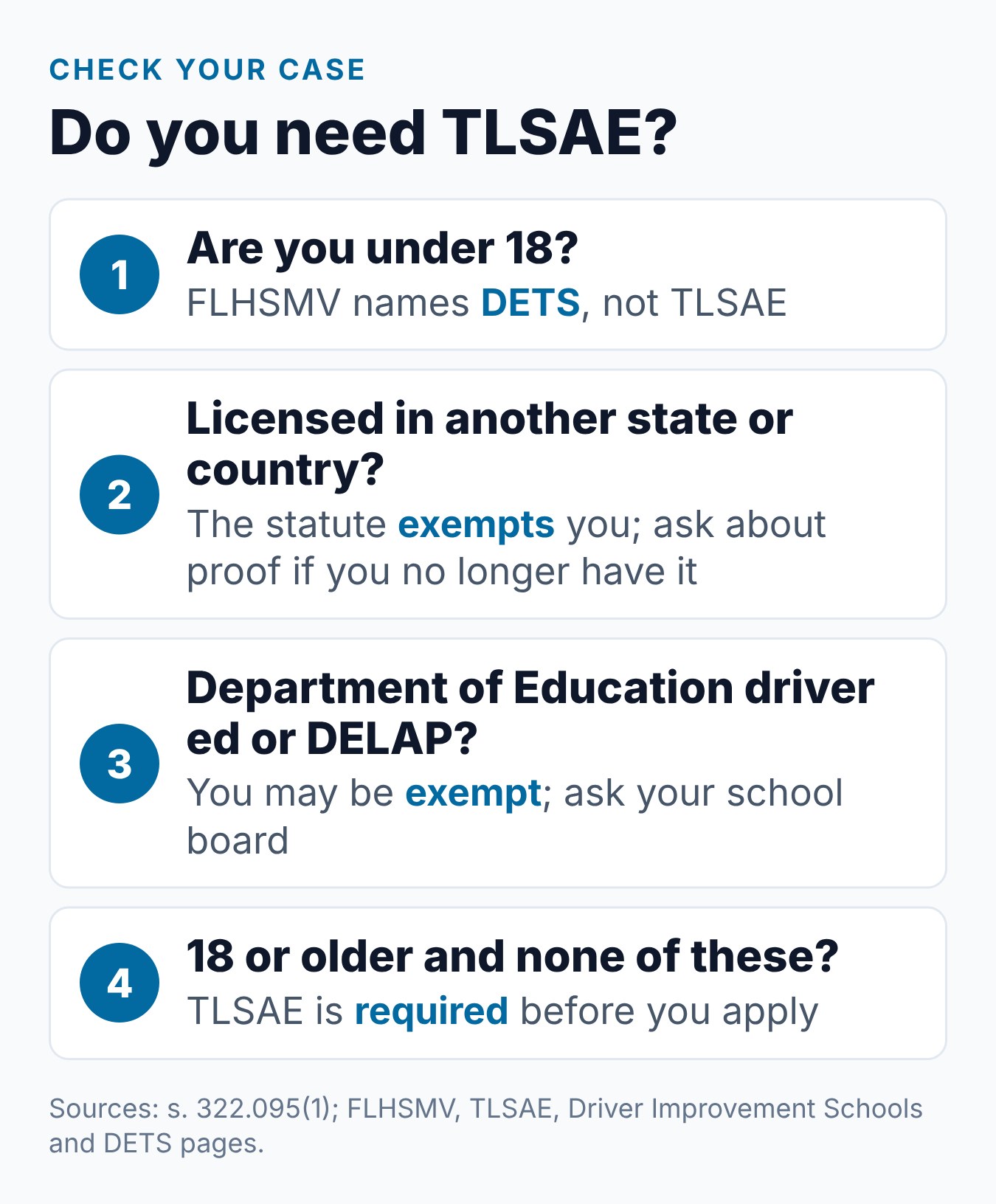
Use these questions in order. Stop at the first one that gives you an answer.
- Are you under 18? Then FLHSMV names DETS, not TLSAE.
- Have you held a license in another state or country? Then the statute exempts you; if you no longer have it, ask the office what proof it accepts.
- Did you finish Department of Education driver education or DELAP? Then you may be exempt; contact your local school board.
- None of the above, and 18 or older? Then TLSAE is required before you apply.
If you are under 21 and reinstating on a hardship after a .02 to .05 suspension notice, the hardship rule applies on its own.
Questions the Official Pages Leave Open
This review read s. 322.095 and FLHSMV’s TLSAE, Driver Improvement Schools, Class E exam, DETS and DETS FAQ pages. Two common questions have no answer there.
A DETS course finished at 17. The pages do not say whether DETS completed at 17 meets the adult TLSAE rule for someone who applies after turning 18.
How long TLSAE stays valid. The pages do not give a time limit for an adult TLSAE completion.
This article does not guess at either one. Ask FLHSMV or your driver license office before you pay for a second course.
Common Mistakes to Avoid
These come from the official rules above:
- Thinking TLSAE ended. It still applies to applicants 18 and older.
- Signing a 17-year-old up for TLSAE. Under 18, FLHSMV names DETS.
- Paying when you are exempt. Check the two exemptions in the statute first.
- Assuming an old license is enough proof. If you no longer have it, ask the office.
- Going to the office the day you finish. The provider has up to 5 days to report.
- Bringing a paper certificate. FLHSMV does not accept paper certificates for licensing.
- Taking a course that is not on the list. Only an approved and certified course counts.
- Mixing up the course and the exam. TLSAE does not replace the Class E Knowledge Exam.
How Requirements Can Vary
Florida’s course and license rules apply statewide, but some details depend on where you live. Driver license services are often handled by your county tax collector’s office, and each office sets its own appointment process and hours. Some county school boards also offer driver education programs, such as DELAP courses, that can count instead of DETS.
FLHSMV can update course rules, forms, documents, and fees. Check FLHSMV and your county office for current requirements before your appointment.
Frequently Asked Questions
Is the TLSAE course required in Florida?
Yes, for each driver license applicant 18 or older, unless the applicant was licensed in another jurisdiction or finished a Department of Education driver education course. First-time drivers under 18 take DETS instead.
Do I need TLSAE if I had a license in another state?
No. The statute exempts an applicant who has been licensed in another jurisdiction. If you no longer have that license, ask the driver license office what proof it accepts.
Does TLSAE count for a 17-year-old?
Not since August 1, 2025. FLHSMV says someone under 18 who completes TLSAE on or after that date will need to take DETS, unless enrolled in an FDOE Traffic Safety Classroom 1900300 or 1900310 course or a DELAP course.
Who else must take TLSAE?
Drivers under 21 who received a suspension notice for a blood alcohol level of .02 to .05 must complete it to reinstate on a hardship. That license is for business or employment purposes only.
When do I have to finish the course?
Before you apply for the license. The provider then reports your completion to FLHSMV within 5 days.
Is TLSAE the same as the drug and alcohol course?
Yes. TLSAE stands for Traffic Law and Substance Abuse Education, and many people call it the drug and alcohol course. The law that requires it is s. 322.095.
Do I need a paper certificate?
No. The completion is sent electronically, and FLHSMV does not accept paper certificates for any licensing purpose.
Conclusion
TLSAE is required in Florida for first-time applicants 18 or older, and for some drivers under 21 reinstating on a hardship. Check the two exemptions before you pay, and remember that teens under 18 take DETS instead. To see how one course is laid out, visit the tlsae course florida page.
Related Articles
- Florida Drug and Alcohol Course (TLSAE): The Complete Guide for Adults
- What Is the Florida TLSAE? Traffic Law and Substance Abuse Education Explained
- Drug and Alcohol Course Florida DMV: What the Office Sees
- How to Get an FLHSMV-Authorized TLSAE Course in Florida
- Florida 4 Hour Drug and Alcohol Course: Who Needs It
Sources
- FLHSMV — Driver Education Courses
- FLHSMV — First-Time Florida Driver
- Florida Statutes — F.S. 322.1615 (DETS)
- Florida Statutes — F.S. 322.095 (TLSAE)
- FLHSMV — TLSAE Course Provider List
- FLHSMV — Driver Improvement Schools
- FLHSMV — Class E Knowledge Exam & Driving Skills Test
- FLHSMV — Driver Education Traffic Safety (DETS)
- FLHSMV — DETS Course Frequently Asked Questions
Billy Forte is the owner of Driving Logic, a state-approved driver improvement course provider serving Florida and other U.S. states.
This article is general information, not legal advice. Florida licensing requirements, course rules, documents, and fees are set by FLHSMV and Florida law and can change. Use official FLHSMV and Florida statute sources for current requirements before you enroll in a course or visit a driver license office.