
Updated November 2026 · Reviewed by Billy Forte
No official source names the best online drivers ed texas course: the Texas Department of Licensing and Regulation (TDLR) says its provider list is “not an endorsement, recommendation, or advertising,” so the best choice is a TDLR-licensed online course of the right type for a teen that fits how your family will do the 44 in-car hours. For a teen under 18, the right types in TDLR’s search are “Online for Minors and Adults” and “Parent Taught for Teens.” Every licensed teen course meets the same state minimums, so the real differences are in how a provider handles the exam, the DE-964 certificate, the in-car hours, the total price and support.
Key Facts
- No official ranking: TDLR’s list only verifies licenses and is not an endorsement. See is there a best course.
- Right course type: a teen needs “Online for Minors and Adults” or “Parent Taught for Teens.” See step 1.
- Same minimums everywhere: 24 classroom hours and 44 in-car hours in every licensed teen course. See what is the same.
- Daily limit: six hours a day, with no more than two hours behind the wheel. See the daily limit.
- What really differs: the exam, the DE-964, who teaches in the car, the total price and support. See questions to ask.
Is There a Best Online Drivers Ed in Texas?
No. Texas does not publish a list of the best courses, and no state page ranks providers. TDLR licenses driver education providers.
Its search tool says it is “provided for the sole purpose of verifying the license status of driver education providers regulated by TDLR.”
The same page adds: “Inclusion in this list is not an endorsement, recommendation, or advertising.” TDLR’s parent-taught classroom page says the same thing another way. It says “TDLR cannot recommend specific courses, but all courses have been reviewed to meet educational standards.”
So a “best” badge on a website is the provider’s own claim. It is not a state rating.
No official page lists prices, pass rates, reviews or star ratings for teen courses. That is why this article names no provider and ranks no one.
What you can do is compare courses on facts you can check. A good choice for your family has three things:
- A current TDLR license that you looked up yourself.
- The right course type for a teen under 18.
- A clear plan for the 44 in-car hours, with the answers to a few questions in writing.
The rest of this article walks through those checks in order. For what parts of drivers ed can happen on a screen and what must happen in the car, see Online Drivers Ed Texas: What Teens Can Do Online.
Step 1: Check the TDLR License and the Course Type
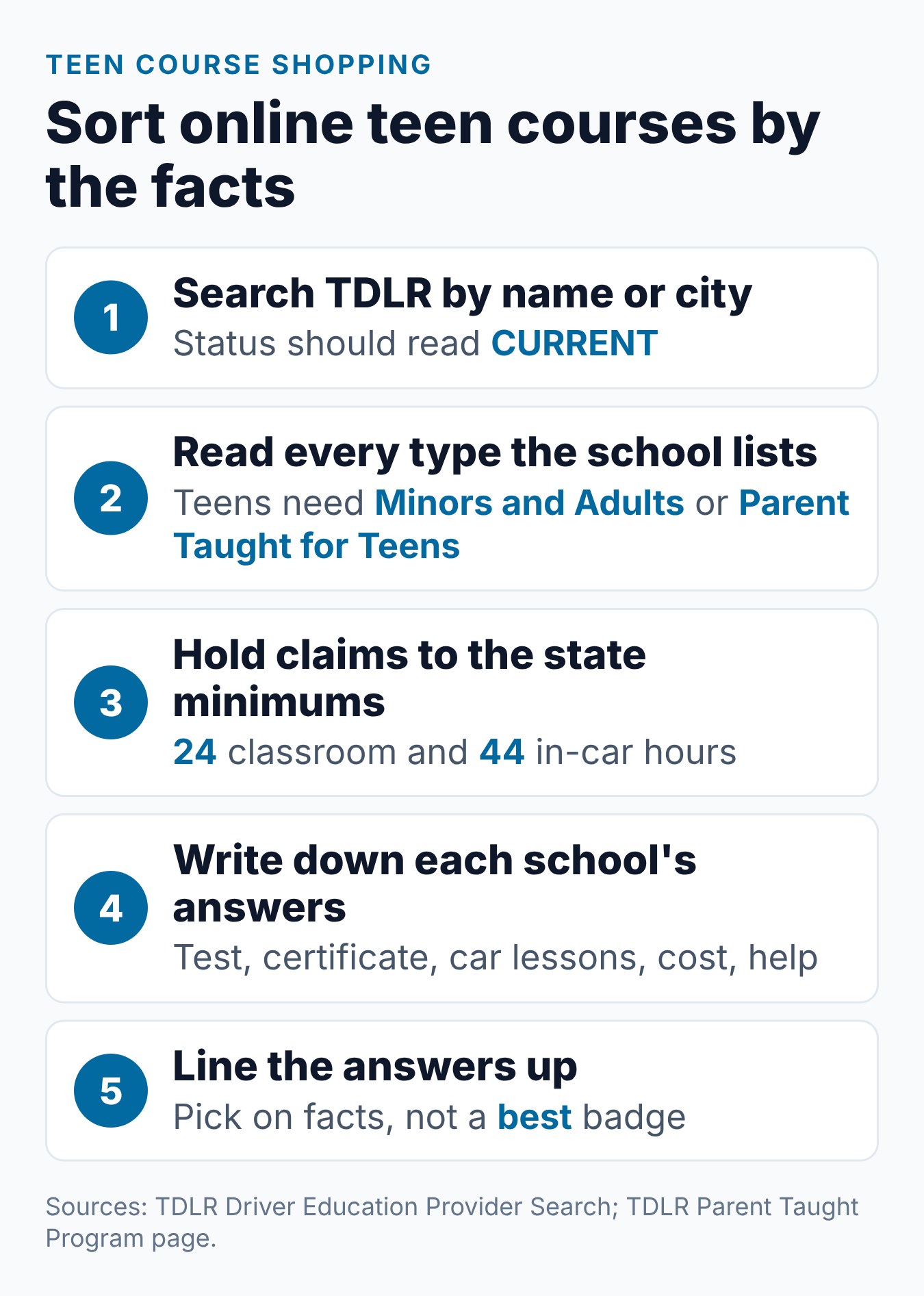
Start with the TDLR Driver Education Provider Search. Look up the provider by name, city, ZIP code or license number. Check that the status is current before you pay.
Next, look at the course types listed for that provider. TDLR uses five types, written exactly like this:
- In-Person for Minors and Adults
- In-Person Exclusively for Adults
- Online Exclusively for Adults
- Online for Minors and Adults
- Parent Taught for Teens
A teen who wants to learn online needs a provider with “Online for Minors and Adults” or “Parent Taught for Teens.” An adults-only course is the wrong one for a teen, even if it is online. “Online Exclusively for Adults” is built for adults, not for a 15-year-old.
One provider can hold several types. So read the full list of types for the provider, not just its name. A school may offer an adults-only online course and only in-person classes for teens.
Public schools are a special case. TDLR’s page says “Public schools may provide Driver Education courses that are not included in this tool.” If your teen’s school offers driver education, ask the school about it directly. It may not appear in the search.
Step 2: Pick the Kind of Online Course
Before you compare providers, decide which kind of course fits your family. Texas DPS lists four teen options on its Choosing a Driver Education Course page. They start at age 14:
- Traditional course: offered by certified driving schools with classroom instruction.
- Online courses: offered by certified driving schools.
- Parent-taught: a parent or guardian with a valid, unexpired Texas driver license teaches.
- Public school driver education: offered by some public schools.
Two of these can be done online. The first is an online course from a licensed driving school. The second is parent-taught, where the classroom part comes from an online curriculum and a parent teaches in the car.
If you choose parent-taught
The parent applies online to TDLR for the parent-taught instructor designation. The fee is $20, and it is non-refundable, according to TDLR’s Parent Instructors page. The family then buys the curriculum from a licensed driver education provider with the parent-taught endorsement, as the Parent Taught Program page explains.
TDLR’s classroom page says instruction can begin after you have the instructor designation from TDLR and the training materials from the course provider. If your family has already picked parent-taught, our guide to choosing a TDLR approved parent taught course online goes deeper on that choice.
If you choose a driving school online course
The driving school provides the online classroom part. Ask who does the in-car lessons.
Some families do the classroom part online and the in-car part with the school. TDLR’s classroom page also notes a hybrid option, where classroom hours are done at a driver education provider or a public school.
If the student is 18 or older
This article is for teens under 18. DPS says a 6-hour adult driver education course is required for everyone between 18 and 24 before testing for a driver license.
People 25 and older are not required to take one. An adult does not need a teen course.
What Is the Same in Every Licensed Teen Course
Some features are set by the state. Every licensed teen course has them, so none of them can make one course better than another. When a website lists these as selling points, it is describing the law.
| Requirement | What every licensed teen course has | Official source |
|---|---|---|
| Classroom hours | 24 hours | TDLR Parent Taught Program |
| Observation in the car | 7 hours | TDLR Parent Taught Program |
| Behind-the-wheel instruction | 7 hours | TDLR Parent Taught Program |
| More practice driving | 30 hours, at least 10 at night | TDLR Parent Taught Program |
| Concurrent method | First 6 classroom hours, then the learner license | DPS Choosing a Driver Education Course |
| Block method | All 24 classroom hours, then the learner license | DPS Choosing a Driver Education Course |
| Earliest learner license | Age 15 | DPS Choosing a Driver Education Course |
The 7 hours of observation, 7 hours behind the wheel and 30 practice hours add up to the 44 in-car hours. A teen may start the classroom part at 14, but DPS says the teen cannot apply for a learner license until at least 15.
The two methods change when the teen can start driving, not how many hours are required. Under the concurrent method, the teen takes the first 6 classroom hours, gets the learner license, and finishes the other 18 hours while practicing. Under the block method, the teen finishes all 24 hours first.
The daily limit is the same too
TDLR’s Parent Taught: Classroom Instruction page sets a daily cap. It says “Instruction is limited to: six hours per day, including not more than two hours of behind-the-wheel instruction per day.”
That cap matters when you compare claims. A course cannot promise to finish all 24 classroom hours in a single day. A promise of fewer hours than the state minimum is a warning sign, not a feature.
What Differs: Questions to Ask a Provider
If the minimums are the same, what is left to compare? The practical details.
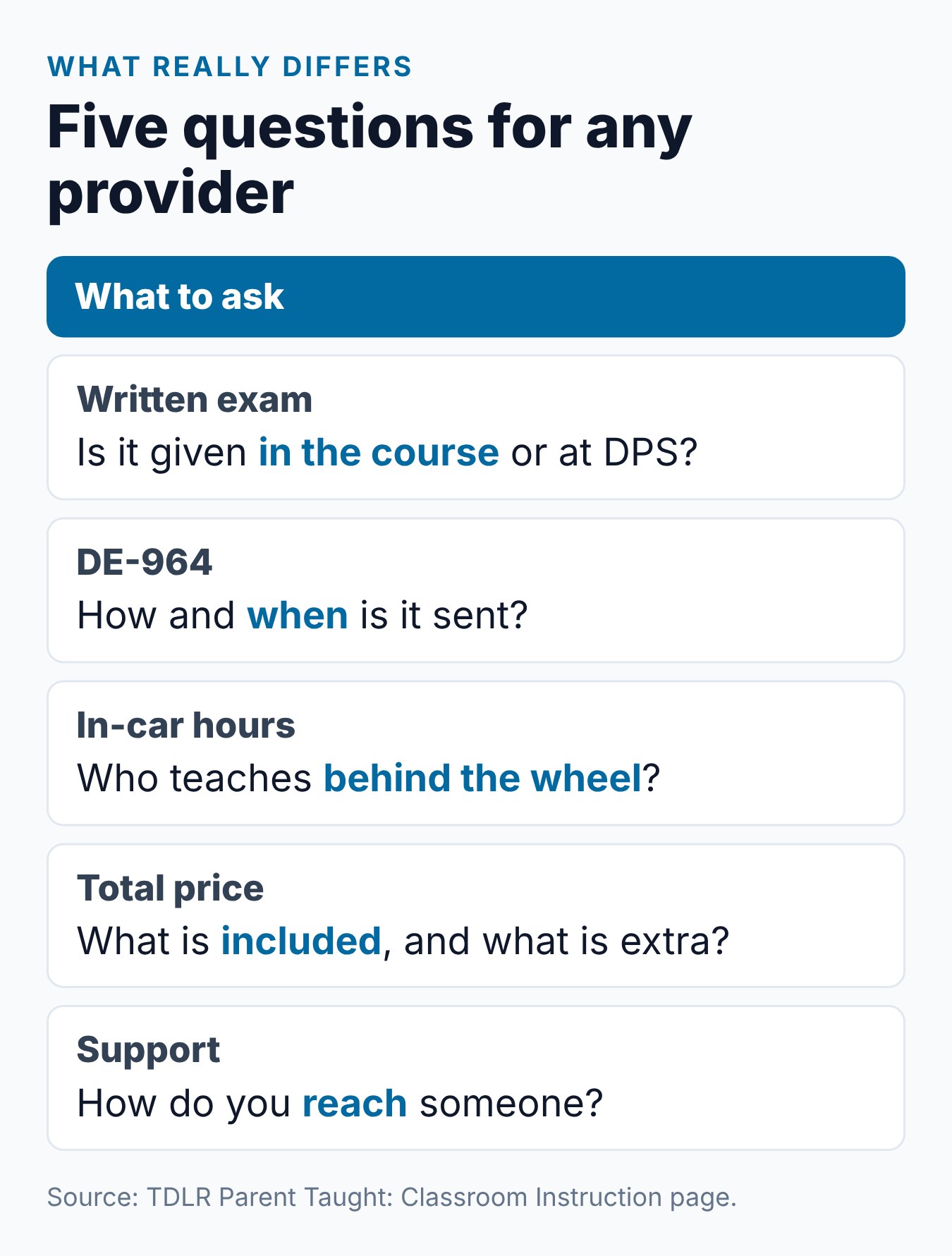
Ask each provider these questions before you pay. These are questions, not facts about any one provider, because each provider sets its own answers.
1. Is the written exam given in the course?
TDLR’s classroom page says the written exam “may be included as part of instruction” by the course provider.
If the provider does not give it, the teen takes the exam at DPS when getting the learner license. Either way works. It only changes where the test happens.
2. How and when is the DE-964 certificate sent?
The student needs the certificate of completion (DE-964) from the course provider to be eligible for the written exam.
Ask how the provider sends it and how long that takes. Ask what you do if it does not arrive.
3. Who does the in-car hours?
In parent-taught, the parent teaches in the car. In a driving school course, ask whether the school’s instructor gives the behind-the-wheel lessons, and how lessons are booked.
4. What is the total price, and what does it include?
No official page lists course prices, so ask the provider for the full amount in writing. Ask whether anything is extra, such as the certificate or the exam.
5. How do you reach support?
Ask how to contact the provider, by phone, email or chat, and when support answers. A course that is valid on paper can still be hard to finish if no one answers.
Write the answers down for each provider. Then compare the answers side by side. That is a fairer test than any “best” label.
What We Found in TDLR’s Search
To see what families face, we read TDLR’s Driver Education Provider Search on November 27, 2026. We left provider names out on purpose.
The search showed 682 entries in total. We looked at the first 20 entries in the default order and counted the course types each one listed:
| Course types listed (first 20 entries, Nov 27, 2026) | Entries |
|---|---|
| In-person types only | 12 |
| Includes “Online for Minors and Adults” | 6 |
| Includes “Parent Taught for Teens” | 6 |
| “Online Exclusively for Adults” as the only type | 1 |
Some entries list more than one type, so the rows overlap. The takeaway is simple.
Most entries in that sample were in-person only, and one was online for adults only. A teen who picks a provider by name alone could land on the wrong kind of course.
This was a small sample on one day. The list changes, so look up any provider yourself before you pay.
Warning Signs Before You Pay
Use the official facts above as a filter. Stop and look again if you see any of these:
- The provider is not in TDLR’s search. A public school course is the one exception TDLR names.
- The only online type is adults only. “Online Exclusively for Adults” is not a teen course.
- The course claims fewer hours than the state minimum. Every teen course has 24 classroom hours and 44 in-car hours.
- The course claims a pace above the daily limit. Instruction is capped at six hours per day.
- The website says the state ranks it. TDLR says its list is not an endorsement.
If a provider will not send the DE-964 after the teen finishes, TDLR gives a next step. Its classroom page says to “email TDLR customer service with the full name of the student and the name of the parent-taught course.”
Common Mistakes When Comparing Courses
These mistakes come straight from the official rules. Each one is easy to avoid once you know it.
- Trusting a “best” badge. No state page ranks teen courses. The badge comes from the seller.
- Buying an adult course for a teen. Check the course type, not just the word “online.”
- Skipping the license lookup. It takes a minute in TDLR’s search, and it is the first filter.
- Comparing hours as if they differ. The 24 classroom hours and 44 in-car hours are the same in every licensed teen course.
- Forgetting the in-car plan. Online classroom work is only part of the course. Decide early who will teach in the car.
- Starting parent-taught lessons too soon. Wait for the TDLR instructor designation and the course materials first.
- Not asking about the exam and certificate. Where the written exam happens and how the DE-964 is sent affect your next steps.
How Requirements Can Vary
Texas driver education rules come from TDLR, and driver license rules come from Texas DPS. They apply statewide, but what you need depends on the student’s age, the course method, and whether the classroom part comes from a parent-taught course, a driving school, or a public school.
Fees, forms, and office procedures can change. Check the TDLR parent-taught pages and the DPS driver license pages before each step, and follow the instructions from your course provider.
Frequently Asked Questions
Is there an official best online drivers ed Texas list?
No official source names one. TDLR licenses providers and says its list is not an endorsement, recommendation, or advertising. The best choice for your family is a TDLR-licensed course of the right teen type with clear answers on the exam, the certificate, the in-car hours, the price and support.
Which course type should a teen pick in TDLR’s search?
A teen should look for “Online for Minors and Adults” or “Parent Taught for Teens.” “Online Exclusively for Adults” and “In-Person Exclusively for Adults” are not teen courses.
Do all licensed teen courses have the same hours?
Yes. Every licensed teen course has 24 classroom hours and 44 in-car hours. The in-car hours are 7 hours of observation, 7 hours behind the wheel and 30 more hours of practice, with at least 10 at night.
Can my teen finish the classroom part in one day?
No. TDLR limits instruction to six hours per day, including no more than two hours of behind-the-wheel instruction. A course that promises less time than that is a warning sign.
Is the written exam part of the online course?
It depends on the provider. TDLR says the exam may be included in the course. If it is not, the teen takes it at DPS when getting the learner license.
Is my public school course in TDLR’s search?
Maybe not. TDLR says public schools may provide driver education courses that are not in its search tool. Ask the school directly.
What if a provider will not send the DE-964?
TDLR says to email TDLR customer service with the student’s full name and the name of the parent-taught course. Keep your receipts and the provider’s answers in writing.
Conclusion
There is no official best online drivers ed course in Texas, and TDLR says its list is not an endorsement. Pick a TDLR-licensed course of the right teen type, then compare providers on the exam, the DE-964, the in-car plan, the total price and support. The hours and the daily limit are the same in every licensed teen course, so use them to spot claims that do not add up. To see what Driving Logic’s Texas teen course covers, visit the texas online drivers ed page.
Related Articles
- Parent Taught Drivers Ed Texas: The Complete PTDE Guide
- Online Drivers Ed Texas DPS Approved: Who Really Approves It
- Parent Taught vs Commercial Teen Drivers Ed in Texas: Which Is Right for Your Family?
- How Much Is Drivers Ed in Texas? State Fees and Course Costs
Sources
- TDLR — Driver Education Provider Search
- TDLR — Parent Taught: Classroom Instruction
- TDLR — Parent Instructors
- TDLR — Parent Taught Program
- Texas DPS — Choosing a Driver Education Course
- TDLR — Parent-Taught Driver Education
- Texas DPS — Texas Learner License as a Teen
- Texas DPS — Texas Provisional License as a Teen
- 16 Tex. Admin. Code § 84.500 — Courses of instruction
Billy Forte is the owner of Driving Logic, a state-approved driver improvement course provider serving Texas and other U.S. states.
This article is general information, not legal advice. Texas driver education and licensing rules are set by TDLR, Texas DPS, and Texas law, and can change. Check the official TDLR and DPS websites for current requirements.