
Updated November 2026 · Reviewed by Billy Forte
There is no single answer to how many points are on a drivers license in the United States, because a license does not come with a set number of points to spend. Each state runs its own system, and in a point system the state adds points to your driving record after you are convicted of a moving violation. The values, how long points count and the totals that lead to action are all set by your own state.
Key Facts
- No national number: a license does not start with points, and each state keeps its own record. See why there is no single number.
- Points follow convictions: in a point system, points are added after a conviction, not at the traffic stop. See how a point system works.
- Indiana example: the BMV says values range from zero to ten and stay active for two years from the conviction date. See the Indiana example.
- New Jersey example: the MVC adds 2 points for a moving violation committed in another state. See the New Jersey example.
- Other states: USA.gov links to the motor vehicle agency of every state. See finding your state’s rules.
Why There Is No Single Number
Many people picture a license that starts with a fixed number of points. You lose some with each ticket until none are left. That is not how point systems work in the two states shown here.
Your license does not hold a point balance. Instead, your state keeps a driving record, and points are added to that record. The more points you collect, the closer you get to the totals where the state steps in.
There is also no national point record. Each state’s motor vehicle agency keeps its own records under its own laws. So the same ticket can count for a different number of points in two states.
That is why a question like “how many points do I have left?” has no answer. The real questions are these:
- How many points has my state added to my record?
- How long do those points count?
- At what total does my state act?
The answers come from your state’s motor vehicle agency, not from a national rule.
How Many Points Are on a Drivers License in a Point System?
The details differ, but the point systems shown in this guide share the same basic parts. Here they are in general terms, without numbers.
- A conviction comes first. Points are tied to a conviction for a moving violation. A ticket alone is a charge, and the points follow the result.
- Each violation has its own value. The state keeps a list, often called a point schedule or point table. More serious violations carry more points.
- Points count for a set time. A state’s rules say how long points stay active or how they come off. After that, they may stop counting toward the totals.
- The state acts at set totals. When the count reaches a level the state sets, it can send a notice, require a course, add a charge or suspend the license.
- Some states offer credits. A state-approved course or a clean period can lower the total, under that state’s rules.
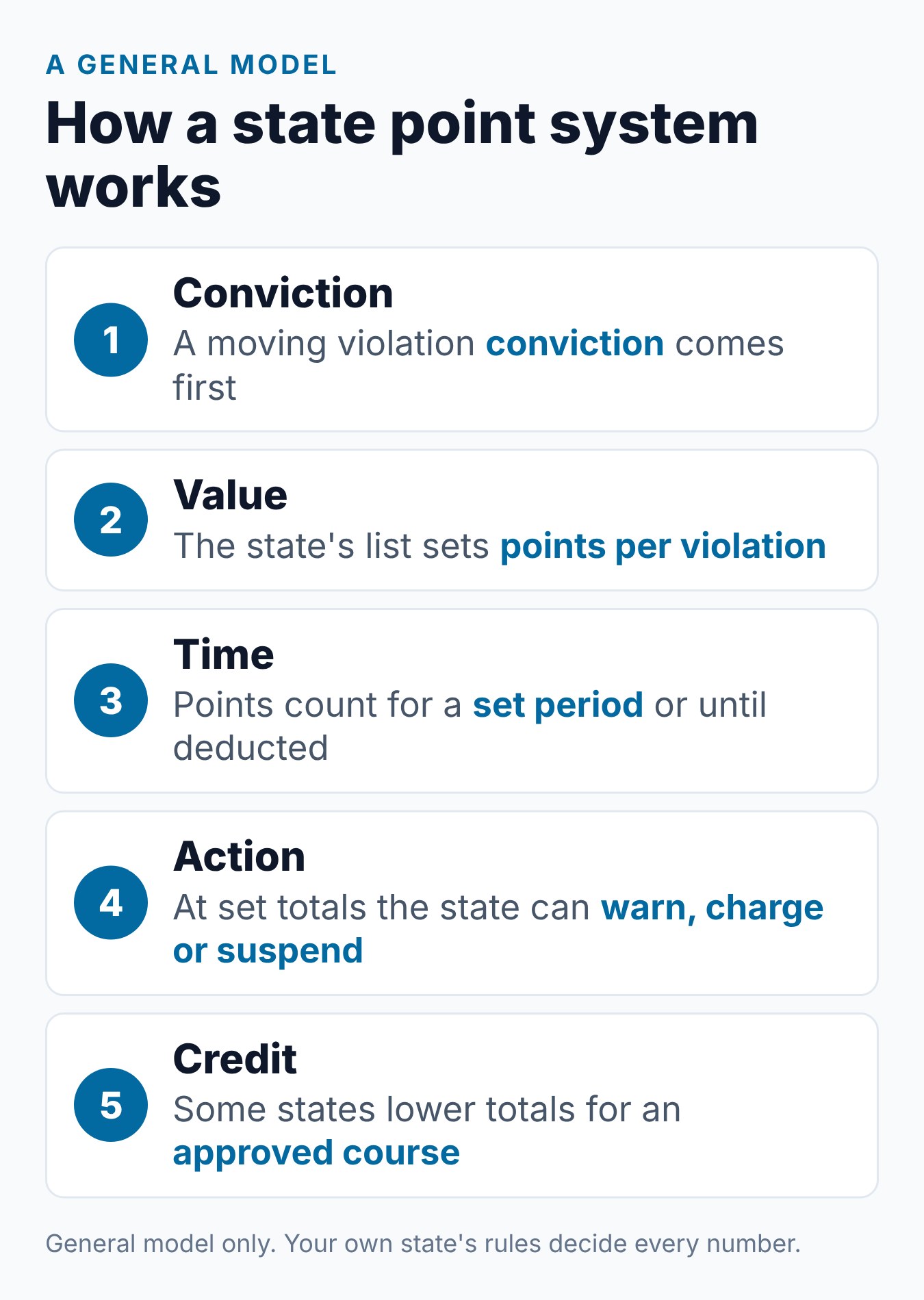
Not every state follows this exact model. Check how your own state handles each step before you rely on any number.
A Worked Example: Indiana
Indiana shows these parts in action. The Indiana Bureau of Motor Vehicles (BMV) keeps each driver’s record.
Points Are Set by Seriousness
The BMV’s Driver Record Points page says Indiana law assesses a point value for each conviction of a moving violation. The value “relates to the seriousness of the offense in posing a risk to traffic safety.”
The same page says point values “range from zero to ten, depending on the violation.” The BMV’s Driver Safety Program page links its point value table to the BMV rule 140 IAC 1-4.5-10.
Points Stay Active for Two Years
The BMV says, “Points stay active on an individual’s driving record for two years from the conviction date.” The clock starts with the conviction, not the ticket.
The record itself holds more than points. The BMV’s Driver Record page says a record shows “current and resolved suspensions, citations, violations and other entries.”
A Course Can Be Required or Chosen
Indiana’s state course is the Driver Safety Program (DSP). The BMV’s Driver Safety Program page sets out when it applies:
- BMV notice: people convicted of two or more traffic offenses within 12 months may be required to take a DSP. Drivers under 21 must take one after two or more traffic offense convictions.
- Deadline: once the BMV mails the notice, the course must be done within 90 days, or driving privileges are suspended.
- Court order: a court may also require a DSP as an alternative to a suspension.
- By choice: any Indiana driver can take a DSP.
Finishing a BMV-approved DSP earns a 4-point credit on the Indiana Official Driver Record. The credit may be applied only once every three years.
The BMV’s FAQ is clear about the limit: completion “will not remove a citation from your driver history.” The credit lowers the total, and the ticket stays on the record.
Every approved course is at least 4 hours, in English and Spanish, by classroom, DVD or online. The BMV’s maximum price for any approved course is $55.
Where the Indiana Totals Are Explained
Indiana’s warning and suspension levels, and the full list of values, are covered in our Indiana BMV points system guide. That guide explains how values are set, how long points stay active and the totals where the BMV sends a warning or suspends a license.
A Second Example: New Jersey
New Jersey also uses a point system, run by the New Jersey Motor Vehicle Commission (MVC). Its rules look different from Indiana’s, which shows why no national number exists.
What the MVC Says About Points
The MVC’s Suspensions and Restorations page has a Points System section. It points readers to the New Jersey Point Schedule and says you can check how many points are on your license by requesting your Driver History.
That page lists a few rules that show how New Jersey’s system works:
- Out-of-state tickets: a moving violation committed outside New Jersey is assessed two points (39:5D-4).
- A permanent record: the MVC “keeps a permanent record of all the points you’ve earned.”
- Deductions: points can come off the total. The MVC lists 3 points for one year with no violations or suspensions, and 2 points for an approved driving course, once every five years.
- Insurance: the page says points may also raise insurance rates, and to ask your insurance carrier.
New Jersey’s Driver History
New Jersey’s record is called a Driver History Abstract. The MVC’s driver history page says it includes New Jersey moving violations, points, accidents and suspensions “for the past five years.”
Our New Jersey points guide sums up the full New Jersey schedule, from the lowest-value violations to the highest. If you drive in New Jersey, you can also see Driving Logic’s New Jersey course.
Indiana and New Jersey Side by Side
This table compares the two example states. Every cell comes from the official pages linked in this guide, read on November 27, 2026.
| Question | Indiana | New Jersey |
|---|---|---|
| Who keeps the record | Bureau of Motor Vehicles (BMV) | Motor Vehicle Commission (MVC) |
| When points are added | For each conviction of a moving violation | Listed with moving violations on your Driver History Abstract |
| How long they count | Active for two years from the conviction date | A permanent record, with deductions for a clean year or a course |
| Points for a ticket in another state | Not stated on the BMV pages we read | Two points for an out-of-state moving violation |
| Where the official list is | BMV rule 140 IAC 1-4.5-10, linked from the BMV | The New Jersey Point Schedule, named on the MVC Points System page |
Why the Numbers Cannot Be Compared
The two states keep separate lists of values and use different rules for how points fade. Indiana points go inactive after two years. New Jersey keeps every point on a permanent record and lowers the total through deductions.
So a total of points means something different in each state. Never use one state’s numbers to judge your record in another.
Other States Driving Logic Explains
Driving Logic has a guide to the point system in these states:
- Florida: Florida driver license points system
- Delaware: Delaware point system
- Tennessee: Tennessee points on license
- Virginia: Virginia DMV points system
For a state not on this list, start with your own state’s motor vehicle agency, as shown below.
How to Find Your State’s Point Rules
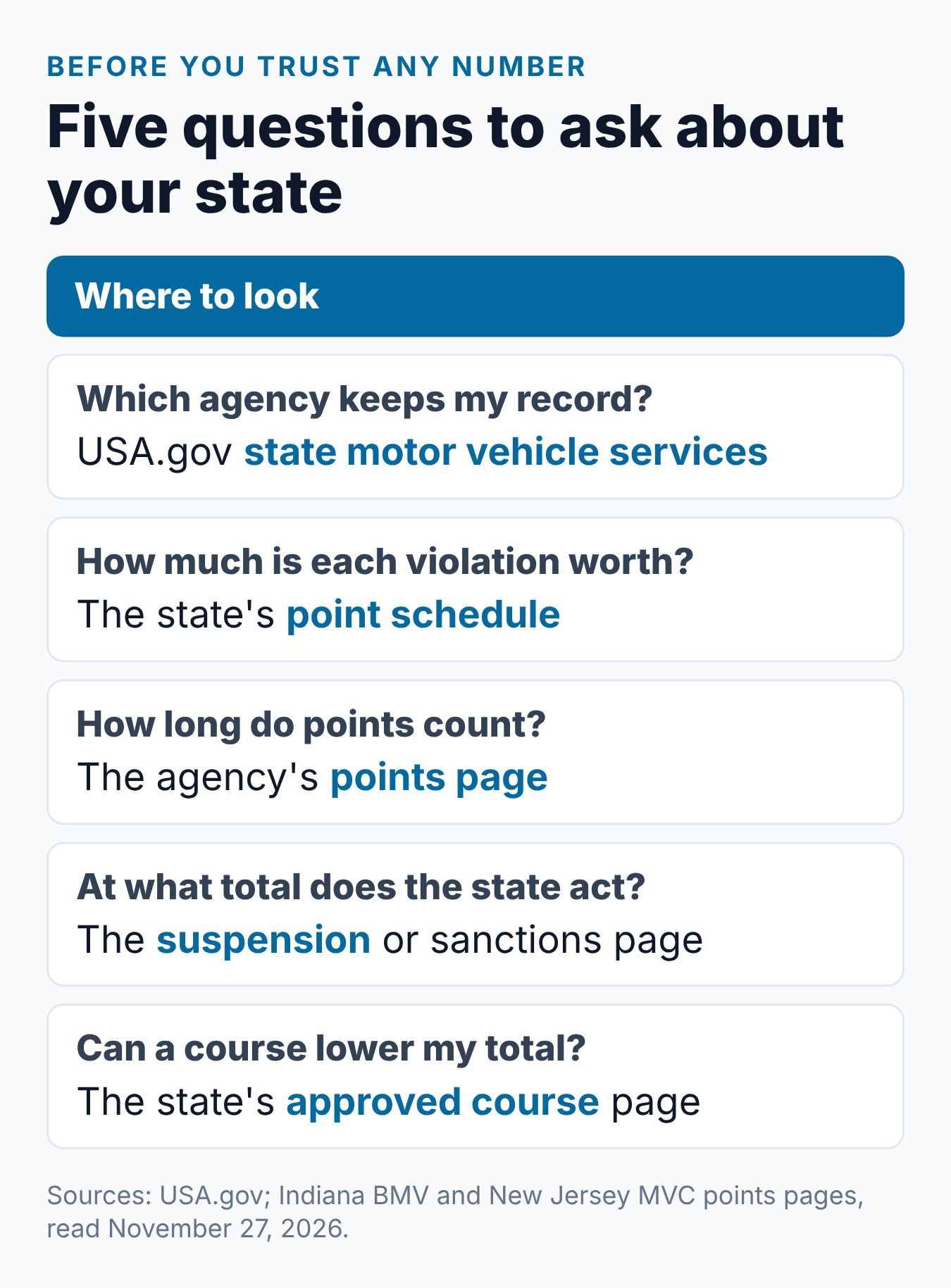
Your state’s motor vehicle agency is the place to start. The USA.gov state motor vehicle services page has a list of every state and territory. Pick yours, and it sends you to that state’s services.
On your state agency’s website, look for these words:
- Point system or driver point system
- Point schedule or point values
- Driving record or driver history
- Suspension or license sanctions
Then answer the three questions from earlier for your state.
How many points does each violation add? How long do they count? At what total does the state act?
What We Found on the Official Pages
On November 27, 2026, we read the Indiana BMV and New Jersey MVC pages linked in this guide. Here is what stood out:
- Different words for the record. Indiana offers a free Viewable Driver Record and a certified Official Driver Record for $4. New Jersey calls its record a Driver History Abstract, and it costs $15.
- Different time rules. Indiana’s points page counts two years from the conviction date. New Jersey’s page describes a permanent record with deductions.
- Spanish courses in Indiana. The BMV says every approved DSP is offered in English and Spanish.
- Driving Logic on the list. The BMV’s list of approved DSP providers included mydrivinglogic.com on the day we checked.
Common Mistakes
Each item below comes from the rules on the official pages above:
- Thinking you start with points. A license has no point balance. Points are added to your record after a conviction.
- Using another state’s numbers. Indiana and New Jersey use different values and time rules.
- Counting from the ticket date in Indiana. The BMV counts two years from the conviction date.
- Ignoring tickets from other states. New Jersey assesses two points for a moving violation committed in another state.
- Ignoring a BMV notice. In Indiana, a required DSP must be done within 90 days of the notice.
- Taking a course that is not approved. Indiana’s 4-point credit is for a BMV-approved DSP.
How Requirements Can Vary
Indiana’s point rules, the 4-point credit and the BMV’s Driver Safety Program order come from state law and BMV rules, and they apply statewide. What you must do still depends on whether you take the course by choice, because of a BMV notice, or under a court order. A court order sets its own deadline and proof steps.
Laws, fees and court practice can change. Check your BMV notice, your court order and the Indiana BMV website for current rules before you enroll or file anything.
Frequently Asked Questions
Does a driver’s license start with a set number of points?
No. A license does not start with a set number of points. In a point system, the state adds points to your record after a conviction for a moving violation.
Is there a national driver’s license point system?
No. Each state keeps its own driving record and sets its own point rules. The USA.gov state motor vehicle services page links to each state’s agency.
How many points is a ticket worth?
It depends on the state and the violation. Indiana’s BMV says its values range from zero to ten, based on how serious the offense is.
How long do points count in Indiana?
The BMV says points stay active for two years from the conviction date. Its Driver Record page says a record shows current and resolved citations and violations.
Do out-of-state tickets add points?
It depends on your home state. New Jersey’s MVC assesses two points for a moving violation committed outside New Jersey.
Can a course lower my points?
In some states, yes. In Indiana, a BMV-approved Driver Safety Program earns a 4-point credit, once every three years. In New Jersey, the MVC lists a 2-point deduction for an approved driving course, once every five years.
Conclusion
A driver’s license does not come with a set number of points, and each state runs its own system. Indiana and New Jersey both add points after a conviction, but their values and time rules differ. In Indiana, you can earn the 4-point credit once every three years with Driving Logic’s indiana driver safety program. If a court ordered your course, check that the order allows an online course.
Related Articles
- Indiana Points on License: How the BMV System Works
- Indiana BMV Demerit Points Chart: How Many Points for Each Violation
- How Long Do Points Stay on Your License in Indiana?
- Indiana License Suspension for Points: Thresholds, What Happens, and How to Reinstate
- How to Check Points on My License: A State Guide
- How Many Points to Lose Your License? Rules by State
Sources
- Indiana BMV — Citation Points & Driver Safety Program
- Indiana BMV — Driver Record Points
- Indiana Code § 9-30-3-12
- Indiana BMV — Driver Record
- New Jersey MVC — Suspensions and Restorations (Points System)
- New Jersey MVC — Driver History Abstract
- New Jersey MVC
- USA.gov — State motor vehicle services
Billy Forte is the owner of Driving Logic, a state-approved driver improvement course provider serving Indiana and other U.S. states.
This article is general information, not legal advice. Indiana BMV rules, court orders, fines and penalties depend on your notice, citation, court and case facts, and they can change. Use official Indiana BMV and court sources, and consult a qualified Indiana attorney for advice about your own case.