
Updated November 2026 · Reviewed by Billy Forte
There is no one answer to how many points to lose your license, because each state sets its own point total and the time window in which those points count. In Indiana, the BMV’s rule suspends a license at 20 active points within 24 months, while New Jersey’s MVC suspends at 12 or more points on your current record. A state can also suspend a license for reasons that have nothing to do with points, such as a missed court date or a lapse in insurance.
Key Facts
- No national total: every state picks its own number and its own counting period. See why there is no one number.
- Indiana: a warning comes at 14 to 18 active points, and a suspension starts at 20 within 24 months. See the Indiana rules.
- New Jersey: 12 or more points on your current record leads to a suspension notice by mail. See the New Jersey rules.
- Not only points: both states also suspend for things like unpaid tickets, insurance problems and DUI. See suspensions that are not about points.
- Near the limit: check your own record and read every notice from your state. See what to do if you are close.
Why There Is No One Number
Each state runs its own driver point system under its own laws. There is no federal point total that applies to every driver. So a question like “how many points to lose your license” always needs a second question: in which state?
Two drivers with the same number of points can face very different results.
One state may count points for two years. Another may keep them on a permanent record and take some off later.
One state may send a warning first. Another may move straight to a notice of suspension.
The two states in this guide show the gap clearly: Indiana’s line is 20 active points, and New Jersey’s line is 12 points. Neither number means anything in a third state.
Your License State Keeps the Count
The state that issued your license keeps your driving record. Its motor vehicle agency adds points, tracks when they stop counting and decides when to act. That agency’s rules are the only ones that set your limit.
If you are not sure which agency runs your state, the USA.gov state motor vehicle services page lists every state and territory. Pick yours to reach its official services.
What Decides the Limit in Any State
Before you trust any number, find four things on your own state’s official site. Each one changes when a license is at risk.
1. The Total
Look for the point total that leads to a suspension. Some states also set a lower total that brings a warning, a fee or a required course. Write down both numbers if your state has them.
2. The Time Window
Ask how long points count toward that total.
A state may count points earned within a set number of months. It may also keep points on the record and lower the total only through deductions. The same total can be easy or hard to reach, depending on the window.
3. Your Age or License Type
Check whether your state treats new, young or probationary drivers differently. Some states use separate rules or programs for them.
4. What Happens First
Find out what the state does before a suspension. It may mail a warning, order a course, add a charge or schedule a hearing. Knowing the first step tells you how much time you may have to respond.
These four checks are the core of this guide. The next two sections answer them for Indiana and New Jersey.
How Many Points to Lose Your License in Indiana
Indiana’s Bureau of Motor Vehicles (BMV) applies a set scale from its rule, 140 IAC 1-4.5-4. Here are the four checks for Indiana.
The Indiana Total
20 or more active points within 24 months brings a suspension.
The count is made after any Driver Safety Program (DSP) credit. At 20 points the suspension is 1 month. Each 2 more points adds 1 more month, up to 12 months at 42 points or more.
The Indiana Time Window
The BMV’s Driver Record Points page says points stay active for two years from the conviction date. After that, they stop counting toward the total. The violation itself stays on the record.
Young Drivers in Indiana
For drivers under 21, Indiana law adds a course rule. Under IC 9-30-3-12, the BMV must order a DSP for a driver under 21 who has twice been the driver in an incident for which points may be assessed while under 21. The course must be finished within 90 days of the BMV’s notice, or driving privileges are suspended.
What Comes First in Indiana
A warning notice comes at 14 to 18 active points, after any DSP credit. The BMV may also require an administrative hearing after three moving offenses in 12 months.
The DSP can lower the count.
The BMV’s Driver Safety Program page says a BMV-approved course earns a 4-point credit on the Indiana Official Driver Record, once every three years. Every approved course is at least 4 hours long. The credit lowers the total, but the course “will not remove a citation from your driver history.”
A BMV-ordered DSP is a separate path. It comes from convictions or judgments, not from points alone. The BMV must order one after two traffic misdemeanor convictions, two traffic judgments, or one of each, for moving violations within any 12-month period.
For the full Indiana suspension scale and how to get a license back, see our guide to Indiana license suspension points, which walks through each step from the warning notice to reinstatement.
How Many Points to Lose Your License in New Jersey
New Jersey’s Motor Vehicle Commission (MVC) explains its rules on its Suspensions and Restorations page. Here are the same four checks for New Jersey.
The New Jersey Total
The MVC says that if you get 12 or more points on your current driving record, your license will be suspended. You will receive a notice of scheduled suspension by mail.
The New Jersey Time Window
The MVC page does not give a time window for the 12-point rule. It says the MVC keeps a permanent record of all the points you have earned. Points come off the total only through deductions:
- 3 points for one year with no violations or suspensions.
- 2 points for an MVC-approved driving course, once every five years.
- 3 points for the Driver Improvement Program, once every two years, in response to MVC proposed action.
- 3 points for the Probationary Driver Program, one time, when the MVC orders it.
New Drivers in New Jersey
The MVC lists the Probationary Driver Program as a deduction that can be completed one time when the MVC orders a driver to attend. The page does not give a separate point total for new drivers.
What Comes First in New Jersey
A charge can come before a suspension. The MVC says 6 or more points within three years on your current record brings a surcharge. At 12 or more points, the first step is the notice of scheduled suspension.
The MVC also says a moving violation committed outside New Jersey is assessed two points. Our guide to NJ license suspension points explains how New Jersey drivers reach the 12-point line and what the suspension notice means. If you drive in New Jersey, you can also see Driving Logic’s New Jersey course.
Indiana and New Jersey at a Glance
This table puts the two states’ suspension rules next to each other. Each cell comes from the official pages named in the last row, read on November 27, 2026.
| Rule | Indiana | New Jersey |
|---|---|---|
| Total that leads to a suspension | 20 or more active points, after any DSP credit | 12 or more points on your current driving record |
| Period counted | Within 24 months; points stay active two years from the conviction date | No window stated; the MVC keeps a permanent record and allows deductions |
| What comes before a suspension | A warning notice at 14 to 18 active points | A surcharge at 6 or more points within three years, then a notice of scheduled suspension |
| Length of a points suspension | 1 month at 20 points, up to 12 months at 42 or more | Not stated on the MVC Suspensions and Restorations page |
| Official page | BMV rule 140 IAC 1-4.5-4 and the BMV Driver Record Points page | MVC Suspensions and Restorations page |
Reading the Table
New Jersey’s total is lower, but that does not make it the stricter state for every driver.
Indiana counts only active points from the last 24 months. New Jersey keeps points on a permanent record and takes some off with deductions. A driver’s real risk depends on how fast the points add up and how the state counts them.
Suspensions That Are Not About Points
Points are only one way to lose a license. Both states list other reasons on their official pages, and none of them waits for a point total.
The Indiana BMV’s Suspensions and Reinstatements pages list reasons such as these:
- Failure to appear or pay: missing a court date on a citation, or not paying a ticket after a judgment.
- Insurance: not having proof of financial responsibility when the BMV asks for it.
- Habitual traffic violator status: this is based on court judgments over a set number of years, not on points.
- Operating while intoxicated: a failed or refused chemical test, or a conviction, can lead to a suspension.
- A missed BMV-ordered DSP: the course must be done within 90 days of the notice.
New Jersey’s MVC Suspensions and Restorations page also covers suspensions for uninsured motorists and for DUI. It says tickets and suspensions are processed through New Jersey municipal courts, and the MVC must follow the court’s actions on the driver history record.
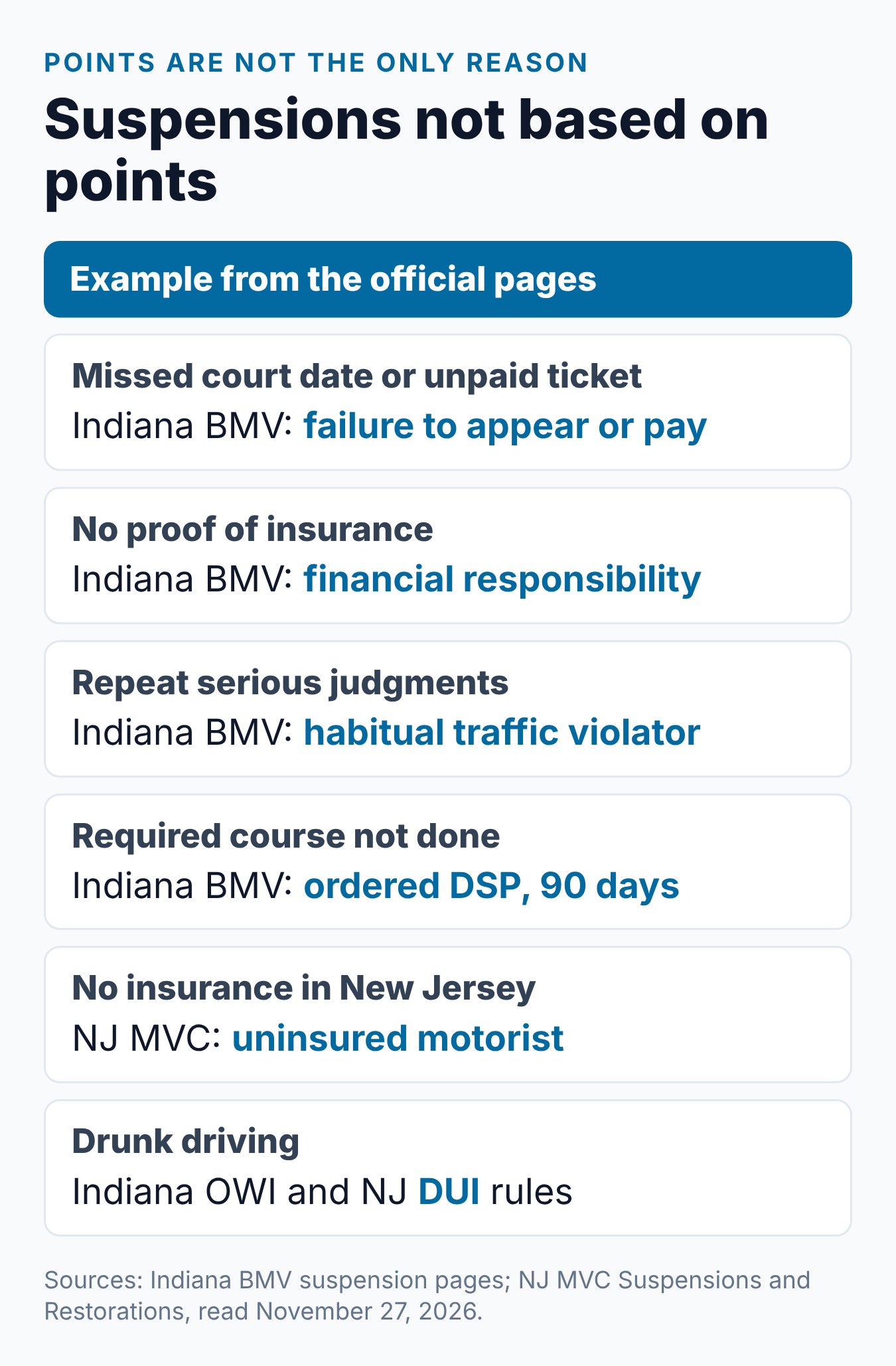
So a driver with very few points can still lose a license. Read any notice for the exact reason, because the reason decides what you must do to get the license back.
Other States With a Driving Logic Suspension Guide
Driving Logic has a points suspension guide for these states. Each one uses that state’s own official pages:
- Arizona: Arizona license suspension points
- Delaware: How many points suspend a license in Delaware
- Florida: Florida license suspension points
- Missouri: Missouri license suspension points
- Tennessee: Tennessee license suspension points
- Virginia: Virginia license suspension points
In any other state, go to your state’s motor vehicle agency through the USA.gov page linked above. Look for its pages on points, suspensions or driver records.
If You Are Close to the Total
Being close to your state’s line is the time to get facts, not guesses. These steps use only what the official pages say.
- Get your own record. Do not count points from memory. Our guide on how to check points on my license shows where to find your record in Indiana, New Jersey and other states.
- Count only what your state counts. In Indiana, that means active points from the last 24 months, after any DSP credit. In New Jersey, it means points on your current record after deductions.
- Read every notice. A warning, a course order or a notice of scheduled suspension sets dates that matter.
- Meet each deadline. In Indiana, a BMV-ordered DSP must be done within 90 days of the notice.
- Ask the agency or the court. If a notice is unclear, contact the agency that sent it. For a court case, ask the court or an attorney.
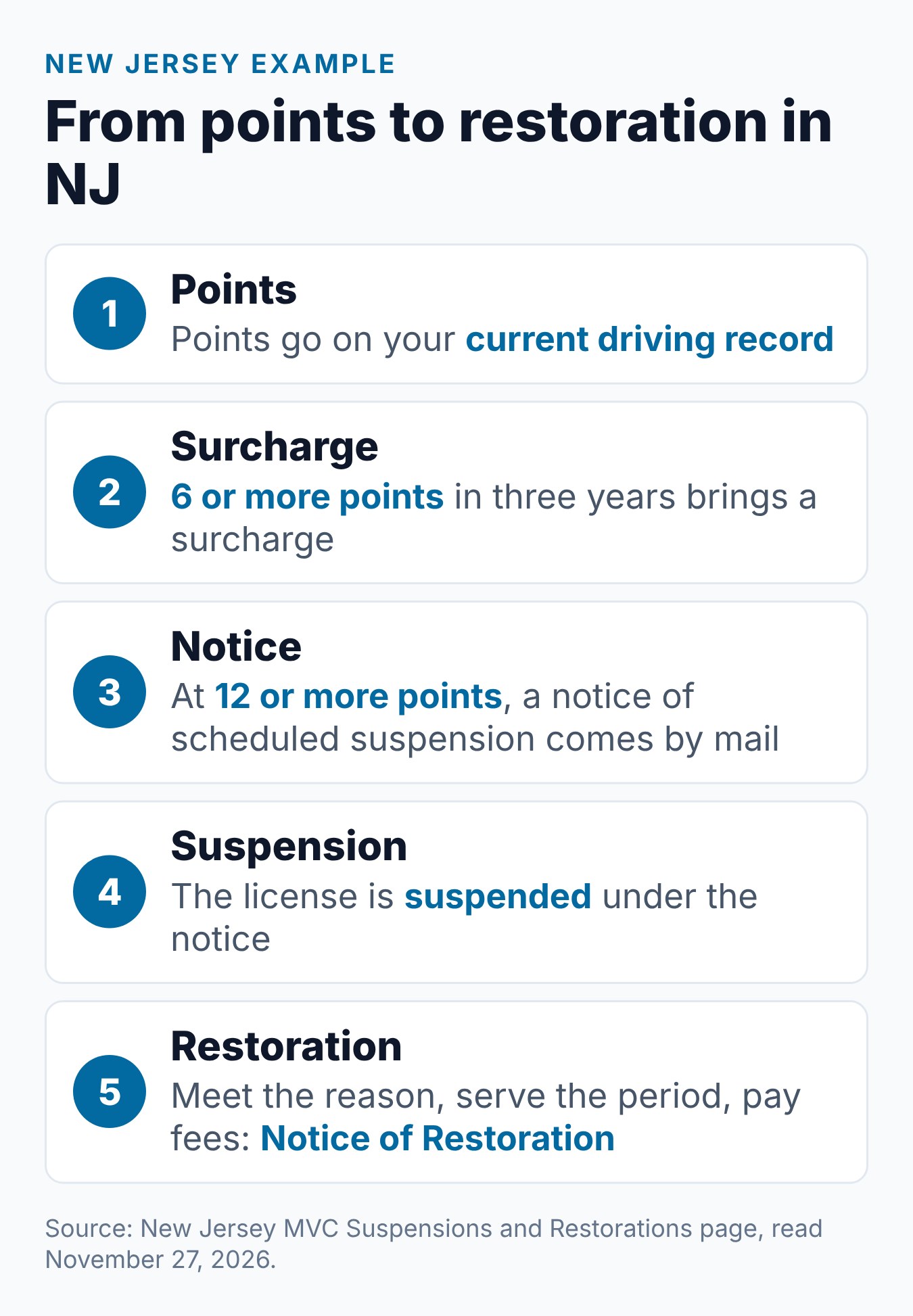
In New Jersey, the MVC says you will receive a Notice of Restoration once you have satisfied the reason for the suspension, completed any suspension period and paid the required fees.
What We Found on the Official Pages
On November 27, 2026, we read the Indiana BMV and New Jersey MVC pages linked in this guide and compared how each one answers the suspension question:
- The totals are far apart. Indiana’s rule starts suspensions at 20 active points. New Jersey’s page says 12 or more points.
- Only Indiana gives a set length. Indiana’s scale runs from 1 month at 20 points to 12 months at 42 or more. The MVC’s Suspensions and Restorations page does not list a length for a points suspension.
- Different first steps. Indiana sends a warning notice at 14 to 18 points. New Jersey adds a surcharge at 6 or more points within three years.
- Both list non-point suspensions. Each agency’s suspension pages cover insurance problems, court actions and drunk driving, separate from points.
Common Mistakes
Each item below comes from the official rules covered in this guide:
- Using one state’s number in another state. Indiana’s 20 and New Jersey’s 12 apply only in those states.
- Counting old Indiana points. Indiana counts points that are still active, which is two years from the conviction date.
- Counting from the ticket date. In Indiana, the two years start at the conviction date.
- Thinking a course erases a ticket. The BMV says the DSP “will not remove a citation from your driver history.”
- Ignoring a warning or course notice. A missed BMV-ordered DSP leads to a suspension after 90 days.
- Thinking low points mean a safe license. Unpaid tickets, missing insurance proof and DUI can suspend a license with no points involved.
How Requirements Can Vary
Indiana’s point rules, the 4-point credit and the BMV’s Driver Safety Program order come from state law and BMV rules, and they apply statewide. What you must do still depends on whether you take the course by choice, because of a BMV notice, or under a court order. A court order sets its own deadline and proof steps.
Laws, fees and court practice can change. Check your BMV notice, your court order and the Indiana BMV website for current rules before you enroll or file anything.
Frequently Asked Questions
How many points to lose your license in any state?
There is no single number. Each state sets its own total and the period it counts. Indiana suspends at 20 active points within 24 months, and New Jersey at 12 or more points on the current record.
Do I get a warning before a suspension?
It depends on the state. Indiana’s rule sends a warning notice at 14 to 18 active points. New Jersey’s MVC mails a notice of scheduled suspension at 12 or more points.
How long does a points suspension last in Indiana?
It starts at 1 month at 20 points. Each 2 more points adds a month, up to 12 months at 42 points or more.
Can I lose my license with only a few points?
Yes. Both states list suspensions that are not based on points. In Indiana these include failing to appear or pay, insurance problems and habitual traffic violator status.
Does a driving course stop a suspension?
A course does not erase a conviction. In Indiana, a BMV-approved DSP earns a 4-point credit once every three years, and the count is made after that credit. In New Jersey, the MVC lists point deductions for approved programs, each with its own limits.
Do points from another state count?
The rules differ by state. New Jersey’s MVC says a moving violation committed outside New Jersey is assessed two points. For Indiana, see our Indiana suspension guide linked above.
Conclusion
How many points it takes to lose your license depends on your state: 20 active points within 24 months in Indiana, and 12 or more points in New Jersey. Find your own state’s total, its time window and its first step before you rely on any number. In Indiana, you can earn the 4-point credit once every three years with Driving Logic’s indiana driver safety program. If a court ordered your course, check that the order allows an online course.
Related Articles
- Indiana Points on License: How the BMV System Works
- Indiana License Suspension for Points: Thresholds, What Happens, and How to Reinstate
- How Many Points Are on a Drivers License? By State
- How to Check Points on My License: A State Guide
- Drivers License Points Chart by State: Where to Look
Sources
- Indiana BMV — Citation Points & Driver Safety Program
- Indiana BMV — Driver Record Points
- Indiana Code § 9-30-3-12
- Indiana Administrative Code 140 IAC 1-4.5 (BMV point rules)
- Indiana BMV — Suspensions and Reinstatements
- New Jersey MVC — Suspensions and Restorations (Points System)
- New Jersey MVC
- USA.gov — State motor vehicle services
Billy Forte is the owner of Driving Logic, a state-approved driver improvement course provider serving Indiana and other U.S. states.
This article is general information, not legal advice. Indiana BMV rules, court orders, fines and penalties depend on your notice, citation, court and case facts, and they can change. Use official Indiana BMV and court sources, and consult a qualified Indiana attorney for advice about your own case.