
Updated November 2026 · Reviewed by Billy Forte
There is no single drivers license points chart for the United States: each state publishes its own chart of point values, usually on its motor vehicle agency’s website or in its rules. The same violation can be worth a different number of points from one state to the next. In Indiana, for example, following too closely is 6 points under BMV rule 140 IAC 1-4.5-10, while New Jersey’s MVC Point Schedule lists tailgating at 5 points.
Key Facts
- No national chart: each state sets its own point values, so use only your own state’s chart. See why there is no national chart.
- Where to look: start at your state’s motor vehicle agency and look for its point system or point schedule page. See how to find your chart.
- How to read it: match the violation name on your ticket, then check the speed, the place and the date. See how to read a chart line.
- Indiana: point values run from 0 to 10, and the full table is in BMV rule 140 IAC 1-4.5-10. See the Indiana chart.
- New Jersey: the MVC’s Point Schedule lists most moving violations at 2 to 5 points. See the New Jersey chart.
Is There a National Drivers License Points Chart?
No. There is no federal points chart that applies to every driver. Each state that uses points writes its own list, gives each violation its own value and decides what those points lead to.
That is why two charts can disagree about the same ticket. A speeding ticket, a red light or a tailgating ticket can each carry a different number of points in another state.
A chart from one state also tells you nothing about the rules in a third state. So the first thing to know about any points chart is which state wrote it.
Your License State Keeps the Record
The state that issued your license keeps your driving record and adds points to it. Its chart is the one that matters for your license.
Indiana’s rule shows how this works for a ticket from another state. Under 140 IAC 1-4.5-10, the BMV assesses points for out-of-state violations reported by another state when an equivalent violation exists in Indiana. The value comes from the Indiana table, not from the other state’s chart.
New Jersey takes a simpler route. Its MVC says a moving violation committed outside New Jersey is assessed two points.
How to Find Your State’s Points Chart
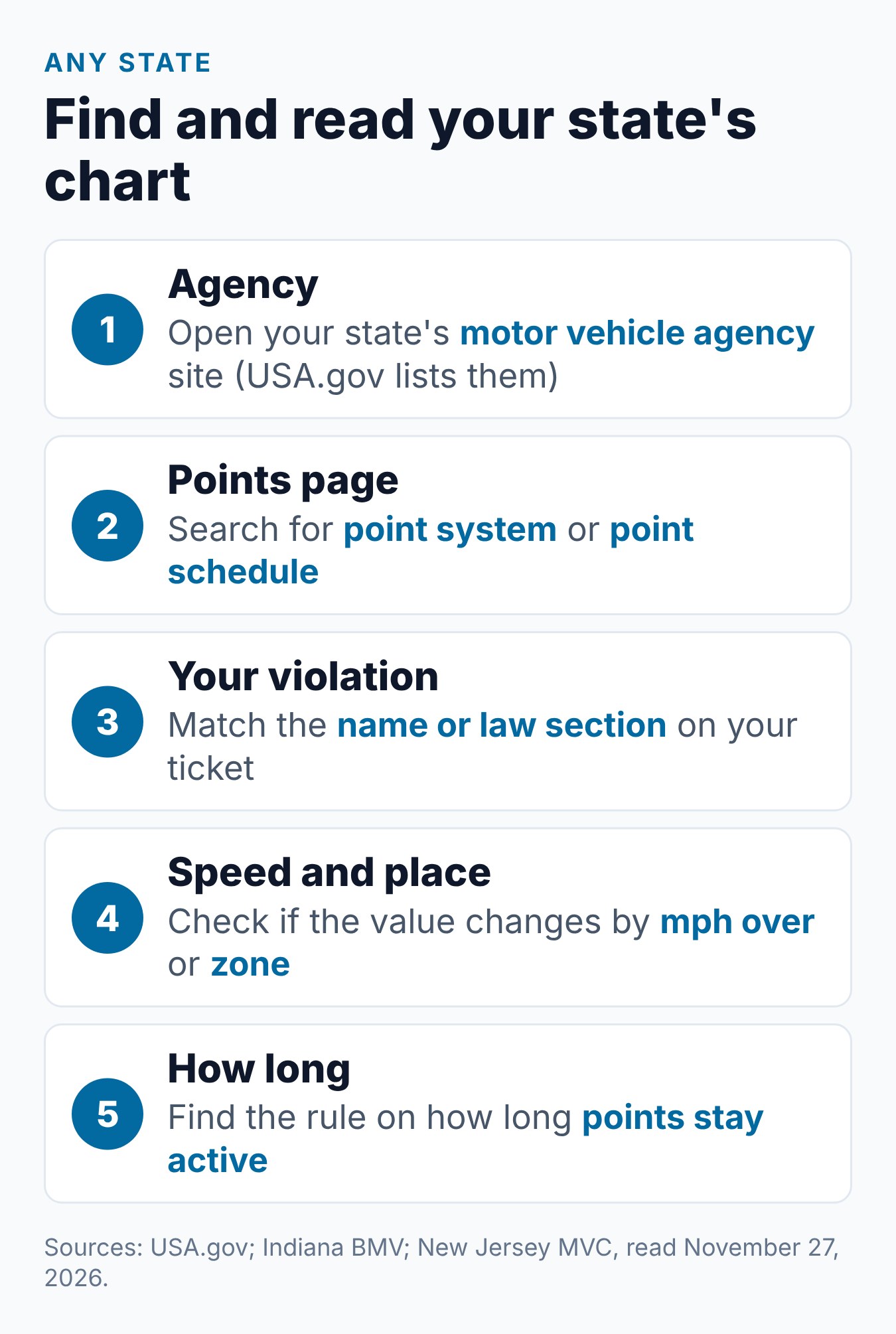
Each state posts its chart in its own place. These steps work in any state:
- Find your state’s motor vehicle agency. The USA.gov state motor vehicle services page lists every state and territory. Pick yours to reach its official site.
- Look for the points page. Search the agency’s site for “point system,” “point schedule,” “points chart” or “driver record points.”
- Find your violation by name. Use the words printed on your ticket, not a nickname for the offense.
- Check whether the value changes. Many charts give different points for different speeds or for special places, such as a school zone.
- Check how long the points count. A chart tells you the points for one violation. A separate rule says how long those points stay active.
Where the Chart Often Lives
Some states put the full chart on an agency web page. Others keep it in a state rule or statute and link to it.
Indiana does the second.
The BMV’s Driver Safety Program page has a “View the Point Value Table” link that leads to the BMV rule. New Jersey does the first. The MVC’s Suspensions and Restorations page links to its New Jersey Point Schedule, a web page with the full list.
How to Read a Points Chart Line
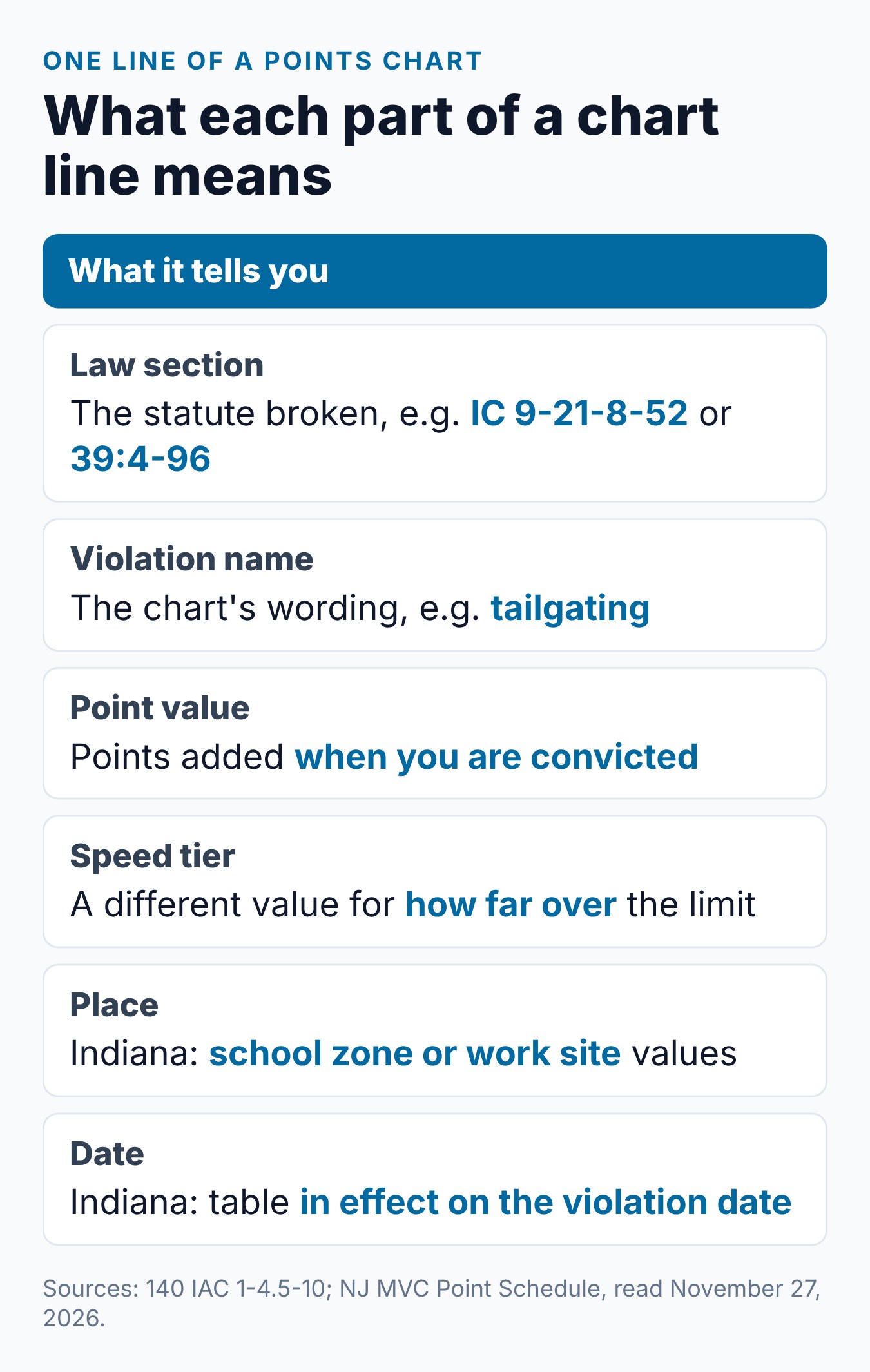
Most charts have the same three parts on each line. Once you know them, any state’s chart is easier to read.
The Law Section
Each line usually names the law that was broken. Indiana’s table lists an Indiana Code cross reference, such as IC 9-21-8-52 for reckless driving. New Jersey’s schedule lists an N.J.S.A. section, such as 39:4-96 for reckless driving.
This is the most exact way to match a ticket. Your ticket or court record often shows the same section number.
The Violation Name
The name on the chart may not match the words people use. New Jersey’s schedule says “tailgating.” Indiana’s table says “following too closely.” Both describe driving too close to the car ahead.
If you can’t find your offense by name, search for the law section instead.
The Point Value
The number is the points added to your record when you are convicted. In Indiana, the BMV’s Driver Record Points page says point values “range from zero to ten, depending on the violation.”
Speed, Place and Date
Some lines split into several values. Indiana gives speeding four values on a regular road and different values in a school zone or a work site. New Jersey gives speeding three values by how far over the limit you went.
The date matters too. Indiana’s rule says the point value comes from the table in effect on the date the violation was committed. If the table changes later, an older ticket keeps the value it had.
The Indiana Points Chart
Indiana’s point values are set by the Bureau of Motor Vehicles (BMV) in Table 1 of 140 IAC 1-4.5-10. These are some of the moving violations drivers ask about most, read from that rule on November 27, 2026:
| Indiana moving violation | Indiana points |
|---|---|
| Speeding, amount over the limit not shown | 2 |
| Speeding 1 to 15 mph over the limit | 2 |
| Speeding 16 to 25 mph over the limit | 4 |
| Speeding more than 25 mph over the limit | 6 |
| Speeding in a school zone or work site, 1 to 15 mph over | 4 |
| Speeding in a school zone or work site, 16 to 25 mph over | 6 |
| Speeding in a school zone or work site, more than 25 mph over | 8 |
| Following too closely | 6 |
| Disregarding a traffic control signal | 4 |
| Failing to yield, or to obey a stop or yield sign | 4 |
| Using a phone or other telecommunications device while driving | 4 |
| Reckless driving | 6 |
| Reckless driving that damages property | 8 |
| Reckless driving that causes bodily injury | 10 |
| Reckless operation in a highway work zone | 8 |
| Passing a school bus while it loads or unloads | 8 |
| Operating while intoxicated (OWI) | 8 |
| OWI causing serious bodily injury or death | 10 |
In a school zone or work site, a speeding ticket that does not show the speed is 4 points. Indiana’s rule also says property damage or injury is not assumed for reckless driving. The court record must show it before the higher value applies.
Points don’t stay active forever. The BMV says points stay active on a driving record for two years from the conviction date.
For the rest of Table 1, grouped by type of violation, see our Indiana BMV demerit points chart. It lists the equipment, lane, passing and emergency-vehicle lines that this summary leaves out.
The New Jersey Points Chart
New Jersey’s Motor Vehicle Commission (MVC) publishes the New Jersey Point Schedule, linked from its Suspensions and Restorations page. These lines were read on the MVC’s schedule on November 27, 2026:
| New Jersey violation (N.J.S.A. section) | New Jersey points |
|---|---|
| Speeding 1 to 14 mph over the limit (39:4-98) | 2 |
| Speeding 15 to 29 mph over the limit (39:4-98) | 4 |
| Speeding 30 mph or more over the limit (39:4-98) | 5 |
| Tailgating (39:4-89) | 5 |
| Reckless driving (39:4-96) | 5 |
| Careless driving (39:4-97) | 2 |
| Failure to observe traffic signals (39:4-81) | 2 |
| Failure to observe stop or yield signs (39:4-144) | 2 |
| Improper passing of a school bus (39:4-128.1) | 5 |
| Handheld phone while driving, third offense within 10 years of the second and later (39:4-97.3) | 3 |
| Leaving the scene of an accident with personal injury (39:4-129) | 8 |
| Moving violation committed out of state (39:5D-4) | 2 |
The schedule notes that no points are assessed for a red light camera violation. It also lists points for “driving in an unsafe manner” only for a third or later offense within five years.
For more of New Jersey’s schedule and what each common violation is worth, see our guide to NJ points on license by violation. If you drive in New Jersey, you can also see Driving Logic’s New Jersey course.
Why the Two Charts Can’t Be Compared Number for Number
The two charts above use different scales, and their states act at different totals. A 6 in Indiana and a 5 in New Jersey are not “almost the same,” because each number only means something next to its own state’s totals for warnings, charges and suspensions. So read a point value only against your own state’s rules, and see our guide on how many points it takes to lose your license for those totals.
The Same Ticket on Both Charts
This table lines up a few similar violations from the two charts above. It shows how far apart the values can be, not how they compare in effect.
| Kind of violation | Indiana chart | New Jersey chart |
|---|---|---|
| Lowest speeding tier | 2 (1 to 15 mph over) | 2 (1 to 14 mph over) |
| Highest speeding tier | 6 (more than 25 mph over) | 5 (30 mph or more over) |
| Driving too close to the car ahead | 6 (following too closely) | 5 (tailgating) |
| Reckless driving, no damage or injury shown | 6 | 5 |
| Passing a stopped school bus | 8 | 5 |
| Running a traffic signal | 4 | 2 (0 for a red light camera) |
Other States With a Driving Logic Points Chart
Driving Logic has a points chart guide for these states. Each one uses that state’s own official pages:
- Florida: Florida traffic violation points chart
- Missouri: Missouri points chart by violation
- Tennessee: Tennessee demerit points chart
In any other state, use the USA.gov state motor vehicle services page linked above. Open your state agency’s site and search it for its point schedule.
What We Found on the Two Official Charts
On November 27, 2026, we read Indiana’s Table 1 in 140 IAC 1-4.5-10 and the New Jersey MVC Point Schedule side by side. Here is what stood out:
- Different top values. Indiana’s highest value is 10, for lines such as reckless driving that causes bodily injury. The highest New Jersey value we found was 8, for leaving the scene of an accident with personal injury.
- Different speeding tiers. Indiana splits at 15 and 25 mph over the limit. New Jersey splits at 14 and 29 mph over.
- Place matters only in Indiana’s speeding lines. Indiana adds separate school zone and work site values. New Jersey’s speeding line has no separate school zone value.
- Repeat-only points in New Jersey. New Jersey adds points for handheld phone use only from a third offense, and for driving in an unsafe manner only from a third offense within five years. Indiana’s phone line is 4 points.
- A zero line. New Jersey’s schedule lists 0 points for a red light camera violation. Indiana’s BMV says its values range from zero to ten.
Common Mistakes When Reading a Points Chart
Each item below comes from the official charts and rules covered in this guide:
- Using a chart from the wrong state. Only your license state’s chart sets your points.
- Using a national chart from an unofficial site. No such official chart exists, so check your state agency instead.
- Matching by nickname. Search by the law section on your ticket if the name doesn’t match.
- Ignoring the speed tier. In both states, the points for speeding depend on how far over the limit you were.
- Missing the place. In Indiana, a school zone or work site changes the speeding value.
- Assuming points last forever. In Indiana, points stay active for two years from the conviction date.
- Thinking a course erases a ticket. The Indiana BMV says completing a Driver Safety Program “will not remove a citation from your driver history.”
How Requirements Can Vary
Indiana’s point rules, the 4-point credit and the BMV’s Driver Safety Program order come from state law and BMV rules, and they apply statewide. What you must do still depends on whether you take the course by choice, because of a BMV notice, or under a court order. A court order sets its own deadline and proof steps.
Laws, fees and court practice can change. Check your BMV notice, your court order and the Indiana BMV website for current rules before you enroll or file anything.
Frequently Asked Questions
Is there one drivers license points chart for all states?
No. Each state publishes its own chart, and the same violation can carry different points in different states. Use only your own state’s chart.
Where do I find my state’s points chart?
Start at your state’s motor vehicle agency. The USA.gov state motor vehicle services page links to each one, and the agency’s points or point schedule page has the chart or a link to it.
How many points is a speeding ticket?
It depends on the state and the speed. In Indiana, 1 to 15 mph over is 2 points on a regular road. In New Jersey, 1 to 14 mph over is 2 points.
Do points from another state’s chart go on my record?
Your license state decides. Indiana uses the value of the equivalent Indiana violation, and New Jersey assesses two points for a moving violation committed out of state.
Where is Indiana’s official points chart?
It is Table 1 of BMV rule 140 IAC 1-4.5-10. The BMV’s Driver Safety Program page links to it as the Point Value Table.
How long do points from the chart count in Indiana?
The BMV says points stay active for two years from the conviction date. The violation itself stays on the driving record.
Conclusion
A drivers license points chart is always a state chart, so find your own state’s chart before you trust any number. Match the violation by name or law section, then check the speed, the place and the date. In Indiana, a BMV-approved indiana driver safety program earns a 4-point credit once every three years, but it does not remove the citation. If a court ordered your course, check that the order allows an online course.
Related Articles
- Indiana Points on License: How the BMV System Works
- How Many Points Are on a Drivers License? By State
- How to Check Points on My License: A State Guide
Sources
- Indiana BMV — Citation Points & Driver Safety Program
- Indiana BMV — Driver Record Points
- Indiana Code § 9-30-3-12
- Indiana Administrative Code 140 IAC 1-4.5-10 (BMV point value table)
- New Jersey MVC — Suspensions and Restorations (Points System and Point Schedule link)
- New Jersey MVC
- USA.gov — State motor vehicle services
Billy Forte is the owner of Driving Logic, a state-approved driver improvement course provider serving Indiana and other U.S. states.
This article is general information, not legal advice. Indiana BMV rules, court orders, fines and penalties depend on your notice, citation, court and case facts, and they can change. Use official Indiana BMV and court sources, and consult a qualified Indiana attorney for advice about your own case.