
Updated June 2026 · Reviewed by Billy Forte
Florida BDI and ADI courses are different because BDI is usually for less serious traffic cases like eligible moving violations, while ADI is a 12-hour course usually required after more serious or repeated driving problems, license suspensions, revocations, or court orders. In Florida, Basic Driver Improvement is commonly tied to an election for a traffic citation when allowed, but Advanced Driver Improvement is often connected to getting back or keeping driving privileges after a suspension, Habitual Traffic Offender status, or other state-required action under FLHSMV. Which course applies can depend on the citation, county, court, judge, case type, and any instructions from the clerk, court, or Florida Department of Highway Safety and Motor Vehicles.
This article covers Florida requirements only.
Key Facts
- Course type: Florida Basic Driver Improvement is the 4-hour BDI / traffic school course used for eligible tickets and some court orders.
- Approval: Use an FLHSMV-approved provider when the course is tied to a Florida citation or court requirement.
- Points: Eligible BDI election can help prevent points from being assessed for the current citation, but it does not erase old points.
- Deadlines: Clerk, court, or judge instructions control the election, completion, and certificate filing deadline.
- Online option: You can complete the course online when the provider and your instructions allow it.
What The Florida Advanced Driver Improvement Course Is And When It Is Required
The Florida Advanced Driver Improvement course, often called ADI, is a 12-hour state-approved class for drivers dealing with more serious license issues than a standard traffic ticket. If you are comparing BDI vs ADI Florida, the clearest difference is purpose: BDI is generally used for eligible minor traffic matters, while ADI is used when the state, a court, or a reinstatement process requires a higher-level course.
In Florida, ADI may be required when your license has been suspended for points, when you have been labeled a Habitual Traffic Offender (HTO) for non-DUI reasons, when a judge orders the course, or when your case falls under a special rule tied to crashes or reinstatement. Florida’s driver improvement course information from FLHSMV and traffic statutes such as Florida Statutes Chapter 322 make clear that these course types serve different roles.
That matters because ADI is not a substitute for BDI, and BDI is not a substitute for ADI. If your notice, court paperwork, or FLHSMV record says Advanced Driver Improvement, you should follow that instruction exactly. And if you were told to complete Basic Driver Improvement, taking ADI instead usually does not fix that mismatch.
Before you enroll, check the wording on your citation, suspension notice, court order, or clerk instructions. Eligibility, deadlines, fees, and filing steps can vary based on the county, court, judge, case type, and the reason your driving privilege was affected.
Who Usually Has To Take The 12-Hour ADI Course In Florida
Most people who take ADI in Florida are not doing it for a routine speeding ticket. They are usually dealing with a license suspension, revocation, court order, or repeated traffic history.
You may be told to complete the advanced driver improvement course Florida drivers take if one of these applies:
- You have a points-based suspension
- You were declared a Habitual Traffic Offender for non-DUI violations
- A court ordered ADI as part of your case
- Your license issue involves a serious crash-related suspension
- You need ADI as part of a hardship license or reinstatement process
This is where people often get confused. A driver may think, “Traffic school is traffic school.” In Florida, that is not how it works. The state uses different courses for different situations. BDI is generally shorter and used in more limited ticket situations. ADI is longer and tied to more serious licensing consequences.
If you are unsure which course you need, the safest source is the paperwork that controls your case: your court order, clerk instructions, suspension letter, or FLHSMV notice. County court pages and clerks may also publish local guidance, but the exact procedure can still depend on your judge and case type. If your issue involves a hardship request, reinstatement, or HTO status, ADI is far more likely than BDI to be the required class.
Point Suspensions, Hardship Licenses, And The Three Crashes In Three Years Rule
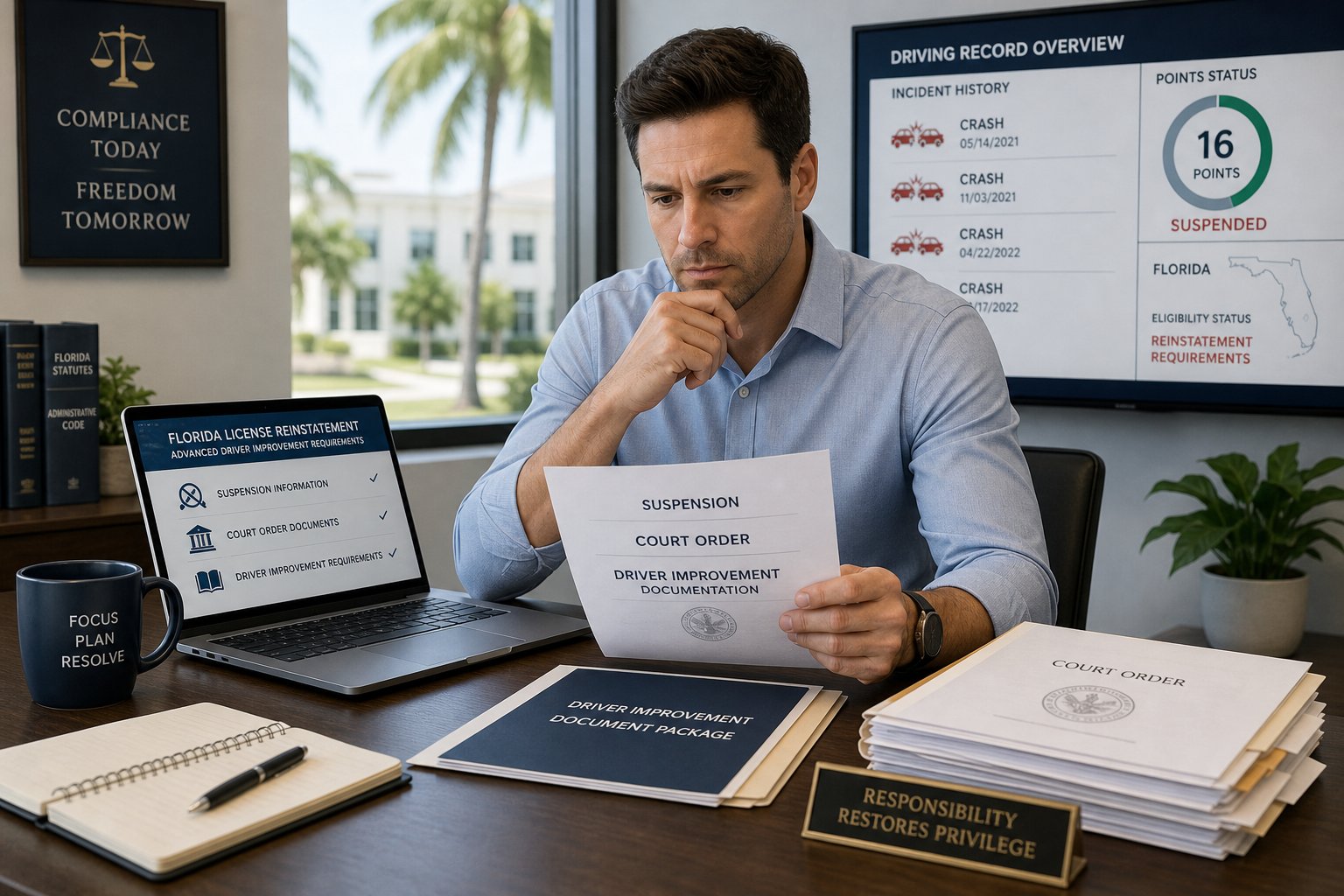
One of the most common reasons people end up in ADI is a point suspension. Florida can suspend your license after too many points in a set time period, and ADI may be required before you can move forward with reinstatement or limited driving privileges. The official driver license handbook and FLHSMV materials explain how points affect suspension status and driving privileges.
A related issue is the hardship license. In many Florida cases, you must enroll in ADI first and use the enrollment proof when applying for a hardship license that allows limited driving, such as for work or school. But the exact process can vary. Clerk instructions, hearing requirements, fees, and eligibility may depend on the county, the type of suspension, and FLHSMV rules. That is why it is important not to guess.
Florida also has the three crashes in three years rule for certain drivers. Under that rule, a driver may need to complete ADI, complete behind-the-wheel training, and pass an extended driving test within the required time frame or face cancellation of the license. This is a good example of why ADI and BDI should never be treated as interchangeable. A BDI course does not cover the same legal role in that type of case.
If your notice mentions points, hardship privileges, HTO, or multiple crashes, read every line carefully and confirm what the state or court requires before choosing a course.
How The Florida ADI Course Works From Enrollment To Certificate
The Florida ADI course is usually offered online and self-paced, which helps if your schedule is packed. In most cases, the course is 12 hours long. Many providers break it into sections or modules, and you can usually log in and out instead of finishing it all at once.
After enrollment, some providers issue an enrollment certificate. That can matter if you are applying for a hardship license and need proof that you have started the required class. Later, after you complete the course and any required test, the provider processes a completion certificate. Depending on the provider and your case, that certificate may be sent electronically to the proper agency, made available for download, or both.
Course rules can include time controls. For example, some approved providers require a 24-hour break after the first 6 hours. Many also give you a set completion window, often up to 90 days from registration. Those rules are important if you are trying to meet a court or reinstatement deadline.
For busy drivers, an online course can make a hard situation easier. Driving Logic’s platform is built around flexible access on your phone, tablet, or computer, with progress saving between sessions. Still, convenience is only part of the decision. Make sure the course is the correct Florida-approved ADI course for your exact requirement, not a different class with a similar name.
What You Learn In An Advanced Driver Improvement Class
ADI is not just a longer version of a basic traffic class. It is designed for drivers whose records or cases show a need for deeper review of safe driving habits, legal duties, and the real cost of risky choices.
Most Florida ADI courses cover topics like:
- Defensive driving skills
- Hazard awareness and crash prevention
- Florida traffic laws and driver responsibilities
- How points, suspensions, and Habitual Traffic Offender status work
- The effect of unsafe driving on other people, finances, and insurance
- Attitude, judgment, and behavior behind the wheel
The goal is practical. The course is meant to help you understand not only what the law says, but also how repeated mistakes build into bigger license problems. That is one of the biggest differences from BDI. A basic course may focus on safer day-to-day choices after a routine citation. ADI goes further into repeat violations, suspension risks, and responsibility when your driving record is already causing serious trouble.
Because providers present the material in different ways, one course may use more reading while another uses quizzes or section checks. But the state-approved purpose stays the same: helping drivers correct patterns that can lead to long-term loss of driving privileges.
How Long You Have To Complete ADI And What Happens After You Finish
In many Florida cases, you have up to 90 days from registration to finish an ADI course, but that does not mean every case works the same way. Your deadline may depend on the court order, suspension notice, county procedure, judge, or the type of case. If your paperwork gives a date, that date controls.
The timing can be even stricter under the three crashes in three years law, where required steps must be completed within the state’s deadline or your license can be canceled. And completing ADI may be only one part of what you need to do. Some drivers also must serve a suspension period, pay reinstatement fees, complete testing, or satisfy other FLHSMV conditions before they can get full driving privileges back.
After you finish the course, keep copies of your records and confirmation. Do not assume one agency automatically updated another unless your provider and your instructions clearly say that will happen. If your case is in court, the clerk or court may have its own process. If your matter is with FLHSMV, the department may have separate reinstatement steps.
If you were actually told to take Basic Driver Improvement instead of ADI, you can enroll in the Florida Basic Driver Improvement course online through Driving Logic and complete it on a flexible schedule.
How To Choose An Online Florida ADI Course That Fits A Busy Schedule
If you need ADI, the right online course should do two things well: meet Florida’s approval rules and fit real life. That sounds simple, but it saves a lot of stress.
Start with the basics:
- Confirm the provider offers a Florida-approved ADI course
- Make sure it is fully online and works on your devices
- Check whether you can log in and out anytime
- Look for clear information about the 90-day window and any required course breaks
- See how the certificate is handled after completion
- Review the full price so there are no surprises
For busy people, small features matter. A mobile-friendly course is easier to finish during breaks, evenings, or while waiting for appointments. Saved progress matters too, because few drivers have 12 open hours in one block.
If your issue is not ADI but BDI vs ADI Florida confusion, slow down and verify your requirement before paying. The wrong class can waste time when you are already up against a deadline. Use your official notice first, then confirm with the court, clerk, or FLHSMV if needed through sources like Florida Courts or the relevant county clerk site.
And if your paperwork calls for BDI rather than ADI, Driving Logic offers a flexible Florida Basic Driver Improvement course built for people who need a simple online path to completion.
This information is general and not legal advice.
FAQ
Is the Florida BDI course online?
Yes. Florida BDI may be completed online when you use an approved provider and your court or clerk instructions allow it. Always check the citation or court order before enrolling.
Does BDI remove old points from my license?
No. BDI does not erase old points or remove a prior conviction. For an eligible current citation, traffic school election may help prevent points from being assessed.
Do I still need to follow the clerk deadline?
Yes. The course is only one part of the process. You must follow the county clerk, court, citation, or judge deadline that applies to your case.
Related Articles
- Florida Basic Driver Improvement (BDI) Course: The Complete Guide
- How the 4-Hour Florida BDI Course Works Online
- Florida Traffic School vs. Defensive Driving vs. BDI: Are They the Same Thing?
- FLHSMV-Approved BDI Providers: What It Means and How to Verify Your Course
Sources
- FLHSMV — Basic Driver Improvement Course Providers
- FLHSMV — Driver Improvement Schools
- Florida Statute 318.14 — Noncriminal Traffic Infractions
- Florida Clerks of Court
Billy Forte is the owner of Driving Logic, a state-approved driver improvement course provider serving Florida and other U.S. states. Driving Logic offers FLHSMV-approved online BDI courses for drivers handling traffic tickets, court orders, and state requirements.
This article is general information, not legal advice. Eligibility, deadlines, court acceptance, and filing steps depend on the citation type, county, court, judge, and the facts of your case. Use official Florida court and state sources for current requirements, and consult a qualified Florida attorney for legal guidance specific to your situation.