
Updated November 2026 · Reviewed by Billy Forte
The best Florida drivers license practice test material is the state’s own: FLHSMV tells applicants to study the Official Florida Driver License Handbook, and that handbook ends with an 84-question Study Guide for Knowledge Exam. The real Class E Knowledge Exam has 50 multiple-choice questions, and you must answer 40 of them correctly, which is 80 percent. The plan below matches your practice to the handbook, section by section, and shows where FLHSMV says each study guide answer is found.
Key Facts
- The state’s own practice material: an 84-question study guide at the end of the official handbook. See the state’s own practice material.
- No answer key, but page numbers: FLHSMV posts a file that lists the handbook page for each answer. See how the answer file works.
- The real exam: 50 questions, 40 correct to pass, in English only. See the real exam in brief.
- Sections that matter most: handbook sections 3 through 10. See the practice plan.
- An older edition: the handbook is marked rev. 08/2023 and misses two newer rules. See what the handbook does not cover yet.
- Spanish readers: a Spanish handbook exists, but the exam is in English. See practicing in Spanish.
What a Florida Drivers License Practice Test Really Is
People use three names for the same thing. A “drivers license practice test,” a “Florida Class E Knowledge Exam practice test” and a “permit practice test” all mean practice for one exam. That exam is the Class E Knowledge Exam.
Some people also call it the DMV test, but Florida’s official agency is FLHSMV, the Department of Highway Safety and Motor Vehicles. County tax collectors run most of the driver license offices.
Our article on the Florida permit practice test explains how to use practice tests to find your weak topics. This article does a different job. It ties your practice to the official handbook, one section at a time.
The Real Exam in Brief
FLHSMV’s Class E Knowledge Exam and Driving Skills Test page gives the rules for the real exam:
- Length. The exam has 50 multiple-choice questions.
- Subjects. The questions are about Florida traffic laws, safe driving practices and identifying traffic controls.
- Passing score. You need 40 correct answers out of 50, which is 80 percent.
- Language. The page says Class E knowledge examinations are available in English only.
FLHSMV does not publish how many of the 50 questions come from each part of the handbook. One county office gives a split. The Manatee County Tax Collector lists the Class E exam as 45 road rules questions and 5 road signs questions.
The exam is taken in person at a service center, or online through approved third-party administrators for applicants under 18. FLHSMV’s fee page lists a knowledge retest at $10.00, and a $6.25 service fee may apply in a tax collector office. Someone who passes with a third-party administrator can be picked at random for a no-fee retest at an office.
Our guide to the Florida permit test covers test day, costs and what happens after you pass.
The State’s Own Practice Material
FLHSMV’s exam page gives one line of study advice. It says to study the Official Florida Driver License Handbook and take the Class E Knowledge Practice Test.
The page names that practice test but gives no details about it. On the day we read the page, the words were plain text and not a link. So this article does not describe its length or format.
The handbook is different, because every page of it is public. FLHSMV’s Handbooks and Manuals page links the handbook as a PDF. The same page also links it in Apple Books and Google Play.
| Official material | What it is | What it does not give you |
|---|---|---|
| Official Florida Driver License Handbook | 11 sections, marked rev. 08/2023 | Rules that changed after August 2023 |
| Study Guide for Knowledge Exam | Section 11 of the handbook, with 84 numbered questions | Printed answers |
| Study Guide Answer Locations | A 3-page FLHSMV file with the handbook page for each question | The answers themselves |
| Class E Knowledge Practice Test | Named on FLHSMV’s exam page | Any detail on the page we read |
The Study Guide for Knowledge Exam
Section 11 of the handbook is called Study Guide for Knowledge Exam. It has 84 numbered questions. No answers are printed under them.
The questions are open questions, not multiple choice. Two of them show the style. Question 1 asks, “In your vehicle, what should you adjust before you start your engine?” Question 84 asks, “What maneuvers are required on a driving exam?” Both are quoted from the Official Florida Driver License Handbook.
The study guide is a study tool from the state. FLHSMV does not say that these 84 questions are the questions on the real exam. The real exam is multiple choice, so expect different wording.
The Answer Locations File
The top of the study guide says answers are available at flhsmv.gov/handbooks-manuals. That address leads to the Handbooks and Manuals page. On it, FLHSMV links a file called Study Guide Answer Locations.
The file is three pages long and is marked “Updated: 5/2024.” It lists all 84 questions. Next to each one is the page, or pages, of the 2023 handbook where the answer is found.
So the state does not hand you an answer key. It hands you a page number, and you find the answer by reading. That is why we print no answer key here.
The Handbook’s 11 Sections
The table of contents lists 11 numbered sections. The page numbers below are the ones printed in the rev. 08/2023 edition.
| Section | Official title | Starts on page |
|---|---|---|
| 1 | Driver Licenses & ID Cards | 3 |
| 2 | Driving Schools & Test Providers | 17 |
| 3 | Your Driving Privilege | 23 |
| 4 | Before You Drive—You the Driver | 33 |
| 5 | Before You Drive—Your Vehicle | 37 |
| 6 | Traffic Controls | 43 |
| 7 | Driving Safety | 59 |
| 8 | Special Driving Situations | 71 |
| 9 | Handling Emergencies | 75 |
| 10 | Sharing the Road | 81 |
| 11 | Study Guide for Knowledge Exam | 91 |
Sections 1 and 2 explain how licensing, courses and testing work. Sections 3 through 10 hold the laws, the safe driving advice and the traffic controls. Those eight sections are where most of your practice time should go.
Practice Plan by Handbook Section
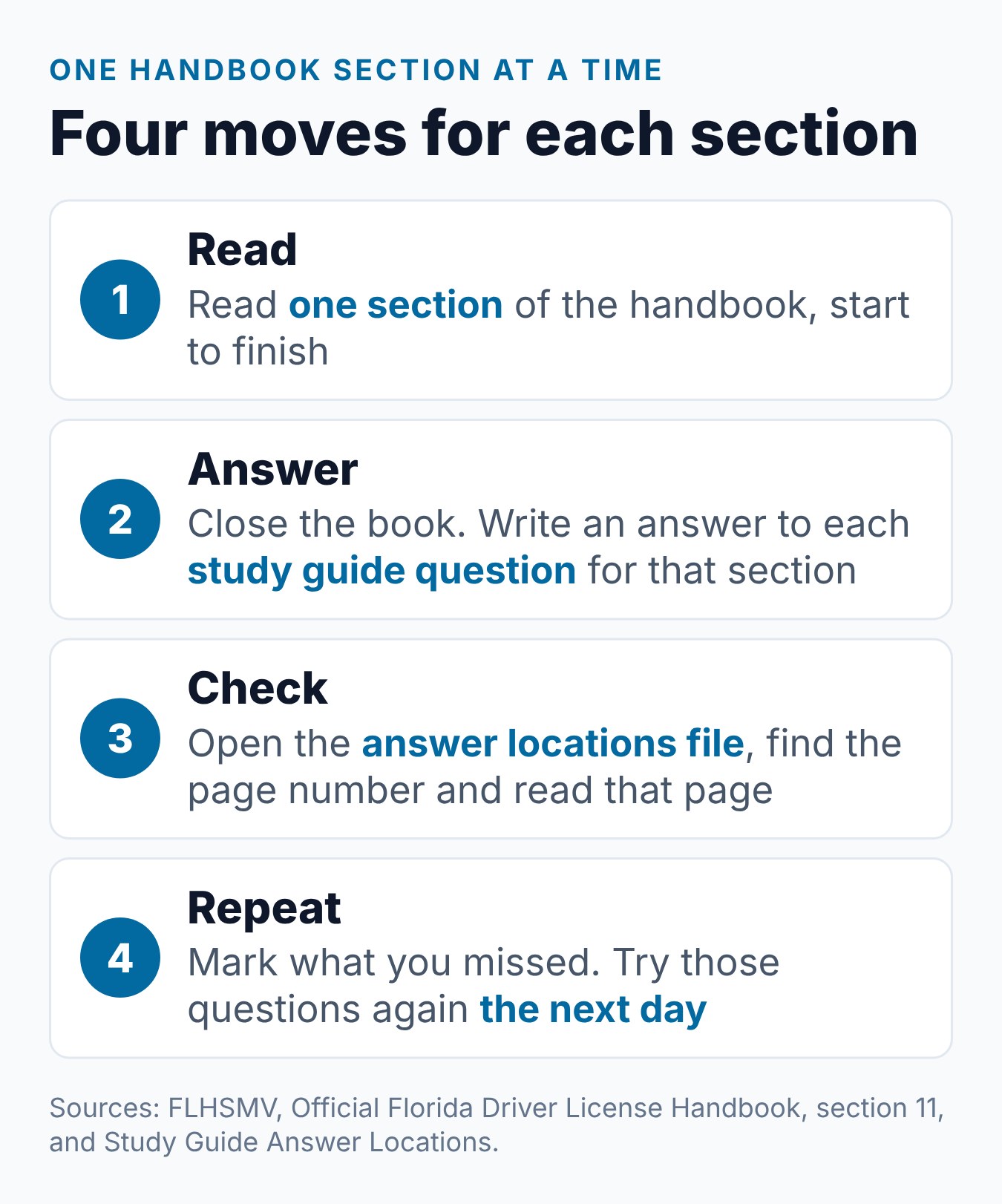
Use the same four moves for every section. They work because the study guide has no answers printed next to the questions.
- Read one section of the handbook from start to finish.
- Answer from memory. Close the handbook and write an answer to each study guide question that belongs to the section.
- Check each answer. Open the answer locations file, find the page for the question and read that page.
- Repeat the missed ones. Mark each question you got wrong and try it again the next day.
FLHSMV does not label handbook sections by exam subject. The match between each section and the three exam subjects below is our own reading of the table of contents.
Section 3: Your Driving Privilege
This section supports the traffic laws part of the exam. It covers insurance laws, driving curfews for minors, DUI, safety belts, speeding, the point system and how a license is lost.
Study guide questions that point here ask about safety belts and child seats, the No-Fault Law, time limits for teen drivers and DUI penalties. Many of the answers are numbers, such as ages, hours and lengths of time. Write each number down as you check it.
Section 4: Before You Drive—You the Driver
This section supports safe driving practices. Its topics are physical health, distracted driving, drinking and driving, drowsy driving, drugged driving, emotions and road rage.
The study guide asks why drowsy driving is dangerous and what to do about a threatening driver. It also asks about the kinds of distraction and how alcohol affects a driver. These are “why” questions, so practice saying the reason out loud.
Section 5: Before You Drive—Your Vehicle
This section supports traffic laws, because it lists what Florida requires on a vehicle. It covers registration, equipment standards, brake systems, bumper height, and trailers, towing and loads.
Study guide questions that point here ask about windshields and windows, bumper height and how to carry and mark a load. The section is short. Read it in one sitting, then answer its questions at once.
Section 6: Traffic Controls
This section supports the third exam subject, identifying traffic controls. It covers pavement markings, traffic signs, traffic signals and special signs for construction, drawbridges, pedestrians, railroad crossings and school zones.
The study guide asks what line colors and line patterns mean, what sign colors mean and what each signal tells a driver to do. Practice by covering the text and naming each sign from its picture. Learn the English words on the signs, because the exam is in English.
Section 7: Driving Safety
This is the longest stretch of driving rules. It supports both traffic laws and safe driving practices. Its topics include blind spots, braking distance, following distance, intersections, roundabouts, limited access highways, the Move Over Law, parking, passing, right-of-way, speed limits, traffic lanes and turning.
In the answer locations file, more study guide questions point to this section than to any other. That fact is about the study guide, not about the real exam. Split this section into two or three sittings, and check each answer before you move on.
Section 8: Special Driving Situations
This section supports safe driving practices. It covers animals, low visibility, rain and night driving.
Study guide questions that point here ask when headlights must be used, when to dim high beams and how to drive on wet roads. Several answers are distances in feet. Add them to your number list.
Section 9: Handling Emergencies
This section supports safe driving practices and some traffic laws. It covers defensive driving, contact with law enforcement, what a driver must do after a crash and a list of emergency scenarios.
The study guide asks what to do when wheels leave the pavement, when tires skid and when a tire blows out. It also asks about a driver’s duties after a crash. Practice these as steps in order, since the order matters.
Section 10: Sharing the Road
This section supports both traffic laws and safe driving practices. It covers bicyclists, commercial motor vehicles, emergency vehicles, motorcycles and mopeds, pedestrians, school buses and school crossings.
Study guide questions that point here ask who must stop for a school bus, how much room to give a bicyclist and what a “No Zone” is. Many are yes-or-no questions about who must stop or yield. For each one, also learn the reason.
Sections 1, 2 and 11
Sections 1 and 2 are about getting a license, not about driving. A few study guide questions near the end point to them. They ask about supervised driving hours, required courses, health reporting and the driving test.
Section 11 is the study guide itself. After you finish sections 3 through 10, go through all 84 questions in one sitting. Mark the ones you still miss and reread only those pages.
What We Found in the Study Guide
On November 26, 2026, we read the handbook’s study guide next to FLHSMV’s answer locations file. Four things stood out.
- The questions do not follow section order. Question 1 points to page 59, which is in section 7. The next few point to section 5, then section 4, then section 3.
- The question numbers do not always match. The handbook asks about following distance in one question, and the answer file splits it into two. The file then joins two parking questions into one. So from question 37 through question 46 of the handbook, the same question is one number higher in the file.
- Some answers are in two places. The file gives two separate pages for a few questions, such as the one about a “No Zone.”
- One answer is out of date for teens. The question about the required education course points to pages 8 and 17. Page 17 names the TLSAE course, and the DETS rule for applicants under 18 is newer than the handbook.
The practical lesson is to match questions by their wording, not by their number. Then read every page the file lists.
What the Handbook Does Not Cover Yet
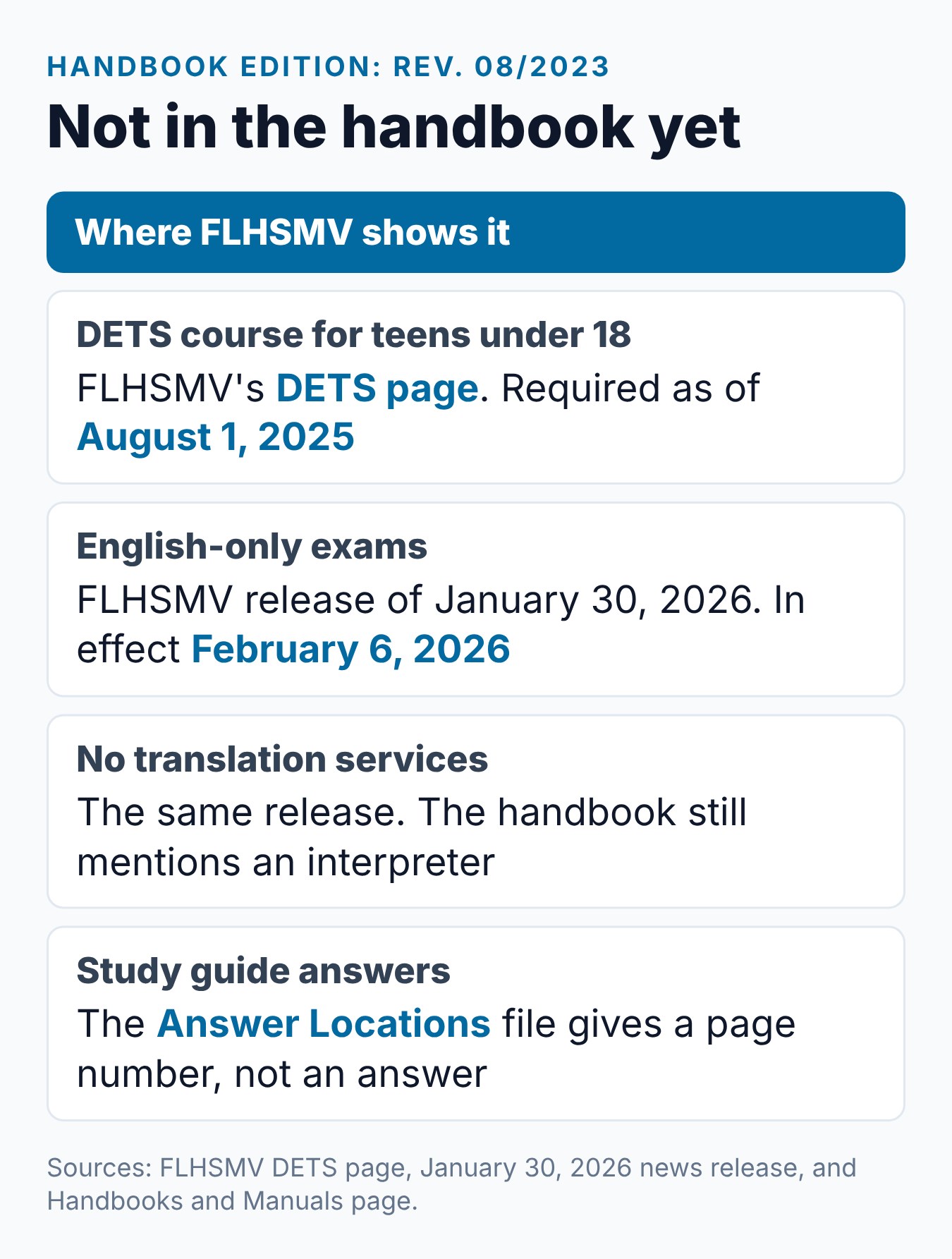
The handbook on FLHSMV’s website is marked rev. 08/2023 on its pages. Two rules that matter to new drivers are newer than that.
The first is the DETS course. As of August 1, 2025, anyone under 18 who has never held a driver license from any other state, country or jurisdiction must complete a 6-hour DETS course before applying for a license in Florida. FLHSMV explains it on its DETS page.
The handbook does not mention DETS. Its section 2 still names the TLSAE course for every first-time applicant.
The second is the language rule. FLHSMV announced on January 30, 2026 that, beginning Friday, February 6, 2026, all driver license knowledge and skills examinations are given exclusively in English. The handbook’s driving test page still mentions a language interpreter.
So use the handbook for the rules of the road. For rules newer than the handbook, use FLHSMV’s web pages.
Practicing If You Read Spanish
FLHSMV publishes a Spanish edition, the Manual Oficial de Licencias de Conducir de Florida. It is also marked rev. 08/2023 and has the same 11 sections. Its section 11, “Guía de Estudio del Examen de Conocimientos,” has the same 84 questions in Spanish.
The Spanish edition helps a Spanish-speaking reader learn the rules. It does not change the language of the exam. FLHSMV’s release says language translation services are no longer permitted for knowledge or skills examinations.
So practice the English wording of signs and rules as well. This rule could change again, so check with FLHSMV or your tax collector office before your test.
Where the DETS Course Fits
The DETS course and the knowledge exam are two separate requirements. A teen under 18 who has never been licensed completes the 6-hour DETS course before applying for a license. The teen must also pass the knowledge exam.
Finishing the course does not replace the exam. The course is also not a practice test for it. Keep studying the handbook after the course ends.
DETS is for teens under 18. Adults 18 and older who have never been licensed take a different course, called TLSAE.
Common Mistakes to Avoid
Each of these mistakes comes from skipping something the official sources say:
- Looking for an answer key. FLHSMV posts page numbers, not answers. Read the page.
- Matching by question number. The handbook and the answer file number some questions differently.
- Treating the study guide as the exam. FLHSMV does not say the 84 questions are the exam questions.
- Trusting the handbook for the newest rules. It predates the DETS course and the English-only exam rule.
- Studying only in Spanish. The exam is given in English.
- Skipping sections 3 and 5. Insurance, license and equipment rules are traffic laws too.
- Counting on one office’s question split. Only the Manatee County Tax Collector’s page gave a split, and FLHSMV gives none.
How Requirements Can Vary
Florida’s course and license rules apply statewide, but some details depend on where you live. Driver license services are often handled by your county tax collector’s office, and each office sets its own appointment process and hours. Some county school boards also offer driver education programs, such as DELAP courses, that can count instead of DETS.
FLHSMV can update course rules, forms, documents, and fees. Check FLHSMV and your county office for current requirements before your appointment.
Frequently Asked Questions
Is there an official practice test for the Florida drivers license?
FLHSMV’s exam page names a Class E Knowledge Practice Test but gives no details about it. The official handbook has an 84-question Study Guide for Knowledge Exam in section 11.
How many questions are in the handbook’s study guide?
The Study Guide for Knowledge Exam has 84 numbered questions. The real exam has 50 multiple-choice questions.
Where are the answers to the study guide?
The handbook prints no answers. FLHSMV’s Handbooks and Manuals page links a Study Guide Answer Locations file, which lists the handbook page for each question.
Are the study guide questions on the real exam?
FLHSMV does not say so. Treat the study guide as a way to learn the rules, not as a copy of the exam.
Which handbook sections should I study first?
Sections 3 through 10 hold the traffic laws, safe driving practices and traffic controls. Start there, then work through section 11.
Can I use the Spanish handbook to practice?
Yes, as a study aid. The exam itself is given in English only since February 6, 2026, so practice the English wording too.
What score do I need on the real exam?
You must answer 40 of the 50 questions correctly, which is 80 percent. No practice score is a promise that you will pass.
Conclusion
The strongest practice for the Class E Knowledge Exam comes from the state: the official handbook, its 84-question study guide and the file that lists the page for each answer. Work through sections 3 through 10 one at a time, answer from memory and check every answer on the page. For rules newer than the rev. 08/2023 handbook, such as the DETS course for teens under 18, read FLHSMV’s web pages. To see the course, visit Driving Logic’s online Florida DETS course page.
Related Articles
- Florida Permit Test: What to Expect and How to Prepare
- Florida Permit Practice Test: How to Prepare for the 50-Question Exam
- Florida Permit Test Study Guide: What to Know Before the Exam
- Florida Drivers License Test: Which Exams You Must Pass
- How Many Questions Are on the Florida Permit Test and What Score Do You Need?
- Driving Test in the U.S.: How to Prepare in Your State
Sources
- FLHSMV — Class E Knowledge Exam and Driving Skills Test
- FLHSMV — The Official Florida Driver License Handbook, rev. 08/2023 (PDF)
- FLHSMV — Study Guide Answer Locations, updated 5/2024 (PDF)
- FLHSMV — Handbooks and Manuals
- FLHSMV — Manual Oficial de Licencias de Conducir de Florida, rev. 08/2023 (PDF)
- FLHSMV — News release, January 30, 2026: driver license exams in English only
- Jacksonville tax collector — FLHSMV Announces Driver License Exams to Be Administered in English Only
- FLHSMV — Driver License and ID Card Fees
- Manatee County Tax Collector — Written Exams
- FLHSMV — Driver Education Traffic Safety (DETS)
- FLHSMV — Driver Education Courses
- Florida Statutes — F.S. 322.1615 (DETS)
- Florida Statutes — F.S. 322.095 (TLSAE)
- FLHSMV — TLSAE Course Provider List
- FLHSMV — Parental Consent Form HSMV 71142
Billy Forte is the owner of Driving Logic, a state-approved driver improvement course provider serving Florida and other U.S. states.
This article is general information, not legal advice. Florida licensing requirements, course rules, documents, and fees are set by FLHSMV and Florida law and can change. Use official FLHSMV and Florida statute sources for current requirements before you enroll in a course or visit a driver license office.