
Updated October 2026 · Reviewed by Billy Forte
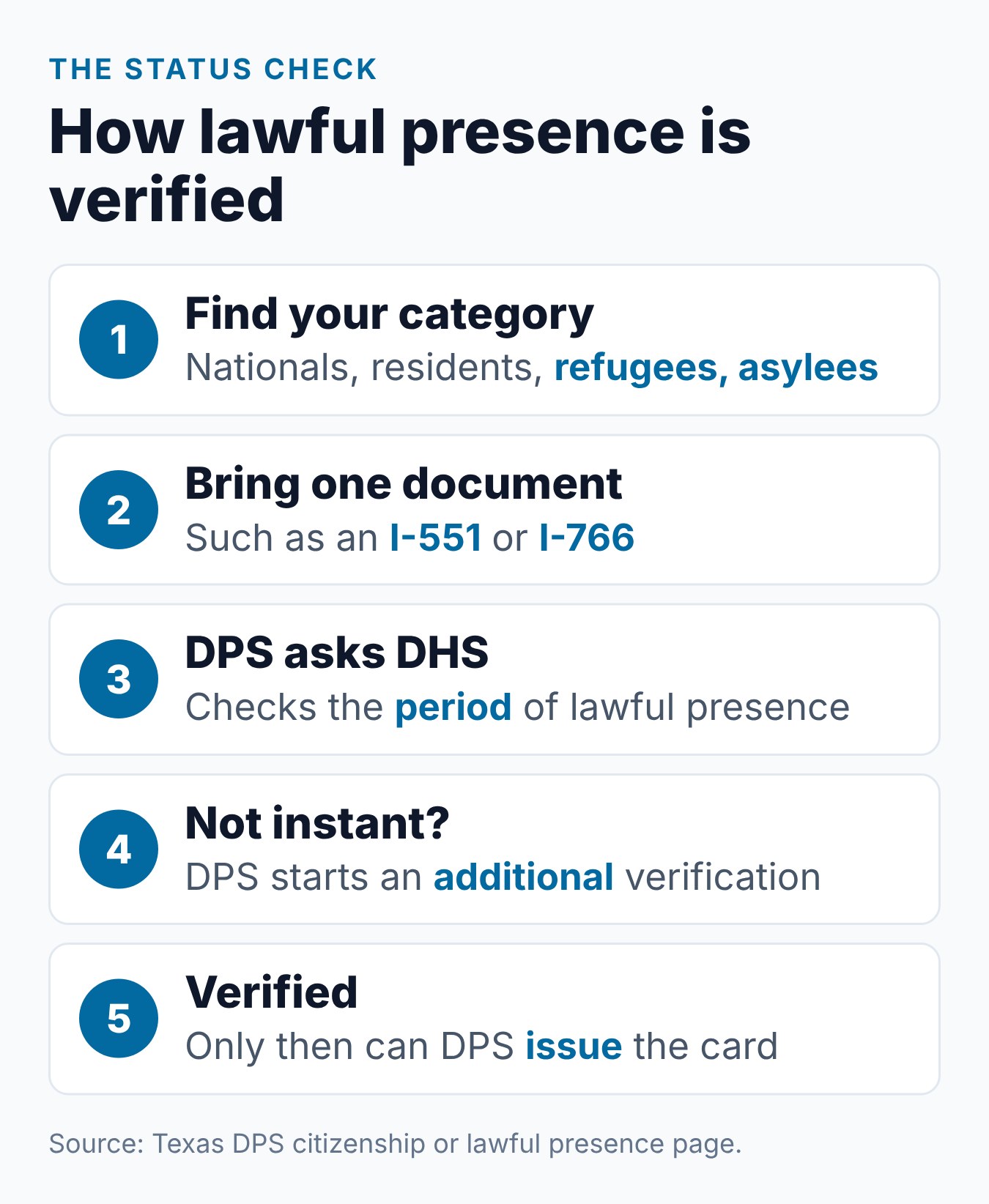
DPS issues a Texas drivers license for immigrants and other non-citizens who prove lawful presence in the United States with a document from the DPS list. DPS checks that status with the Department of Homeland Security (DHS) and cannot issue the license until DHS verifies it. After that, the steps match those for any first-time applicant, including driver education at 18 to 24, ITAD and the DPS tests.
Key Facts
- Lawful presence: every applicant shows “one document from the appropriate category.” See who can apply.
- Accepted papers: examples include the I-551, a foreign passport with a visa and I-94, and the I-766. See accepted documents.
- DHS check: DPS cannot issue a card until DHS verifies the period of lawful presence. See the DHS check.
- Limited-term cards: some licenses end when lawful presence ends. See limited-term licenses.
- Same other rules: course at 18 to 24, ITAD and the DPS tests. See the other rules.
Who Can Apply
Every Texas license applicant must prove one of two things. You show you are a U.S. citizen, or you show you are lawfully present.
The DPS citizenship and lawful presence page asks for “one document from the appropriate category.” It groups applicants by status. U.S. nationals, lawful permanent residents, refugees and asylees share one list.
DPS does not decide your immigration status. It checks the status DHS has on file. For questions about your own status, talk with an immigration attorney.
The same rule covers ID cards. The DPS ID card page also asks for proof of citizenship or, if you are not a citizen, lawful presence.
Naturalized Citizens and Citizens Born Abroad
If you became a U.S. citizen, you use the citizen list, not the lawful presence list. DPS accepts these for citizens:
- A valid U.S. passport book or passport card.
- A certificate of citizenship or naturalization with a photo.
- A Consular Report of Birth Abroad or Certificate of Report of Birth.
- A U.S. citizen ID card, Form I-179 or I-197.
A certified U.S. birth certificate also works for citizens born in the United States. DPS does not accept laminated copies or photocopies.
Texas Drivers License for Immigrants: Accepted Documents
The DPS page lists these documents for U.S. nationals, permanent residents, refugees and asylees:
| Document | Form | Note from the DPS page |
|---|---|---|
| U.S. passport for a national | — | Must say the bearer is a national, not a citizen |
| Permanent Resident Card | I-551 | Verified through DHS |
| Immigrant visa | — | Machine-readable, with temporary I-551 language and an ADIT stamp |
| Foreign passport and visa | I-94 | Valid passport and visa with a valid I-94, with some exceptions |
| Employment Authorization Document | I-766 | Verified through DHS |
The page notes that some expired documents in this group may be accepted unless a note says otherwise. Read the notes beside each item on the DPS page before you rely on an older card. If you are not sure, bring your newest document.
Applicants who fit neither group should read the DPS DL-53 guide, “Verifying Lawful Presence,” which covers other statuses such as temporary visitors and students.
How the DHS Check Works
The check is the step that sets non-citizen applications apart. DPS says it verifies lawful presence with DHS. A license or ID card cannot be issued until DHS verifies “the period of lawful presence.”
Sometimes the check cannot finish during your visit. DPS says it then starts an additional verification. You get instructions on what to do next.
The DPS page also points to a License Eligibility page. If you recently applied for a limited-term card and needed more checks, you can look there for a DHS response.
The DL-53 and DL-62 Guides
DPS publishes a guide called “Verifying Lawful Presence,” Form DL-53. It covers immigration statuses, eligibility and the documents for each one. DPS says it is for information only.
A second form, the DL-62, explains how to complete lawful presence verification. Both are linked from the DPS lawful presence page.
Limited-Term Licenses
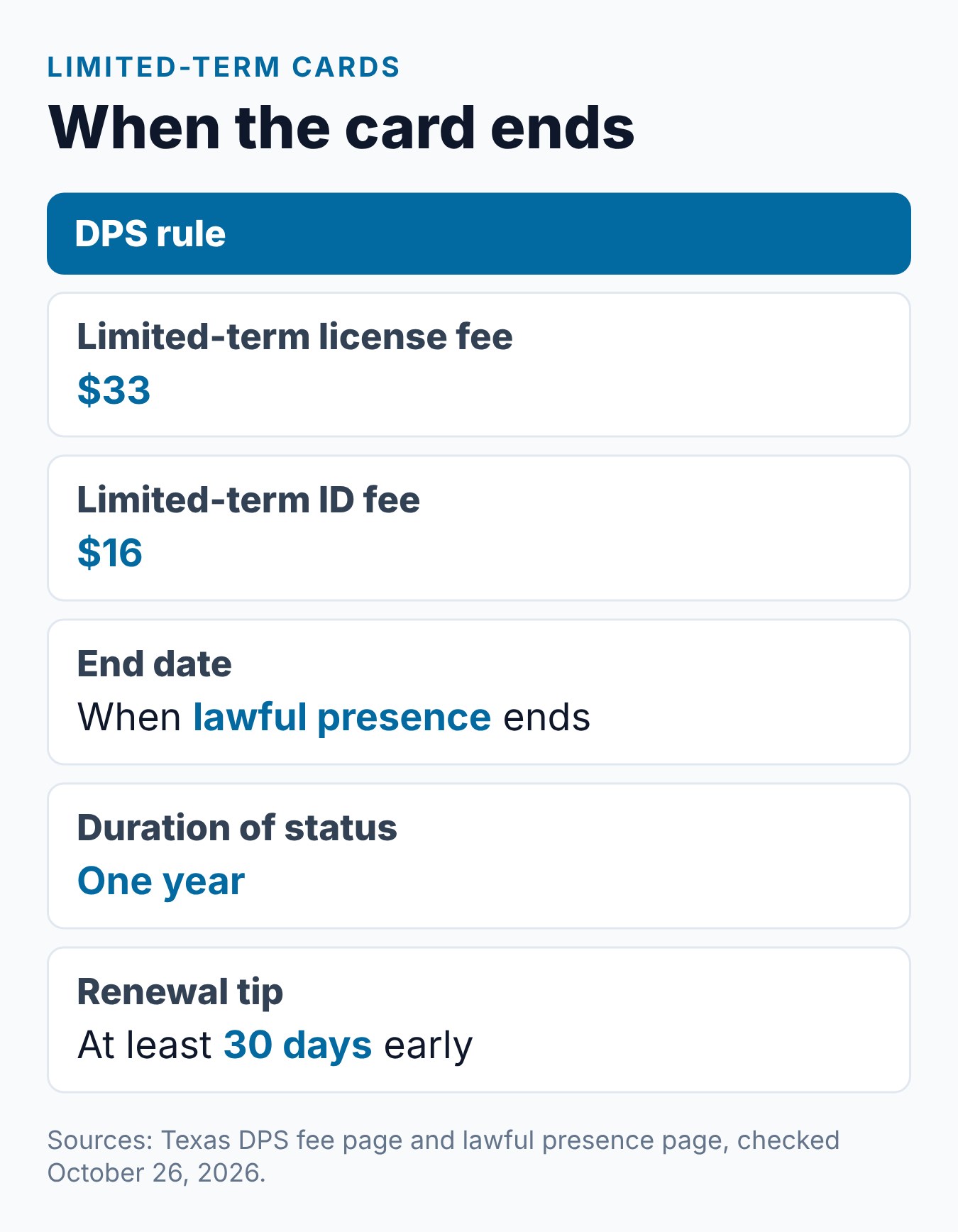
DPS issues some licenses as “Limited-Term.” The DPS fee page lists a limited-term license for temporary visitors at $33.
Its end date is tied to your status. The fee page says it expires when lawful presence ends. If your status is “duration of status,” it expires in one year.
A limited-term ID card is also listed, at $16. It follows the same end-date rule.
Renewing a Limited-Term Card
The DHS check takes time at renewal too. DPS encourages renewal at least 30 days before your card expires. Mark that date when you get your card.
Identity and Residency for Non-Citizens
Lawful presence is only one of the document groups. You also prove identity and Texas residency, like any applicant.
The DPS identification requirements page lists primary identity documents. Two of them fit non-citizen applicants:
- Certain DHS or USCIS photo documents, such as a permanent resident card or work permit.
- A foreign passport with an attached visa and Form I-94, with some exceptions.
The supporting list includes a consular document and an unexpired foreign passport. A marriage license or divorce decree not in English needs a certified translation.
For residency, DPS wants two printed papers with your name and Texas address. The DPS residency page accepts Form DS-2019 or a USCIS document as one of them, for a regular license or ID. Our document guide lists the rest.
The Other Rules Are the Same
Once lawful presence is verified, the rest of the process does not change. Every first-time applicant follows the DPS steps.
| Requirement | Ages 18 to 24 | Ages 25 and older |
|---|---|---|
| Six-hour adult course | Required | Not required |
| ITAD or ITTD | Before the driving test | Before the driving test |
| Vision test | Required | Required |
| Knowledge test (70 percent) | Required | Required |
| Driving test | Required | Required |
| New license fee | $33 | $33 (ages 18 to 84) |
The adult course is for first-time applicants 18 through 24. A TDLR-licensed course can give the highway sign and traffic law parts of the knowledge test. Ask your provider whether its course includes that test.
Under 37 TAC 15.62, applicants 18 and older complete ITAD or ITTD before the skills test. The certificate must be printed and dated within 90 days of the test. Our step-by-step guide covers the order.
Other Items DPS Asks For
The DPS apply page lists a few more items for every applicant:
- Your Social Security number.
- Proof of insurance for each vehicle you own, or a statement that you own none.
- Form DL-14A, filled out online or at the office.
If you are unsure how the Social Security item applies to you, ask DPS before your visit. The DPS REAL ID Document Check tool asks about citizenship and builds a personal list.
When Names Do Not Match
Your name and date of birth must match across your documents. That can be harder when records come from more than one country.
If your name changed, DPS asks for legal proof. Examples include a marriage license, a divorce decree or a court order. If some other detail differs, DPS says to speak with a License and Permit Specialist.
Fees and the Card
A standard new license costs $33 at ages 18 to 84 and lasts eight years. A limited-term license is also $33, but it ends with your lawful presence.
DPS gives you a temporary license once you pass, and the card comes by mail. DPS says all original, renewal and replacement cards “will now have a star to indicate they are Real ID compliant.”
License or ID Card
Some applicants only need an ID card. DPS says Texas law lets a person hold a license or an ID card, “but not both.” If you hold a Texas ID and apply for a license, you surrender the ID. Our license vs ID guide compares the two.
Where to Get Help
DPS staff can answer questions about documents and the DHS check. A License and Permit Specialist handles your application at the office.
For questions about your immigration status itself, DPS is not the right place. Speak with an immigration attorney. This article explains DPS rules only and is not legal advice.
If you hold a license from another country, ask DPS how it applies to you. This article does not cover that case.
What We Found on the Official Pages
On the DPS pages we checked on October 26, 2026, the lawful presence page listed one group for nationals, permanent residents, refugees and asylees. It said DPS cannot issue a card until DHS verifies the period of lawful presence.
The fee page listed limited-term cards with end dates tied to lawful presence. The lawful presence page encouraged renewal at least 30 days early.
The DPS REAL ID tool asked whether you are a U.S. citizen before it built a document list. It also asked about driver education and Impact Texas Drivers, based on your age. The checklist it gave was a starting point, and DPS said it may not cover every case.
Common Mistakes to Avoid
Each item comes from a DPS page:
- Bringing a copy. DPS accepts originals or certified copies only.
- Expecting a card the same day without the DHS check. DPS waits for DHS verification.
- Renewing at the last minute. DPS encourages renewal at least 30 days early.
- A foreign-language record with no translation. Marriage and divorce papers need a certified translation.
- Skipping ITAD. Applicants 18 and older need it before the driving test.
How Requirements Can Vary
Texas driver license rules come from state law, Texas DPS rules and TDLR rules, and they apply statewide. What you need still depends on your age, whether you hold a license from another state, and which tests you have already passed.
Laws, fees and office procedures can change. Check the Texas DPS and TDLR websites for current rules before you book an appointment or enroll in a course.
Frequently Asked Questions
Can immigrants get a Texas driver license?
DPS issues licenses to applicants who prove U.S. citizenship or lawful presence. Non-citizens show a document from the DPS list, and DPS verifies it with DHS.
Which documents prove lawful presence?
Examples include the Permanent Resident Card (I-551), a foreign passport with a visa and I-94, and the I-766 work permit. The full list is on the DPS lawful presence page.
Why is my license not issued right away?
DPS cannot issue a license until DHS verifies your lawful presence. If the check takes longer, DPS starts an additional verification and gives you instructions.
What is a limited-term license?
It is a license whose end date is tied to your lawful presence. For “duration of status,” DPS says it expires in one year.
Do non-citizens take the same tests?
Yes. Every first-time applicant passes the vision, knowledge and driving tests. Ages 18 to 24 also take the six-hour adult course.
Where can I learn which status qualifies?
Read the DPS DL-53 guide, “Verifying Lawful Presence.” For questions about your own status, speak with an immigration attorney.
Can I use an expired permanent resident card?
The DPS page says some expired documents in this group may be accepted unless a note says otherwise. Check the note beside your document, or ask DPS before your visit.
How much does a limited-term license cost?
The DPS fee page lists $33 for a limited-term license for temporary visitors. A limited-term ID card is $16.
Conclusion
A Texas license for non-citizens starts with one lawful presence document and a DHS check that DPS must finish before it issues the card. After that, the course, ITAD and tests follow the same rules as for everyone else.
Read the DL-53 guide and ask an immigration attorney about your own status. If you are 18 to 24, you can take Driving Logic’s online Texas adult driver education course.
Related Articles
- How to Get a Texas Driver’s License at 18: The Complete Step-by-Step Guide
- What Documents Do You Need for Your First Texas Driver’s License?
- Texas Driver’s License Requirements: Everything You Need Before Your DPS Appointment
- Texas Driver’s License vs. Texas ID Card: Which One Do You Need?
Sources
- Texas DPS — U.S. Citizenship or Lawful Presence Requirement
- Texas DPS — Identification Requirements
- Texas DPS — Texas Residency Requirement
- Texas DPS — Driver License Fees
- Texas DPS — REAL ID
- Texas DPS — Apply for a Texas Driver License
- Texas DPS — Impact Texas Drivers (ITD) Program
- 37 Tex. Admin. Code § 15.62 — Impact Texas Drivers program
- Texas DPS — Texas Driver Handbook (DL-7, PDF)
Billy Forte is the owner of Driving Logic, a state-approved driver improvement course provider serving Texas and other U.S. states.
This article is general information, not legal advice. Texas driver license and driver education rules are set by Texas law, Texas DPS and TDLR, and they can change. Check the official DPS and TDLR websites for current requirements before you apply.