
Updated June 2026 · Reviewed by Billy Forte
An Indiana speeding ticket can put a CDL driver at risk of BMV points, higher costs, job trouble, and even a CDL disqualification if the speed was high enough or if there are other serious violations on the record. Under federal CDL rules, speeding 15 mph or more over the limit is a serious traffic violation, and two serious traffic violations within three years can lead to a 60-day CDL disqualification, while three can lead to 120 days. Indiana also uses demerit points through the Indiana BMV, and paying a ticket is usually treated as an admission that can affect both your personal driving record and your commercial driving status, even when the stop happened in a personal vehicle.
This article covers Indiana requirements only.
Key Facts
- CDL risk is higher: CDL holders face extra federal and employment consequences for certain speeding convictions.
- 15 mph can matter: Driving 15 mph or more over the limit may be treated as a serious traffic violation for CDL purposes.
- Personal vehicle counts: Some CDL rules can apply even when driving a non-commercial vehicle.
- DSP is limited: A Driver Safety Program does not erase a CDL conviction or guarantee employer acceptance.
- Get advice when needed: CDL drivers should review BMV, federal, employer, and legal requirements before acting.
If you need a BMV-approved online option, review the Indiana Driver Safety Program course and compare it with your ticket, court notice, or BMV requirement.
How An Indiana CDL Speeding Ticket Can Affect Your License And Driving Record
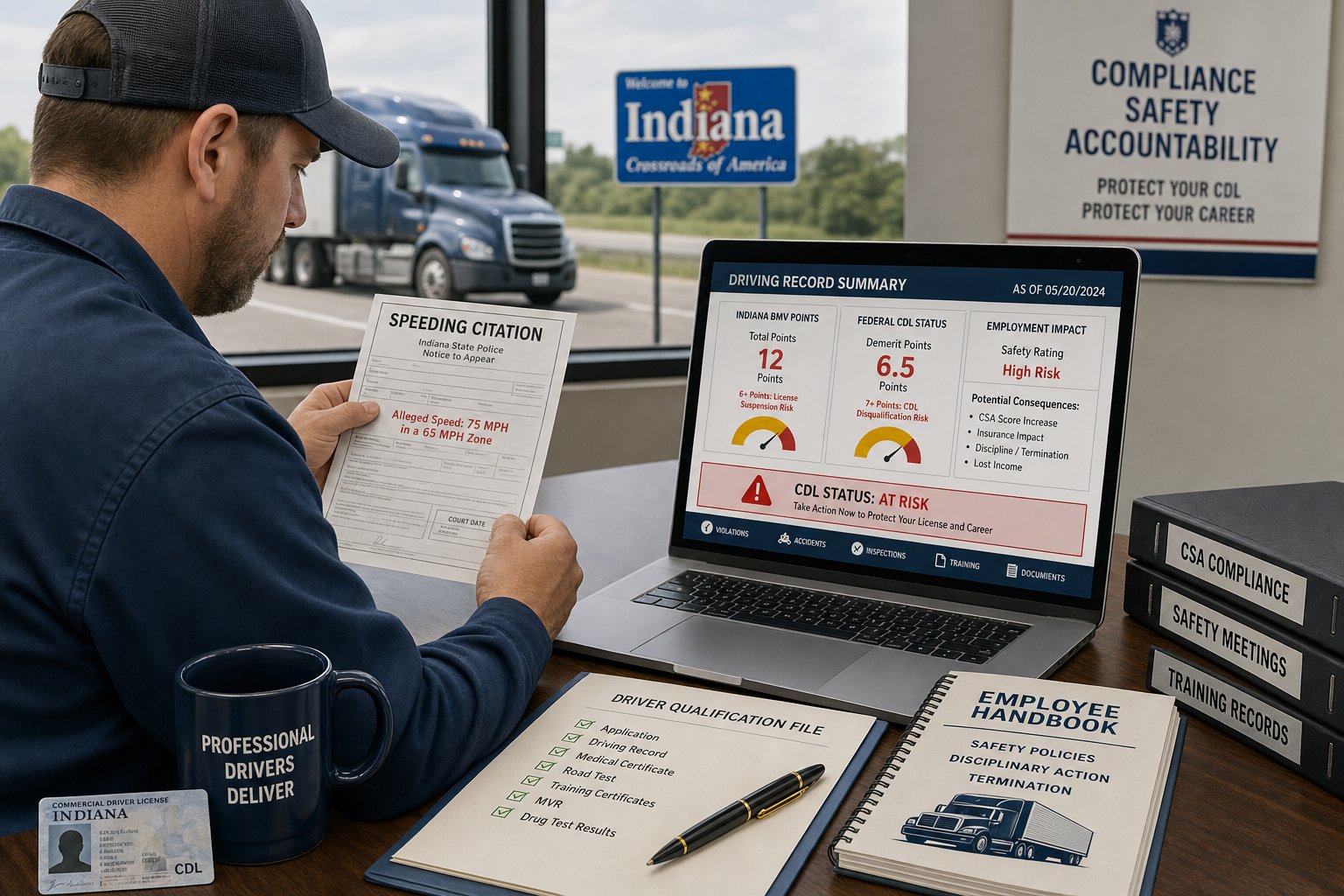
A commercial driver speeding ticket in Indiana can affect more than one part of your life at once. It can add Indiana BMV demerit points, raise the risk of a license suspension if your point total gets too high, and trigger federal CDL penalties that apply only to CDL holders.
Indiana uses a point system for traffic convictions. Depending on the violation, a moving offense can add 2 to 10 points, and reaching 18 points within two years can lead to suspension by the Indiana Bureau of Motor Vehicles. A speeding ticket may look like a routine Class C infraction, but for a CDL holder, the effect can be much bigger than the fine and court costs on the citation.
What catches many drivers off guard is that the CDL rules do not stop at the state line of ordinary traffic law. Federal Motor Carrier Safety Administration rules sit on top of Indiana law. That means one citation can create two separate problems:
- State record impact through Indiana BMV points
- Federal CDL impact if the offense counts as a serious traffic violation
- Work impact if your employer reviews MVRs or requires reporting
And yes, the vehicle matters, but not always in the way people think. Some violations in a personal vehicle can still count against your CDL. If the offense falls under the federal list of serious traffic violations, it may still be used toward disqualification even if you were not driving a semi at the time.
Before you prepay any moving violation, it is smart to look at the full record effect, not just the amount due on the ticket.
Why CDL Drivers Face Higher Stakes Than Regular Drivers
CDL drivers face stricter rules because the license carries extra duties. A regular Indiana driver may deal mainly with fines, court costs, and demerit points. A CDL holder may face those same penalties plus a separate hit to the CDL itself.
Under federal rules, serious traffic violations include:
- Excessive speeding of 15 mph or more above the limit
- Reckless driving
- Following too closely
- Certain improper lane change violations
You can review the federal standard in 49 CFR § 383.51. Two serious traffic violation convictions within three years can mean a 60-day CDL disqualification. Three within three years can mean 120 days.
That is why an Indiana CDL speeding ticket is not just a traffic hassle. It can affect your ability to work. It can also affect hiring, since employers often look closely at speed-related convictions, especially if they suggest a pattern.
When A Speeding Ticket Becomes A Serious CDL Problem In Indiana
A speeding ticket becomes a serious CDL problem when it crosses the federal line for excessive speeding or when it stacks with other serious violations already on your record. For CDL drivers, the biggest threshold is simple: 15 mph or more over the limit.
That threshold matters because federal rules classify it as a serious traffic violation. If you already have another serious traffic conviction within the last three years, a new 15-over speeding conviction can trigger CDL disqualification. The other offense does not have to be another speeding ticket. It could be reckless driving, following too closely, or another listed violation.
This is also where the difference between a personal vehicle and a commercial vehicle becomes important. Some drivers assume a personal car ticket cannot hurt a CDL. That is not always true. Under federal rules, a qualifying serious traffic violation can count even when the incident happened in your personal vehicle.
Indiana law still matters too. Even when a ticket does not trigger a federal disqualification by itself, it can still add BMV points. If your total reaches the suspension range, that creates another license problem. You can review Indiana traffic statutes through the Indiana General Assembly code site and some driver licensing rules in the Indiana Administrative Code.
So the real question is not just, “Was I speeding?” It is also:
- Was it 15 or more over?
- Do you have another serious violation within 3 years?
- Was another charge added, such as reckless driving?
- Will the conviction add enough BMV points to put your license at risk?
Why Paying The Ticket Right Away Can Cost You More
Paying an Indiana speeding ticket usually means you are admitting the violation. For many CDL holders, that is the most costly part. The fine may seem manageable, but the record damage can last much longer than the payment itself.
Once the ticket is paid, the case is often treated as a conviction for traffic record purposes. That can mean:
- Indiana BMV points are added
- The violation appears on your driving record
- The offense may count toward federal CDL disqualification
- Your employer or insurer may see the conviction
This matters even more if the ticket alleges 15+ mph over the limit. A prepaid ticket can become the serious traffic violation that starts, or completes, the disqualification clock. If you already have one prior serious violation in the last three years, paying this one may lead to a 60-day CDL disqualification.
There is also a practical point many busy drivers miss. Courts, judges, and case facts differ. The best response may depend on the wording of the citation, your prior record, the county court, and whether the state can prove the speed. That is one reason CDL holders often consult an attorney before paying any moving violation. It is not about delay for delay’s sake. It is about knowing the full cost before you turn a citation into a conviction.
If the Indiana BMV or court notice requires action, read it closely and act by the deadline. Do not miss a required court appearance.
Your Options For Responding To An Indiana CDL Speeding Citation
You usually have more than one option after a CDL speeding citation in Indiana. The right path depends on the ticket, your record, the court, and the facts of the stop.
Common options include:
- Contest the ticket
- Seek a lawful charge reduction
- Enter a plea in court
- Go to trial if the facts support it
For CDL drivers, the key issue is often not just whether you were cited, but what offense appears as the final conviction. A reduction from a serious moving violation to a less serious offense can make a big difference. But what is available depends on the prosecutor, judge, local court practice, and the evidence.
Also, do not confuse traffic school with a dismissal tool. Indiana’s official course is the BMV-approved Driver Safety Program (DSP), and it is a 4-hour course when assigned or approved for point credit purposes. The DSP may help eligible drivers earn a 4-point credit on the BMV record, but it does not erase the conviction or remove the underlying violation. Requirements depend on the Indiana BMV notice, court order, ticket, driver record, license status, court, judge, and case facts.
If you need to complete the Indiana Driver Safety Program online, Driving Logic offers the Indiana DSP course in a format built for busy schedules and mobile access.
Plea Deals, Trial, And The Risk Of Masking Violations
CDL cases have one extra rule that many drivers do not know about: masking is not allowed. Under federal law, courts cannot use diversion, deferral, or similar programs to hide a CDL conviction from the licensing system when reporting is required. You can review that rule under federal CDL regulations and related court treatment standards in 49 CFR Part 384.
That does not mean every case must end the same way. A prosecutor may still agree to a lawful plea reduction if the facts support it. But a court generally cannot just make the violation disappear to protect a CDL.
If no fair plea is offered, a trial may be the next step. At trial, the court looks at the officer’s evidence, your evidence, and whether the charge was proven. That may include speed measurement, pacing, road conditions, signage, and witness testimony. For a CDL holder, the goal is not only to fight the fine. It is to avoid a result that harms the license and work record more than necessary.
What To Do Immediately After Getting A CDL Speeding Ticket In Indiana
The first step is simple: do not rush to pay it. For a CDL holder, paying can create a conviction with point and job effects that are much bigger than the ticket amount.
Next, look closely at the citation. Check:
- The alleged speed and the posted limit
- Whether the claim is 15+ mph over
- The court date or response deadline
- The county and court listed
- Any added charge, such as reckless driving
Then gather records right away. Save dash-cam video, trip logs, GPS data, weather details, road conditions, and photos of signs or lane markings if they matter. Small facts can matter a lot in a speeding case.
You should also review your driving history with the Indiana BMV. If you already have points or a prior serious traffic violation, the new case may carry more risk than it appears to on the front of the ticket.
If the BMV or court later requires the Driver Safety Program, make sure you follow the exact notice. The Indiana DSP is a 4-hour BMV-approved course, and any requirement can depend on the notice, your record, your license status, and the court handling the case. If you need a state-approved online option, you can review the Indiana course at MyDrivingLogic.com.
This article is for general information only and is not legal advice.
FAQ
Can a Driver Safety Program remove my speeding ticket?
No. The Indiana DSP does not erase the speeding ticket or conviction. It may provide a 4-point credit when you complete a BMV-approved course and meet the rules.
Can I take the Indiana DSP online?
Yes. Indiana BMV-approved Driver Safety Program providers may offer online courses. Confirm that the course matches your court or BMV requirement before enrolling.
Do I still need to follow my court deadline?
Yes. A course does not replace court instructions or deadlines. Follow the citation, court order, clerk instructions, or BMV notice tied to your case.
Will my insurance change after a speeding ticket?
Maybe. Each insurance company uses its own rating rules. Ask your insurer how a conviction, point credit, or course completion may affect your policy.
Conclusion
Indiana Speeding Ticket for CDL Holders: Federal Rules Apply is easier to handle when you know the Indiana BMV point rules, court deadline, and the limits of the Driver Safety Program. The DSP may provide a 4-point credit when eligible, but it does not erase the ticket, conviction, or violation. Review your citation or court notice before you act.
Take the Indiana Driver Safety Program course online when you are ready to begin.
Related Articles
- Indiana Speeding Ticket: Costs, Points, and What to Know
- When Does an Indiana Speeding Ticket Become Reckless Driving?
- Indiana Driver Safety Program: The Complete Guide
- Court-Ordered Driver Safety Program in Indiana: What to Do
Sources
- Indiana BMV — Citation Points and Driver Safety Program
- Indiana BMV — Driver Record Points
- myBMV — Indiana BMV Online Services
- Indiana Code and Administrative Rules
Billy Forte is the owner of Driving Logic, a state-approved driver improvement course provider serving Indiana and other U.S. states. Driving Logic offers online driver safety and driver improvement courses for drivers handling BMV notices, court orders, and state requirements.
This article is general information, not legal advice. Indiana BMV rules, court orders, deadlines, provider reporting, insurance decisions, and case facts can differ. Use official Indiana BMV and court sources for current requirements, and consult a qualified Indiana attorney for legal guidance specific to your situation.