
Updated June 2026 · Reviewed by Billy Forte
You should usually pay your Indiana speeding ticket only if you accept the charge, because paying is treated like a guilty plea, while you should contest it in court if you dispute the ticket or the stakes are high for your record, job, or insurance. In Indiana, paying a ticket can lead to a conviction for a Class C infraction and add demerit points to your Indiana BMV record, while some tickets are marked for a required court appearance and cannot be paid like a normal waiver. The Indiana Bureau of Motor Vehicles also allows a BMV-approved Driver Safety Program (DSP), a 4-hour course that may matter before or after your court date depending on your BMV notice, court order, driver record, license status, and the facts of your case.
This article covers Indiana requirements only.
Key Facts
- Paying can matter: Paying a ticket may resolve the case, but it can also mean accepting the violation.
- Court option: Contesting a ticket is a legal decision tied to the court process.
- Deadlines count: Missing the due date can create additional problems.
- DSP option: A DSP may help with BMV point credit if you are eligible.
- No legal advice: Use court instructions and legal guidance for case-specific decisions.
If you need a BMV-approved online option, review the Indiana Driver Safety Program course and compare it with your ticket, court notice, or BMV requirement.
How To Tell Whether You Can Pay The Ticket Or Must Appear In Court
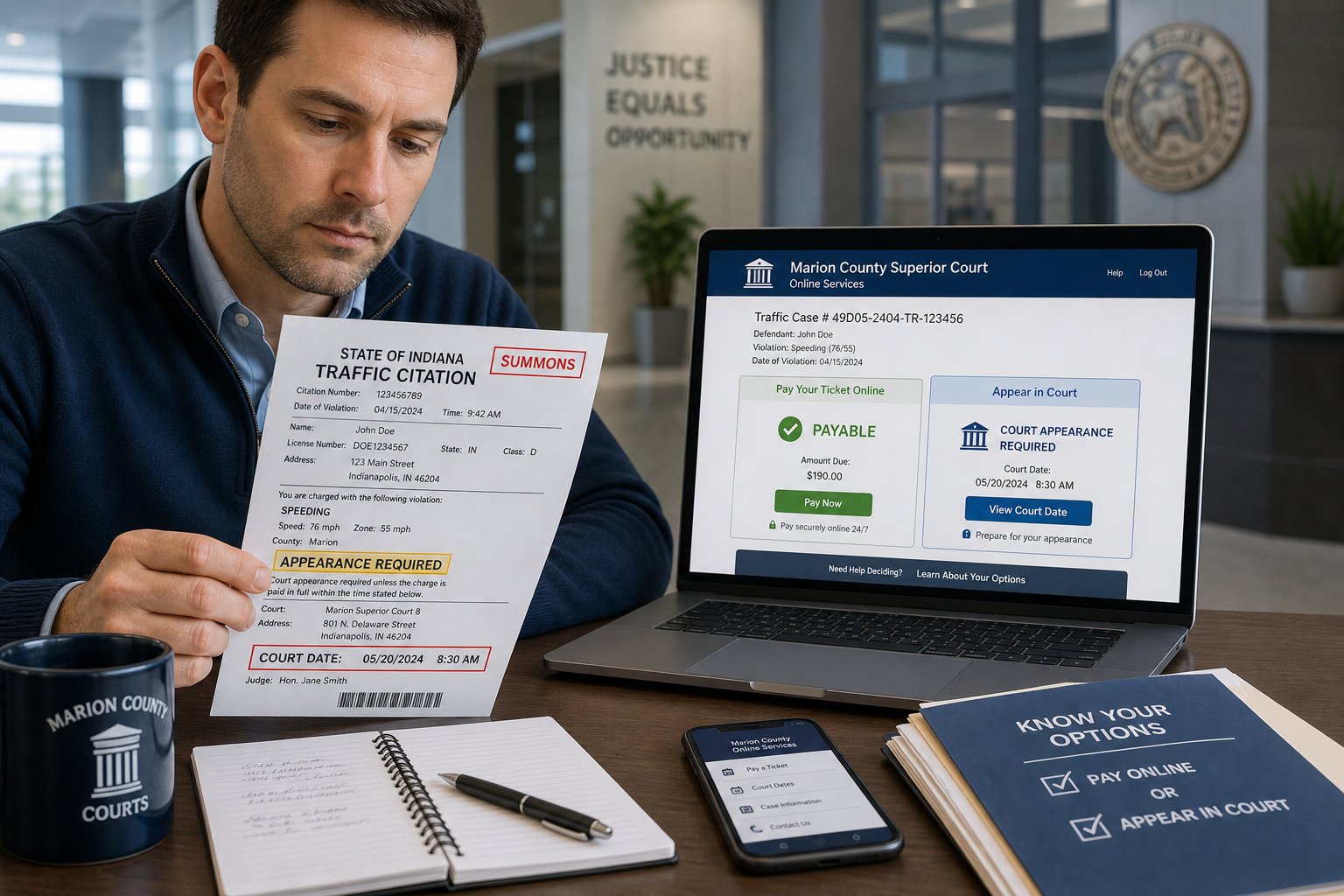
The first thing to check is the ticket itself. Your citation usually tells you whether you can pay the ticket or whether you must appear in court.
Look for words such as “appearance required,” “summons,” or a court date. If you see those, do not treat the ticket like a simple online payment matter. Follow the instructions from the court or county clerk listed on the citation.
In Indiana, some violations require a court appearance by rule or local practice. Counties make this clear in their public instructions. For example, courts note that misdemeanor charges usually require you to appear, and some serious traffic cases do too. Even when your issue is described by a police officer as “speeding,” the exact charge on the ticket matters.
A few common signs that you may need to appear:
- The ticket lists a court date and time
- The ticket says mandatory appearance
- The charge is more serious than a basic speeding infraction
- The case does not appear as payable in the county system
- The clerk tells you the ticket is not waiver-eligible
If you are not sure, check the county court or clerk instructions. You can also search for a case through mycase.IN.gov if one has been filed. Some counties also use the Indiana courts payment system at ePay Public Access. The safest next step is to read the ticket line by line, then contact the court named on it if anything is unclear.
What Paying A Speeding Ticket In Indiana Usually Means
Paying an Indiana speeding ticket usually means you are accepting the charge. In practical terms, that works like a guilty plea for the traffic infraction.
That matters because payment is not just a convenience fee. Once you pay, the court usually enters judgment on the case, and the result can be reported to the Indiana BMV. That can place BMV points or demerit points on your driving record, based on the violation.
The exact point impact depends on the charge and case facts. Indiana publishes point values through the BMV and related rules, and those values can affect your record status. You can review the state framework through the Indiana BMV and the Indiana Administrative Code.
You also need to think about money beyond the listed fine. Many cases include court costs and other fees, and totals can vary by county, court, speed alleged, and charge level. So the amount due on one ticket may not match another.
A missed deadline can make things worse. Courts warn that failure to pay or appear can lead to more penalties, and in some cases a license suspension issue can follow. If you choose the pay option, make sure the ticket is actually eligible and that you pay by the deadline shown.
Under Indiana law, many speeding violations are handled as infractions, often a Class C infraction unless facts support a more serious charge. You can review traffic offense language in the Indiana Code.
When Going To Court May Make More Sense
Going to court may make more sense when the ticket could have a bigger effect on your record or your work. If you want to contest Indiana speeding ticket facts, court is the path that lets you do that.
For example, court may be worth considering if:
- You believe the speed is wrong
- You were not the driver
- The facts on the ticket are not correct
- The speed is close to a reckless driving threshold or another more serious issue
- You hold a CDL and want to understand the record impact
- You have a strong concern about insurance costs
- This is a first offense and you want to ask what options exist
Contesting usually means you appear on the date listed, or you request a hearing as the court directs. You may deny the allegation and ask the court to hear the case. In some counties, you may also ask about a deferral or diversion program through the prosecutor, if one is offered. Availability depends on the county, judge, prosecutor, charge, and your record.
The Driver Safety Program can also be relevant. Indiana’s official course is a BMV-approved DSP, and it is a 4-hour course. In some situations, a BMV notice or court order may make the course important before or after your court date. But it does not erase the violation. It gives a 4-point credit that reduces your point total when allowed.
If the stakes feel high, consider getting legal advice from an Indiana attorney before you choose between paying and going to court.
Ways To Handle An Indiana Speeding Ticket
You usually have a few ways to handle an Indiana speeding ticket, but the right option depends on what the ticket allows. Start with the citation, the court notice, and any clerk instructions.
In general, your options may include:
- Pay the ticket if the case is eligible for payment without a court appearance
- Appear in court if you want to deny or contest the charge
- Ask about deferral or diversion if the county prosecutor offers it
- Complete a Driver Safety Program if the Indiana BMV notice, court, or your record makes that relevant
Paying is the simplest path, but it is also the path that usually accepts the violation. Going to court takes more time, yet it may be worth it when the facts are disputed or the record impact matters a lot.
The DSP is separate from the basic pay-or-court choice. It is not a promise of dismissal, and it does not remove a conviction from your record. Still, for some drivers, the 4-point credit can matter. Requirements can depend on your BMV notice, court order, ticket, driver record, license status, court, judge, and case facts.
Online Payment
Many Indiana courts let you pay traffic cases online. Often, you need your ticket number, citation number, or case number, plus your name or date of birth.
You may find online payment through a county portal or through Indiana ePay Public Access. But not every ticket can be paid online. If the system does not show your case, that does not always mean the ticket disappeared. It may mean the case has not posted yet, the number is wrong, or the charge requires a court appearance.
By Mail Or In Person
Indiana courts often allow payment by mail or in person through the county clerk. Many clerks ask for a cashier’s check or money order and want your ticket or cause number included.
In-person payment can be useful if you need to confirm the balance or ask whether the ticket is payable. Bring the citation and a photo ID if possible. Before mailing anything, confirm the court’s accepted payment methods and mailing address on the official county site.
What To Do If You Cannot Find Your Ticket Or It Is Not Eligible For Online Payment
If you cannot find your ticket online, do not guess. Use the court and county information printed on the citation and verify the status first.
A good first step is to search mycase.IN.gov. If a case has already been filed, you may find the cause number there. Some counties also require the cause number before you can pay online or by phone.
If the case still does not show up, several things may be happening:
- The court has not entered it yet
- The ticket number was typed wrong
- The case must be handled in court
- The county does not offer online payment for that charge
When a ticket is not eligible for online payment, contact the county clerk or court named on the ticket. Ask whether you must appear, whether payment by mail or in person is allowed, and what deadline applies. Do not ignore a citation just because the online system does not find it.
If your record or BMV notice points you toward a course, look at the Indiana Driver Safety Program options carefully. Driving Logic offers the Indiana DSP online through MyDrivingLogic.com, which can help busy drivers complete a required or approved 4-hour course on their own schedule when that option applies.
For official rules and record details, check the Indiana BMV, the Indiana Administrative Code, and the Indiana Code.
This information is general and not legal advice.
FAQ
Can a Driver Safety Program remove my speeding ticket?
No. The Indiana DSP does not erase the speeding ticket or conviction. It may provide a 4-point credit when you complete a BMV-approved course and meet the rules.
Can I take the Indiana DSP online?
Yes. Indiana BMV-approved Driver Safety Program providers may offer online courses. Confirm that the course matches your court or BMV requirement before enrolling.
Do I still need to follow my court deadline?
Yes. A course does not replace court instructions or deadlines. Follow the citation, court order, clerk instructions, or BMV notice tied to your case.
Will my insurance change after a speeding ticket?
Maybe. Each insurance company uses its own rating rules. Ask your insurer how a conviction, point credit, or course completion may affect your policy.
Conclusion
Indiana Speeding Ticket: What to Know Before You Pay or Contest It is easier to handle when you know the Indiana BMV point rules, court deadline, and the limits of the Driver Safety Program. The DSP may provide a 4-point credit when eligible, but it does not erase the ticket, conviction, or violation. Review your citation or court notice before you act.
Take the Indiana Driver Safety Program course online when you are ready to begin.
Related Articles
- Indiana Speeding Ticket: Costs, Points, and What to Know
- Indiana Speeding Ticket Fines: What Affects the Cost?
- Indiana Speeding Ticket from Out of State: What Happens to Your License
- Indiana Driver Safety Program: The Complete Guide
Sources
- Indiana BMV — Citation Points and Driver Safety Program
- Indiana BMV — Driver Record Points
- myBMV — Indiana BMV Online Services
- Indiana Code and Administrative Rules
Billy Forte is the owner of Driving Logic, a state-approved driver improvement course provider serving Indiana and other U.S. states. Driving Logic offers online driver safety and driver improvement courses for drivers handling BMV notices, court orders, and state requirements.
This article is general information, not legal advice. Indiana BMV rules, court orders, deadlines, provider reporting, insurance decisions, and case facts can differ. Use official Indiana BMV and court sources for current requirements, and consult a qualified Indiana attorney for legal guidance specific to your situation.