
Updated June 2026 · Reviewed by Billy Forte
A Texas speeding-ticket conviction appears on your TxDPS driving record, and how long you see it depends on which record type you pull: a 3-year record (Type 2 or 2A) shows roughly the last three years, while the Type 3A certified complete record shows your full history. There is no points system in Texas, so a speeding conviction affects you through insurance pricing and your record rather than any point total. The most reliable way to keep a speeding ticket off your record is to dismiss the eligible citation through a court-approved Driver Safety Course before it becomes a conviction.
Applies to Texas. Court rules and deadlines vary by county.
Key Facts
- Depends on the record type: A 3-year record (Type 2/2A) shows about three years; the Type 3A complete record shows your full history.
- No points: Texas has no points system, so a speeding conviction affects insurance and your record, not a point balance.
- Insurer look-back: Insurers commonly review the past three to five years when pricing a policy.
- Dismissal prevents the conviction: A court-approved Driver Safety Course can keep an eligible ticket from being recorded as a conviction.
- Convictions are not erased on demand: Once recorded, a conviction stays on the complete record; the cleanest path is avoiding the conviction in the first place.
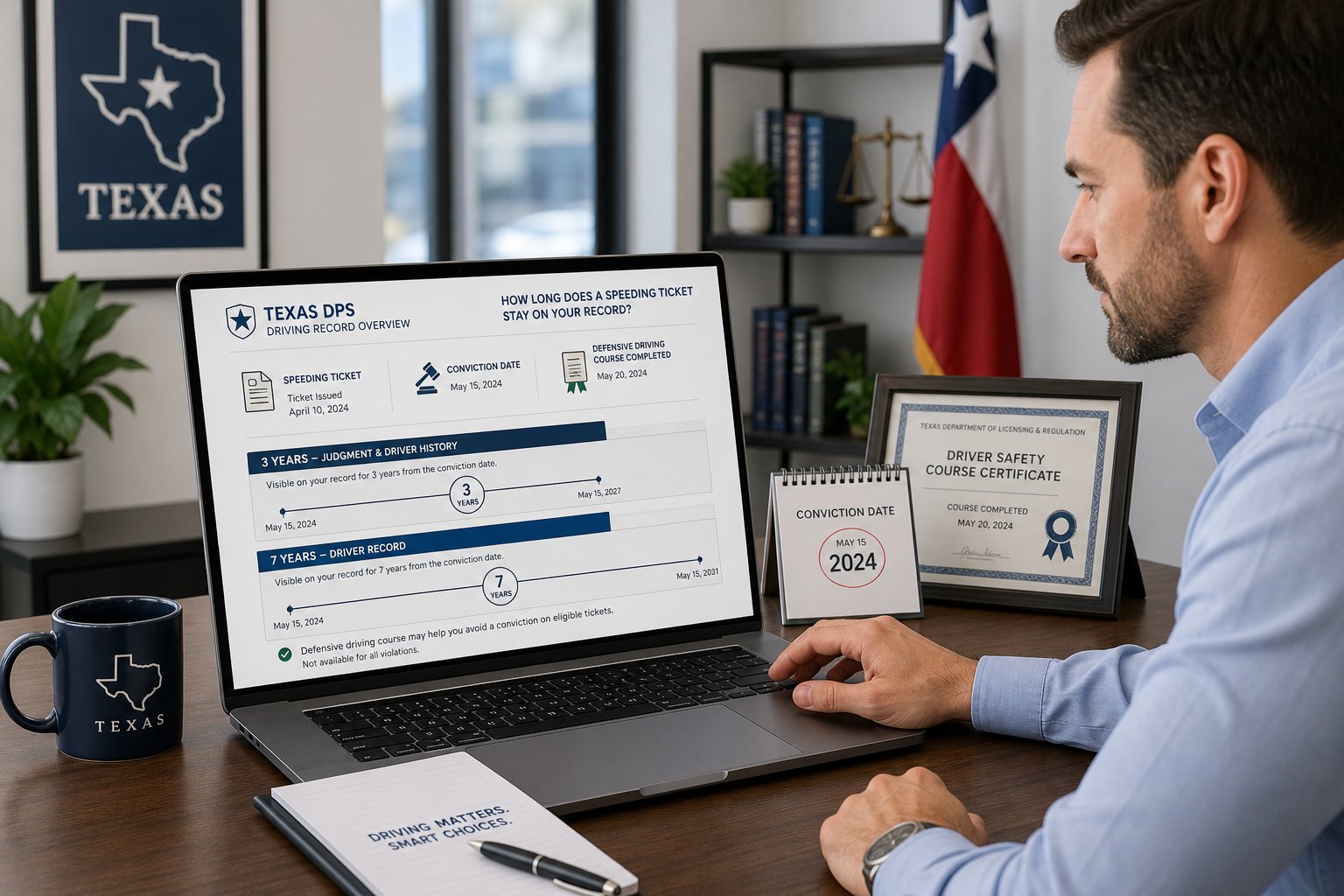
How Long A Speeding Ticket Usually Stays On Your Texas Record
For most drivers, the short answer is about 3 years. A speeding ticket conviction in Texas usually appears on the Texas DPS driving record for three years on the standard Type 3A record.
That 3-year record is the one many employers, courts, and insurance companies ask for. It shows your recent moving violations, traffic convictions, and crashes from the past three years. So if you were convicted of speeding, that conviction will usually stay visible there until it ages out of that window.
But there’s an important catch. Texas also offers other versions of your driving record, including a 7-year record and a more complete history. If someone pulls a longer record, an older speeding ticket may still appear there even after it no longer shows on the 3-year record.
A lot depends on the conviction date, not just the date you got the ticket. If your case took time in court, the clock usually matters from when the court entered the conviction.
That’s why the cleanest way to avoid a conviction is often to prevent one from being entered at all. If you qualify and the court approves it, a Driver Safety Course, also called a defensive driving course, can lead to dismissal instead of conviction. In Texas, those are the same TDLR-approved 6-hour program. And you must ask the court for that option before the appearance date on the citation.
If you want to check what is showing now, you can request your record from Texas DPS.
What “On Your Record” Means In Texas
When people say a ticket is “on your record,” they usually mean your Texas driving record. That record is kept by Texas DPS, also called TxDPS.
It can show things like:
- Traffic convictions
- Moving violations
- Crash entries
- License status
- Prior suspensions or other actions
A speeding ticket that ends in conviction goes onto that state record. If you order a certified record or a Type 3A record, that history can be part of what appears, depending on the date range.
There is another point many drivers miss. In Texas, a speeding ticket conviction is usually handled as a Class C misdemeanor in municipal or justice court. That does not make it serious in the way people often fear, but it is still a court conviction unless the case is dismissed.
That is why dismissal matters so much. If the court dismisses the ticket after a Driver Safety Course (DSC) or another approved route, then there is no speeding conviction to post to your driving record. In Texas, the DSC and defensive driving course are the same thing, and the course must be approved by the Texas Department of Licensing and Regulation (TDLR), not by TxDPS or TxDMV.
You can read the court rule for dismissal by course in Texas Code of Criminal Procedure Art. 45.0511. If you want to use that option, do not wait past your court date on the ticket.
Driving Record Vs. Insurance Record
Your driving record and your insurance record are not the same. That difference explains why a ticket may stop showing on one record but still affect your costs.
Your driving record is the state file from TxDPS. It may show 3 years, 7 years, or a fuller history depending on the record type ordered.
Your insurance record is part of how an insurer rates your policy. Each company has its own rating rules. Many insurers look back 3 to 5 years for speeding tickets, even if the ticket is no longer prominent on a short DPS record.
So, if you ask, “How long does speeding ticket stay on record Texas?” the honest answer has two parts:
- About 3 years on a standard Texas DPS 3-year record
- Up to 5 years for insurance pricing with some insurers
That’s also why a dismissal can matter twice. It may help keep the conviction off your texas speeding ticket driving record, and it may reduce the chance of a rate increase later.
What Happens After 3 Years And When You May Still See Effects
After about 3 years, a routine speeding conviction often falls off the standard 3-year driving record. For many drivers, that is the main date they care about.
Still, that does not always mean the ticket has vanished in every setting. A longer Texas record, such as a 7-year record, may still show it. A complete driving history may also include older entries.
Insurance is another reason the effects may last longer. Some insurers may count a speeding ticket in rating for up to 5 years. So even when the Type 3A record looks cleaner, your premium may not reset right away.
The 12-month DSC rule is also tied to recent record history. Under Texas law, a driver generally cannot use a Driver Safety Course for ticket dismissal if the driver completed one for another ticket within the prior 12 months. That is one reason your recent record matters. A court may look at whether you used that dismissal option recently before granting it again.
This rule does not mean every past ticket blocks you. It means the timing matters. And the request must be made before the appearance date listed on the citation.
If you are checking whether an old case still appears, order the correct record type instead of guessing. A 3-year record (Type 2 or 2A) shows only the recent three-year window, while the Type 3A certified record shows your complete history, so they can tell different stories.
That small detail trips up a lot of people.
How A Texas Speeding Ticket Can Affect Insurance, Fines, And Your License
A Texas speeding ticket can cost more than the fine. It can affect your insurance, your court costs, and in some cases your driving status.
First, insurance. A single ticket may raise rates, though not every insurer treats it the same way. The increase can depend on:
- How fast you were driving
- Your past ticket history
- Your age and location
- Your insurer’s own rating rules
If you already have other moving violations, the effect may be larger. If the ticket is dismissed, that may help avoid the same impact because there is no conviction to report.
Second, fines and court costs. Texas law allows fines for speeding, and courts may add costs and fees. The exact amount can vary by court and facts, so it is smart to read the citation and court notice closely. Do not assume all speeding tickets cost the same.
Third, your license record. Repeated traffic convictions can create bigger problems than one basic ticket. Even though Texas no longer uses the old statewide Driver Responsibility Program, repeated violations can still matter for your overall record and for how insurers and employers view it.
In some cases, a court may allow options that reduce the damage, such as a Driver Safety Course, deferred disposition, or a plea arrangement. But none of those are automatic.
If you need your official status, use Texas DPS for your driving record. If you need an approved course, remember that the Texas Department of Licensing and Regulation oversees the course provider, not TxDPS.
Ways To Keep A Speeding Ticket Off Your Record Or Reduce The Damage
The best way to keep a speeding ticket off your Texas record is to avoid a conviction. In Texas, that usually means dismissal, deferred disposition, or a successful court challenge.
Each option depends on your facts, your court, and your eligibility. But the key point is simple: once a speeding ticket becomes a conviction, it can appear on your driving record and affect insurance.
A few common options are:
- Driver Safety Course (DSC), if the court allows it
- Deferred disposition, if offered by the court
- Not guilty plea and contesting the ticket
- Negotiating for a reduced charge in some cases
You should never ignore the citation or miss court deadlines. If you want a dismissal option, ask the court before the appearance date on the ticket.
For busy drivers, the course route is often the most practical because it can be completed online if the provider is approved. Driving Logic offers a Texas course built for phone, tablet, or computer use, with flexible pacing for people who do not have time for a classroom.
Driver Safety Course, Dismissal, And Fighting The Ticket
A Driver Safety Course and a defensive driving course are the same thing in Texas. It is a TDLR-approved 6-hour program. The court may allow it for dismissal under Texas Code of Criminal Procedure Art. 45.0511.
Important details matter here:
- The course is approved by TDLR, not by TxDPS
- You must request DSC before the appearance date on the citation
- You must meet court and case eligibility rules
- If the case is dismissed, it does not appear as a speeding conviction on your record
- You usually cannot use DSC again if you completed one for dismissal in the prior 12 months
Deferred disposition is different. The court delays a finding and gives you conditions to meet. If you complete those conditions, the case is dismissed and no conviction is entered.
Fighting the ticket is another path. You may plead not guilty and go to court. Some drivers also speak with a traffic lawyer if the stakes are high.
If the court lets you use the course option, you can take the Texas DSC through Driving Logic. It is made for busy schedules and works on almost any device.
FAQ
How long does a speeding ticket stay on my Texas record?
On a 3-year record type it appears for about three years; on the Type 3A certified complete record it remains part of your full history. Which one matters depends on who is checking and the record type they pull.
Does a speeding ticket add points in Texas?
No. Texas ended its points-based program in 2019, so a speeding conviction has no points. It can still raise insurance costs and appear on your record.
How long do insurers look back?
Insurers commonly consider the past three to five years, though this varies by company. A single minor speeding conviction usually matters less than repeated violations.
Can I keep a speeding ticket off my record?
Yes, if it is eligible and the court approves a Driver Safety Course. Completing the course before the deadline results in dismissal, so no conviction is recorded.
Conclusion
The honest answer to how long a Texas speeding ticket lingers is: it depends on the record someone pulls and on whether it ever became a conviction. A 3-year record type shows it for about three years; the complete record keeps it. Since Texas has no points, the real cost is insurance and your record — which is exactly why dismissing an eligible ticket through a Driver Safety Course before it posts is the strongest move you can make.
If your speeding ticket is eligible and the court approves it, you can dismiss it with a TDLR-approved Texas Driver Safety Course completed online.
Related Articles
- Your Texas Driving Record: How to Get It and What It Shows
- How Long Do Traffic Violations Stay on Your Texas Driving Record?
- Texas Defensive Driving for Ticket Dismissal: The Complete Guide
- Texas Driving Record Points: Does Texas Still Have a Points System?
Sources
- Texas DPS — Online Driver Record System
- TDLR — Driver Safety
- Texas Code of Criminal Procedure Art. 45.0511
Billy Forte is the owner of Driving Logic, a state-approved driver safety and defensive driving course provider serving Texas and other U.S. states. Driving Logic offers online driver safety, defensive driving, and traffic-ticket courses for drivers handling court, license, and insurance-related requirements.
This article is general information, not legal advice. Texas court rules, TDLR requirements, deadlines, eligibility, and case facts can differ by county and court. Use official Texas court and state sources for current requirements, and consult a qualified Texas attorney for legal guidance specific to your situation.