
Updated June 2026 · Reviewed by Billy Forte
For a Texas CDL holder, a speeding ticket carries higher stakes because federal FMCSA rules apply on top of Texas law: speeding 15 mph or more over the limit is a “serious traffic violation,” and two such violations within three years generally trigger a 60-day CDL disqualification (120 days for three). Federal rules also prohibit masking, so a CDL holder generally cannot use a Driver Safety Course to dismiss a violation committed in a commercial vehicle. Because a conviction can affect both your license and your livelihood, a CDL speeding ticket is worth handling carefully and often with legal advice.
Applies to Texas. Court rules and deadlines vary by county.
Key Facts
- Federal layer: FMCSA rules apply in addition to Texas law for CDL holders.
- Serious violation: Speeding 15+ mph over the limit is a “serious traffic violation” under FMCSA.
- Disqualification risk: Two serious violations in three years generally bring a 60-day disqualification; three bring 120 days.
- No masking: Federal rules bar dismissing commercial-vehicle violations, so the DSC generally cannot remove them.
- Livelihood at stake: A conviction can affect your CDL and employment — consider legal advice.
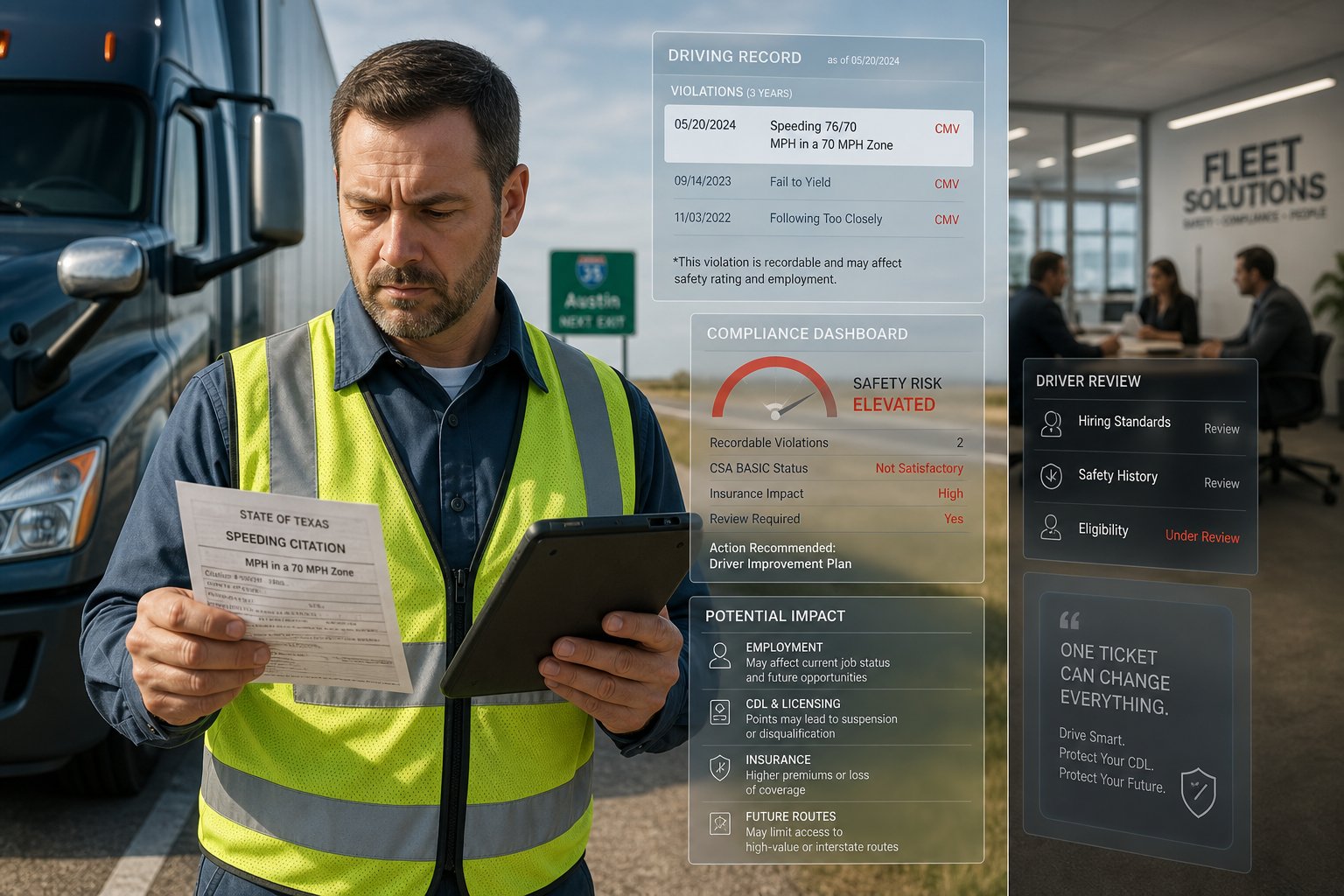
Why A Speeding Ticket Matters More With A Texas CDL
A texas cdl speeding ticket matters more because your license is your job. A regular driver may see a fine, court costs, and maybe higher insurance. You may face those same problems, but you also risk damage to your CDL record, your work status, and your future hiring options.
In Texas, a moving violation can show on your motor vehicle record. For a CDL holder, that record matters to more people. It can be seen by Texas DPS, employers, and safety staff who review driving history before assigning routes or keeping drivers on payroll. If you drive across state lines, federal rules also matter, not just Texas rules.
Another key issue is that CDL cases are harder to “make disappear.” Federal anti-masking rules limit the ability to hide or re-label certain commercial driver convictions. That means a ticket that seems minor can stay important long after the court date passes.
And then there is the work side. Many carriers have strict internal rules for moving violations. Some care about any speeding conviction. Others draw a hard line at 15 mph over the limit because that can count as a serious traffic offense under federal law. Even one conviction can affect:
- job applications
- fleet insurance eligibility
- company safety reviews
- route assignments
- promotions or bonuses
So while the ticket may start as a simple citation, the real issue is the record it creates. That is why many CDL holders should pause before paying a Texas traffic ticket without first understanding the full effect.
How Texas Classifies Serious Traffic Offenses For CDL Holders
For CDL holders, not all speeding is treated the same. The big line is often 15 mph or more over the speed limit. Under FMCSA-based rules, that can count as a serious traffic violation. Texas CDL drivers are subject to those federal standards along with state law.
Serious traffic offenses can include more than speeding. Common examples include:
- speeding 15+ mph over the limit
- reckless driving
- improper or erratic lane change
- following too closely
- driving a commercial motor vehicle without the proper class of CDL
- driving a commercial motor vehicle without the needed endorsement
The key risk is repeat violations. If you are convicted of two serious traffic violations within three years, you can face a 60-day CDL disqualification. If you get three within three years, the disqualification can rise to 120 days.
It also matters whether the violation happened in a commercial vehicle or a personal vehicle. Some CDL-related rules apply even when you were not on the job. For example, many traffic convictions in your own car still matter to your driving record and to your employer. But a violation in a commercial vehicle can be even harder to dismiss because federal rules apply more directly.
If you want the state agency side of this, review CDL information from Texas DPS. For the practical question, though, the main point is simple: a commercial driver speeding ticket in Texas can trigger more than a fine if it falls into the serious-offense category.
What Happens After A Conviction: Fines, Disqualification Risks, And Job Impact
If you are convicted, the first result is usually money. You may owe a fine and court costs, and the amount depends on the court. Texas courts set schedules that can vary by county or city, so there is no one statewide total for a speeding case.
But the fine is often not the biggest problem. A conviction can become part of the record employers review. That can affect hiring, safety scoring inside a company, and even whether you can stay in your current role. Some employers have policies that require discipline after a moving violation, even if the ticket happened in your personal vehicle.
There is also a reporting duty. CDL holders generally must report a traffic conviction to their employer within 30 days, including many convictions that happened in a non-commercial vehicle. That means the issue does not stay private once the case is resolved.
If the offense qualifies as a serious traffic violation, the federal disqualification rules become the bigger threat:
- 2 serious violations in 3 years: 60-day CDL disqualification
- 3 serious violations in 3 years: 120-day CDL disqualification
And once a CDL is disqualified, your income can stop fast. Even a short disqualification can mean missed work, lost loads, or job replacement. That is why paying a ticket just to “move on” can be costly in ways the citation does not show on its face.
The insurance impact can also reach your personal and commercial driving profile, depending on your employer and carrier rules.
Can You Dismiss Or Reduce A Texas CDL Speeding Ticket?
Sometimes, yes, but usually not through the easy options many non-CDL drivers use. For a CDL holder, the main path is often to contest the ticket, challenge the facts, or try to negotiate a result that avoids a moving violation conviction if the court and prosecutor allow it.
That can include looking closely at:
- the speed measurement method
- the officer’s notes
- location and posted speed evidence
- dashcam or bodycam footage
- witness statements
- whether the charge can be amended
The goal is usually not to “erase” a valid ticket by routine request. It is to seek a lawful outcome that protects your CDL record as much as possible. In some cases, a lawyer may be able to pursue dismissal based on proof issues. In others, the better result may be a reduction to a non-moving offense, depending on local practice and the facts.
You should also keep timing in mind. Do not miss the court date or response deadline on the citation. If you want to fight the ticket, contact the court before the appearance date and follow its process.
For general Texas dismissal rules, courts often rely on Texas Code of Criminal Procedure Art. 45.0511, but CDL cases have extra limits. That is why a standard ticket dismissal path may not fit a CDL case.
Why Defensive Driving And Deferred Disposition Usually Do Not Work For CDL Drivers
In Texas, a Driver Safety Course (DSC) and a defensive driving course are the same TDLR-approved 6-hour program. For many regular drivers, that course can help with ticket dismissal if the driver asks the court before the appearance date. But CDL holders usually face stricter limits.
For CDL-related moving violations, especially in a commercial vehicle, federal rules generally block using the DSC to dismiss the case. Deferred disposition is also often unavailable for CDL holders in moving violation cases. The idea is to prevent masking convictions that matter to commercial safety records.
That is why you should not assume the normal Texas traffic ticket options apply. Also, the DSC is approved by the Texas Department of Licensing and Regulation, not by Texas DPS or TxDMV. Texas DPS handles driver licenses. TxDMV handles vehicle registration.
If your ticket was in a personal car, eligibility can still be limited for a CDL holder, and court practice matters. Always verify with the court before relying on DSC or deferred disposition.
What To Do After You Get A Texas CDL Speeding Ticket
First, do not just pay the ticket until you understand the effect. In most Texas cases, paying a moving violation means you are accepting a conviction. For a CDL holder, that can be the step that creates the bigger problem.
Next, look at the citation closely. Check the court name, appearance date, alleged speed, posted speed, and whether you were in a commercial vehicle or personal vehicle. If the speed alleged is 15 or more over, treat that as a higher-risk case because of the serious traffic violation rules.
Then take a few practical steps:
- contact the court before the answer date
- ask what plea and hearing options are available
- gather dashcam footage, logs, and dispatch records
- save the bill of lading or trip records if relevant
- write down what happened while it is still fresh
- check your recent driving record for prior moving violations
If you were thinking about a Texas traffic ticket dismissal through a course, remember the rule: the Driver Safety Course (DSC), also called defensive driving, must be requested from the court before the appearance date listed on the citation. But for CDL holders, especially for commercial vehicle violations, that route is usually not available.
If you need a court-approved course for some non-CDL-eligible situation, Driving Logic offers online Texas courses built for busy drivers on any device. Still, for a CDL speeding case, confirm eligibility with the court first.
When To Get Legal Help And How To Protect Your CDL Record
You should strongly consider legal help before paying any moving violation that could affect your CDL. That is especially true if the ticket says 15+ mph over, if you already had another serious offense in the last three years, or if your employer has strict safety rules.
A lawyer who handles Texas CDL traffic cases may help by:
- reviewing whether the evidence supports the charge
- appearing in court for you in many cases
- seeking dismissal where the facts allow
- negotiating for a non-moving outcome when possible
- helping you avoid steps that create an unnecessary conviction
This matters because once a conviction is entered, your options often shrink. And because CDL holders have fewer dismissal tools than regular drivers, early action is often more useful than trying to fix the record later.
To protect your CDL record, keep copies of citations, court notices, and case results. Report convictions to your employer when required. Watch your deadlines. And if you are ever unsure whether a plea will count as a conviction for CDL purposes, ask the court and consider legal advice before you respond.
If you later need a court-ordered course for a standard Texas case where you are eligible, you can review online options through Driving Logic.
FAQ
Why is a speeding ticket worse for a Texas CDL holder?
Federal FMCSA rules add consequences on top of Texas law. Speeding 15+ mph over the limit is a serious traffic violation, and repeat violations can disqualify your CDL.
Can a CDL holder dismiss a speeding ticket with defensive driving?
Generally not for a violation in a commercial vehicle, because federal rules prohibit masking CDL convictions. Confirm with the court and consider legal advice.
How many violations disqualify a CDL?
Generally, two serious traffic violations within three years lead to a 60-day disqualification, and three within three years lead to 120 days, under FMCSA rules.
What should I do after a CDL speeding ticket?
Act quickly, confirm options with the court, and consider a Texas attorney, since a conviction can affect your CDL and your job in ways a course cannot undo.
Conclusion
A CDL speeding ticket is a different animal: federal rules turn 15-over into a serious violation and stack disqualification risk on top of the Texas fine, while the masking ban keeps the Driver Safety Course from bailing you out of a commercial-vehicle conviction. The stakes are your license and your income, so treat it accordingly — move fast, confirm options with the court, and get legal advice when the consequences warrant it.
Non-commercial tickets may be eligible for a TDLR-approved Texas Driver Safety Course, but CDL holders should confirm eligibility with the court before relying on it.
Related Articles
- Texas Speeding Ticket: Costs, Record Impact, and What to Know
- Texas CDL Holders and the Driver Safety Course: Why Commercial Drivers Can’t Use It
- Texas Speeding Ticket Options: Pay, Contest, or Take Defensive Driving
- Is a Texas Speeding Ticket a Criminal Charge?
Sources
Billy Forte is the owner of Driving Logic, a state-approved driver safety and defensive driving course provider serving Texas and other U.S. states. Driving Logic offers online driver safety, defensive driving, and traffic-ticket courses for drivers handling court, license, and insurance-related requirements.
This article is general information, not legal advice. Texas court rules, TDLR requirements, deadlines, eligibility, and case facts can differ by county and court. Use official Texas court and state sources for current requirements, and consult a qualified Texas attorney for legal guidance specific to your situation.