
Updated June 2026 · Reviewed by Billy Forte
Most Texas Class C misdemeanor moving violations — such as ordinary speeding, running a stop sign or red light, and similar tickets — can be dismissed with a Driver Safety Course when the court approves it under CCP Art. 45.0511. Common exclusions are speeding more than 25 mph over the limit, construction-zone violations with workers present, commercial-vehicle (CDL) violations, and cases where you lacked a valid license or insurance. Check your citation’s specific charge and confirm eligibility with the court before the appearance date, because the court makes the final call on whether your violation qualifies.
Applies to Texas. Court rules and deadlines vary by county.
Key Facts
- Usually eligible: Class C misdemeanor moving violations like everyday speeding, stop-sign, and red-light tickets.
- Usually not eligible: Speeding more than 25 mph over the posted limit and construction-zone violations with workers present.
- Never via DSC for commercial violations: CDL/commercial-vehicle violations cannot be dismissed this way.
- Basic requirements: You generally need a valid Texas license and proof of insurance at the time required by law.
- Court confirms eligibility: The court named on your citation decides — confirm before the appearance date.
Which Texas Traffic Violations Usually Qualify For Defensive Driving
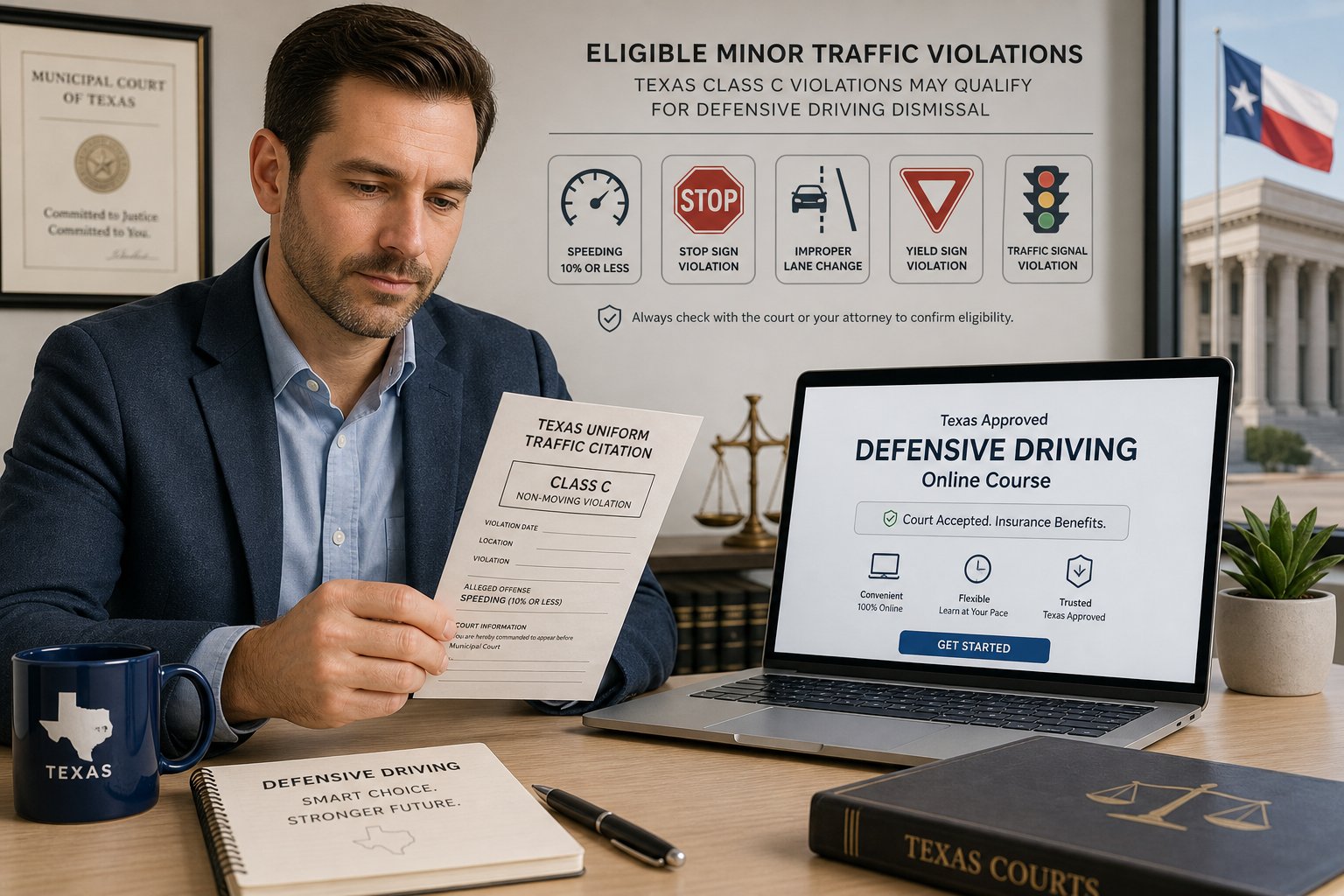
Most minor moving violations in Texas usually qualify for ticket dismissal through a defensive driving course. In Texas, that course is the same thing as a Driver Safety Course (DSC). It must be a TDLR-approved 6-hour course.
The key rule is simple. The ticket usually must be a Class C misdemeanor traffic offense. That includes many routine tickets a police officer writes during a normal traffic stop.
Common examples that often qualify include:
- Speeding tickets that are not more than 25 mph over the posted limit
- Failure to signal
- Running a stop sign
- Failure to yield
- Following too closely
- Improper lane change
- Disobeying a traffic control device
Many drivers ask, what violations qualify for defensive driving Texas courts will dismiss? The short answer is routine, lower-level traffic offenses. But the final answer always comes from the court handling your citation.
And that matters. Texas law gives you a path to citation dismissal, but court approval still controls the process. A ticket that seems eligible on paper may still be denied if your record, vehicle type, or request timing does not meet the rules.
So, if you got a standard moving violation, you may be able to use a Texas defensive driving course for dismissal. Check the citation, find the court listed on it, and contact that court right away before your appearance date.
Tickets That Usually Do Not Qualify In Texas
Some Texas tickets do not qualify for defensive driving dismissal, even if they look like normal traffic violations. These limits are important because many drivers sign up for a course before checking with the court.
In general, these violations usually do not qualify:
- Speeding more than 25 mph over the posted limit
- Speeding over 95 mph total
- DWI or alcohol-related offenses
- Violations committed in a commercial motor vehicle
- Tickets issued to drivers who hold a CDL in many court situations
- Criminal offenses that are not traffic Class C misdemeanors
- Cases where the court denies the request
Texas courts also often exclude certain serious traffic offenses, such as:
- Passing a school bus
- Leaving the scene of an accident
- Failure to give information after an accident
- Construction or maintenance zone violations when workers are present
It is also important to keep the agencies straight. The course itself is approved by the Texas Department of Licensing and Regulation, not by Texas DPS or TxDMV. Texas DPS handles driver licenses. TxDMV handles vehicle registration.
Because local court practices vary, the safest step is to confirm your exact ticket with the court clerk. Do that before you enroll in any course.
Basic Eligibility Requirements Before You Request A Driving Safety Course
You must meet both the offense rules and the driver rules before the court can grant DSC. Even if your ticket is for a minor violation, you can still be denied if you miss one of the basic eligibility points.
Most courts look for these requirements:
- You have a valid Texas driver license or permit
- You are not charged with an excluded offense
- You do not hold a CDL
- The violation did not happen in a commercial vehicle
- You have not used DSC for dismissal in the past 12 months
- You are not currently using DSC for another ticket
- You request it before the appearance date on the citation
The court may also ask for documents. Two common ones are:
- Proof of financial responsibility or insurance
- A Type 3A driving record
That driving record helps the court confirm whether you already used defensive driving for another dismissal within the last year. After approval, you will usually need to turn in your completion certificate and any other forms by the deadline the court gives you.
This is where many people get tripped up. They assume a course alone gets the ticket dismissed. It does not. First, the court must approve your request under Texas Code of Criminal Procedure Art. 45.0511.
How To Ask The Court For Defensive Driving After A Ticket
You must ask the court for permission before you take the course for dismissal. In Texas, that request must be made before the appearance date listed on your citation. That deadline is strict, so contact the court immediately.
The usual process works like this:
- Find the court name and appearance date on your ticket.
- Contact the court clerk and ask if your violation is eligible for a Driver Safety Course (DSC).
- Follow the court’s request method. Some courts accept requests in person, by mail, online, email, or fax.
- Enter a plea, often guilty or no contest, if the court requires it for the DSC request.
- Submit any documents the court asks for.
- Wait for court approval before relying on the course for dismissal.
After approval, the court will usually tell you exactly what to file and when. That often includes:
- Your completion certificate
- A Type 3A driving record
- Any court forms or fees the court requires
If you want a fast online option after the court approves you, Driving Logic offers a Texas course built for busy drivers who want flexible access on any device.
Course Rules, Deadlines, And How Often You Can Use It
A Texas defensive driving course for dismissal is usually a 6-hour TDLR-approved course, and the court sets the filing deadline. In most cases, courts give you about 90 days to finish the course and submit your paperwork, though you should follow the exact date in your court order.
A few rules matter a lot:
- The course must be a TDLR-approved Driver Safety Course
- Defensive driving and DSC mean the same course in this context
- You must finish by the court’s deadline
- You must file the required proof with the court
- You can usually use DSC dismissal only once every 12 months
That 12-month rule is one reason courts ask for a Type 3A driving record. They want proof that you have not already used this option within the last year.
Also, do not assume enrolling is enough. If the court wants your certificate, driving record, and forms by a certain date, missing even one item can stop the dismissal.
Before you start, make sure the course fits Texas rules. The Texas Department of Licensing and Regulation oversees approved providers, not TxDPS. That point causes a lot of confusion, but it matters when you choose a valid course.
What Happens If You Do Not Complete The Course Requirements
If you do not complete the course requirements, your ticket will usually not be dismissed. The court may then treat the case like any other unresolved citation.
That can mean several things:
- The conviction may stay on your driving record
- You may owe the fine or court costs tied to the case
- The court may order you to appear
- Missing a required appearance can lead to added court action
This is why the paperwork matters as much as the course itself. You need more than seat time. You need the right completion certificate, the right driving record, and delivery to the right court by the right date.
If something is unclear, contact the court clerk before the deadline passes. Do not wait and do not assume the court received your documents unless the court confirms it.
A lot of dismissal problems come from timing. Drivers ask too late, take a course before getting approval, or miss the filing date after finishing. Each of those mistakes can cost you the chance to use DSC for that citation.
Other Benefits Beyond Ticket Dismissal, Including Insurance Discounts
Ticket dismissal is the main reason most drivers take the course, but it is not the only benefit. Completing a Texas Driver Safety Course may also help you avoid some record effects that come with an unresolved ticket, and some insurers offer a car insurance discount for approved defensive driving completion.
That said, keep your expectations realistic. A discount is not guaranteed, and each insurer sets its own rules. Ask your insurance company what proof it needs and whether your policy qualifies.
The course can still be useful because it covers practical safety topics such as:
- Crash prevention habits
- Space management
- Speed control
- Effects of distraction and fatigue
- Texas traffic law basics
If the court has approved you for dismissal and you need a simple online option, you can take the Texas DSC through Driving Logic. The course is made for busy drivers and works on your phone, tablet, or computer.
FAQ
Which Texas tickets qualify for defensive driving dismissal?
Most Class C misdemeanor moving violations qualify, such as ordinary speeding, stop-sign, and red-light tickets, when the court approves the Driver Safety Course for your case.
What violations do not qualify?
Speeding more than 25 mph over the limit, construction-zone violations with workers present, commercial-vehicle (CDL) violations, and cases without a valid license or insurance are commonly excluded.
Does a speeding ticket qualify?
Ordinary speeding usually qualifies, but speeding more than 25 mph over the posted limit typically does not. Check the exact speed charged on your citation.
How do I confirm my ticket is eligible?
Read the charge on your citation and contact the court before the appearance date to confirm it allows a Driver Safety Course for that violation.
Conclusion
Eligibility for defensive driving turns on the exact charge: most everyday Class C moving violations qualify, while high-speed, work-zone, and commercial-vehicle tickets generally do not. Because the court has the final say, the safe move is to read your citation closely and confirm before the appearance date. Knowing where your ticket falls before you request keeps you from counting on an option you cannot use.
If your violation qualifies and the court approves it, you can dismiss it with a TDLR-approved Texas defensive driving course completed online.
Related Articles
- Texas Defensive Driving for Ticket Dismissal: The Complete Guide
- How to Request Defensive Driving from a Texas Court
- Texas CDL Holders and the Driver Safety Course: Why Commercial Drivers Can’t Use It
- Texas Defensive Driving Deadline: Request Before the Appearance Date
Sources
Billy Forte is the owner of Driving Logic, a state-approved driver safety and defensive driving course provider serving Texas and other U.S. states. Driving Logic offers online driver safety, defensive driving, and traffic-ticket courses for drivers handling court, license, and insurance-related requirements.
This article is general information, not legal advice. Texas court rules, TDLR requirements, deadlines, eligibility, and case facts can differ by county and court. Use official Texas court and state sources for current requirements, and consult a qualified Texas attorney for legal guidance specific to your situation.