
Updated June 2026 · Reviewed by Billy Forte
In Texas, taking a TDLR-approved defensive driving (Driver Safety) course dismisses an eligible traffic citation under Code of Criminal Procedure Art. 45.0511 — but only after the court grants permission, which you must request before the appearance date on your ticket. Plead guilty or no contest as the court directs, pay the court costs, complete the six-hour course, and submit your certificate with a Type 3A driving record by the court’s deadline. Done correctly, no conviction is recorded and the citation stays off your record, but dismissal is the court’s decision, is limited to once every 12 months, and is not available for every violation or driver.
Applies to Texas. Court rules and deadlines vary by county.
Key Facts
- The court must approve it first: Request the Driver Safety Course before the appearance date on your citation (CCP Art. 45.0511) — this timing is non-negotiable.
- Plea and pay, then complete: You enter the plea the court requires and pay court costs, then finish the six-hour course within the court’s deadline (commonly about 90 days).
- Submit the certificate + Type 3A record: Most courts require your completion certificate plus a TxDPS three-year (Type 3A) driving record.
- Result is dismissal, not a reduction: When granted, no conviction is recorded and the citation does not appear as a conviction on your record.
- Once every 12 months: Only one citation can be dismissed this way in a 12-month period.
- Not for everyone: Commercial-license (CDL) violations, speeding more than 25 mph over the limit, construction-zone violations with workers present, and drivers without a valid license or insurance are commonly ineligible.
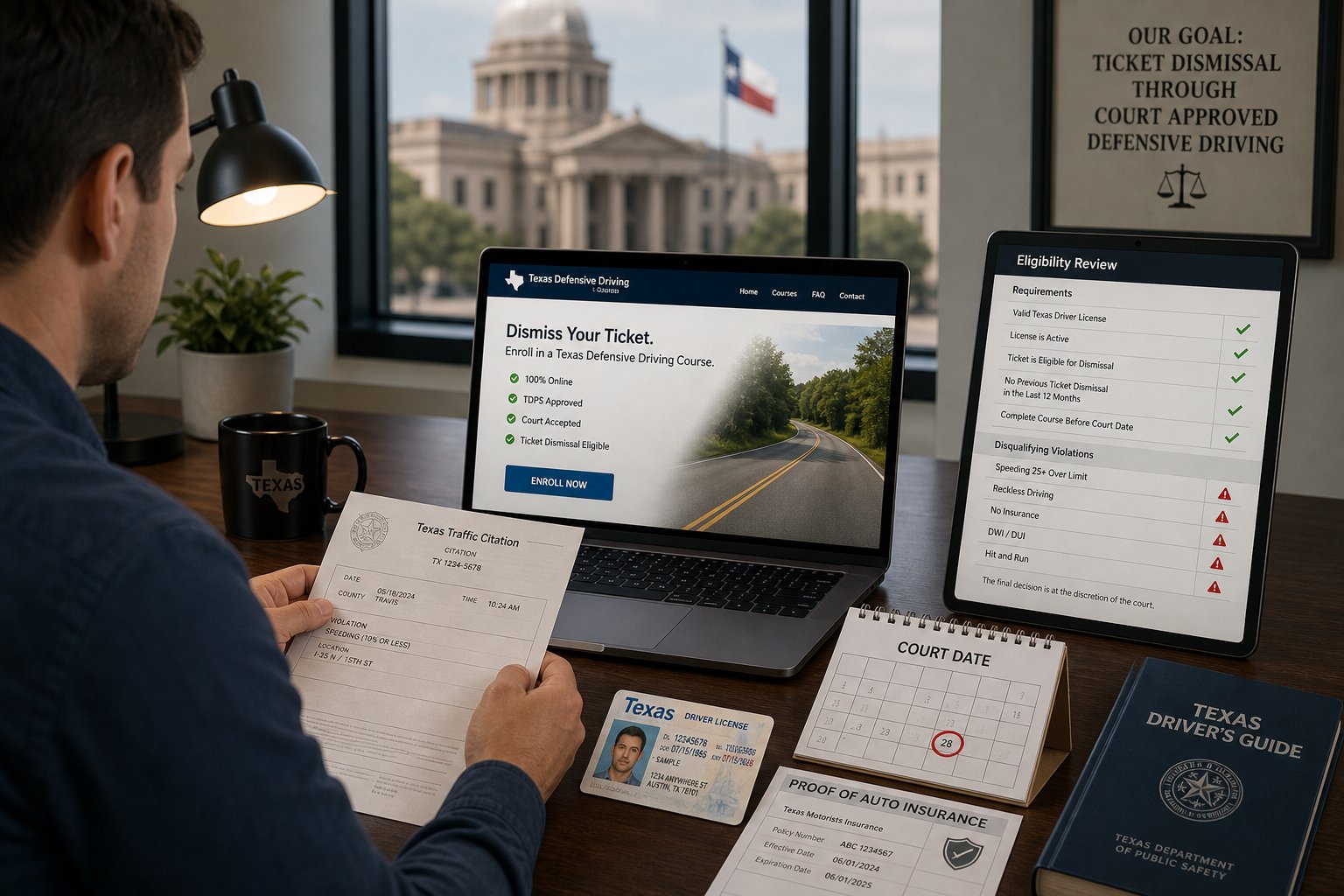
Who Qualifies For Ticket Dismissal In Texas
You may qualify for ticket dismissal in Texas if your ticket is eligible and the court agrees to let you take a Driver Safety Course. In Texas, a defensive driving course and a Driver Safety Course (DSC) are the same 6-hour program approved by the Texas Department of Licensing and Regulation (TDLR), not TxDPS or TxDMV.
Most courts look for a few basic things first:
- You have a valid Texas driver license or permit
- You have current liability insurance
- You have not used DSC for ticket dismissal in the past 12 months from the violation date
- You do not hold a commercial driver license (CDL)
- Your ticket is for an eligible moving violation
Some tickets usually do not qualify. That can include:
- Speeding 25 mph or more over the limit
- Speeding at 95 mph or higher
- Passing a school bus
- Certain work zone violations with workers present
- Hit-and-run or other serious charges
Even if you seem to qualify, the court still has the final say. That matters. Not all courts are required to grant DSC for every eligible violation.
So before you enroll in any texas driver safety course for ticket dismissal, check with the court listed on your citation. And if your appearance date is close, contact the court at once.
How To Request A Driving Safety Course From The Court
The key step is simple: you must request the course from the court before the appearance date on the citation. If you miss that date, the court may deny ticket dismissal even if you would have qualified otherwise.
Under Texas Code of Criminal Procedure Art. 45.0511, the usual process works like this:
- Contact the court before the appearance date
- Ask for permission to take a Driver Safety Course
- Plead guilty or no contest
- Pay the court costs or administrative fee
- Give the court any documents it asks for
Courts may let you apply online, by mail, or in person. Each court sets its own process, so follow its instructions closely.
You may need to provide:
- A copy of your driver license
- Proof of liability insurance
- A request form from the court
- In some courts, a Type 3A driving record from TxDPS
After approval, the court usually gives you a deadline, often about 90 days, to finish the course and file the final documents. Do not take the course first and hope it counts later. For ticket dismissal, court approval comes first.
What To Expect From A Texas Online Defensive Driving Course
A Texas online defensive driving course for ticket dismissal is a 6-hour TDLR-approved Driver Safety Course. Again, in Texas, defensive driving and DSC mean the same thing for this purpose.
The course covers safe driving habits, traffic laws, crash risks, and ways to avoid common mistakes. Most online options let you sign in from a phone, tablet, or computer and work in short sessions. That helps if your schedule is packed.
A typical course includes:
- Short reading or video sections
- Small quizzes between sections
- A final test or review at the end
- A completion certificate after you pass
For court use, make sure the provider is approved by TDLR. That approval matters more than anything else. A course from the wrong provider may not be accepted.
Driving Logic fits the needs of busy drivers because it offers a state-approved online format, flexible access, and fast certificate delivery. Still, the most important rule is this: take the course only after the court grants permission. The course alone does not dismiss the ticket. The court does.
What You Need To Submit After You Finish
Finishing the course is not the last step. To get citation dismissal, you must send the court the documents it ordered by the deadline it gave you.
Most courts want these items:
- Your completion certificate for the court
- Your Type 3A driving record from Texas DPS
- Any extra form or proof listed in the court order
The Type 3A driving record is the TxDPS 3-year unofficial driving record. Courts often use it to confirm that you were eligible for DSC and that you did not already use the same dismissal option within the last 12 months.
Do not assume the course provider sends everything for you. In many cases, you must order the driving record and you must submit both documents to the court.
Also, check whether the court wants mail, online upload, email, or in-person delivery. Small filing errors can create big problems. If the court receives your papers late or in the wrong format, it may not dismiss the case.
Keep copies of everything you submit. That gives you proof if the court asks questions later.
Deadlines, Costs, And Common Rules To Know
Texas ticket dismissal through DSC has two main costs and one very important clock. You usually pay a court fee and a separate course fee, and then you must finish everything by the court’s deadline.
In many cases, the court gives you about 90 days from the date you enter your plea or receive approval. But do not guess. Use the exact date from the court order.
Here are the rules that matter most:
- Request DSC before the appearance date on the ticket
- Wait for court approval before taking the course
- Complete a TDLR-approved 6-hour course
- Submit the completion certificate by the deadline
- Submit the Type 3A driving record if the court requires it
- Do not use DSC for more than one qualifying dismissal within 12 months
Another common point of confusion: TxDPS handles driving records and licenses, while TDLR approves the course providers. Those are different agencies with different jobs.
If you are unsure what your court requires, ask the court clerk for the exact list. That one step can save you from missing something important.
Mistakes That Can Cause A Dismissal Request To Be Denied
Most denials happen because a driver misses a rule, not because the course itself is hard. The biggest mistake is waiting too long.
Here are the most common problems:
- Requesting DSC after the appearance date
- Taking the course without court approval
- Missing the 90-day deadline
- Forgetting the Type 3A driving record
- Sending the wrong certificate or incomplete forms
- Having a CDL
- Using DSC for another Texas ticket within the last 12 months
- Trying to dismiss a ticket that is not eligible
Speed can also block eligibility. A ticket may be denied if it was for 25 mph or more over the limit or 95 mph and above.
Another mistake is assuming every court handles the process the same way. They do not. One court may ask for your driving record up front. Another may ask for it after course completion.
If anything on your citation or court notice is unclear, contact the court right away. Fast action matters more than guessing.
Can A Texas Defensive Driving Course Also Lower Insurance Rates
Yes, a Texas defensive driving course may also help lower your insurance rate, but that is separate from ticket dismissal. The same TDLR-approved Driver Safety Course can sometimes serve both purposes.
Many insurers offer a discount after course completion, often in the 1% to 10% range. But the discount is not automatic, and not every policy works the same way. You need to ask your insurer what it accepts.
Usually, you will need:
- Your completion certificate
- Your policy details
- The insurer’s own form, if it has one
Keep in mind that ticket dismissal depends on the court, while an insurance discount depends on your insurance company. One does not guarantee the other.
If you need a flexible option, you can take your Texas Driver Safety Course with Driving Logic after the court approves your request. And for official course provider information, review the Texas Department of Licensing and Regulation site first.
FAQ
How does defensive driving dismiss a Texas ticket?
You request the court’s permission before your appearance date, enter the required plea, complete a TDLR-approved six-hour course, and submit the certificate with a Type 3A record by the deadline. If the court approves, the citation is dismissed with no conviction recorded.
Do I still pay anything if my ticket is dismissed?
Usually yes — you pay the court’s administrative costs and the course fee, and you order a Type 3A record. These are separate from the fine you would have paid on a conviction.
What disqualifies me from dismissal?
Common disqualifiers include a CDL/commercial-vehicle violation, speeding more than 25 mph over the limit, construction-zone violations with workers present, no valid license or insurance, and having used the course for dismissal within the last 12 months.
How long do I have to finish the course?
The court sets the completion deadline, commonly around 90 days from your plea date. The separate, firmer rule is that the request itself must come before the appearance date on your citation.
Will the dismissed ticket show on my record?
No conviction is recorded when the court grants dismissal, so it does not appear as a conviction. The request and dismissal are processed through the court, not added as points — Texas no longer uses a statewide points system.
Can I do the whole thing online?
You can complete the six-hour course online with a TDLR-approved provider, but the request and certificate submission go through the court named on your citation, in the method that court specifies.
Conclusion
Dismissing a Texas ticket with defensive driving is really a sequence: ask the court before your appearance date, plea and pay, complete the six hours, and file the certificate with a Type 3A record on time. Each step has a deadline, and skipping the first one — the pre-appearance request — is what most often sinks a case. Treat it as a court process you manage carefully, and the dismissal takes care of itself.
Once the court approves your request, you can complete a TDLR-approved Texas defensive driving course for ticket dismissal online and download your certificate to submit before the deadline.
Related Articles
- How to Request Defensive Driving from a Texas Court
- What Texas Traffic Violations Qualify for Defensive Driving Dismissal?
- Texas Defensive Driving Deadline: Request Before the Appearance Date
- Texas Driver Safety Course (DSC): The Complete Guide
Sources
- TDLR — Driver Safety
- Texas Code of Criminal Procedure Art. 45.0511
- Texas Education Code § 1001
- Texas DPS — Driving Records
Billy Forte is the owner of Driving Logic, a state-approved driver safety and defensive driving course provider serving Texas and other U.S. states. Driving Logic offers online driver safety, defensive driving, and traffic-ticket courses for drivers handling court, license, and insurance-related requirements.
This article is general information, not legal advice. Texas court rules, TDLR requirements, deadlines, eligibility, and case facts can differ by county and court. Use official Texas court and state sources for current requirements, and consult a qualified Texas attorney for legal guidance specific to your situation.