
Updated June 2026 · Reviewed by Billy Forte
No — Texas does not have a driver points system; the state repealed the surcharge-based Driver Responsibility Program in 2019 (HB 2048), so no points are assigned to licenses. TxDPS still records traffic convictions, crashes, and license actions on your driving record, and it can still suspend a license for specific offenses such as DWI or driving without insurance. Insurers and courts review that record directly, so a conviction can still raise your premiums or affect your options even though there is no point total to track.
Applies to Texas. Court rules and deadlines vary by county.
Key Facts
- No points system: Texas repealed the Driver Responsibility Program in 2019 (HB 2048); licenses carry no points.
- Convictions still recorded: TxDPS keeps traffic convictions, crashes, and license actions on your record.
- Suspensions still happen: A license can still be suspended for offenses like DWI, driving without insurance, or driving while suspended.
- Insurance still affected: Insurers review your record directly and can raise premiums based on convictions, with no points needed.
- Dismissal still helps: A court-approved Driver Safety Course can keep an eligible ticket from becoming a conviction.
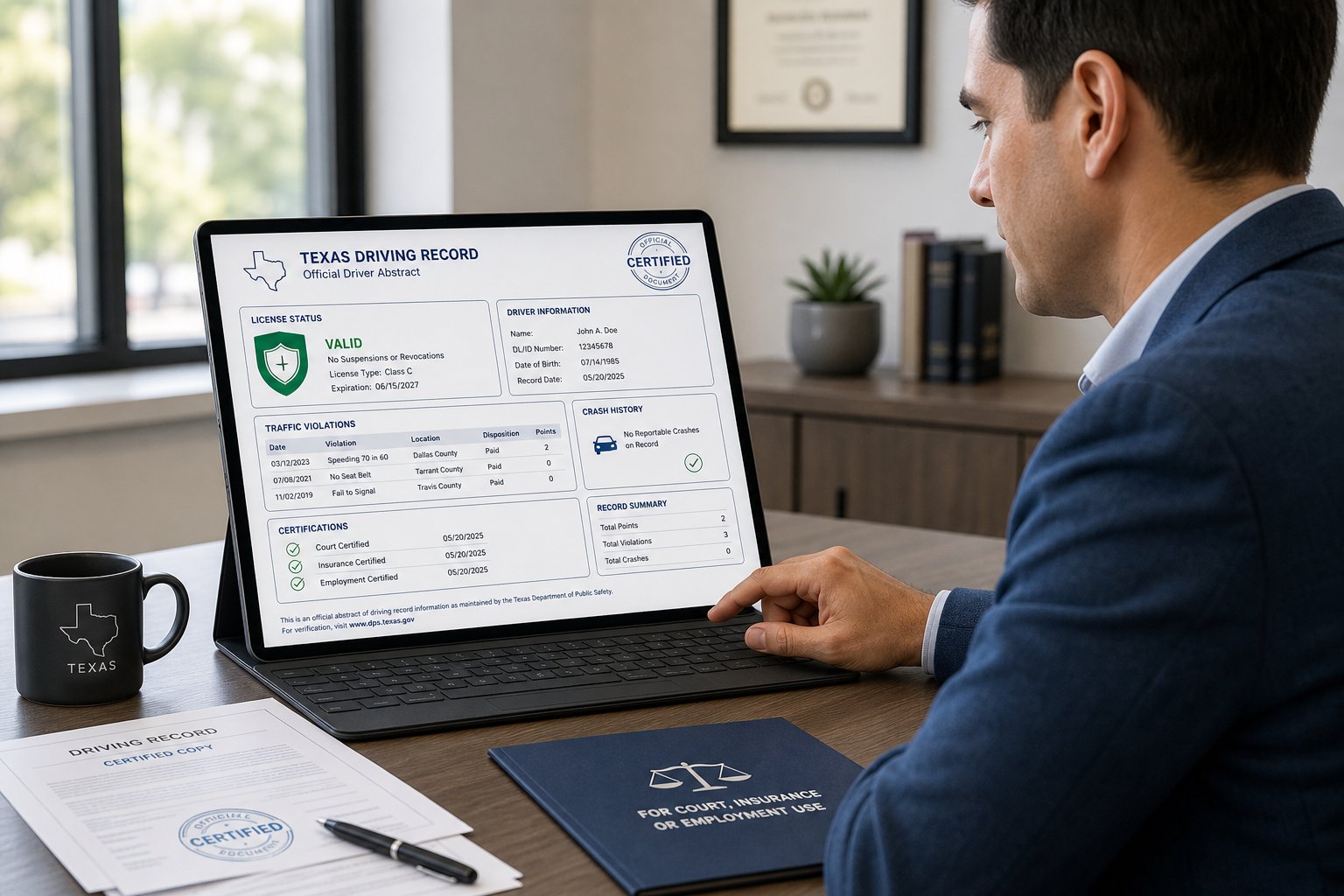
What A Texas Driving Record Shows And Why Drivers Check It
Your Texas driving record is the official history tied to your license. It can show your license status, moving violations, crashes, and any suspension or reinstatement action reported by Texas DPS.
That matters more than many drivers think. Even though the old Texas driving record points system is gone, your record still tells courts, insurers, and sometimes employers what has happened behind the wheel.
A Texas record may include:
- Your name and license details
- Whether your license is valid, suspended, or revoked
- Traffic convictions and moving violations
- Reported crashes
- Suspension, disqualification, or reinstatement history
Drivers often check their record for simple reasons. Maybe you got a ticket and want to see if it posted. Maybe you need a certified record for court. Or maybe you want to know what an insurer is likely to see before renewal.
It also comes up when you want to take a Driver Safety Course (DSC) for ticket dismissal. In Texas, defensive driving course and Driver Safety Course mean the same TDLR-approved 6-hour program. For many courts, you will need a Type 3A certified driving record with your request.
If you drive for work, a 3-year record or full record can also help you check for errors before an employer does. And if your license status is unclear, pulling your record is one of the fastest ways to confirm where things stand through Texas DPS.
Did Texas Get Rid Of Driving Record Points?
Yes. Texas got rid of its old points-based surcharge system in 2019.
More exactly, the state ended the Driver Responsibility Program (DRP) through HB 2048, effective September 1, 2019. Under that old system, certain traffic convictions added points, and those points could trigger yearly surcharges. Those surcharges are gone.
This is where many drivers get confused. They search for texas dps points system or ask how many points are on a license. But in current Texas law, there is no active state points chart that works like the old DRP.
Still, that does not mean tickets stopped mattering.
Texas DPS still keeps violation data on your driving record. Courts still report convictions. And DPS can still take administrative action in some cases, depending on the offense. That action is separate from the old DRP surcharges.
So the short answer is:
- No current Texas driver license points system like the old DRP
- No DRP surcharges anymore
- Yes, violations still stay on your record
- Yes, license suspensions can still happen for certain offenses
That distinction is the key. Texas removed the surcharge program, not the whole enforcement system. If you get a moving violation, it may still affect your insurance, your court options, and in some cases your license status. That is why checking your record and using options like a court-approved DSC can still make a real difference.
How Traffic Violations Can Still Affect Your License And Insurance
A ticket can still cost you, even without Texas driving record points. The main effects now are record history, insurance pricing, and possible DPS action.
First, a conviction can appear on your Texas driving record. Insurers often review that record when they price or renew a policy. They do not need a state points system to decide you are a higher risk. A speeding ticket, at-fault crash, or repeated moving violations may still lead to higher premiums.
Second, some offenses carry direct license consequences under Texas law or DPS rules. Examples include:
- DWI and some alcohol or drug offenses
- Driving without insurance in some situations
- Driving while license invalid or suspended
- Serious or repeated violations
- Certain commercial driver violations
Third, courts look at your history too. A clean record may help with options for an eligible ticket. A messy record can limit them.
This is where the DSC can help protect your record. In Texas, the Driver Safety Course and defensive driving course are the same 6-hour program approved by the Texas Department of Licensing and Regulation (TDLR), not TxDPS. If the court allows it and you request it before the appearance date on the citation, an eligible ticket can often be dismissed under Texas Code of Criminal Procedure Art. 45.0511.
If you need a flexible option, Driving Logic offers a Texas-approved online course built for busy schedules.
When A Texas License Can Be Suspended Or Reinstated
Texas can still suspend a license even though the old DRP points are gone. Suspension happens because of the offense or legal failure, not because you hit a modern points total.
Texas DPS may suspend, revoke, cancel, or disqualify driving privileges for reasons such as:
- DWI or other alcohol or drug offenses
- Driving while license invalid or suspended
- Failing to maintain required insurance in some cases
- Failing to comply with certain court or legal requirements
- Serious violations involving commercial driving
The exact rule depends on the offense. Some suspensions are automatic after a conviction or administrative finding. Others are tied to failure to meet a legal duty, such as insurance filing or compliance with a court order.
Reinstatement usually takes more than just waiting. You may need to:
- Finish the suspension period
- Pay required reinstatement fees
- Resolve court fines or case issues
- File proof of insurance, such as an SR-22, if required
Because the reason for suspension controls the next step, your driving record is often the best starting point. It can show whether the action is active and what kind of history is attached.
If you already have a citation, do not miss the court date or appearance date. And if you hope to use a Driver Safety Course for dismissal on an eligible ticket, ask the court before that deadline. Waiting too long can shut off that option.
How To Check Your Texas Driving Record Online Or By Mail
You can get your Texas driving record online or by mail. For most people, the online route is faster.
The main online option is the Licensee Driver Records service through the Texas.gov system connected to Texas DPS. You choose the record type, pay the listed fee, and then download, print, or receive the record as offered in the portal.
If you prefer mail, you can submit Form DR-1, Application for Copy of Driver Record, with payment to DPS. Mail takes longer, but it can work if you need to send a paper request.
Before you order, decide why you need the record. That helps you avoid buying the wrong type. For example:
- License status check only: basic status record
- Insurance or personal review: 3-year or full history
- Court request for DSC: often certified Type 3A
Be careful with court rules. Some courts want a certified record, not just a screen print. If you are asking to take a Driver Safety Course for dismissal, check the citation instructions and court requirements first. And remember, the DSC is approved by TDLR, while the driving record itself comes from TxDPS. Those are different agencies with different jobs.
Which Texas Driving Record Type To Request For Your Situation
The best record type depends on what you need to prove. Texas offers several driver record options, and the names can be confusing at first.
Here are the common ones:
- Type 1: Status only
- Type 2: 3-year history
- Type 2A: Certified 3-year history
- Type 3: Complete history
- Type 3A: Certified complete history
If you only want to know whether your license is valid, Type 1 may be enough. If you want to review recent tickets, crashes, or violations, a 3-year record may work. If you want the broadest picture, choose a complete history.
For many Texas courts, the record used with a Driver Safety Course request is the certified Type 3A. That is why people often search for a Type 3A record by name. It is commonly required because it is certified and shows the full record, which helps the court check eligibility.
Use cases often look like this:
- Court/DSC request: Type 3A
- Job or company review: Type 2A or Type 3A
- Insurance or personal review: Type 2, 2A, 3, or 3A depending on need
If the court paperwork is unclear, contact the court clerk before ordering. That small step can save time and keep you from having to request the same record twice.
How To Keep Your Texas Driving Record Clean Going Forward
The best way to protect your record is to prevent convictions from landing on it when a legal option exists. In Texas, one of the most useful tools is the Driver Safety Course for an eligible ticket.
Again, the names matter. In Texas, defensive driving and Driver Safety Course (DSC) mean the same TDLR-approved 6-hour course. It is not approved by DPS or TxDMV. If the court grants your request under Art. 45.0511, completing the course and meeting the court’s terms can help keep that ticket off your driving record.
A few smart habits also help:
- Request DSC before the appearance date on the citation if you want that option
- Pay close attention to court notices and deadlines
- Avoid repeat moving violations
- Keep insurance active
- Check your record from time to time for mistakes or old issues
If you want an online Texas course, Driving Logic offers a TDLR-approved Driver Safety Course that works on your phone, tablet, or computer and fits a busy schedule.
FAQ
Does Texas still have a driving-record points system?
No. Texas ended the Driver Responsibility Program in 2019 under HB 2048, so licenses no longer carry points. Convictions and license actions are still recorded on your driving record.
If there are no points, do tickets still matter?
Yes. A conviction stays on your record, insurers can raise your premiums based on it, and serious offenses can still lead to a license suspension — none of which requires a points system.
What can still suspend my Texas license?
Offenses such as DWI, driving without required insurance, driving while license invalid or suspended, and certain serious or repeated violations can lead to suspension under Texas law or DPS rules.
How can I protect my record without a points system?
Avoid convictions in the first place. For an eligible ticket, a court-approved Driver Safety Course results in dismissal, so no conviction is recorded.
Conclusion
The short version is that Texas traded its old points-and-surcharge system for a simpler reality: no points, but convictions that still follow you through insurance pricing and possible license action. Drivers searching for their Texas point total will not find one — what matters now is keeping convictions off the record. For an eligible ticket, a court-approved Driver Safety Course does exactly that, which is why it remains the most useful tool even without a points system.
For an eligible citation, you can avoid a conviction by completing a TDLR-approved Texas Driver Safety Course online once the court approves.
Related Articles
- Your Texas Driving Record: How to Get It and What It Shows
- How Long Do Traffic Violations Stay on Your Texas Driving Record?
- Texas Defensive Driving for Ticket Dismissal: The Complete Guide
- Texas DPS Driving Record: What TxDPS Tracks and Why It Matters
Sources
Billy Forte is the owner of Driving Logic, a state-approved driver safety and defensive driving course provider serving Texas and other U.S. states. Driving Logic offers online driver safety, defensive driving, and traffic-ticket courses for drivers handling court, license, and insurance-related requirements.
This article is general information, not legal advice. Texas court rules, TDLR requirements, deadlines, eligibility, and case facts can differ by county and court. Use official Texas court and state sources for current requirements, and consult a qualified Texas attorney for legal guidance specific to your situation.