
Updated June 2026 · Reviewed by Billy Forte
Texas can double the fine for speeding in an active school zone (when the lights are flashing or the zone is otherwise in effect) and in a work zone when workers are present. These higher fines apply on top of the normal cost, and the conviction affects your record and insurance the same way other speeding convictions do — Texas has no points system. For an eligible ticket you may still request a Driver Safety Course for dismissal before the appearance date, but speeding far over the limit can remove that option, so confirm the charge and your eligibility with the court.
Applies to Texas. Court rules and deadlines vary by county.
Key Facts
- Doubled fines: Active school zones and work zones with workers present can double the speeding fine.
- “Active” matters: School-zone penalties apply when the zone is in effect (e.g., lights flashing); work-zone enhancements apply when workers are present.
- Same record/insurance impact: A conviction affects your record and insurance like other speeding tickets; Texas has no points.
- DSC may still apply: An eligible ticket can be dismissed via a court-approved Driver Safety Course requested before the appearance date.
- High speeds can disqualify: Speeding more than 25 mph over the limit can remove the dismissal option.
What Counts As A School Zone Speeding Ticket In Texas
A school zone speeding ticket in Texas means you were accused of driving over the posted school-zone speed limit while that lower limit was legally in effect. That part matters. It is not enough for the street to be near a school. The zone must be properly marked, and the lower speed must be active at the time of the stop.
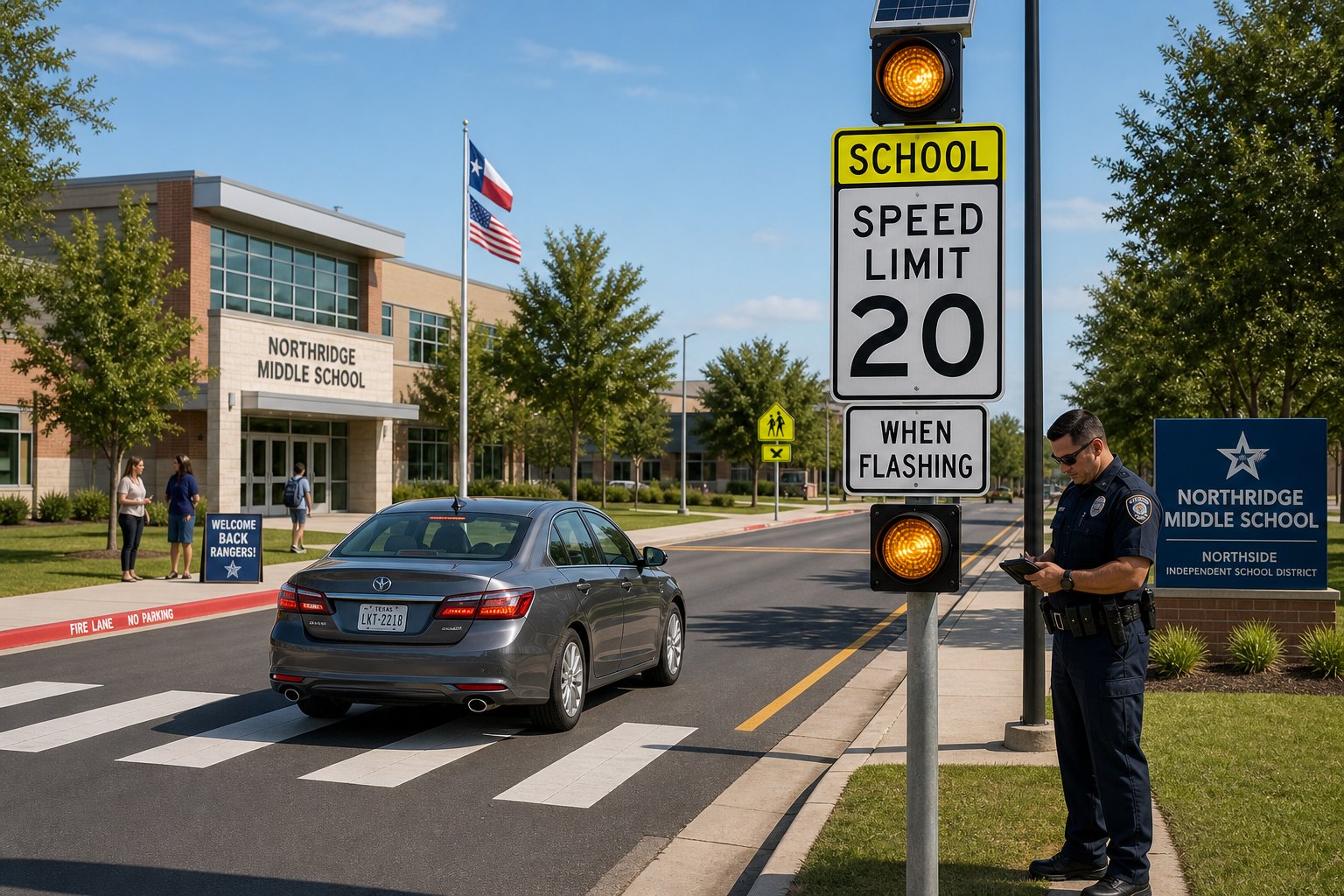
In Texas, school zones are usually marked by signs, pavement markings, and sometimes flashing beacons. Many school zones post a lower limit such as 15 mph, 20 mph, or 25 mph. The normal street speed limit may be much higher, but once the school-zone rule is active, the lower number controls.
This is also where readers often get confused about cost. The answer to how much more does a Texas speeding ticket cost in a school zone or work zone is not one flat statewide dollar amount. Instead, Texas law allows enhanced penalties in these zones, and local courts set the actual fine schedule and court costs. So the real-world total can vary a lot by city, county, and the speed listed on the citation.
For school zones, the big issue is whether the zone was active. If the lower speed was not active, that can affect both the charge and the enhanced fine.
When School Zone Speed Limits And Signs Are Legally Enforced
In many Texas school zones, the lower speed applies only during posted times or while flashing lights are activated. If the sign says “When Flashing,” the reduced limit is tied to the flashing beacon. If the sign lists hours, those posted hours matter.
That is why the active zone requirement is so important. A school-zone ticket with doubled penalties generally depends on the zone being legally active at that moment. If lights were not flashing when required, or if the stop happened outside the posted time window, that can be a key fact.
You should check:
- The exact wording on the sign
- Whether flashing lights were on
- The time listed on your citation
- Whether the officer marked the school zone as active
Photos, dashcam video, and the sign wording can matter here. And if you plan to ask the court for a Driver Safety Course, don’t wait. Under Texas Code of Criminal Procedure Art. 45.0511, a request for DSC must be made before the appearance date on the ticket.
Penalties And Other Consequences You Could Face
The short answer is simple: active school zones and active work zones can mean higher fines in Texas, often by doubling the fine portion of the ticket. But drivers should know that a ticket total is usually made up of more than one piece. There is often a base fine, then court costs and local fees.
So when people ask how much more a work zone speeding ticket Texas or school-zone ticket costs, the safest answer is this: it can be substantially more, and the exact amount depends on the court. Texas courts do not all use the same total. Some local schedules show school-zone amounts well above regular speeding amounts for the same speed range.
For example, some Texas courts publish schedules where a school-zone speeding ticket is clearly higher than a regular speeding ticket, and some counties list totals in the hundreds of dollars. That is why it is risky to assume a zone ticket is only a little more.
There can also be indirect costs:
- Insurance impact after a conviction
- Loss of a good-driver discount
- Harder choices later if you want dismissal on another ticket
- More stress if you miss the court deadline
Texas no longer uses the old DPS points system. Still, a conviction for a moving violation can affect your record and your insurance. For license questions, use the official Texas DPS site, since DPS handles driver licenses in Texas.
And for work zones, the same idea applies: the higher penalty generally depends on the zone being active, which usually means workers were present. If no workers were present, that fact can matter.
Why Paying The Ticket Is Not Always The Best First Move
Paying a Texas traffic ticket is often treated as a guilty or no-contest resolution that results in a conviction. That is the key reason many drivers should pause before paying right away. Fast is not always cheap.
Once you pay, you may lose the chance to ask for a different outcome. That can include a request for DSC, a request for deferred disposition, or the chance to contest whether the school or work zone was active at all. If your ticket involves a school zone with flashing lights, or a work zone where workers may not have been present, those facts should be checked before you lock in a conviction.
This does not mean you should ignore the ticket. You should not. Texas courts set deadlines, and missing them can create bigger problems. But paying first and asking questions later is often the wrong order.
Before you decide, review:
- The appearance date on the citation
- The speed alleged
- Whether the zone was active
- Whether you have used DSC in the last 12 months
- Whether you hold a CDL
A conviction may also affect your insurance for years. That is why many drivers look at dismissal options first, if available. The right first move is usually to contact the court listed on the ticket before the deadline and ask what options apply to your case.
Your Main Options: Pay, Contest, Or Take A Texas Defensive Driving Course
Most drivers have three basic paths: pay the ticket, contest the ticket, or ask for a Driver Safety Course. Which option makes sense depends on the facts, the court, and whether the zone was active.
Paying is the simplest step, but it usually means a conviction. That may be the fastest route, but not always the lowest-cost route over time.
Contesting the ticket means asking for a hearing and challenging part of the case. In school-zone and work-zone cases, a common issue is whether the enhanced zone was active. That might involve the sign wording, flashing lights, posted hours, worker presence, or the officer’s observations.
Taking a Texas defensive driving course can be an option for some drivers. In Texas, a defensive driving course and a Driver Safety Course (DSC) are the same TDLR-approved 6-hour program. The approval comes from the Texas Department of Licensing and Regulation, not Texas DPS and not TxDMV.
Courts often allow DSC for eligible moving violations, including some speeding tickets, but you must verify eligibility with the specific court. A school-zone or work-zone ticket is not automatically excluded in every case, but the active-zone facts and your eligibility still matter.
If you need a course option that fits a busy schedule, Driving Logic’s Texas DSC is built for online use on your phone, tablet, or computer.
How Defensive Driving Dismissal Works For Eligible Texas Drivers
The most important rule is timing: you must ask the court for DSC before the appearance date on your citation. If you miss that step, you may lose the option.
For eligible Texas drivers, the usual process looks like this:
- Contact the court before the deadline.
- Ask to request Driver Safety Course (DSC) dismissal.
- Wait for court approval and instructions.
- Complete the TDLR-approved 6-hour course by the court’s deadline.
- Get any required driving record.
- Submit the course certificate and other required documents on time.
DSC and “defensive driving” mean the same thing in this context. The legal framework is in Texas Code of Criminal Procedure Art. 45.0511.
A few limits often come up:
- Courts can deny DSC even when a driver seems eligible
- CDL holders usually face different rules
- High-speed allegations can block eligibility
- Prior DSC use within 12 months can matter
Also note the minimum course price set by Texas law is $25 plus a $3 materials fee. Confirm all court requirements before you enroll.
Special Situations That Can Raise The Stakes
Some facts can make a school-zone or work-zone ticket more serious. The most common is very high speed. If the allegation is far above the limit, the court may be less flexible, and DSC eligibility may be harder or impossible under the court’s rules.
Another issue is the type of license you hold. If you have a CDL, special rules often apply, and a simple dismissal path may not be available in the same way it is for other drivers. That is one reason commercial drivers should confirm options directly with the court instead of assuming a normal traffic-school path applies.
Repeat history can matter too. Courts may look more closely at drivers with multiple recent violations. And if the ticket involves more than speeding, such as a school-bus offense, phone use in a restricted area, or another charge, the cost and consequences can increase fast.
Work zones have their own key fact question: Were workers present? The enhanced penalty generally depends on an active work or construction zone. If the zone was posted but inactive, that detail can affect the case.
Before you choose a path, gather the basics:
- Citation details
- Date and time of stop
- Photos of signs or flashing lights
- Notes about workers present or not present
- Your driving history if the court asks for it
If the court approves DSC and you want a simple online option, you can take the Texas Driver Safety Course at Driving Logic on your own schedule.
FAQ
Are school zone speeding fines higher in Texas?
Yes. Texas can double the fine for speeding in an active school zone, meaning when the zone is in effect such as while the lights are flashing. The conviction also affects your record and insurance.
When do work zone penalties apply?
Enhanced work-zone penalties generally apply when workers are present. Signs in the zone typically note that fines double under those conditions.
Do these tickets add points?
No — Texas has no points system. A conviction still appears on your record and can raise insurance, but no points are assessed.
Can I dismiss a school zone ticket with defensive driving?
Often yes, if the ticket is eligible and the court approves, and you request the course before the appearance date. Speeding far over the limit may make it ineligible.
Conclusion
School-zone and work-zone tickets hit harder mainly through doubled fines, but the record and insurance impact tracks any other speeding conviction — and with no points in Texas, that conviction is the lasting cost. The dismissal option is often still on the table for an eligible ticket if you act before the appearance date. Confirm the exact charge with the court, since a very high speed can take that option away.
If your zone ticket is eligible and the court approves, you can dismiss it with a TDLR-approved Texas Driver Safety Course online.
Related Articles
- Texas Speeding Ticket: Costs, Record Impact, and What to Know
- Texas Speeding Ticket Fines: What Affects the Cost?
- Texas Speeding Ticket Total Cost: What Affects the Amount?
- Texas Defensive Driving for Ticket Dismissal: The Complete Guide
Sources
- Texas Transportation Code — Speed Restrictions
- TDLR — Driver Safety
- Texas Code of Criminal Procedure Art. 45.0511
Billy Forte is the owner of Driving Logic, a state-approved driver safety and defensive driving course provider serving Texas and other U.S. states. Driving Logic offers online driver safety, defensive driving, and traffic-ticket courses for drivers handling court, license, and insurance-related requirements.
This article is general information, not legal advice. Texas court rules, TDLR requirements, deadlines, eligibility, and case facts can differ by county and court. Use official Texas court and state sources for current requirements, and consult a qualified Texas attorney for legal guidance specific to your situation.