
Updated June 2026 · Reviewed by Billy Forte
To teach Texas parent-taught drivers ed, the instructor must hold a valid Texas driver’s license for at least three years, have a clean driving and criminal record, and be the teen’s parent or legal guardian — or, under current Texas law, another qualifying adult 25 or older. The instructor cannot have certain serious violations and is responsible for supervising and logging the teen’s behind-the-wheel practice. Confirming you meet these requirements before buying the program guide saves time, since eligibility is the foundation of the whole parent-taught path.
Applies to Texas teen driver education and licensing (ages 14–17). Requirements are set by TDLR (driver education) and the Texas DPS (licensing) and can change.
Key Facts
- Valid Texas license, 3+ years: The instructor must have held a Texas driver’s license for at least three years.
- Clean record: A clean driving and criminal history is required; certain serious offenses disqualify an instructor.
- Who qualifies: The teen’s parent or legal guardian, or a qualifying adult 25 or older under current Texas law.
- Supervises and logs driving: The instructor oversees behind-the-wheel practice and records it in the driving log.
- Teen is under 18: PTDE is a teen program; adults 18+ use the separate Adult Driver Education course instead.
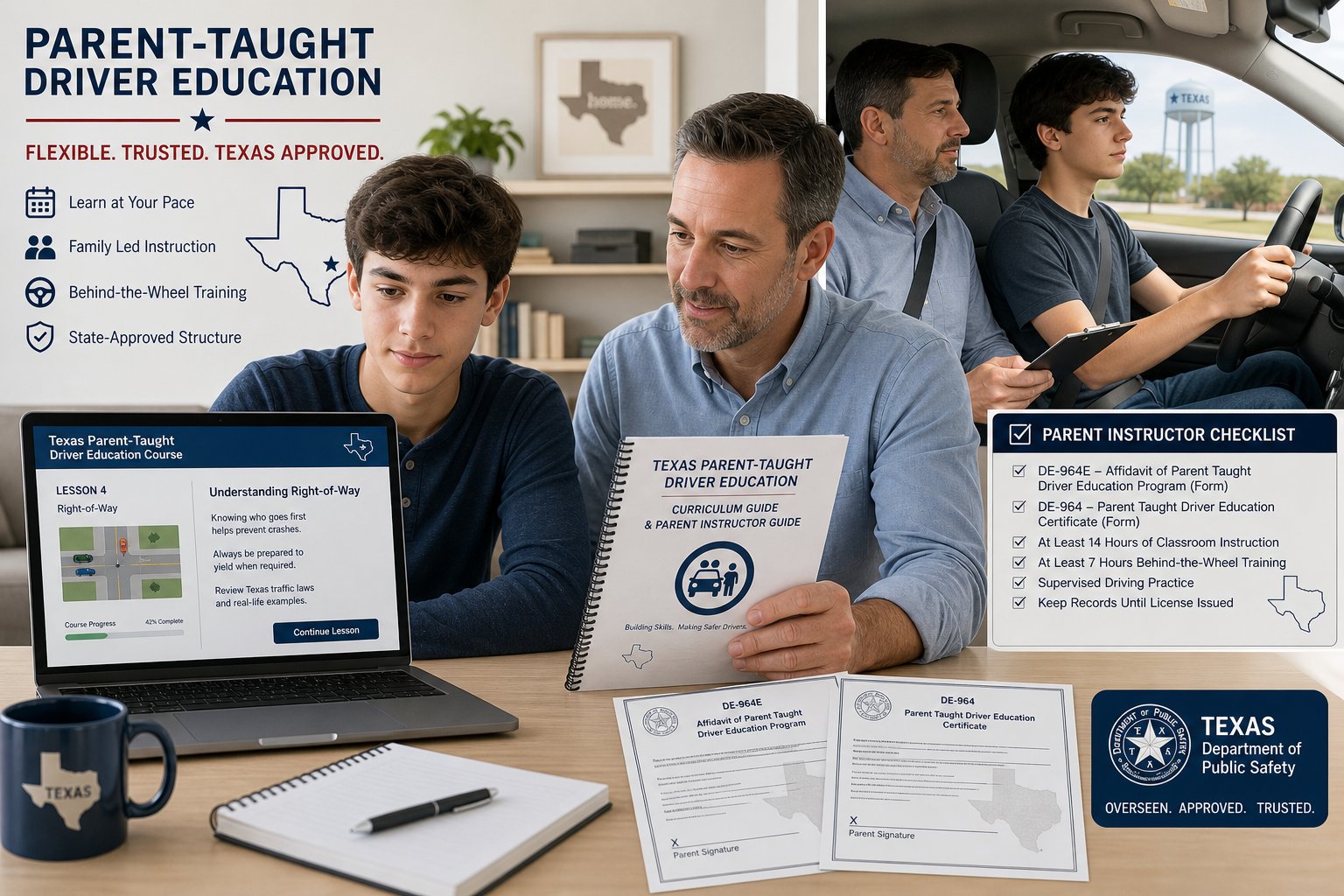
What Parent-Taught Drivers Ed Means In Texas
Parent Taught Drivers Ed, often called PTDE, is a Texas teen driver education option. It lets a family use a TDLR-approved course instead of a driving school classroom and car instructor.
PTDE is only for teens under 18. That matters. It is not the same as Adult Driver Education (ADE), which is a separate course for adults age 18 and older.
In Texas, the course has two main parts:
- Classroom instruction
- Behind-the-wheel instruction
- Supervised driving practice
The classroom part teaches rules, signs, safety, and basic driving habits. The in-car part covers real driving skills with an approved adult instructor. When the teen finishes key steps, the course provider issues the needed certificates, including DE-964E for partial completion and DE-964 for full completion.
Those forms matter because Texas DPS, not TDLR, handles the learner license and provisional license. TDLR approves the course and the PTDE process. TxDPS issues the actual license.
Many families choose PTDE because it gives them more control over time and schedule. If you need a flexible online option, a provider like Driving Logic can help you complete the state-approved course on your own device and on your own time. But the adult who teaches the teen still must meet the state rules. That is where most questions come up, and where parent taught drivers ed texas requirements really matter.
Who Qualifies For Texas PTDE
Texas has rules for both the teen and the adult instructor. You need both sides to qualify before you start.
Teen Student Requirements
The teen must be 14 to 17 years old to enroll in PTDE. A teen can begin the course at 14, but cannot get a learner license until age 15.
The teen must also meet school rules. In most cases, that means being enrolled in public school, private school, homeschool, or an approved high school equivalency program, with acceptable attendance and progress. For DPS visits, families often need a VOE or another accepted school record.
The teen should also live in Texas and be able to provide the usual identity and residency documents when applying with Texas DPS.
Parent Instructor Requirements
The ptde instructor requirements texas families ask about are pretty specific. The instructor is often a parent, step-parent, grandparent, foster parent, or legal guardian. Under newer Texas law, another qualifying adult age 25 or older may also be able to teach the behind-the-wheel part, such as an aunt, uncle, older sibling, or close family friend, if that person meets the state rules.
The adult must generally:
- Hold a valid Texas driver license
- Have held that license for at least 3 years
- Have a driving record that is clean enough under state rules
- Have no disqualifying criminal history
- Not be a licensed driver education instructor
Common disqualifiers include a suspended, revoked, or forfeited license, certain recent convictions such as DWI/DUI within the past 7 years, criminally negligent homicide, or a recent pattern of moving violations.
To check current eligibility, use the PTDE information on the TDLR website. If you are unsure, verify before the teen starts.
How To Start PTDE The Right Way
The order matters. Families often get tripped up by doing things too soon.
First, buy the PTDE Program Guide from TDLR. The fee is $20, and as of January 2026, the guide is sent by email only. There is no mailed paper packet. You can start that process through the Texas Department of Licensing and Regulation.
Next, confirm that the adult instructor qualifies. Do not guess. Review the current PTDE rules and make sure the person meets the license, age, and record standards. If the adult does not qualify, the teen should not begin under that instructor.
After that, enroll in a TDLR-approved PTDE course. The course must be approved for Texas teen driver education. A provider like Driving Logic offers a Texas parent-taught teen drivers ed course designed for flexible online use.
Then start the classroom portion. In many PTDE courses, the first segment leads to the partial certificate needed for the permit step. Keep your records organized from day one. Save emails, certificates, logs, and any forms tied to the course.
A simple checklist helps:
- Buy the PTDE Program Guide from TDLR
- Confirm the adult instructor is eligible
- Enroll in a TDLR-approved PTDE course
- Begin classroom lessons in order
- Keep all forms and progress records
Doing the steps in the right order can save you a second trip to DPS later.
Course Steps From Permit To License
Texas PTDE moves in stages. You cannot skip ahead.
The teen starts with the classroom portion. After Module 1, the teen may qualify for the partial completion form, DE-964E. That form is used for the learner license step. It is not the full completion certificate.
If your course includes the knowledge test, the teen may take it as part of the course. If not, follow current TxDPS instructions. Then go to Texas DPS with the needed documents to apply for the learner license.
Once the learner license is issued, the teen can begin the driving portion. That includes both:
- Behind-the-wheel instruction
- Observation and supervised practice
The adult instructor must follow the required lesson order and keep accurate driving logs. The teen also continues and finishes the remaining classroom lessons.
When all course requirements are complete, the provider issues the full DE-964 certificate. That certificate is needed for the next licensing step.
Before the road test, the teen must also complete Impact Texas Teen Drivers (ITTD). This is a free, 2-hour course from TxDPS. It is separate from PTDE itself. You can find it at Impact Texas Teen Drivers.
For the provisional license, the teen must usually:
- Be at least 16 years old
- Have held the learner license for at least 6 months
- Finish PTDE requirements
- Complete ITTD
- Pass the road test through DPS or an approved testing option
That sequence is the part many families miss. DE-964E gets you to the permit stage. DE-964 gets you to the license stage.
Required Hours, Tests, And Final Documents
Texas teen driver education has set time requirements. Families should plan for both course time and driving time.
For the classroom portion, many PTDE programs use 32 hours of instruction, though Texas minimum rules may be lower in some formats. The teen must complete the assigned lessons in order and follow any daily time limits built into the course.
For in-car work, the teen usually completes:
- 7 hours behind-the-wheel with instruction
- 7 hours observation
- 30 additional hours of supervised driving practice
- At least 10 of those 30 hours at night
That adds up to a large amount of real driving time. And that is the point. Safe driving takes practice in daylight, darkness, traffic, and normal daily conditions.
Families should also know the key tests and forms:
- Knowledge test for the learner license step
- ITTD completion before the driving test
- Road test for the provisional license
- DE-964E for partial completion after the early classroom stage
- DE-964 for full course completion
Bring the documents DPS asks for. That usually includes proof of identity, lawful presence, Social Security, Texas residency, and school status such as a VOE, when required.
If you want a simple online option for the Texas teen course, Driving Logic’s PTDE/TDE program is built for busy families who want flexible access on any device. Just make sure your adult instructor meets current state rules first, because the course and the instructor approval are two different pieces of the process.
FAQ
Who can teach parent taught drivers ed in Texas?
A parent, legal guardian, or qualifying adult 25 or older who holds a valid Texas license for 3+ years and has a clean driving and criminal record.
Can a non-parent teach PTDE?
Under current Texas law a qualifying adult 25 or older can serve as the instructor, in addition to a parent or legal guardian, provided they meet the license and record requirements.
Does the instructor need a special certification?
No special teaching certificate is required, but they must meet the license-length and clean-record rules and follow the program guide’s instructions and logging.
Can I teach PTDE if I have a recent violation?
A clean driving and criminal record is required, and certain serious violations disqualify an instructor. Confirm your eligibility against current TDLR and DPS rules before starting.
Conclusion
Instructor eligibility is the first gate to clear, because everything else in PTDE depends on having a qualified adult to supervise and log the driving. The core requirements are simple to check: a Texas license held three or more years, a clean record, and the right relationship or age under current law. Confirm you qualify before ordering the program guide, and you’ll start the program on solid footing.
Once you confirm eligibility, your teen can begin the classroom hours through a TDLR-approved Texas parent-taught drivers ed course online.
Related Articles
- Texas Parent Taught Drivers Ed (PTDE): The Complete Guide
- How Texas Parent Taught Drivers Ed Works Online: Step-by-Step
- Parent Taught vs Commercial Teen Drivers Ed in Texas: Which Is Right for Your Family?
- Texas PTDE: Concurrent vs Block Method — Which Should Your Family Choose?
Sources
Billy Forte is the owner of Driving Logic, a TDLR-approved Texas driver education provider. Driving Logic offers the online Texas parent-taught and teen driver education course that helps Texas teens complete the 32-hour classroom requirement and work toward a learner’s permit and provisional license.
This article is general information about Texas teen driver education and licensing, not legal advice. Requirements, fees, and procedures are set by TDLR and the Texas DPS and can change, so confirm current details with official Texas sources before you enroll or visit a DPS office.