
Updated October 2026 · Reviewed by Billy Forte
A Florida permit practice test is an unofficial quiz that helps you find weak topics before the real 50-question knowledge exam, where you need 40 correct to pass. Use practice tests to test yourself, then go back to the official Florida Driver License Handbook to fix what you missed. Practice tests work best as a study tool, not as a shortcut.
Key Facts
- The real exam: 50 questions, 40 correct (80%) to pass, in English only. See the real exam.
- The source: The official Florida Driver License Handbook covers every exam topic. See where to find questions.
- The method: Test, review misses, reread, test again. See the practice loop.
- Scores: Practice scores aren’t official and aren’t a promise you’ll pass. See how to read your scores.
- Online passers: Teens who pass online may be picked for a random retest. See why that matters.
What a Florida Permit Practice Test Is
A practice test is a set of sample questions written to look like the real exam. Schools, apps, websites and driver education courses offer them.
They are not the official exam. FLHSMV doesn’t post its exam questions on its public pages, so no practice test can promise you’ll see the same questions. What they can do is show you which topics you don’t know yet.
Many people search for a “Florida permit practice test 50 questions.” A 50-question practice set is useful because it matches the length of the real exam and helps you build focus for the full test.
How the Real Exam Compares
Know the real exam before you practice for it. FLHSMV’s exam page lists these facts:
- 50 multiple-choice questions on Florida traffic laws, safe driving practices and traffic controls
- 40 correct answers needed, which is 80%
- Teens under 18 can take it online through an approved provider. Everyone else tests at a county office.
Since February 6, 2026, the exam is given in English only. For the full exam rules, see our Florida permit test guide.
Where to Find Practice Questions
Start with the official source, then add practice sets. Every exam topic comes from Florida law and is explained in the Florida Driver License Handbook from FLHSMV.
Good places to find practice questions:
- Your driver education course. The DETS course ends with a 40-question final exam on Florida traffic laws and safe driving, and many courses add lesson quizzes.
- Online practice sites and apps. Many are free. Pick ones that are clearly written for Florida, not a general U.S. test.
- Questions you write yourself. Turning a handbook section into your own questions is a strong way to learn it.
Be careful with any site that claims to have the “real” exam questions. FLHSMV doesn’t post them publicly. Also check that a site’s rules match Florida’s current ones, such as the English-only exam rule.
The Practice Test Loop
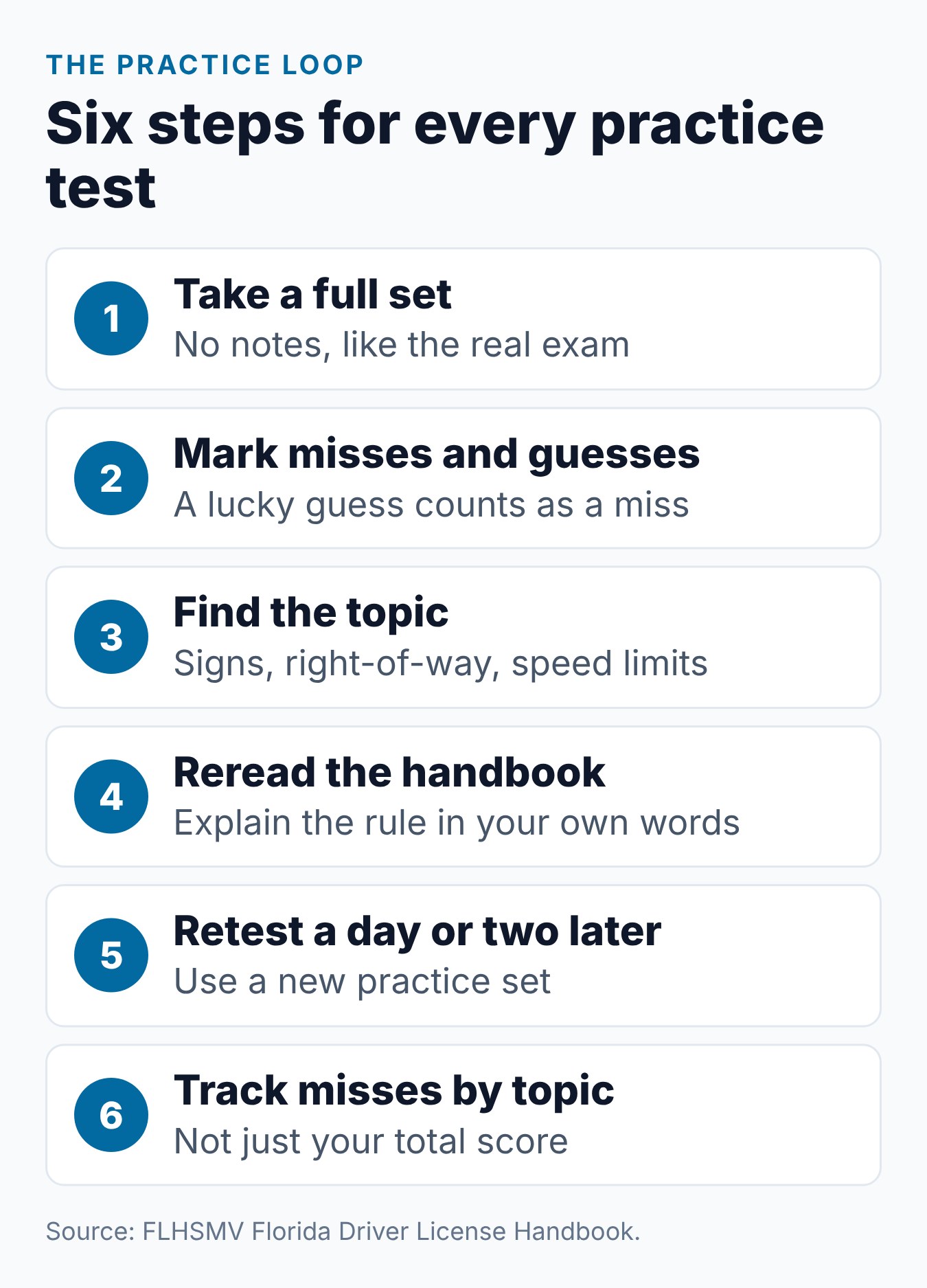
The value of a practice test comes after you finish it. Use the same loop every time:
- Take a full practice set without notes, like the real exam.
- Mark every miss and every lucky guess.
- Find the topic each miss comes from, such as signs, right-of-way or speed limits.
- Reread that handbook section until you can explain the rule in your own words.
- Take a new practice set a day or two later.
- Track your misses by topic, not just your total score.
Repeat the loop until your misses are spread thin and no topic keeps showing up.
Practice by Topic
FLHSMV groups the exam into three areas. Practice each one on its own before you mix them.
Traffic Laws
These questions cover the rules you must follow. Think right-of-way, speed limits, school zones, turns, passing and the license rules for teen drivers.
Practice tip: when you miss a law question, write down the rule and the number in it, such as a speed or a distance. Numbers are easy to mix up.
Safe Driving Practices
These questions ask what a careful driver should do. Topics include following distance, sharing the road with motorcycles and trucks, driving in rain and the effects of alcohol and drugs.
Practice tip: picture yourself in the driver’s seat, then pick the safest legal choice. If two answers both seem safe, look for the one that follows Florida law exactly, since the exam tests the rule, not just good sense.
Traffic Controls
These questions cover signs, signals and pavement markings. Learn signs as groups by shape and color, since each shape has a meaning.
Practice tip: make flash cards with the sign on one side and its meaning on the other. Shuffle the deck each time so you learn the signs, not the order they come in. Our Florida permit test study guide lists the topics in more detail.
Reading Your Practice Scores
There’s no official practice score that means you’ll pass. The real exam asks different questions, so treat your practice score as a signal, not a promise.
What matters more is the pattern of your misses. This table shows what different results usually mean and what to do next.
| What you see | What it likely means | What to do |
|---|---|---|
| Misses spread across many topics | You haven’t read the whole handbook yet | Read it start to finish, then retest |
| Most misses in one topic | A gap in that area | Reread that section and quiz just that topic |
| High scores on one site only | You may be memorizing that site’s questions | Switch to a different practice source |
| Scores drop when you’re tired | Focus, not knowledge | Practice full 50-question sets at a set time |
| Guessing right but unsure why | Luck, not learning | Treat lucky guesses as misses |
The goal is to know why each answer is right. If you can explain the rule, you can answer a new question about it.
One more pattern to watch: if your score jumps after you retake the same practice set, that’s memory, not learning. Always judge your progress on a set you haven’t seen before, because the real exam will be new to you too.
How Many Practice Tests to Take
There’s no official number. The right amount is however many it takes for your misses to stop repeating.
A good sign is when you take a new set from a source you haven’t used and miss only a few questions, each on a different topic. A warning sign is when the same topic keeps showing up, no matter how many tests you take.
Quality beats quantity. One practice test that you review carefully teaches more than five you rush through and never look at again.
Practice Tests and the Random Retest
Teens who pass the exam online should keep studying after they pass. FLHSMV says anyone who passes through a third-party provider may be randomly picked for a no-fee retest at an office, with no notice.
If you fail that retest, a re-exam fee is charged at the next attempt. The Manatee County Tax Collector says the learner’s license is issued after you pass the retest.
So don’t memorize one practice site’s answers to get through an online test. Learn the handbook rules so you can pass any version of the exam.
Practice Tips for Teens Testing Online
Teens under 18 can take the real exam online through an FLHSMV-approved provider. A parent or guardian proctors the test and signs form HSMV 71144.
Treat your last practice test like the real one. Sit in a quiet room, put your phone away and finish all 50 questions in one sitting.
That way the online exam feels familiar, and your parent sees what proctoring will be like. See our Florida permit test online guide for how the online exam works.
Practice Tips for Adults
Adults 18 and older take the same 50-question exam, but they test in person, since online testing is for applicants under 18. Adults also finish the 4-hour TLSAE course first.
If it’s been years since you studied for a test, start with the handbook and short practice sets. Build up to full 50-question sets before your office visit.
Practicing in English
Since February 6, 2026, Florida gives the knowledge exam in English only. The Palm Beach County Tax Collector says outside translation services are no longer allowed.
If English isn’t your first language, practice in English from the start. Make a short list of driving words, such as yield, merge, right-of-way and pedestrian, and learn them first.
A Simple Two-Week Practice Plan
This plan is one way to organize your time. Adjust it to your schedule.
- Days 1 to 4: Read the handbook, one chapter per session. No practice tests yet.
- Day 5: Take your first full practice set. Write down every topic you missed.
- Days 6 to 9: Reread the sections you missed. Quiz yourself on signs with flash cards.
- Day 10: Take a new full practice set from a different source.
- Days 11 to 13: Focus only on the topics that still show up.
- Day 14: Light review of signs and numbers, then rest before the exam.
The Day Before the Real Test
Don’t cram new material the night before. Use the last day to review, not to learn.
- Look over road signs one more time.
- Review the numbers you tend to forget, like speed limits and distances.
- Reread your list of missed topics.
- Confirm your reservation, the office address and its testing cutoff time.
- Get a full night’s sleep.
Common Practice Test Mistakes
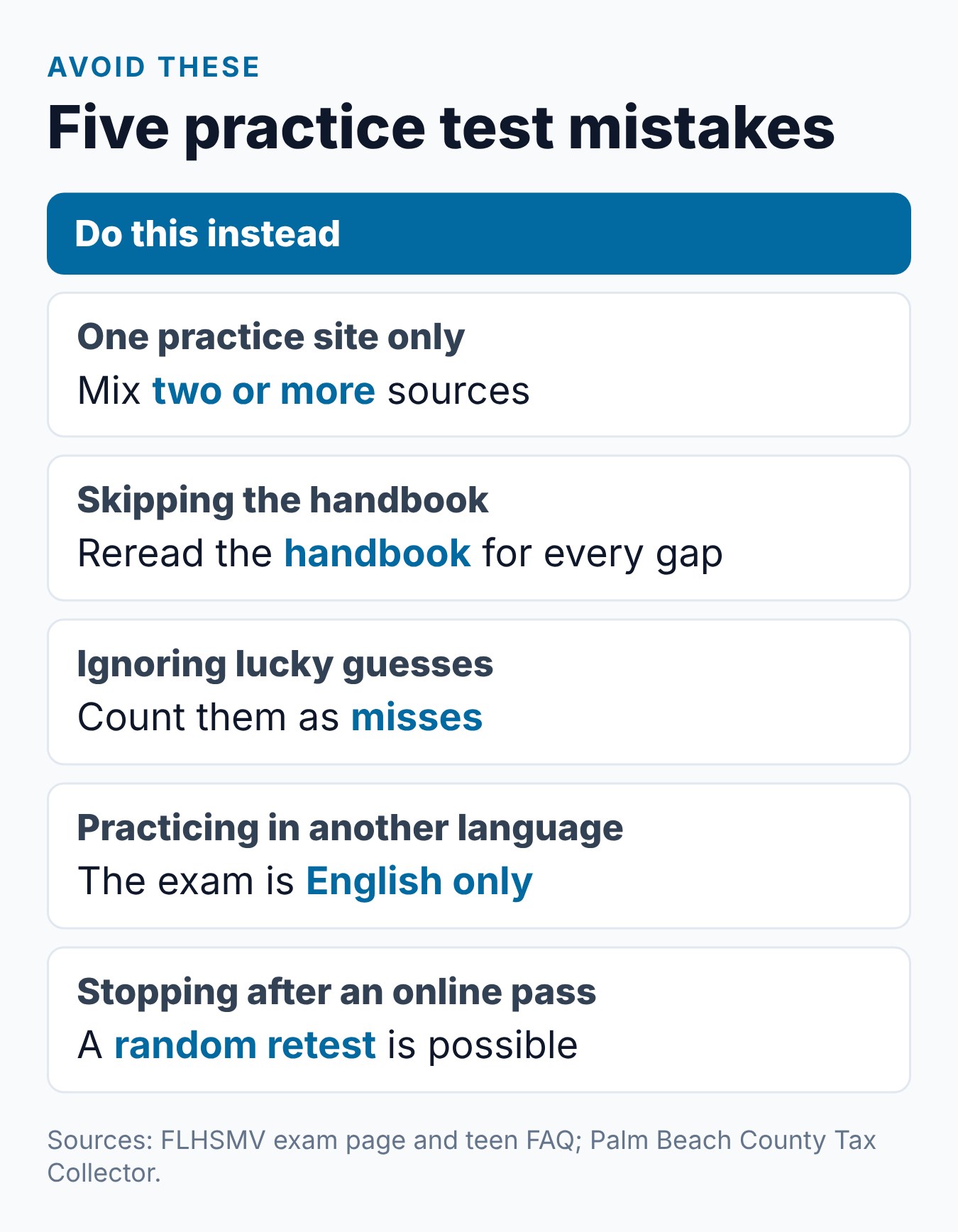
These habits feel productive but don’t build real knowledge.
- Using only one practice site. You may memorize its questions instead of the rules.
- Skipping the handbook. Practice tests check what you know, but the handbook teaches it.
- Ignoring lucky guesses. A guess you got right is still a gap.
- Practicing in another language. The real exam is in English only.
- Stopping after an online pass. A random retest at an office is possible.
How Requirements Can Vary
Florida’s course and license rules apply statewide, but some details depend on where you live. Driver license services are often handled by your county tax collector’s office, and each office sets its own appointment process and hours. Some county school boards also offer driver education programs, such as DELAP courses, that can count instead of DETS.
FLHSMV can update course rules, forms, documents, and fees. Check FLHSMV and your county office for current requirements before your appointment.
Frequently Asked Questions
Are Florida permit practice tests the same as the real test?
No. FLHSMV doesn’t post its exam questions publicly. Practice tests cover the same topics but use different questions.
How many questions are on the Florida permit test?
There are 50 questions, and you need 40 correct (80%) to pass.
What practice score should I get before the real test?
There’s no official target. Aim to pass several full practice sets from different sources and to understand why each answer is right.
Where can I find a Florida permit practice test?
Driver education courses, apps and online practice sites offer them. Use the official Florida Driver License Handbook as your main study source.
Are practice tests enough to pass?
Not on their own. Use them to find weak topics, then study those topics in the handbook.
Can I take Florida permit practice tests in Spanish?
Some sites offer them, but the real exam is in English only since February 6, 2026. Practice in English to match the real test.
Conclusion
A Florida permit practice test is most useful when you treat each miss as a topic to study, not a score to beat.
Use practice sets from more than one source, go back to the official handbook for every gap and practice in English. Keep studying even after an online pass, since a random retest is possible. Our online Florida DETS course is coming soon.
Related Articles
- Florida Permit Test: What to Expect and How to Prepare
- Florida Permit Test Study Guide: What to Know Before the Exam
- How Many Questions Are on the Florida Permit Test and What Score Do You Need?
Sources
- FLHSMV — Class E Knowledge Exam and Driving Skills Test
- FLHSMV — Teen Licensing Frequently Asked Questions
- FLHSMV — Official Florida Driver License Handbook (PDF)
- Manatee County Tax Collector — Written Exams
- Hillsborough County Tax Collector — Driver License Exams in English Only Beginning February 6
- Palm Beach County Tax Collector — New Drivers Aged 18 or Older
Billy Forte is the owner of Driving Logic, a state-approved driver improvement course provider serving Florida and other U.S. states.
This article is general information, not legal advice. Florida licensing requirements, course rules, documents, and fees are set by FLHSMV and Florida law and can change. Use official FLHSMV and Florida statute sources for current requirements before you enroll in a course or visit a driver license office.