
Updated October 2026 · Reviewed by Billy Forte
The Florida permit test vs drug and alcohol course question comes down to this: the course is a class you finish first, and the permit test is a separate 50-question exam you pass afterward. Adults 18 and older take the 4-hour drug and alcohol course, called TLSAE, while teens under 18 now take the 6-hour DETS course instead. Everyone who has never been licensed takes the permit test after the course.
Key Facts
- Two separate steps: The course comes first, then the permit test. See the difference.
- Adults: Take the 4-hour TLSAE, the drug and alcohol course. See who takes which course.
- Teens: Take the 6-hour DETS course since August 1, 2025, not the drug and alcohol course. See the teen rule.
- The test: 50 questions, 40 correct to pass, at an office or online if under 18. See the test.
- Proof: Course completion is reported to FLHSMV electronically. See how proof works.
Florida Permit Test vs Drug and Alcohol Course: The Core Difference
People mix these up because both come before a first license, and many still call both “the drug and alcohol test.” They are different things.
| The course | The permit test | |
|---|---|---|
| What it is | A required education class | The Class E knowledge exam |
| Who gives it | An FLHSMV-approved course provider | A county driver license office or an approved third-party provider |
| Length | 4 hours (TLSAE) or 6 hours (DETS) | 50 questions; 60 minutes at an office |
| How you finish | Complete the course with the provider | Answer at least 40 of 50 correctly |
| When | First | After the course |
| Proof | Reported to FLHSMV electronically by the provider | Recorded at the office or sent by the provider |
You need both. Finishing the course doesn’t mean you passed the permit test, and passing the test doesn’t replace the course.
Which Course Do You Need?
Your age decides the course. People who have never held a license follow these rules:
- Adults 18 and older: The 4-hour Traffic Law and Substance Abuse Education course (TLSAE). F.S. 322.095 requires it unless you’ve been licensed in another jurisdiction. This is the course most people call the drug and alcohol course.
- Teens under 18: The 6-hour Driver Education Traffic Safety course (DETS), or an approved school course. F.S. 322.1615 requires an approved driver education course before a learner’s license.
If you hold a valid license from another state, you usually transfer it and skip both the course and the knowledge exam. For a full side-by-side of the two courses, see our DETS vs TLSAE guide.
The Teen Rule Changed in 2025
This is the biggest source of confusion. Before August 1, 2025, Florida teens took the same 4-hour drug and alcohol course as adults.
Since August 1, 2025, FLHSMV’s DETS page requires applicants under 18 who have never been licensed to complete DETS instead. FLHSMV’s DETS FAQ says teens who complete TLSAE on or after that date will need to take DETS.
So a parent searching for the “drug and alcohol permit test” for a 15-year-old is looking for the wrong course. Teens need DETS. Our article on the 6-hour drug and alcohol course explains where that search term comes from.
What the Drug and Alcohol Course Is
TLSAE is a 4-hour course on Florida traffic laws and on how alcohol and drugs affect driving. You take it from an approved provider on FLHSMV’s TLSAE provider list, and many providers offer it online.
It’s a class, not the licensing exam. Its lessons are delivered by the approved provider under FLHSMV’s rules. Passing it means you’ve met the education requirement, not the knowledge exam requirement.
What the Permit Test Is
The permit test is the Class E knowledge exam. FLHSMV’s exam page says it has 50 multiple-choice questions on Florida traffic laws, safe driving practices and traffic controls, and you need 40 correct to pass.
Where you can take it depends on age:
- Under 18: at a county office, or online through an approved third-party provider with a parent proctor
- 18 and older: in person only, since online testing is for applicants under 18
Since February 6, 2026, the exam is given in English only. Our Florida permit test guide covers it in full.
What Each One Covers
The courses and the exam overlap in subject, which adds to the confusion. Here is what each one is built around.
- TLSAE: Florida traffic laws plus substance abuse education, as its full name, Traffic Law and Substance Abuse Education, says.
- DETS: A broader driver education course. It must meet or exceed Florida’s school standard for Driver Education/Traffic Safety, course 1900300.
- The permit test: Florida traffic laws, safe driving practices and traffic controls such as signs and signals.
Because the courses teach traffic laws, they help you study. But the exam draws on the whole handbook, so read it too. Our permit test study guide lists the topics.
Time and Cost for Each
The two steps also differ in time and money.
- The course takes 4 hours (TLSAE) or 6 hours (DETS), and you pay the course provider.
- The permit test takes up to 60 minutes at an office. On your first attempt at an office, the state’s $10 test fee is waived. Online exams for teens are priced by the provider.
- The license costs $48 under FLHSMV’s fee schedule, and most tax collector offices add $6.25.
See our Florida permit test cost guide for totals by path.
How Proof Gets to FLHSMV
You usually don’t need to carry paperwork for either step. FLHSMV’s DETS FAQ says approved providers report completions electronically, and the teen FAQ says vendors provide exam scores electronically.
Still, save a copy of your course certificate. It’s a useful backup if the office can’t find your record on the day of your visit. Check that the name and birth date on it match your identity documents exactly, and ask the provider to fix any error before your visit.
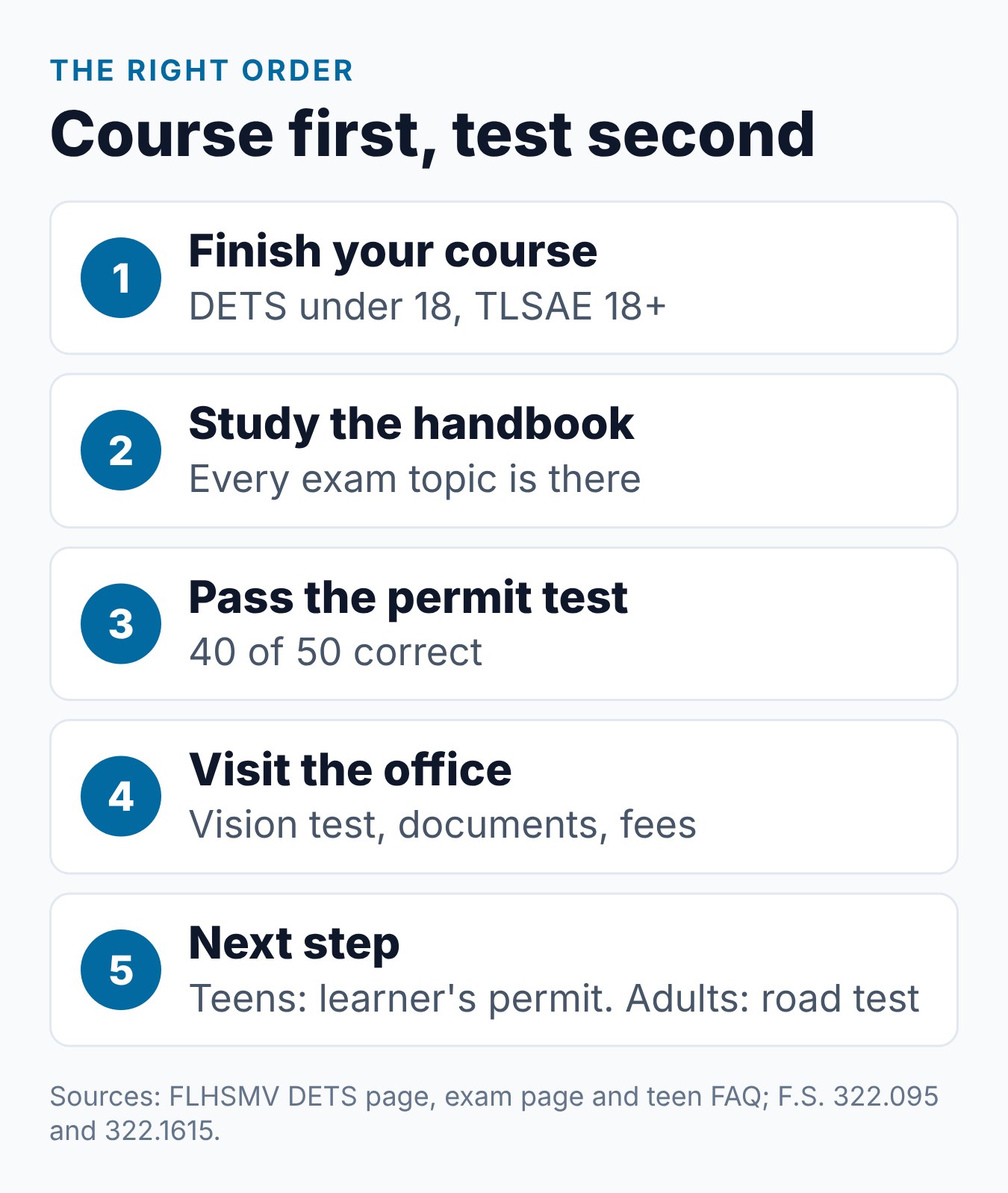
The Right Order
Doing things in order saves trips. Here is the usual sequence for someone who has never been licensed:
- Finish the right course for your age: DETS for teens, TLSAE for adults.
- Study the Florida Driver License Handbook.
- Pass the permit test at an office, or online if you’re under 18.
- Visit a driver license office for the vision test (and hearing test for a learner’s permit), documents and fees.
- Teens get a learner’s permit. Adults move on to the driving skills test.
Most offices are run by county tax collectors. Many people call them “the DMV,” but the licensing agency in Florida is FLHSMV.
Real Situations
These examples show how the rules apply to different people. Each one follows FLHSMV’s published rules.
- A 15-year-old who has never driven: Takes the 6-hour DETS course, then the permit test, then gets a learner’s permit.
- A 17-year-old who finished TLSAE in September 2025: That course doesn’t meet the teen rule, since it was done after August 1, 2025. The teen needs DETS before the permit.
- A 19-year-old who has never been licensed: Takes the 4-hour TLSAE, then the permit test in person, then the vision and road tests.
- A 30-year-old moving from Georgia with a valid license: Transfers the license. No course, and usually no knowledge exam.
- A 45-year-old whose old license from another state expired: F.S. 322.095 doesn’t require TLSAE for someone licensed in another jurisdiction, but tests may be required. Call the county office first.
Why the Names Get Confusing
A few things make this topic hard to search.
- Old habits. For years, teens and adults took the same drug and alcohol course, so older articles still say teens need it.
- Many names for one course. TLSAE is also called the drug and alcohol course or the 4-hour course.
- “Test” vs “course.” People often say “drug and alcohol test” when they mean the course.
- Bundles. Some providers sell a course and the online permit exam together, which makes them look like one thing.
When in doubt, ask two questions: Is this the course or the knowledge exam? And is it for my age group? If a product page doesn’t make both answers clear, contact the provider before you pay, or check FLHSMV’s approved provider lists yourself.
If a Teen Already Took the Drug and Alcohol Course
This happens often, since older articles still point teens to TLSAE. FLHSMV’s DETS FAQ says applicants under 18 who complete a TLSAE course on or after August 1, 2025 will need to take DETS, unless they are in a qualifying school course.
Teens who finished TLSAE before August 1, 2025 had a one-year window to use it. FLHSMV’s transition rule says those certificates could be used for one year from the completion date, so all of those windows have now ended.
Questions to Ask Before You Buy
Many schools sell more than one Florida course, and some bundle a course with the online permit exam. Ask these questions first:
- Is this DETS or TLSAE? Make sure it matches your age.
- Is the provider approved by FLHSMV for that course?
- Does the price include the permit exam? If so, is it the online exam, and are you under 18?
- What happens if I fail the course exam or the permit exam?
A clear answer to each one prevents buying the wrong product.
Common Mistakes
These come straight from FLHSMV’s rules.
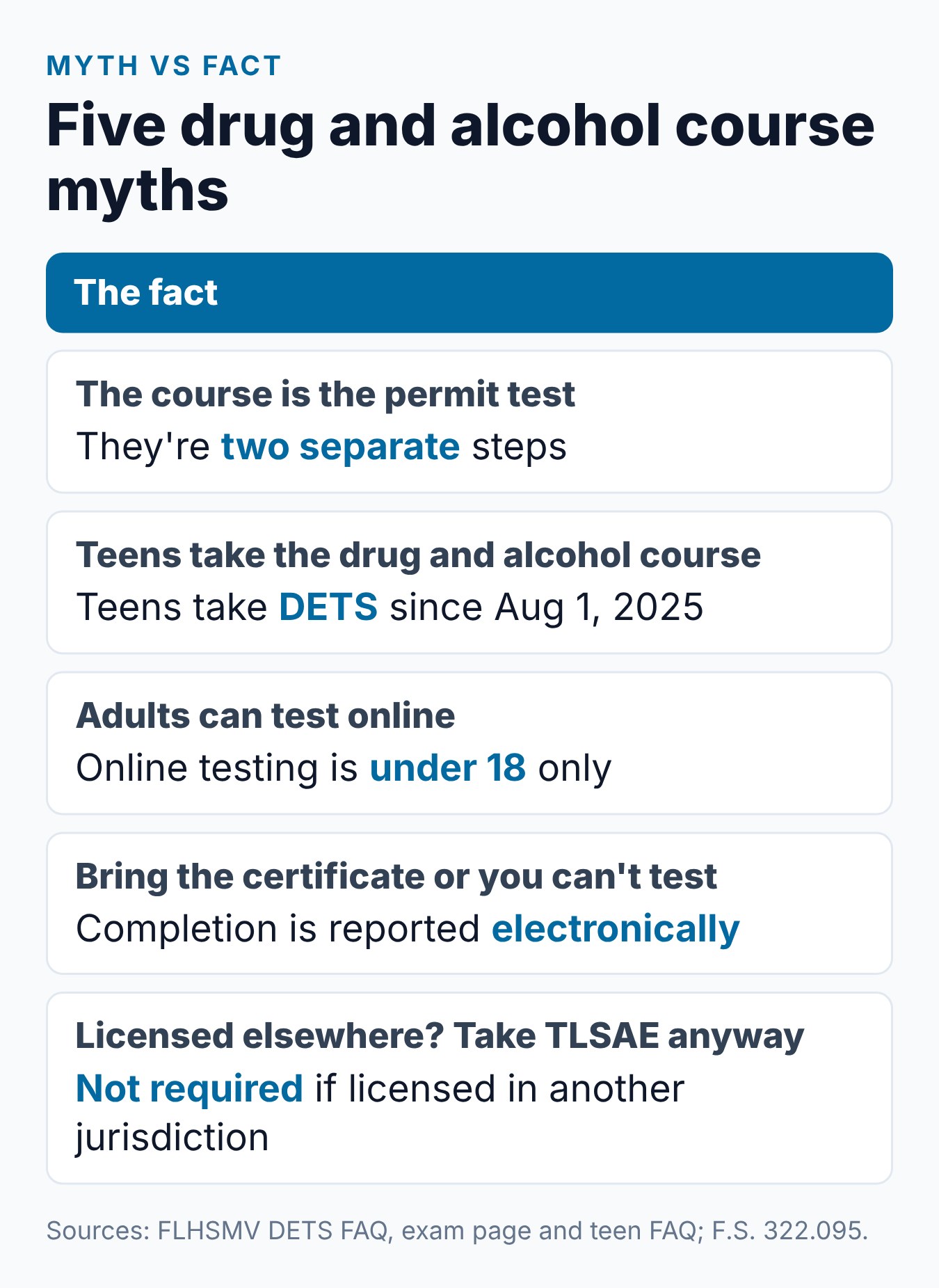
- A teen taking TLSAE. Since August 1, 2025, teens need DETS.
- Thinking the course is the permit test. You still need to pass the 50-question exam.
- An adult signing up for an online permit test. Online testing is for applicants under 18.
- Taking the course after the exam. Finish the course first.
- Throwing away the certificate. Keep a copy as backup.
How Requirements Can Vary
Florida’s course and license rules apply statewide, but some details depend on where you live. Driver license services are often handled by your county tax collector’s office, and each office sets its own appointment process and hours. Some county school boards also offer driver education programs, such as DELAP courses, that can count instead of DETS.
FLHSMV can update course rules, forms, documents, and fees. Check FLHSMV and your county office for current requirements before your appointment.
Frequently Asked Questions
Is the drug and alcohol course the same as the permit test in Florida?
No. The drug and alcohol course (TLSAE) is a 4-hour class. The permit test is a separate 50-question knowledge exam you take after the course.
Do teens take the drug and alcohol course in Florida?
Not anymore. Since August 1, 2025, teens under 18 who have never been licensed take the 6-hour DETS course instead.
Do I need both the course and the permit test?
Yes, if you’ve never been licensed. You finish the course first, then pass the knowledge exam.
Can I take the drug and alcohol course and the permit test online?
Many providers offer TLSAE online. The permit test can be taken online only by applicants under 18, who take DETS rather than TLSAE.
Do I need to bring my course certificate to the permit test?
Providers report completion to FLHSMV electronically, so it’s usually not required. Bring a copy as a backup.
How long is the drug and alcohol course?
TLSAE is a 4-hour course. DETS, the teen course, is 6 hours.
Conclusion
The Florida permit test vs drug and alcohol course difference is simple: the course is a class you finish first, and the permit test is a separate 50-question exam.
Adults take the 4-hour TLSAE, and teens now take the 6-hour DETS course instead. Finish the right course for your age, then study the handbook and pass the knowledge exam. Our online Florida DETS course is coming soon.
Related Articles
- Florida Permit Test: What to Expect and How to Prepare
- Florida DETS vs TLSAE: What Changed and Who Needs Which Course
- Florida 6-Hour Drug and Alcohol Course: Is It the Same as DETS?
- Florida Permit Test for Adults Over 18: What You Need to Know
Sources
- FLHSMV — Class E Knowledge Exam and Driving Skills Test
- FLHSMV — Teen Licensing Frequently Asked Questions
- FLHSMV — Driver Education Traffic Safety (DETS) and approved provider list
- FLHSMV — DETS Course Frequently Asked Questions
- FLHSMV — Approved TLSAE Course Providers
- Florida Statutes — F.S. 322.095 (TLSAE)
- Florida Statutes — F.S. 322.1615 (Learner’s Driver License)
- Palm Beach County Tax Collector — New Drivers Aged 18 or Older
- Hillsborough County Tax Collector — Driver License Exams in English Only Beginning February 6
Billy Forte is the owner of Driving Logic, a state-approved driver improvement course provider serving Florida and other U.S. states.
This article is general information, not legal advice. Florida licensing requirements, course rules, documents, and fees are set by FLHSMV and Florida law and can change. Use official FLHSMV and Florida statute sources for current requirements before you enroll in a course or visit a driver license office.