
Updated October 2026 · Reviewed by Billy Forte
The Florida drug and alcohol course cost is set by each FLHSMV-approved provider, because the state doesn’t sell the course itself. In our review of four approved providers on October 20, 2026, list prices ran from $19.95 to $29.95. There’s no state-run free version, so any “free” offer needs a close look.
Key Facts
- Who sets the price: Each approved provider, not FLHSMV. See why.
- Typical prices: $19.95 to $29.95 in our October 20, 2026 review. See the review.
- State fee: Schools collect a $3 assessment fee per student. See the fee rules.
- Certificates: Providers can’t make you buy one. See certificate fees.
- License costs: $48 for an original Class E license, plus $6.25 at most offices. See the full budget.
Who Sets the Price
TLSAE is taught by private providers that FLHSMV approves under F.S. 322.095. Each one sets its own price, the way any business would.
That’s why you’ll see different numbers on different sites. FLHSMV doesn’t publish a standard price, and it doesn’t run a course of its own.
It also explains why no state-run free course exists. If you want to compare providers, start with FLHSMV’s approved TLSAE provider list.
The price you pay goes to the provider or the school that sells the course. FLHSMV gets the $3 assessment fee from each student, and your license fees are paid separately at the office. Keeping those two buckets apart makes it easier to see what each part really costs.
Florida Drug and Alcohol Course Cost by Provider
We checked the public pages of four approved online providers on October 20, 2026. We’ve left their names off, since prices change and this isn’t an endorsement.
| Provider | Listed price | Extra fees shown |
|---|---|---|
| Provider 1 | $19.95 | None listed |
| Provider 2 | $20 | Separate $8 certificate and handling fee |
| Provider 3 | $29.95 | None listed |
| Provider 4 | No price shown | Not listed |
Based on our review, expect to pay about $20 to $30 for the course itself. Prices can change at any time, so confirm the total at checkout.
A higher price doesn’t mean the course counts more. Every approved course covers the same required topics and is reported to FLHSMV the same way.
Fee Rules in Florida Law
F.S. 322.095 includes several rules that protect you as a buyer:
- A $3 assessment fee. Schools collect $3 from each student. The provider sends it to FLHSMV to get a unique completion certificate number.
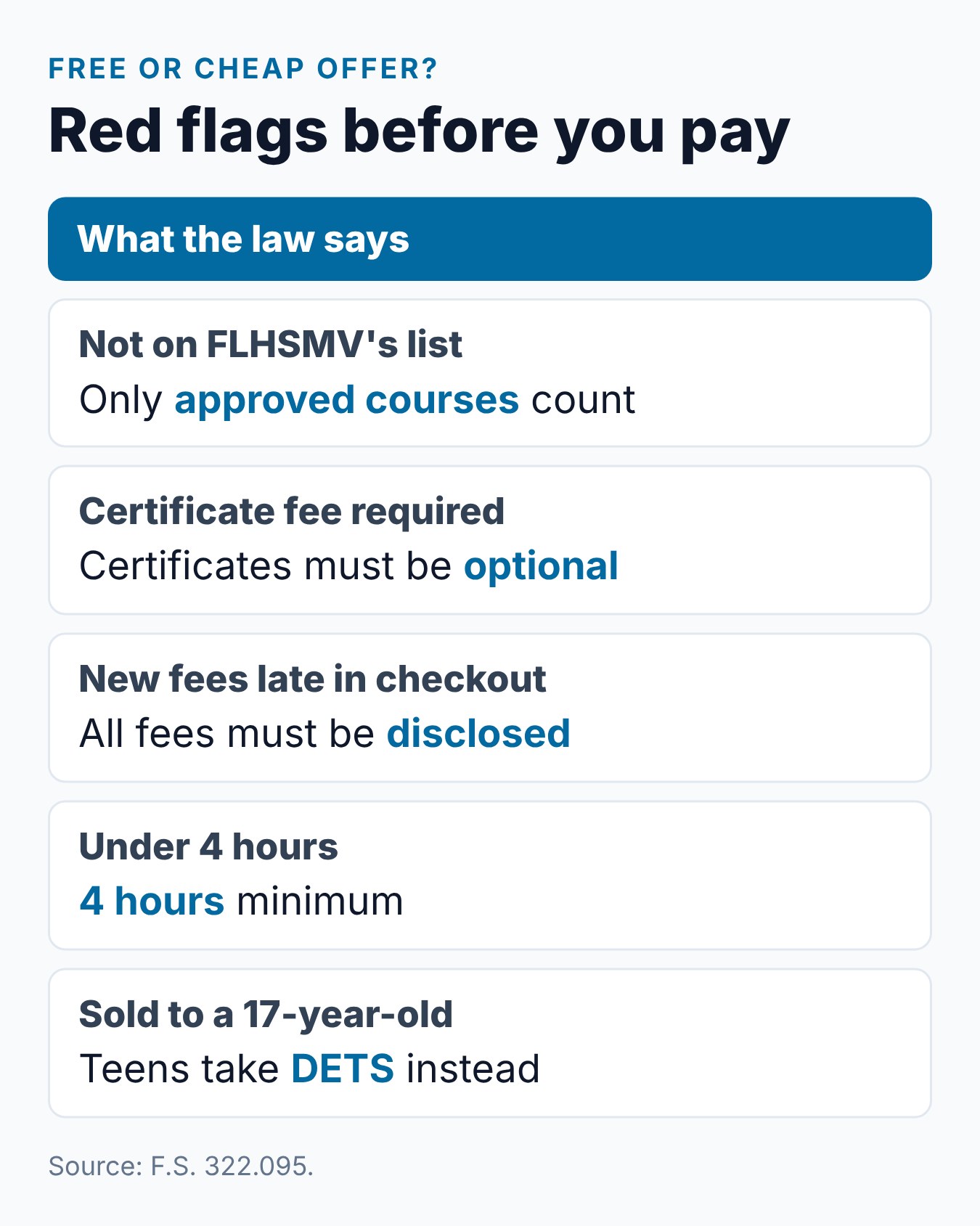
- Full disclosure. Providers must disclose all course fees.
- No surprise fees. Providers can’t add fees during registration that they didn’t disclose.
- No forced certificate purchase. Providers can’t require you to buy a completion certificate.
If a site adds a fee late in checkout that wasn’t shown up front, that’s a red flag. Compare the final total, not the first number you see.
Certificate Fees
Some providers sell a printed or emailed certificate. Under the law, any certificate a provider sells must be clearly marked as optional.
You don’t need a paid certificate for your license. The provider reports your completion to FLHSMV electronically within 5 days at no charge, and only that electronic record is valid for licensing.
A free copy or a screenshot of your completion page is still worth saving as a backup. Our article on the Florida drug and alcohol course certificate explains what to check.
Is There a Free Florida Drug and Alcohol Course?
Some people search for a free 4-hour drug and alcohol course. Here is what we found:
- FLHSMV doesn’t offer a free course.
- The law doesn’t require providers to offer one.
- Every approved provider we checked charged for the course or didn’t show a price.
That doesn’t mean a low-cost or promotional offer is fake. It means you should check it before you pay or hand over personal details.
How to Check a Free or Low-Cost Offer
Use these checks on any deal:
- Find the provider on FLHSMV’s approved list. If you can’t, ask which approved provider’s course the site uses.
- Look for the total. Add the course, any certificate or processing fee and any exam fee.
- Read the retake rules. A cheap course with paid retakes can cost more.
- Check the reporting promise. The provider should report to FLHSMV within 5 days at no charge.
- Watch for “free” with a catch. A free lesson preview isn’t the same as a free completion.
Our guide on how to get an FLHSMV-authorized TLSAE course covers the approval checks in detail.
Your Total Budget
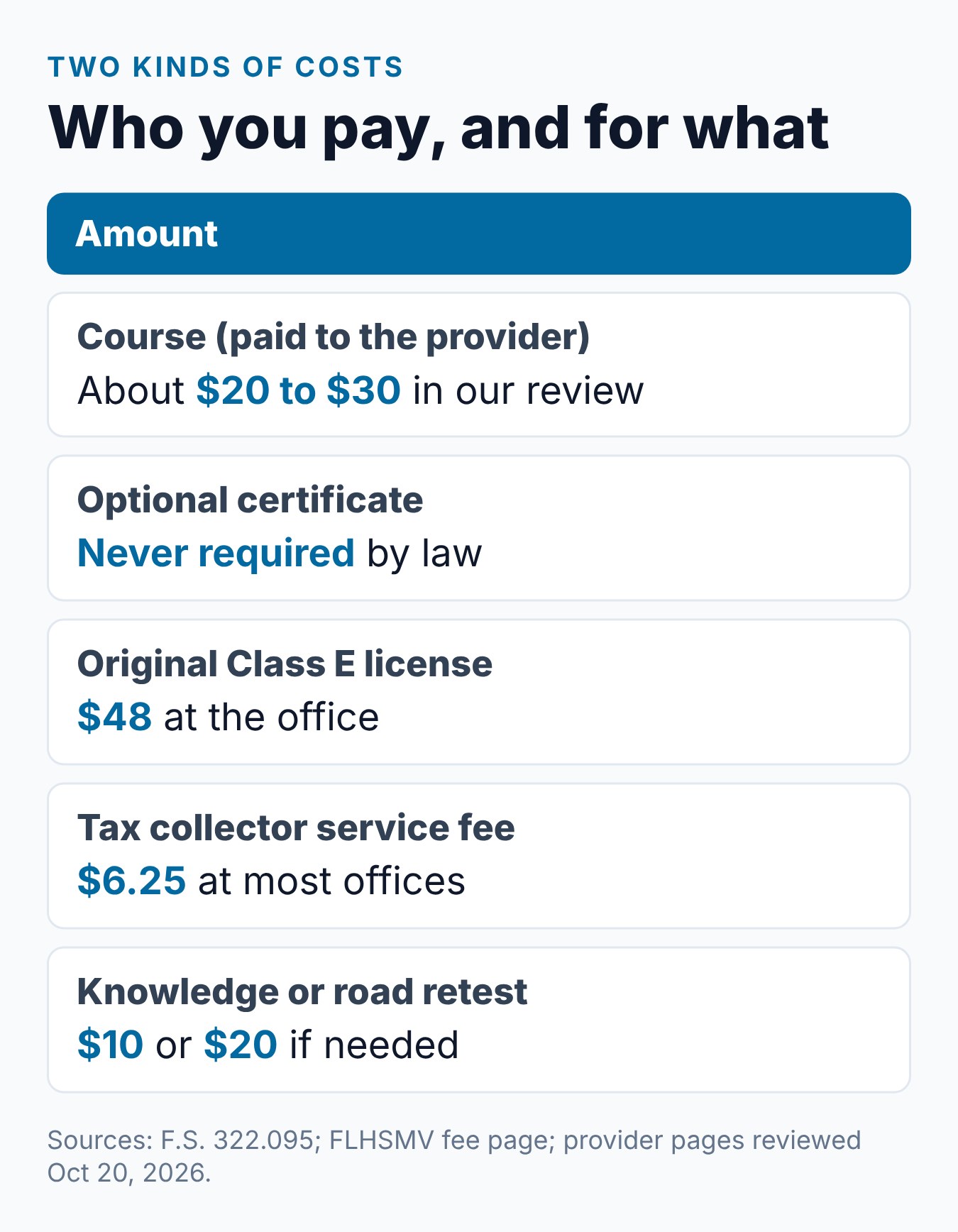
The course is only one part of getting a first license as an adult. Here is what FLHSMV and county offices list for the other parts.
| Cost | Amount | Paid to |
|---|---|---|
| TLSAE course | About $20 to $30 in our review | The course provider |
| Original Class E license | $48 | FLHSMV, at the office |
| Tax collector service fee | $6.25 at most offices | Your county office |
| Knowledge exam retest | $10 | Only if you need it |
| Driving skills retest | $20 | Only if you need it |
The Pinellas County Tax Collector says the state’s $10 knowledge test fee is waived on your first attempt. So if you pass the first time, you skip that fee.
Put together, a first-try pass costs about $74 to $84 at the prices we found: the course, the $48 license and the $6.25 office fee. Veterans with proof of veteran status aren’t charged the $6.25 fee for an original Class E license, according to FLHSMV’s fee page.
Ways to Pay Less
You can’t get the course free from the state, but you can keep the total down:
- Compare the final total. Include certificate, processing and retake fees.
- Skip the paid certificate. Your electronic record is what counts.
- Pass the knowledge exam on the first try. The $10 state test fee is waived only on the first attempt.
- Book an early test time. If you fail, you may have time for a second try that day.
- Bring proof of veteran status, if it applies. It removes the $6.25 office fee on an original license.
Each retest adds a fee, so the cheapest plan is to study the handbook well before your first exam. The course alone won’t cover every exam topic.
A Sample Budget
Here is how the numbers add up for one adult. Say Maria is 24, has never held a license and lives in a county that charges the $6.25 service fee.
- The course. She picks an approved online provider with a $19.95 list price and skips the optional certificate.
- The knowledge exam. She studies the handbook and passes on her first try, so the $10 state test fee is waived.
- The license. She pays $48 for an original Class E license and $6.25 to the tax collector’s office.
Her total is $74.20. If she had failed the knowledge exam once, she would add the $10 retest fee, plus any office fee her county charges for the return visit.
Questions to Ask Before You Pay
A few questions can save you money and time:
- Is this course on FLHSMV’s approved TLSAE list, or which approved provider’s course is it?
- What is the full price, including every fee?
- Is any certificate or processing fee optional?
- How many tries do I get on the final exam, and do retakes cost extra?
- Can I stop and come back later without losing progress?
- How soon will you report my completion to FLHSMV?
Get answers in writing, such as on the provider’s FAQ page or in an email. If a provider won’t answer, choose another one.
Costs That Aren’t Fees
Some costs don’t show up on any fee chart. Plan for these too:
- Your time. The course takes at least 4 hours, and each office visit takes part of a day.
- A vehicle for the road test. It has to be registered and insured.
- Documents. You need identity, Social Security and two Florida address documents, and replacing a missing one can cost money.
- Practice. Some adults pay for driving lessons, which FLHSMV doesn’t require.
Our guide to the first-time adult license process lists the documents to bring.
What Your Money Buys
Every approved course has to deliver the same basics. F.S. 322.095 requires at least 4 hours of content, not counting breaks, on topics such as Florida driving laws, the effects of alcohol and drugs, and distracted driving.
Where providers differ is in the extras. Look at these before you buy:
- Format: Online, classroom or both
- Device support: Whether it works well on a phone
- Saving progress: Whether you can stop and come back
- Exam rules: How many questions, the passing score and retakes
- Support: How you reach the provider if something goes wrong
The law also protects you if the provider makes a mistake. If you can’t finish because of the provider’s or school’s error, the provider must let you complete the course at no extra cost.
Who Can Skip the Cost
Not every adult pays for TLSAE. The law exempts two groups:
- People who were licensed in another jurisdiction
- People who completed a Department of Education driver education course
Teens under 18 don’t pay for TLSAE either, because they take the 6-hour DETS course instead. Since August 1, 2025, DETS replaced TLSAE for that age group.
If you think an exemption applies, check before you buy. Ask your county driver license office if you aren’t sure.
Common Cost Mistakes
These are the mistakes that cost people the most:
- Paying for an unapproved course. It won’t count, so you pay twice.
- Buying a certificate you don’t need. The electronic record is what FLHSMV uses.
- Missing a late fee at checkout. The law requires providers to disclose all fees.
- Taking TLSAE at 17. Teens need DETS, so the TLSAE course is wasted money.
- Testing without studying. Each knowledge retest costs $10 plus any office fee.
How Requirements Can Vary
Florida’s course and license rules apply statewide, but some details depend on where you live. Driver license services are often handled by your county tax collector’s office, and each office sets its own appointment process and hours. Some county school boards also offer driver education programs, such as DELAP courses, that can count instead of DETS.
FLHSMV can update course rules, forms, documents, and fees. Check FLHSMV and your county office for current requirements before your appointment.
Frequently Asked Questions
How much is the Florida drug and alcohol course?
Providers set the price. In our review of four approved providers on October 20, 2026, list prices ranged from $19.95 to $29.95.
Is there a free Florida drug and alcohol course?
FLHSMV doesn’t offer a free course, and the law doesn’t require one. Check any free offer against FLHSMV’s approved list.
What is the $3 fee for the TLSAE course?
Schools collect a $3 assessment fee per student. The provider sends it to FLHSMV to get a unique completion certificate number.
Do I have to pay for a TLSAE certificate?
No. Providers can’t require you to buy one. Your completion is reported to FLHSMV electronically at no charge.
Does a more expensive course count more?
No. Every approved course covers the same required topics and is reported the same way.
What else will I pay for my first license?
FLHSMV lists $48 for an original Class E license, and most tax collector offices add $6.25. Retests cost $10 for the knowledge exam and $20 for the road test.
Conclusion
The Florida drug and alcohol course cost is set by each approved provider, and our October 20, 2026 review found list prices from $19.95 to $29.95.
There’s no state-run free version, so compare full totals and skip any paid certificate you don’t need. Budget for the $48 license and $6.25 office fee too. Our online Florida TLSAE course is coming soon.
Related Articles
- Florida Drug and Alcohol Course (TLSAE): The Complete Guide for Adults
- How to Get a FLHSMV-Authorized TLSAE Course in Florida
- Florida Drug and Alcohol Course Certificate: What It Is and What to Do With It
- Florida Permit Test Cost: How Much You Will Pay
Sources
- Florida Statutes — F.S. 322.095 (TLSAE)
- FLHSMV — Approved TLSAE Course Providers
- FLHSMV — Driver License and ID Card Fees
- FLHSMV — Class E Knowledge Exam and Driving Skills Test
- Pinellas County Tax Collector — Learner’s Permit
- Manatee County Tax Collector — Written Exams
Billy Forte is the owner of Driving Logic, a state-approved driver improvement course provider serving Florida and other U.S. states.
This article is general information, not legal advice. Florida licensing requirements, course rules, documents, and fees are set by FLHSMV and Florida law and can change. Use official FLHSMV and Florida statute sources for current requirements before you enroll in a course or visit a driver license office.