
Updated October 2026 · Reviewed by Billy Forte
The Florida drug and alcohol course test is the final exam at the end of your TLSAE course, set by your course provider. It isn’t the Class E knowledge exam, often called the permit test, which adults take separately in person. No statewide rule we found sets the course test’s format, so the rules come from your provider.
Key Facts
- What it is: The provider’s own final exam for the 4-hour TLSAE course. See the basics.
- Format: Two providers we reviewed list 40 questions with 80% to pass. See what providers list.
- Retakes: Two providers we reviewed list unlimited retakes. See retake rules.
- Topics: Drawn from the subjects F.S. 322.095 requires. See the topics.
- Not the permit test: Adults still take the 50-question knowledge exam in person. See the difference.
What the Florida Drug and Alcohol Course Test Is
TLSAE is the 4-hour Traffic Law and Substance Abuse Education course required by F.S. 322.095 for most first-time license applicants 18 and older. Three of the four providers we reviewed list a final exam to check what you learned.
The law sets the course topics, the 4-hour minimum and how completion is reported. We didn’t find a statewide rule that sets how many questions the final has or what score you need.
That’s why the test can look different from one provider to the next. Read your provider’s exam rules before you buy, not after.
What Providers List
We reviewed the public pages of four FLHSMV-approved online providers on October 20, 2026. We’ve left their names off, since rules can change.
| What we checked | What providers listed |
|---|---|
| Number of questions | Two list 40 multiple-choice questions |
| Passing score | Those two list 80%, which is 32 of 40 correct |
| Retakes | Two list unlimited retakes |
| Other details | Not every provider posts its exam rules |
So two of the four providers we checked use a 40-question, multiple-choice final with an 80% passing score. It isn’t a state rule, though, and your provider may differ.
If a provider’s page doesn’t explain its final exam, ask before you pay. You want to know the number of questions, the passing score and what happens if you fail.
What the Questions Cover
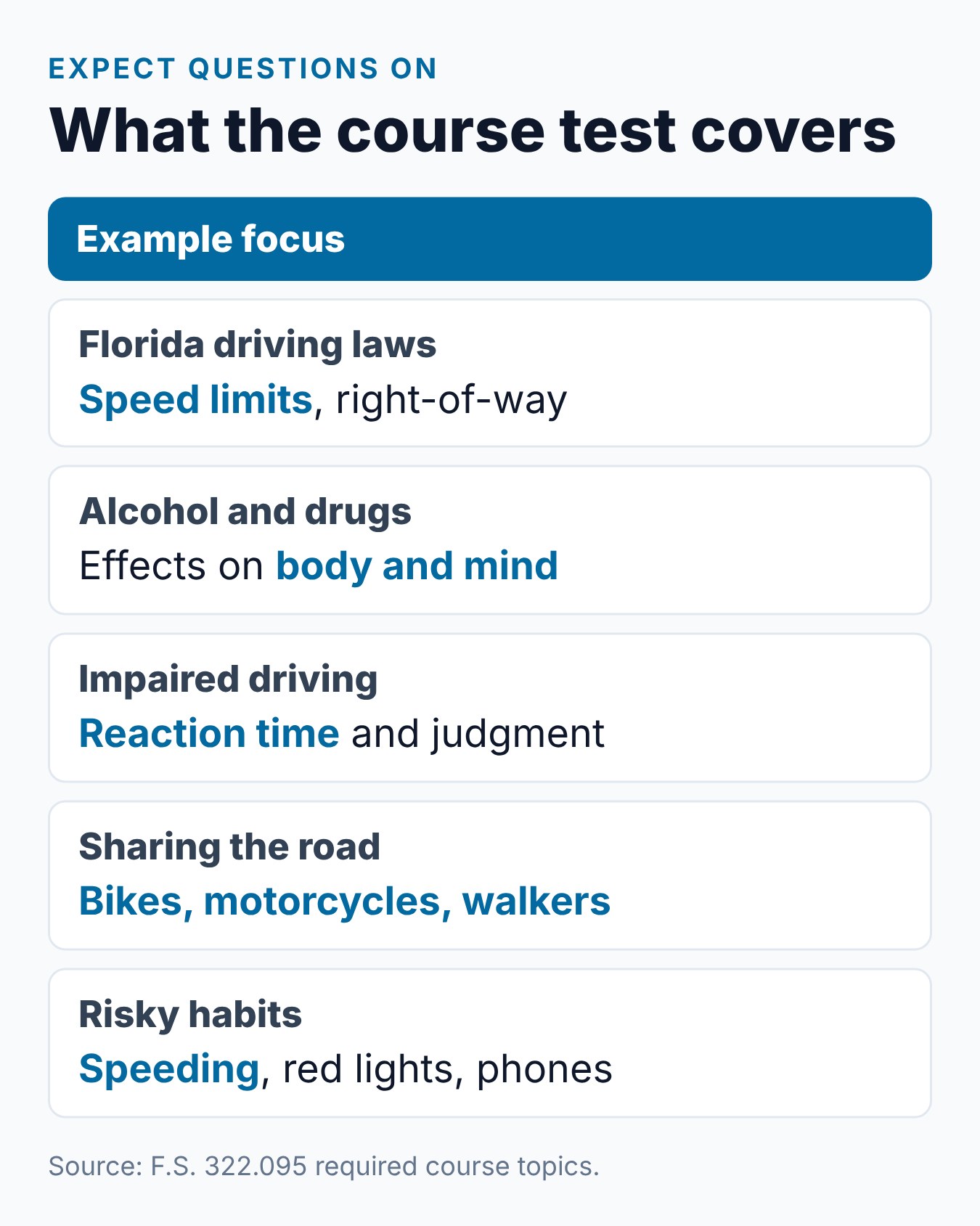
The questions come from the course content, and the content comes from the law. F.S. 322.095 requires every approved course to teach these subjects, so expect questions on each one:
- Florida driving laws, such as speed limits and right-of-way
- What alcohol and drugs do to the body and the mind
- The costs of substance abuse for families and society
- How impairment changes driving, like reaction time and judgment
- Sharing the road with motorcyclists, bicyclists and pedestrians
- Risky driving, such as speeding, reckless driving and running red lights and stop signs
- Phones and other devices used while driving
Your provider writes its own questions, so the wording varies. The safest plan is to know each topic well, not to memorize answers.
Examples of Facts Worth Knowing
We can’t share a provider’s real test questions. These are Florida facts from state law that fit the topics the course must cover:
- Drivers under 21 and alcohol. Under F.S. 322.2616, a driver under 21 with a blood or breath alcohol level of 0.02 or higher faces a license suspension. It’s 6 months for a first violation.
- Refusing a test under 21. The same law sets a 1-year suspension for a first refusal and 18 months for a later one.
- Default speed limits. F.S. 316.183 sets 30 mph in business and residence districts and 55 mph on other roads, unless signs say otherwise.
- School zones. F.S. 316.1895 says school zone limits in urbanized areas can’t be more than 20 mph.
- Highway speeds. F.S. 316.187 allows limits up to 70 mph on limited-access highways. F.S. 316.183 sets a 40 mph minimum on interstates, or 50 mph where the limit is 70.
Facts like these also help on the knowledge exam later. The official Florida Driver License Handbook covers them in more detail.
How to Prepare
The course is built to teach you what’s on the test, so the best prep is paying attention as you go:
- Take notes on numbers. Limits, ages and suspension times are easy to mix up.
- Pause after each lesson. Say the main point out loud in one sentence.
- Review any lesson quizzes. If your course has them, they show the style of the final.
- Don’t rush the last lessons. Fatigue near the end causes careless mistakes.
- Take the final when you’re rested. If you’re tired, save it for the next session.
If your provider lets you stop and come back, use that. A fresh start on the final can beat pushing through at the end of a long session.
During the Test
A few habits help on any multiple-choice test:
- Read the whole question. Watch for “not,” “except” and “always.”
- Read every answer before you choose one.
- Picture the situation. Imagine you’re the driver and pick the safest legal choice.
- Answer every question before you submit.
- Change an answer only for a reason, such as realizing you misread the question.
Your provider’s rules apply to the test itself, including any time limit. Read the instructions before you click start.
Taking the Test Online
If you take TLSAE online, expect the final on the same site as the lessons. A little setup helps it go smoothly:
- Charge your device or plug it in before you start.
- Use a steady internet connection. A dropped connection mid-test is stressful, even if your provider saves your place.
- Close other tabs and apps so notifications don’t pull you away.
- Keep your login handy in case you’re signed out.
- Pick a quiet time when no one needs you for a while.
If the site has a problem while you’re testing, write down what happened and contact the provider. The law protects students who can’t finish because of the provider’s error.
When You’re Stuck on a Question
Every test has a question or two that feels unclear. Don’t let one question eat your time.
First, rule out the answers you know are wrong. Then ask yourself which choice a careful, sober driver would make, since the course is built around safe, legal choices.
If your provider lets you flag questions and return, do that and move on. Coming back with fresh eyes can make the answer clearer.
If You Don’t Pass
Failing the course test doesn’t end your course. What happens next depends on your provider’s rules.
Two providers we reviewed on October 20, 2026 list unlimited retakes. Others may limit attempts or charge for them, so check before you buy.
Before you try again, look at which topics gave you trouble and review those lessons. Then take the test when you’re fresh.
If you fail more than once, slow down. Go back through the lessons on your weakest topics instead of retaking the test right away, since repeated guessing rarely fixes a gap.
If something goes wrong because of the provider’s or school’s error, such as a site problem that stops you from finishing, the law says the provider must let you complete the course at no extra cost.
Why the Course Test Matters
It’s tempting to treat the final as a box to check. But the course covers choices that matter long after you have your license.
The alcohol rules for drivers under 21, the dangers of phones at the wheel and the way speeding raises risk all come up in real driving. Knowing them well can keep you, your passengers and people outside your car safer.
There’s a practical reason too. The better you understand the course, the easier the knowledge exam feels, since some of the traffic law topics overlap.
After You Pass
Passing the course test is what finishes TLSAE. Your provider then reports your completion to FLHSMV’s Driver Improvement Certificate Issuance System within 5 days, at no charge.
That electronic record is the only proof that counts for licensing. Paper certificates aren’t accepted, so a printout is just a backup.
Give the report time to arrive before your office visit. Booking about a week after you finish keeps you clear of the 5-day window.
Course Test vs Knowledge Exam
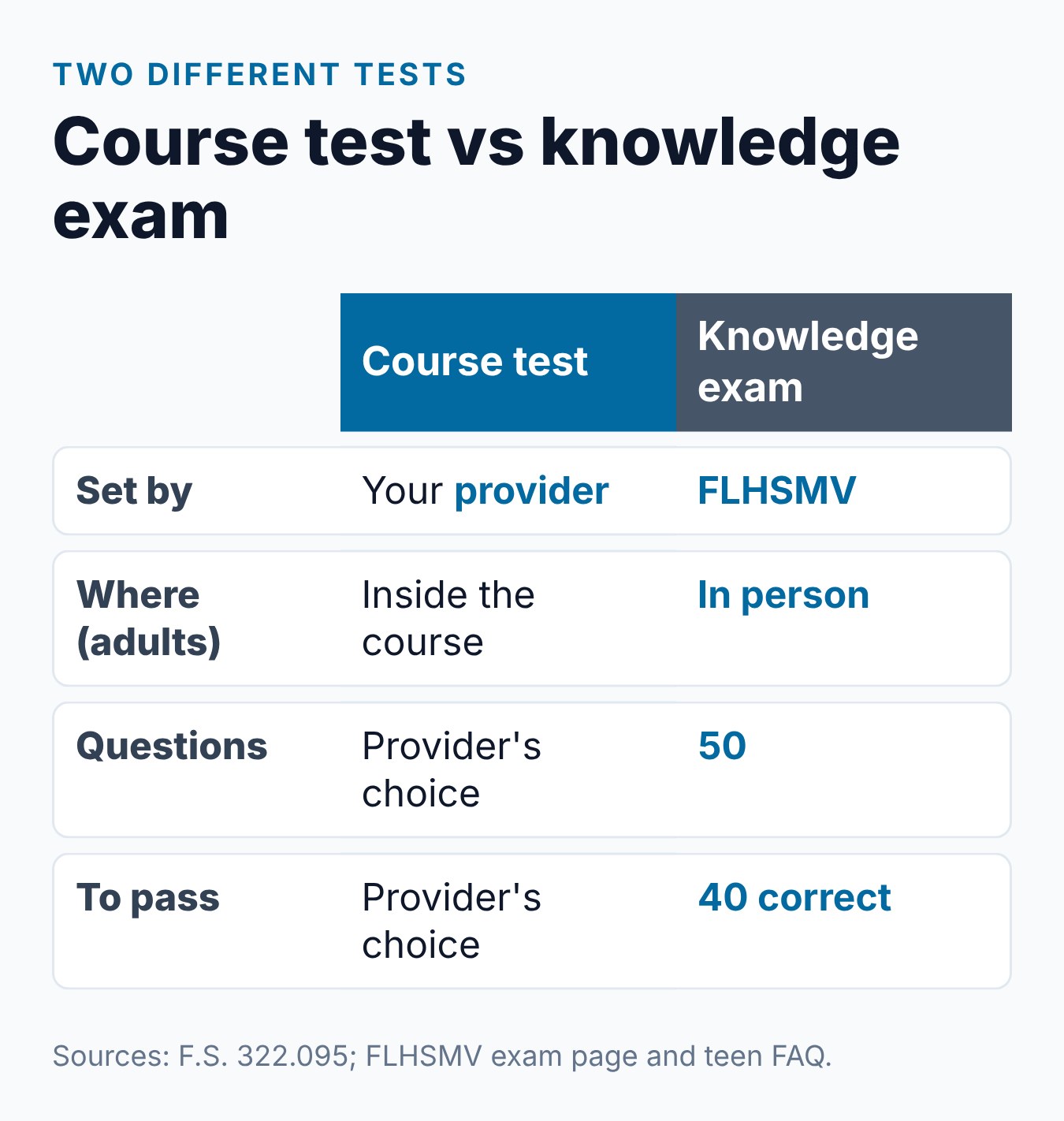
These two tests are easy to confuse, but they come from different places and serve different purposes.
| TLSAE course test | Class E knowledge exam | |
|---|---|---|
| Set by | Your course provider | FLHSMV |
| Where | Inside the course | At an office for adults |
| Questions | Provider’s choice | 50 |
| To pass | Provider’s choice | 40 correct |
| Language | Ask your provider | English only since Feb 6, 2026 |
Passing the course test doesn’t count as passing the knowledge exam. Adults take that exam in person, since FLHSMV’s teen FAQ says online knowledge exams are for applicants under 18 only.
Our article comparing the permit test and the drug and alcohol course goes deeper. For the exam itself, see how many questions are on the Florida permit test.
Getting Ready for the Knowledge Exam Next
Once TLSAE is done, shift your study to the knowledge exam. It covers Florida traffic laws, safe driving practices and traffic controls such as signs, signals and pavement markings.
The course helps with some of that, but not all. Road signs aren’t on the list of topics F.S. 322.095 requires, so you’ll need the handbook for those.
Use the driver handbook as your main source, and study in English, since all driver license exams have been given in English only since February 6, 2026.
Common Test Mistakes
Watch out for these:
- Thinking the course test is the permit test. It isn’t, and adults still test in person.
- Not reading the provider’s exam rules. Questions, passing score and retakes vary.
- Rushing the final at the end of a long session. Take it when you’re rested.
- Memorizing instead of understanding. Question wording varies by provider.
- Booking the office the day you pass. Allow up to 5 days for reporting.
How Requirements Can Vary
Florida’s course and license rules apply statewide, but some details depend on where you live. Driver license services are often handled by your county tax collector’s office, and each office sets its own appointment process and hours. Some county school boards also offer driver education programs, such as DELAP courses, that can count instead of DETS.
FLHSMV can update course rules, forms, documents, and fees. Check FLHSMV and your county office for current requirements before your appointment.
Frequently Asked Questions
Is there a test at the end of the Florida drug and alcohol course?
Three of the four providers we reviewed list one, set by the provider. Check your provider’s rules before you start.
How many questions are on the TLSAE test?
No statewide rule we found sets the number. Two providers we reviewed on October 20, 2026 list 40 multiple-choice questions.
What score do I need to pass the TLSAE test?
It depends on the provider. Two providers we reviewed list 80%, which is 32 of 40 correct.
Can I retake the Florida drug and alcohol course test?
Two providers we reviewed list unlimited retakes. Check your provider’s policy before you buy.
Is the course test the same as the permit test?
No. The permit test is the 50-question Class E knowledge exam, given by FLHSMV. Adults take it in person.
What happens after I pass the course test?
Your provider reports your completion to FLHSMV within 5 days, at no charge. Then you can book your knowledge exam.
Conclusion
The Florida drug and alcohol course test is your TLSAE provider’s own final exam, and no statewide rule we found sets its format.
Providers we reviewed list 40 questions with 80% to pass, and some allow unlimited retakes. Passing it finishes the course, but adults still take the 50-question knowledge exam in person. Our online Florida TLSAE course is coming soon.
Related Articles
- Florida Drug and Alcohol Course (TLSAE): The Complete Guide for Adults
- Florida Permit Test vs Drug and Alcohol Course: What’s the Difference?
- How Many Questions Are on the Florida Permit Test and What Score Do You Need?
Sources
- Florida Statutes — F.S. 322.095 (TLSAE)
- FLHSMV — Approved TLSAE Course Providers
- FLHSMV — Class E Knowledge Exam and Driving Skills Test
- FLHSMV — Teen Licensing Frequently Asked Questions
- Florida Statutes — F.S. 322.2616 (Drivers Under 21, 0.02 Alcohol)
- Florida Statutes — F.S. 316.183 (Speed Limits)
- Florida Statutes — F.S. 316.187 (Establishment of State Speed Zones)
- Florida Statutes — F.S. 316.1895 (School Speed Zones)
- FLHSMV — Official Florida Driver License Handbook (PDF)
- Hillsborough County Tax Collector — Driver License Exams in English Only Beginning February 6
Billy Forte is the owner of Driving Logic, a state-approved driver improvement course provider serving Florida and other U.S. states.
This article is general information, not legal advice. Florida licensing requirements, course rules, documents, and fees are set by FLHSMV and Florida law and can change. Use official FLHSMV and Florida statute sources for current requirements before you enroll in a course or visit a driver license office.