
Updated November 2026 · Reviewed by Billy Forte
No official Florida page lists a free traffic school, and a ticket-election course cannot cost nothing. State law has the school collect a $2.50 assessment fee from each person who elects to attend, on top of the school’s own course fee, and the clerk’s costs for the ticket still apply. A search for free traffic school florida is a search for the Basic Driver Improvement (BDI) course, the course FLHSMV approves for a ticket election.
Key Facts
- No free course is listed: FLHSMV’s provider list shows no prices and marks no course as free. See what the official pages say.
- One fee never goes away: the school collects a $2.50 state assessment from every student who elects. See the state fee.
- Ask, don’t assume: a “free” offer is checked with a few plain questions. See how to read a free offer.
- The ticket still costs money: the civil penalty is reduced, not waived, and the clerk charges an election fee. See costs that stay.
- Short on money? Within 30 days of the citation, the clerk can take payment or set up a payment plan for the civil penalty. See if money is the problem.
Free Traffic School Florida: What the Official Pages Say
Two official sources decide what a Florida BDI course is and who may teach it. Neither one names a free course.
- The FLHSMV provider list. FLHSMV posts the Approved BDI Course Providers list. It shows each provider’s Name, Delivery Method and Contact Information. It shows no prices, and no course on it is marked free.
- The statute. Section 318.1451 lets FLHSMV approve and regulate the courses. It sets no course price, no lowest price and no highest price.
So the honest answer has two parts. Florida does not run a free course for ticket elections. And Florida does not set a price that every school must charge.
That leaves the price to each school. Each provider sets its own course fee. The state’s role is to approve the course and to set rules about how fees are shown.
Because no official page lists a free course, this article cannot confirm any free offer. It names no provider and gives no price. It shows you what the law says and what to ask.
The Fee Every Student Pays
One dollar amount is written into the BDI statute. Section 318.1451(4) says:
> “In addition to a regular course fee, an assessment fee in the amount of $2.50 shall be collected by the school from each person who elects to attend a course.”
Read that sentence slowly, because it answers the “free” question on its own.
- “In addition to a regular course fee.” The law expects the course to have its own fee. The $2.50 is added to it.
- “Shall be collected by the school.” The school must collect it. It is not up to the school.
- “From each person who elects to attend.” It applies to every student who takes the course for a ticket election.
The same subsection says the course provider must send this money to the department. The school does not keep it.
So even a school that charged nothing for its own course would still have to collect $2.50 from you. A ticket-election course in Florida cannot have a total of zero.
How Florida Treats Course Fees
The statute does not set the course price. It does set rules about how a school tells you the price.
Section 318.1451(6)(h)1 says a provider must disclose all fees associated with its courses. It also says a provider may not charge any fees that are not disclosed during registration.
That rule matters when you see the word “free.” Whatever the advertisement says, the registration screen must show every fee the school will charge. The total on that screen is the number that counts.
Section 318.1451(6)(h)4 adds one more duty. A provider must issue a certificate to persons who successfully complete the course. The certificate is part of what an approved school must provide.
These rules apply to every approved provider. A school with a low fee and a school with a high fee follow the same disclosure rule and issue the same kind of certificate.
How to Read a “Free” Offer
You may see a course described as free in an ad or a search result. The statute does not set a minimum course fee, so this article does not call such offers wrong or unlawful. It simply cannot confirm them.
The fair way to handle an offer is to ask questions. These are questions, not accusations:
- Is the provider on FLHSMV’s list? Look for its name on the Approved BDI Course Providers page.
- Does its row show Internet? If you want to take the course online, the delivery method should say Internet.
- What is the total at registration? Ask whether it includes the $2.50 state assessment.
- Is there a charge for the certificate? The school must issue one when you finish.
- Is there a charge for anything else you need to finish? All fees must be shown during registration.
If the answers show a total that includes the state fee and every other charge, you know what the course will cost you. If you cannot get clear answers, you have not yet learned the real price.
Checking the list costs you nothing but a few minutes. It is a public FLHSMV web page.
Costs That Stay Even With a Low Course Fee
A ticket election has costs that have nothing to do with the school. A free or very low course fee would not change any of them.
| What you pay | Who you pay | Would a free course remove it? | Source |
|---|---|---|---|
| The civil penalty on the ticket, cut by 18 percent | The clerk of court | No. The election reduces it but does not waive it | s. 318.14(9) |
| The election fee | The clerk of court in the county where the citation was issued | No. The clerk sets and collects it | FLHSMV, Approved BDI Course Providers |
| The $2.50 assessment | The school, which sends it to the state | No. Every school must collect it | s. 318.1451(4) |
| If you finish late: the 18 percent back, plus a processing fee of up to $18 | The clerk of court | No. Points are also assessed | s. 318.15(1)(b) |
The civil penalty is the fine on the ticket. Under section 318.14, electing the course lowers it by 18 percent. You still pay the rest.
The election fee is a separate charge. FLHSMV’s BDI page says it is paid to the clerk of court in the county where the citation was issued. No statewide amount applies, so ask that clerk.
The last row is the one that can surprise people. Under section 318.15, if you elect and do not finish the course by the court’s date, you pay back the 18 percent. A processing fee of up to $18 is added, and points are assessed.
For a full walk-through of what the course and the ticket cost, see How Much Is Traffic School in Florida?.
If Money Is the Problem
Some people search for a free course because money is tight. Florida law gives one option that is worth knowing about, and it runs through the clerk, not the school.
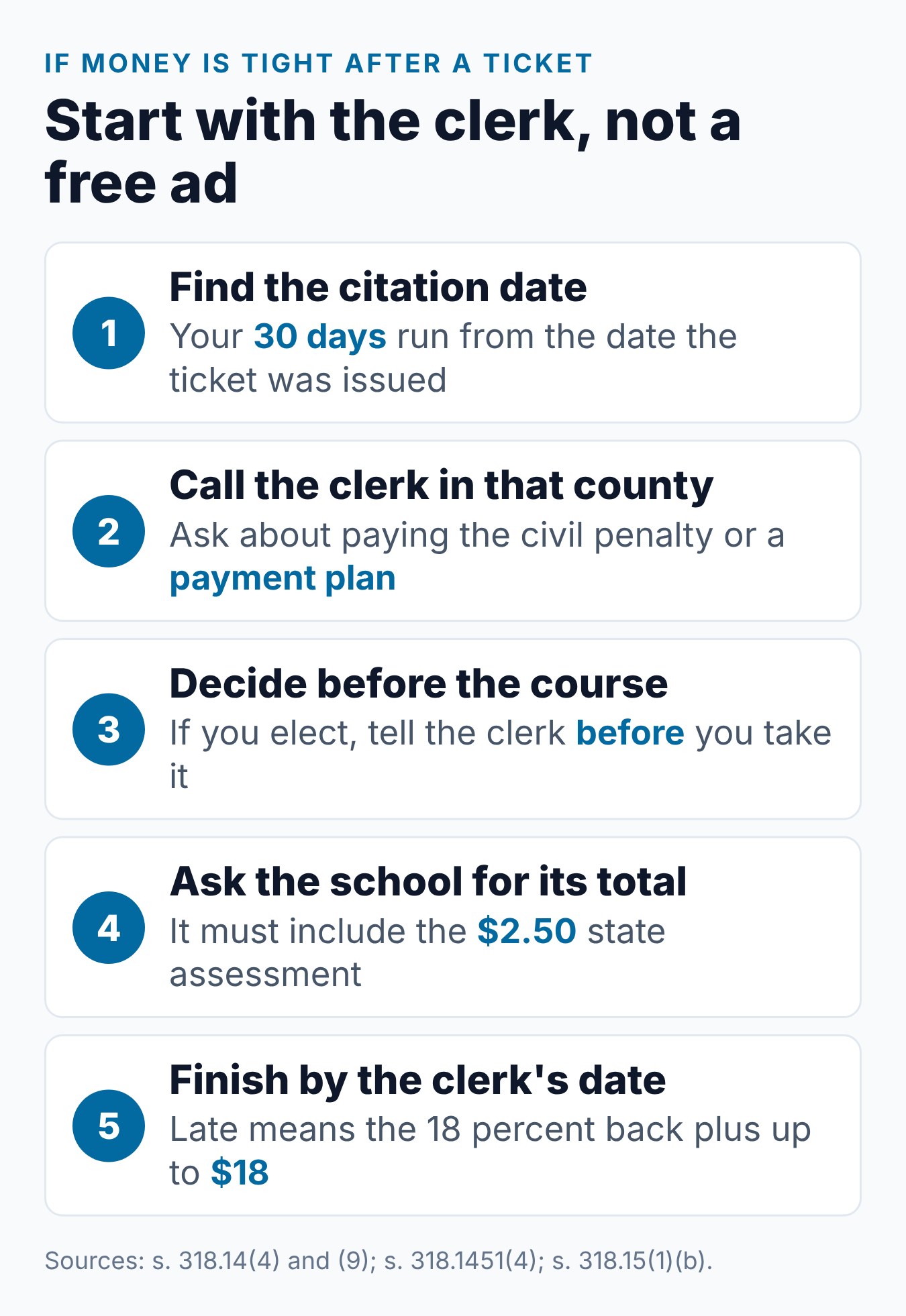
Section 318.14(4) says that within 30 days after the date the citation was issued, a person may pay the civil penalty or enter into a payment plan with the clerk of court under section 28.246.
Keep three points in mind about that rule:
- It is about the civil penalty. The statute speaks of paying the civil penalty. It does not say the plan covers a school’s course fee.
- The clerk runs it. The clerk of court in the county on your ticket is the office to ask.
- The 30 days matter. The same 30-day period applies to the course election itself.
No official page read for this article describes a fee waiver for traffic school. For that reason this article does not describe one.
Ask the clerk in the county on your ticket what it offers.
Election Basics in Brief
A course only helps with a ticket if you elect it properly. Within 30 days of the citation date, you tell the clerk of court that you will take the course, and you do this before you take it. When the election is valid, adjudication is withheld and no points are assessed for that ticket.
The election has limits. You cannot elect if you elected in the past 12 months, and no one may elect more than eight times in a lifetime (s. 318.14(9)).
Our pillar guide to the Florida Basic Driver Improvement (BDI) course explains who can elect and how the process works.
Is It the Right Course for Your Case?
Price is only one question. The other is whether the course fits your situation at all.
- A court order. If a court ordered you to take a course, follow the order. Ask the court or clerk if you are unsure which course to take or when it is due.
- An FLHSMV notice. FLHSMV can require a driver improvement course after certain crashes or convictions (s. 322.0261). Follow the notice you receive.
- Other courses. The Advanced Driver Improvement (ADI) course, the Mature Driver course for drivers 55 and older, and the DETS course for new drivers are different courses from BDI.
Eligibility, deadlines, fees, court procedures and clerk instructions can depend on the citation, county, court, judge and case type. A free offer does not help if the course is not the one your case calls for.
What We Found on the Official Pages
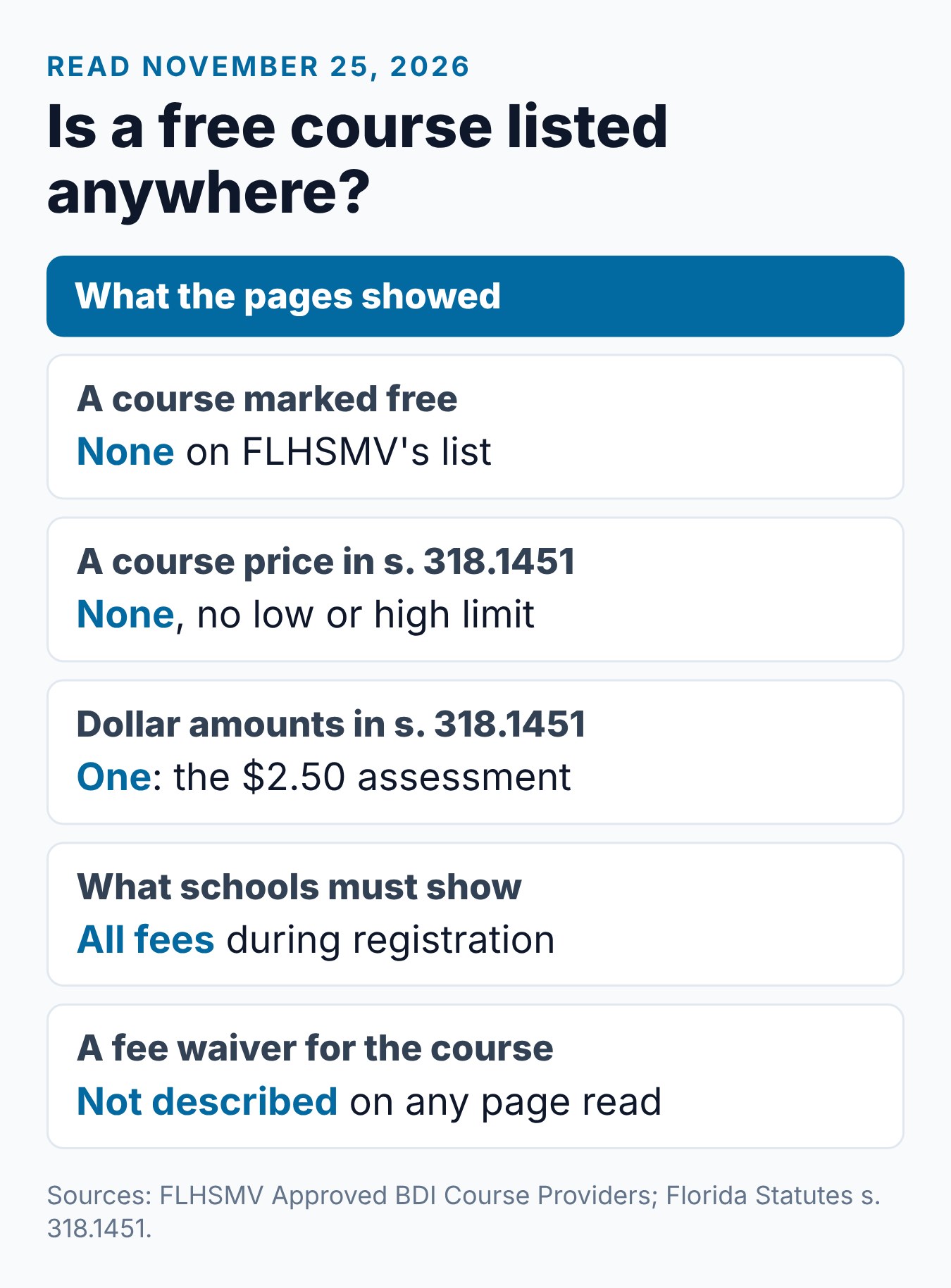
On November 25, 2026, the official pages behind this article were read for one question: does any of them show a free traffic school? Here is what they showed:
- The provider list had no price column. Its columns were Name, Delivery Method and Contact Information.
- No course on the list was marked free.
- The statute set no course price. Section 318.1451 had no lowest price and no highest price.
- The statute’s only dollar amount was the $2.50 assessment.
- The fee rule was about disclosure, not price. Providers must show all fees during registration.
- No page read described a fee waiver for the course.
The finding that matters most is the gap. The state tells you who is approved and what every student pays the state. It does not tell you any school’s price, and it does not list a free option.
These pages can change. Read the provider list again on the day you choose a school.
Common Mistakes to Avoid
Each mistake below breaks one of the rules above:
- Taking “free” to mean a total of zero. Every student who elects pays the $2.50 assessment.
- Forgetting the ticket. The civil penalty is reduced by 18 percent, not waived.
- Leaving out the clerk. The election fee is paid to the clerk of court, apart from the course.
- Skipping the list. Confirm the provider’s name and delivery method on FLHSMV’s list first.
- Paying before you see the total. All fees must be shown during registration.
- Taking the course before you elect. Tell the clerk within 30 days, then take the course.
- Missing the finish date. The 18 percent comes back, a fee of up to $18 is added, and points are assessed.
- Expecting a payment plan to cover the course. Section 318.14(4) speaks of the civil penalty.
How Requirements Can Vary
Florida’s election rules, point values and suspension levels come from Florida Statutes and FLHSMV, and they apply statewide. The election fee, the date to finish the course and how proof is filed are set by the Clerk of Court in the county on your ticket, or by the court. A court order sets its own deadline and proof steps.
Laws, fees and clerk practice can change. Check your citation, your clerk’s instructions, any court order and the FLHSMV website before you enroll or file anything.
Frequently Asked Questions
Is there a free traffic school in Florida?
No official Florida page lists one. FLHSMV’s approved provider list shows no prices and marks no course as free. A ticket-election course also carries a $2.50 state assessment that the school must collect.
Can a school waive the $2.50 fee?
No. Section 318.1451(4) says the school shall collect it from each person who elects to attend. The provider then sends it to the department.
Does Florida set the price of traffic school?
No. Section 318.1451 sets no course price, no lowest price and no highest price. Each provider sets its own course fee and must disclose all fees during registration.
If the course were free, would my ticket be free?
No. The civil penalty is reduced by 18 percent, not waived, and the clerk charges an election fee. Those costs do not depend on the school.
Can I get a payment plan for my ticket?
Section 318.14(4) says that within 30 days after the citation date, a person may pay the civil penalty or enter into a payment plan with the clerk of court. Ask the clerk in the county on your ticket what it offers.
How can I check a free offer?
Find the provider on FLHSMV’s Approved BDI Course Providers list and check its delivery method. Then ask for the total at registration, including the $2.50 fee and any certificate charge.
Conclusion
No official Florida page lists a free traffic school, and every student who elects the course pays the $2.50 state assessment through the school. The civil penalty, the clerk’s election fee and the cost of finishing late stay the same whatever a school charges, and the clerk is the office to ask about a payment plan. Check the provider on FLHSMV’s list, ask for the full total at registration and finish by your date. When you are ready to compare, see Driving Logic’s florida traffic school course page.
Related Articles
- Florida Basic Driver Improvement (BDI) Course: The Complete Guide
- How Much Is Traffic School in Florida?
- Traffic School Florida Cheap: What a Low Price Must Include
- FLHSMV-Approved BDI Providers: What It Means and How to Verify Your Course
Sources
- Florida Statutes s. 318.1451 — Driver improvement schools
- Florida Statutes s. 318.14 — Noncriminal traffic infractions
- Florida Statutes s. 318.15 — Failure to comply with civil penalty or to appear
- FLHSMV — Basic Driver Improvement (BDI) Approved Course Providers
- FLHSMV — Driver Improvement Schools
Billy Forte is the owner of Driving Logic, a driver improvement course provider serving Florida and other U.S. states.
This article is general information, not legal advice. Election rules, deadlines, fines and penalties depend on your citation, county, court and case facts, and they can change. Use official FLHSMV, Florida Statutes and Clerk of Court sources, and consult a qualified Florida attorney for advice about your own case.