
Updated November 2026 · Reviewed by Billy Forte
Here is how to get drivers license in Florida over 18 if you have never been licensed: complete the TLSAE course, bring identity, Social Security and address documents to a driver license office, pass the vision, hearing, knowledge and driving tests, and pay the license fee. An adult does not have to hold a learner’s license first. Each step below names the Florida statute or FLHSMV page that sets it, so you can check the rule yourself.
Key Facts
- First step: Adults who have never held a license in any state or country take the 4-hour TLSAE course. See Step 1.
- No learner’s license wait: The 12-month learner’s license and the 50 practice hours apply to applicants 16 and 17. See what adults skip.
- Knowledge exam: 50 questions, 40 correct to pass, taken in person by adults. See Step 4.
- State fee: $48.00 for an original Class E license, plus a $6.25 service fee that may apply. See Step 6.
- Practice permit: Adults may apply for a 90-day temporary instruction permit under F.S. 322.07(1). See the permit rule.
- Licensed elsewhere: The course rule does not apply to someone who has been licensed in another jurisdiction. See the exception.
Who This Path Is For
These steps are for people who are 18 or older and have never been issued a driver license in any state or country. That includes adults who never learned to drive and adults who are new to driving in the U.S.
Many people call the licensing office the Florida DMV, but the state agency is the Florida Department of Highway Safety and Motor Vehicles (FLHSMV). Applications are made in person at an office that offers driver license services.
Our first-time Florida driver’s license guide for adults covers the general adult process, including what the road test checks. This article answers the exact over-18 question and adds the source for each step, the rules adults skip, the 90-day permit, the retest fees and the exception for people licensed elsewhere.
What Adults Skip That Teens Cannot
Several Florida licensing rules are written for applicants under 18. Once you turn 18, those rules no longer apply to you. The table shows each rule and where it comes from.
| Rule | Teens 16-17 | Adults 18 and over |
|---|---|---|
| Hold a learner’s license for at least 12 months first (F.S. 322.05(2)) | Required | Not required |
| 50 hours of behind-the-wheel experience, 10 of them at night (F.S. 322.05(3)) | Required | Not required |
| Driver Education Traffic Safety (DETS) course (FLHSMV, Driver Improvement Schools) | Required for first-time drivers under 18 | Not taken |
| Parental Consent Form (FLHSMV, Licensing Requirements for Teens) | Required | Not required |
| Traffic Law and Substance Abuse Education (TLSAE) course (F.S. 322.095(1)) | Not the teen course | Required unless an exception applies |
| Online Class E knowledge exam (FLHSMV, Class E exam page) | Allowed under 18 | Not offered; test in person |
So the adult path is shorter, but it is not empty. You still take a course, bring documents and pass every exam a teen passes.
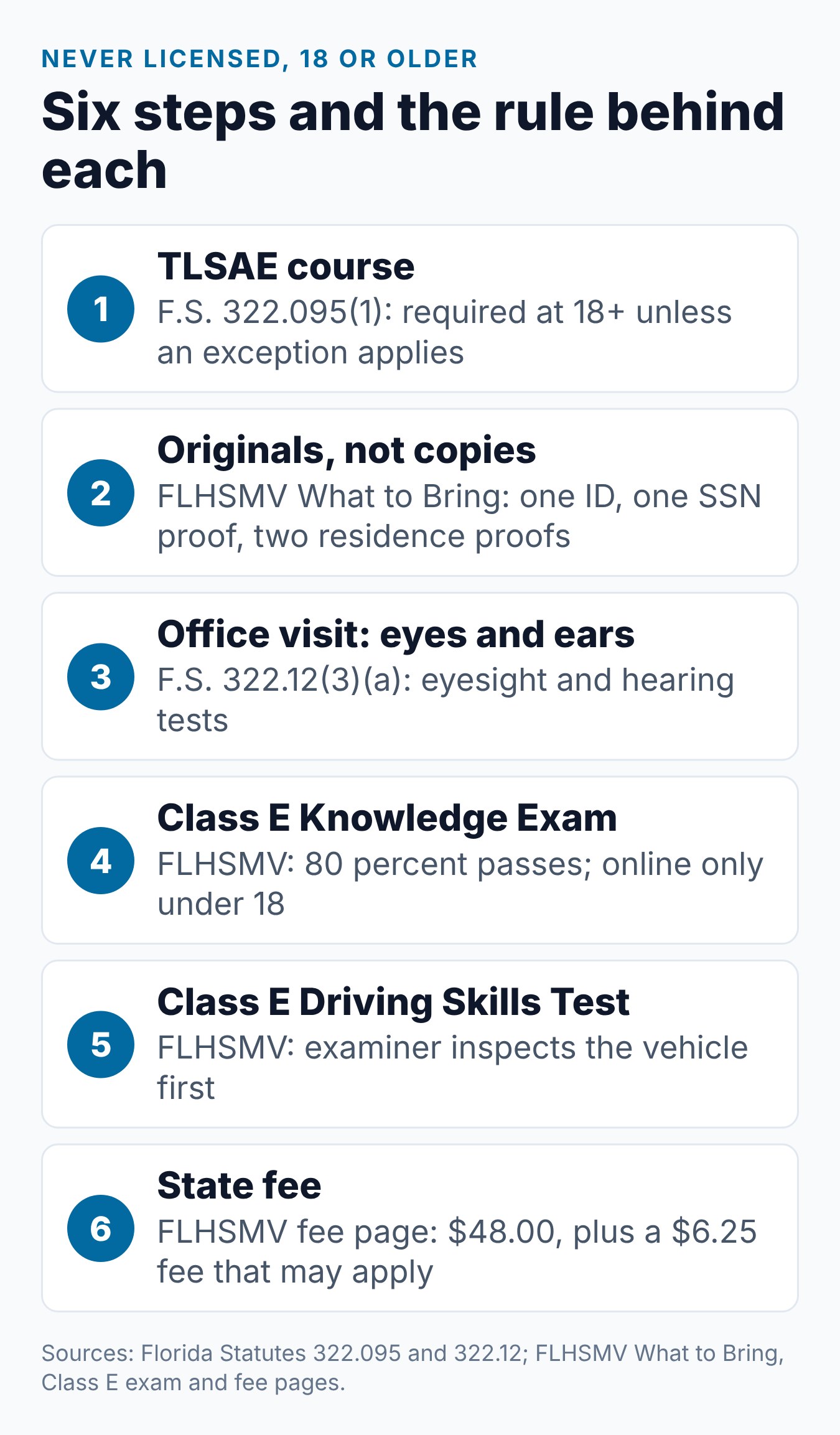
How to Get Drivers License in Florida Over 18: The Six Steps
The six steps below run in the order most adults follow them. The source for each one is in its own section.
- Complete the TLSAE course. This is required by F.S. 322.095(1).
- Gather original documents. FLHSMV’s What to Bring pages set the list.
- Visit an office and pass the vision and hearing tests. These are set by F.S. 322.12(3)(a).
- Pass the Class E Knowledge Exam. FLHSMV’s Class E exam page sets the format.
- Pass the Class E Driving Skills Test. The same FLHSMV page sets the vehicle rules.
- Pay the license fee. FLHSMV’s fee page lists the amounts.
Step 1: Complete the TLSAE Course
Florida law sets the course rule. F.S. 322.095(1) says each applicant for a driver license who is 18 years of age or older must complete a traffic law and substance abuse education course. The statute names two exceptions: an applicant who has been licensed in another jurisdiction, and an applicant who has satisfactorily completed a Department of Education driver education course.
FLHSMV’s Class E exam page says customers must complete a TLSAE course before applying for a license in Florida if they have never been issued a driver license in any state or country. FLHSMV’s TLSAE page describes it as a 4-hour course. People also call it the drug and alcohol course.
You do not need to carry a paper certificate. FLHSMV’s Driver Improvement Schools page says the course provider electronically submits your completion to FLHSMV. It is then accessible at all driver license issuing offices, and a physical copy of the certificate is not required when you get your license.
Do not take DETS by mistake. DETS is the course for first-time drivers under 18, and it is a different course from TLSAE. Our DETS vs TLSAE guide explains the difference.
Step 2: Bring Original Documents
A first driver license must be applied for in an office with original documents. FLHSMV’s What to Bring page for U.S. citizens asks for three kinds of proof:
- One primary identification document, such as a U.S. birth certificate or a valid U.S. passport
- One proof of Social Security number, such as your Social Security card or a W-2 form that is not handwritten
- Two different documents that show your Florida residential address
If you are not a U.S. citizen, use the right list on FLHSMV’s main What to Bring page. It has separate lists for immigrants, non-immigrants and Canadians.
Our Florida driver’s license checklist by age goes through the document rules in more depth. For this step, the main point is simple: originals, not copies, and two different address proofs.
Step 3: Visit an Office and Pass Vision and Hearing
You apply in person at an office that offers driver license services. FLHSMV’s New Resident page and Locations page point you to those offices. Many offices require appointments, and county tax collector offices publish their own rules.
Look up your county office before you go. Check whether it needs an appointment and which exams it gives.
At the office, the testing starts with your eyes and ears. F.S. 322.12(3)(a) says the Class E examination includes a test of the applicant’s eyesight and hearing. If you wear glasses or contacts, bring them.
Step 4: Pass the Class E Knowledge Exam
FLHSMV’s Class E exam page describes the test:
- Format: 50 multiple-choice questions
- Topics: Florida traffic laws, safe driving practices and identifying traffic controls
- Passing score: 40 correct answers, or 80 percent
- Language: English only
FLHSMV’s January 30, 2026 news release says all driver license knowledge and skills exams are given only in English starting February 6, 2026. Plan your study time with that in mind.
Where you take it matters. FLHSMV says any applicant under the age of 18 can take the knowledge exam online. An adult takes it at a service center or with an approved provider that lists in-person knowledge exams on FLHSMV’s Driver License Exams page.
For study tips and what the adult exam day looks like, see our Florida permit test for adults guide.
Step 5: Pass the Driving Skills Test
The road test is the Class E Driving Skills Test. FLHSMV says you can take it at a service center or with a driver license exam provider or third party administrator.
You bring the vehicle. FLHSMV’s Class E page says it must:
- Have a valid registration
- Have proof of insurance
- Pass a basic vehicle inspection by the examiner
If any of those is missing, plan on rescheduling. Practice the basics, such as turns, stops and backing, before test day.
Step 6: Pay the License Fee
FLHSMV’s fee page lists these state amounts for this path:
- Original Class E license: $48.00
- Tax collector service fee: $6.25, which may apply to a credential issued in a tax collector office
- Knowledge exam retest: $10.00
- Driving skills retest: $20.00
The TLSAE course is paid separately to the course provider. Course prices are set by each provider, not by FLHSMV, so they are not listed here.
How to Practice Legally: The 90-Day Permit
Many adults want time behind the wheel before the road test. Florida law gives adults a specific option for that.
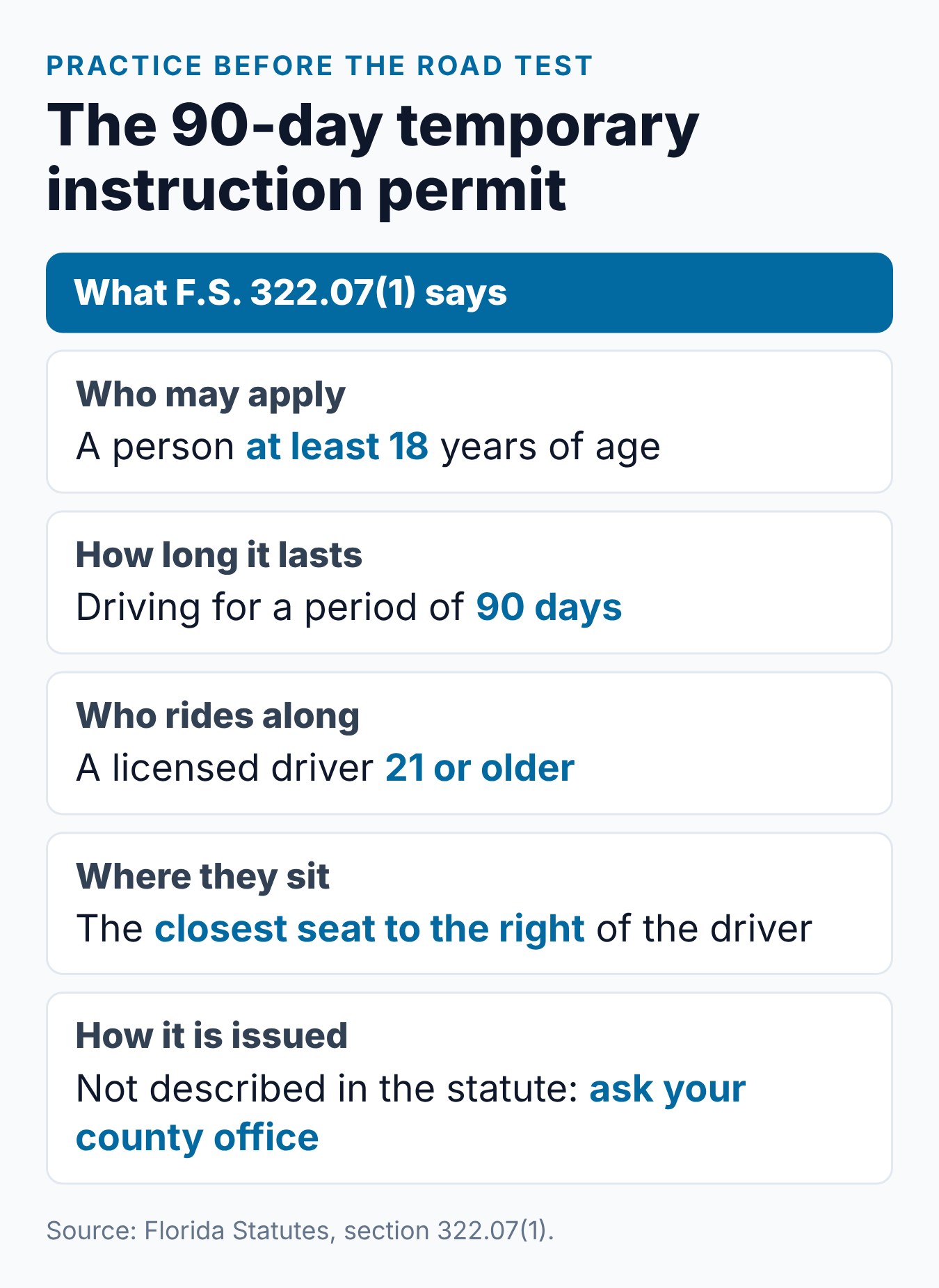
F.S. 322.07(1) says a person who is at least 18 years of age may apply for a temporary instruction permit. The permit lets the holder drive for a period of 90 days. The holder must be accompanied by a licensed driver who is 21 or older and sits in the closest seat to the right of the driver.
The statute does not describe how an office issues the permit. Ask your county office about it when you book your visit.
If You Were Licensed Somewhere Else
This article is about adults who have never been licensed. If you have held a license before, the rules change.
- The course: F.S. 322.095(1) exempts an applicant who has been licensed in another jurisdiction from the TLSAE requirement.
- The exams: Under F.S. 322.12(1), the department may waive the knowledge and skills tests for an applicant who surrenders a valid driver license from another state, a province of Canada or the United States Armed Forces.
- The vision test: FLHSMV’s New Resident page says a vision test is given.
Our new Florida resident driver’s license guide walks through the transfer process.
What We Found When We Traced Each Step
We read the statutes and FLHSMV pages behind each adult step on November 25, 2026. Three things stood out.
First, no single FLHSMV page holds the adult checklist. The Class E exam page and the teen licensing page describe the exams, and both sit in FLHSMV’s teen licensing section. The adult path has to be built from four Florida statutes and several FLHSMV pages.
Second, every rule adults skip is tied to an age. The 12-month learner’s license and the 50 hours apply to applicants at least 16 but under 18. The DETS course and the Parental Consent Form are both for applicants under 18.
Third, the practice option for adults is in a different statute. The temporary instruction permit is in F.S. 322.07(1), not in the learner’s license law. It gives a never-licensed adult a legal way to practice on public roads before the road test.
Mistakes That Send Adults Home
Each of these comes from one of the rules above.
- Skipping TLSAE. A never-licensed adult must complete the course before applying.
- Taking DETS instead. DETS is the course for first-time drivers under 18.
- Bringing copies. A first license needs original documents.
- Bringing one address proof. FLHSMV asks for two different documents.
- Planning to test online. The online knowledge exam is for applicants under 18.
- Arriving without an appointment. Many offices require one, so check your county’s rules.
- Driving alone to practice. Without a license, practice only with a permit and a licensed driver 21 or older beside you.
- A test vehicle with no proof of insurance. The examiner checks registration and insurance before the road test.
How Requirements Can Vary
Florida’s course and license rules apply statewide, but some details depend on where you live. Driver license services are often handled by your county tax collector’s office, and each office sets its own appointment process and hours. Some county school boards also offer driver education programs, such as DELAP courses, that can count instead of DETS.
FLHSMV can update course rules, forms, documents, and fees. Check FLHSMV and your county office for current requirements before your appointment.
Frequently Asked Questions
How do I get a driver license in Florida if I am over 18?
Complete the TLSAE course, bring your original documents to a driver license office, and pass the vision, hearing, knowledge and driving tests. Then pay the $48.00 license fee and any service fee.
Do I need a learner’s permit if I am over 18 in Florida?
No. The 12-month learner’s license rule applies to applicants 16 and 17. Adults may apply for a 90-day temporary instruction permit if they want to practice first.
Do adults need the drug and alcohol course in Florida?
Yes, if you have never been licensed. F.S. 322.095(1) requires TLSAE for applicants 18 and older, except people licensed in another jurisdiction or who finished a Department of Education driver education course.
Can an adult take the Florida knowledge exam online?
No. FLHSMV says applicants under 18 can take it online. Adults take it at a service center or with an approved provider that offers in-person exams.
How much does a first Florida license cost for an adult?
FLHSMV lists $48.00 for an original Class E license. A $6.25 service fee may apply in a tax collector office, and the TLSAE course is paid separately.
What happens if I fail a test?
You can retest. FLHSMV lists $10.00 for a knowledge exam retest and $20.00 for a driving skills retest.
Do I need my own car for the road test?
You bring the vehicle. It must have a valid registration and proof of insurance and pass a basic inspection by the examiner.
Conclusion
An adult first license in Florida takes six steps: the course, documents, an office visit with vision and hearing tests, the knowledge exam, the road test and the fee. Adults skip the teen learner’s license wait, the 50 hours, DETS and the parent form. For Step 1, see our drug and alcohol course florida page. Check your county office’s rules before you book, and use the 90-day permit if you want supervised practice first.
Related Articles
- Florida Learner’s Permit: How to Get It, Requirements, and What It Allows
- First-Time Florida Driver’s License for Adults: The Complete Process
- New Florida Resident Driver’s License: How to Get Yours
- What Do I Need to Get a Florida Drivers License? By Age
Sources
- Florida Statutes — F.S. 322.095 (TLSAE)
- Florida Statutes — F.S. 322.05 (Persons not to be licensed)
- Florida Statutes — F.S. 322.07 (Instruction permits and temporary licenses)
- Florida Statutes — F.S. 322.12 (Examination of applicants)
- Florida Statutes — F.S. 322.1615 (DETS)
- FLHSMV — Class E Knowledge Exam and Driving Skills Test
- FLHSMV — Driver License Exams
- FLHSMV — Licensing Requirements for Teens
- FLHSMV — Driver Education Courses
- FLHSMV — Driver Improvement Schools
- FLHSMV — TLSAE Course Provider List
- FLHSMV — What to Bring
- FLHSMV — What to Bring: U.S. Citizen
- FLHSMV — Driver License and ID Card Fees
- FLHSMV — New Resident
- FLHSMV — Locations
- FLHSMV — English-Only Driver License Exams, January 30, 2026
- FLHSMV — Parental Consent Form HSMV 71142
Billy Forte is the owner of Driving Logic, a state-approved driver improvement course provider serving Florida and other U.S. states.
This article is general information, not legal advice. Florida licensing requirements, course rules, documents, and fees are set by FLHSMV and Florida law and can change. Use official FLHSMV and Florida statute sources for current requirements before you enroll in a course or visit a driver license office.