
Updated November 2026 · Reviewed by Billy Forte
To get a Florida DMV learner’s permit, a teen who is at least 15 visits a driver license service center or county tax collector office with original identity documents and a parent or a notarized consent form, takes the vision and hearing tests and the knowledge exam if it was not taken online, pays the $48.00 fee, and is issued a Class E learner’s license. The agency behind the visit is the Florida Department of Highway Safety and Motor Vehicles (FLHSMV). This article walks through the visit itself: what to finish before you go, what happens at the counter and what you leave with.
Key Facts
- Before you go: Finish the 6-hour DETS course a few days ahead, since posting can take 24 to 72 hours. See the course step.
- Appointments: Many offices require one, and the rules differ by county. See how to book.
- Parent form: HSMV 71142 must be notarized or signed in front of an examiner. See the form rules.
- At the counter: A document check, vision and hearing tests, and the knowledge exam if you did not take it online. See the visit.
- Fee: $48.00 for an original Class E license, which includes the learner’s license, plus a $6.25 service fee that may apply. See the fee.
Florida DMV Learner’s Permit: Where You Actually Go
“Florida DMV” is the phrase most people search, but the state agency is FLHSMV. FLHSMV’s county location pages show that many local offices are county tax collector-sponsored service centers.
So the visit usually means going to a driver license office in your county. Each county’s offices can set their own appointment rules, so the county page matters as much as the state page.
The office visit is the only topic here. Three other guides cover the rest of the permit:
- Our Florida learner’s permit guide explains what the permit is and what it allows.
- Our step-by-step permit article covers the full process in order.
- Our learner’s permit documents list goes through every accepted document.
The Visit at a Glance
The visit has four parts. Most problems start in the first part, before you ever reach the counter.
- Before: The DETS course has posted, you know where you will take the knowledge exam, and you have an appointment if your office needs one.
- What you carry in: Original documents, the parent consent form and, after an online exam, the proctoring form.
- At the counter: Document check, vision and hearing tests, the knowledge exam or a possible re-test, then the fee.
- After: You leave with a Class E learner’s license and its driving rules.
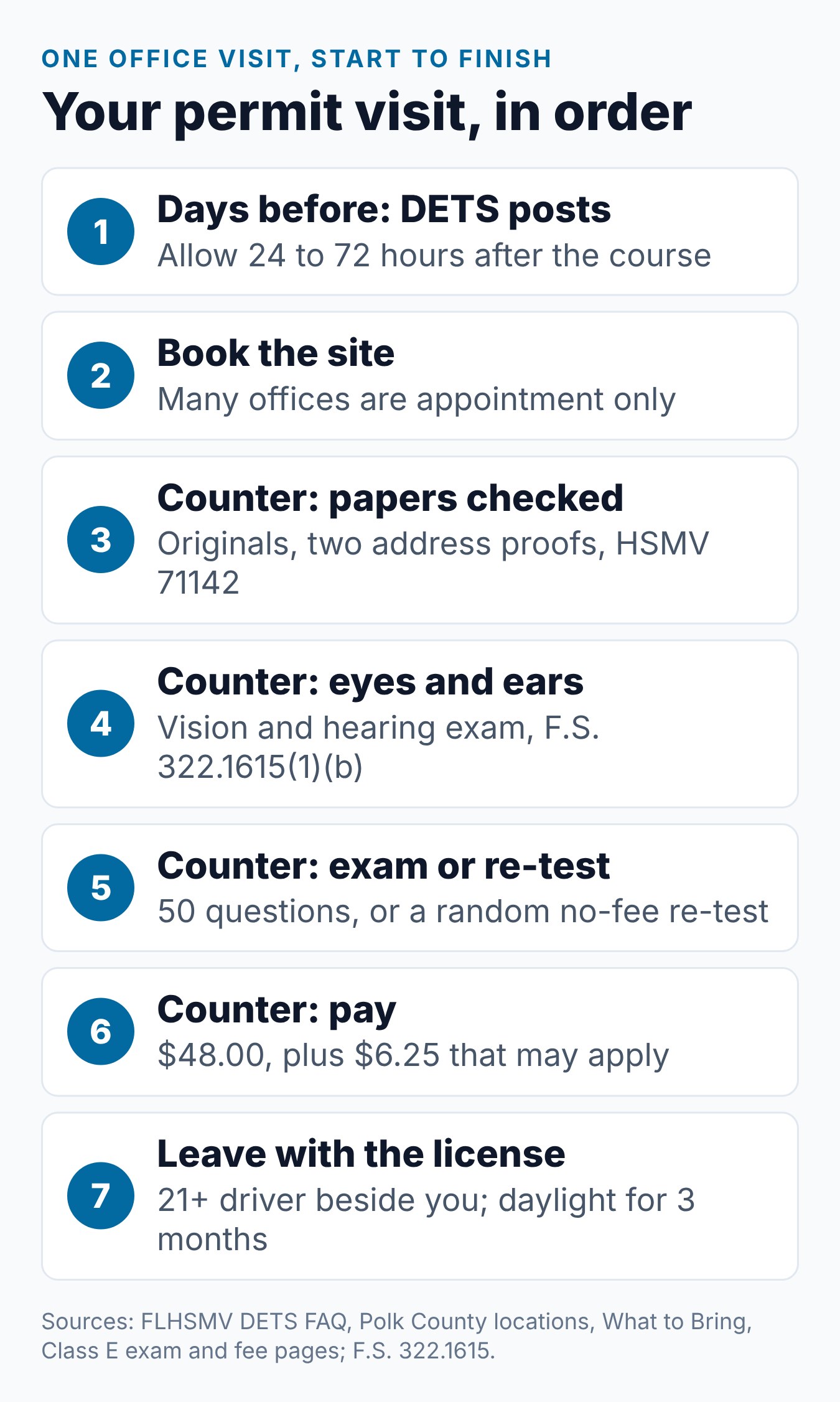
Before the Visit
Three things should be settled before you leave home. Each one can end the visit early if it is missing.
Finish DETS and Let It Post
As of August 1, 2025, anyone under 18 who has never held a driver license from any other state, country or jurisdiction must complete a 6-hour Driver Education Traffic Safety (DETS) course before applying. That rule is on FLHSMV’s DETS page.
You do not bring a certificate. The course provider reports your completion to FLHSMV through its school system, called DICIS. FLHSMV’s DETS FAQ says to allow 24 to 72 hours for school completions to be posted.
FLHSMV also says it does not accept paper certificates for any licensing purpose. So the office can only see a course that has posted. Finish DETS a few days before the visit, not the night before.
Decide Where to Take the Knowledge Exam
You have two choices. You can take the Class E Knowledge Exam at the office, or, if you are under 18, online through an approved third-party administrator, according to FLHSMV’s Class E exam page.
An online exam result is submitted to FLHSMV automatically. FLHSMV’s Driver License Exams page explains how approved providers fit in.
The choice changes your visit. Testing online means a shorter counter visit but one more form to bring. Testing at the office means no extra form but more time at the counter.
Book an Appointment
FLHSMV’s county location pages say many offices require appointments for service. The rules differ by county and even by site.
The Polk County locations page is one example. It lists sites that serve by appointment only, and it notes one site that does not give written or computer exams. That is one county, not a statewide rule.
Find your own county’s page on the FLHSMV site, then check your county tax collector’s website. Book ahead, and confirm that the site you pick gives the knowledge exam if you still need it.
What to Bring
FLHSMV’s What to Bring page for U.S. citizens asks for three kinds of original proof:
- Primary identification: for example, a U.S. birth certificate or a valid U.S. passport
- Social Security number: for example, a Social Security card or a W-2 form that is not handwritten
- Florida residential address: two different documents, and printouts or faxes are acceptable
Most 15-year-olds have no mail in their own name. In that case, the teen may use two proofs of residential address from a parent, step-parent or legal guardian, together with a Certification of Address form. FLHSMV has separate lists for immigrants and non-immigrants.
Our documents article covers each document in more detail. For the visit, the key rule is originals for identity, and two different address documents.
Parent Consent: HSMV 71142
A teen under 18 needs the Parental Consent for a Driver Application of a Minor, form HSMV 71142. One parent or legal guardian must sign it.
All signatures must be notarized or witnessed by an examiner. That gives a family two options for the visit:
- Parent comes along: The parent signs at the office in front of the examiner.
- Parent stays home: The parent signs in front of a notary first, and the teen brings the notarized form.
FLHSMV’s Required Forms for Teens page adds two rules. A step-parent may not sign unless he or she has legally adopted the minor. The form is not required if the minor is married.
Our HSMV 71142 guide explains the form line by line.
Form 71144 If You Tested Online
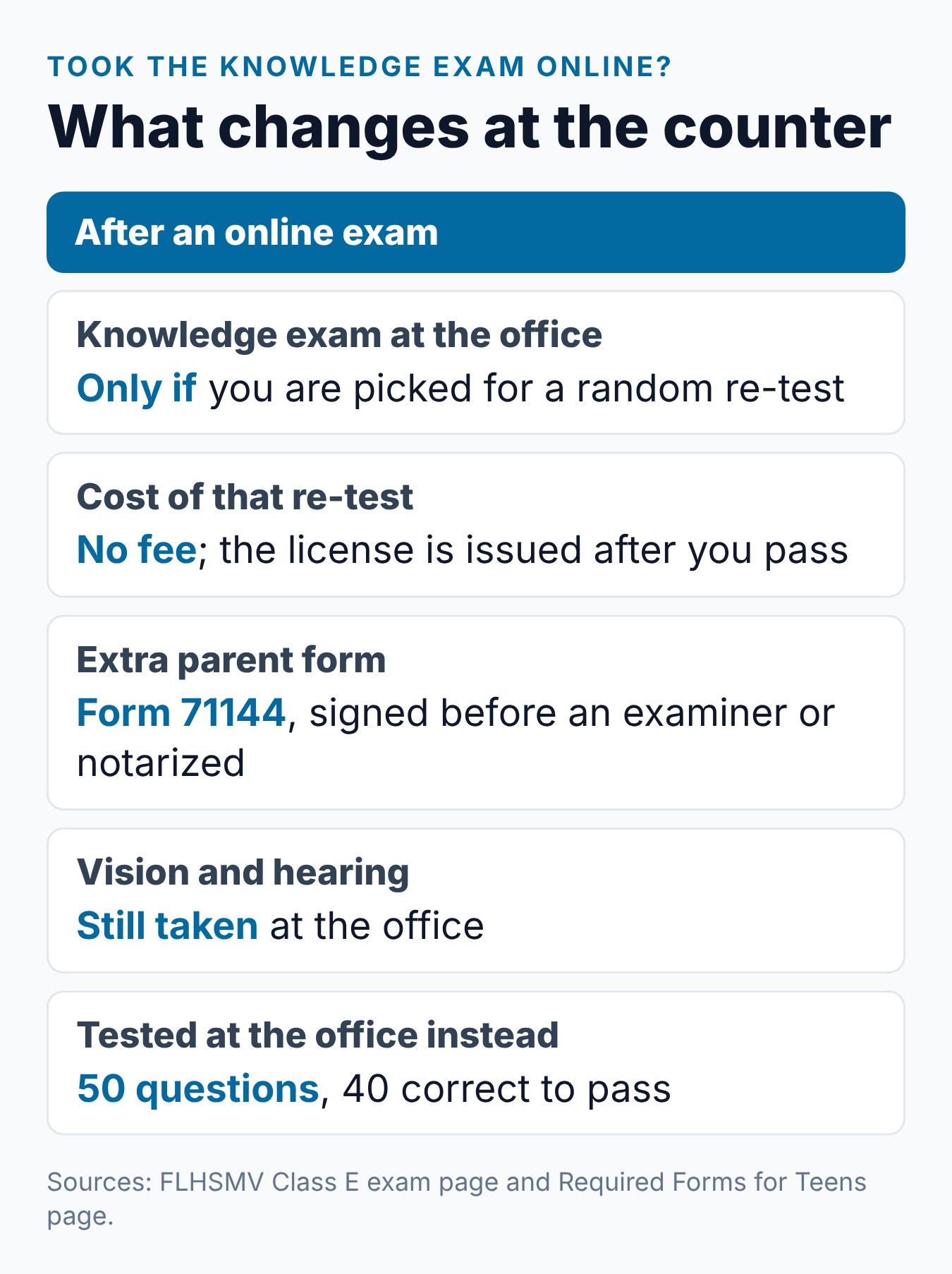
If the teen took the knowledge exam online, bring the Parent/Guardian On-line Test Proctoring Form, form 71144. The same Required Forms for Teens page says it is signed in the presence of a driver license examiner.
If the parent or guardian will not be at the office, the form must be notarized. A family that tested online and plans a parent-free visit therefore needs two notarized forms, HSMV 71142 and 71144.
At the Office
The counter steps follow the same order for most teens. Each one depends on the step before it.
The Document Check
Staff first look at your identity, Social Security and address documents and the parent forms. This is where copies, a missing second address proof or an unsigned form stop the visit. Your DETS completion must already show in FLHSMV’s records, since paper certificates are not accepted.
Vision and Hearing
Florida law requires a vision and hearing examination for a learner’s license. That rule is in F.S. 322.1615(1)(b). These tests are part of the office visit, so bring glasses or contacts if you wear them.
Knowledge Exam or a Random Re-Test
If you did not take the knowledge exam online, you take it here. FLHSMV’s Class E page says it has 50 multiple-choice questions, and you need 40 correct, or 80 percent, to pass.
If you passed online, you may still be tested at the counter. FLHSMV says a customer who passed through a third-party administrator may be randomly selected for a no-fee mandatory re-test. The license is issued after a passing re-test.
FLHSMV’s January 30, 2026 news release says all driver license knowledge and skills exams are given only in English from February 6, 2026. It also says translation services are no longer permitted. If you need language help, confirm the current rule with FLHSMV or your tax collector office before the visit.
Paying the Fee
The last counter step is payment. FLHSMV’s fee page lists these amounts:
- Original Class E license: $48.00, which includes the learner’s license
- Tax collector service fee: $6.25, which may apply in a tax collector office
- Knowledge exam retest: $10.00
The DETS course is paid to the course provider, not at the office.
What You Leave With
At the end of a successful visit, the teen is issued a Class E learner’s license. The official pages read on November 25, 2026 do not say whether the card is handed over at the counter or mailed, so ask the office before you leave.
The learner’s license comes with three rules from F.S. 322.1615 and FLHSMV’s Licensing Requirements for Teens page:
- Supervision: Drive only with a licensed driver at least 21 years old in the closest seat to the right of the driver.
- Hours: Daylight hours only for the first 3 months, then until 10 p.m.
- Holding period: Hold it for at least 12 months or until the 18th birthday, whichever comes first, before the Class E license.
Our learner’s permit guide explains how those rules work day to day.
What We Found Reading the Official Pages
We read the official pages behind each part of the visit on November 25, 2026. Three findings shape this article.
No single official page describes the visit. The parts above come from seven FLHSMV sources: the DETS page and FAQ, the Class E exam page, the Required Forms for Teens page, form HSMV 71142, the What to Bring page, the fee page and a county location page, plus F.S. 322.1615. A family reading only one of them would miss part of the visit.
Rules can differ inside one county. The Polk County page alone showed appointment-only sites and a site that does not give written or computer exams. That is why this article tells you to check the exact site, not just the county.
One question has no official answer. None of the pages read says whether the learner’s license card is handed over at the counter or mailed. We left that out rather than guess, and you can ask your office.
Why a Visit Ends Without a Permit
Each of these comes straight from the rules above.
- No appointment at an office that requires one
- Copies instead of original identity documents
- A consent form that is signed but not notarized when no parent is at the office
- A DETS completion that has not posted yet, because the course was finished too close to the visit
- No form 71144 after an online exam, when the parent is not present to sign it
- A step-parent signature from a step-parent who has not adopted the teen
If one of these happens, fix that one item before you book again.
How Requirements Can Vary
Florida’s course and license rules apply statewide, but some details depend on where you live. Driver license services are often handled by your county tax collector’s office, and each office sets its own appointment process and hours. Some county school boards also offer driver education programs, such as DELAP courses, that can count instead of DETS.
FLHSMV can update course rules, forms, documents, and fees. Check FLHSMV and your county office for current requirements before your appointment.
Frequently Asked Questions
What happens at the office when you apply for a learner’s permit?
Staff check your documents, parent form and DETS record. You take the vision and hearing tests and the knowledge exam if you did not test online, then pay the fee.
Does a parent have to come to the permit appointment?
Not always. A parent can sign HSMV 71142 in front of the examiner, or sign it in front of a notary before the visit.
Can I take the permit test before going to the office?
Yes, if you are under 18. You can take the Class E Knowledge Exam online through an approved third-party administrator, and the result goes to FLHSMV automatically.
Will I have to retake the knowledge exam at the office?
You might. FLHSMV says a customer who passed online may be randomly selected for a no-fee re-test, and the license is issued after a passing re-test.
How much is a learner’s permit at the office?
FLHSMV lists $48.00 for an original Class E license, which includes the learner’s license. A $6.25 service fee may apply in a tax collector office.
How soon after DETS can I go to the office?
FLHSMV says to allow 24 to 72 hours for school completions to post. Book your visit for a few days after you finish the course.
Do I get the permit card the same day?
The official pages we read do not say whether the card is handed over or mailed. Ask your office when you book.
Conclusion
A learner’s permit visit goes smoothly when the work before it is done: DETS posted, the exam plan set, an appointment booked and original documents in hand. At the counter, expect a document check, vision and hearing tests, the knowledge exam or a possible re-test, and the $48.00 fee. Finish the online Florida DETS course a few days before you book. Then check your county site’s rules so nothing stops the visit.
Related Articles
- Florida Learner’s Permit: How to Get It, Requirements, and What It Allows
- How to Get a Florida Learner’s Permit Step by Step
- Florida Learner’s Permit Documents: What to Bring
- Florida Parental Consent Form HSMV 71142: What It Is and How to Get It
Sources
- FLHSMV — Driver Education Traffic Safety (DETS)
- FLHSMV — DETS Course Frequently Asked Questions
- FLHSMV — Driver Education Courses
- FLHSMV — Driver Improvement Schools
- FLHSMV — Class E Knowledge Exam and Driving Skills Test
- FLHSMV — Driver License Exams
- FLHSMV — Licensing Requirements for Teens
- FLHSMV — Required Forms for Teens
- FLHSMV — Parental Consent Form HSMV 71142
- FLHSMV — What to Bring: U.S. Citizen
- FLHSMV — Driver License and ID Card Fees
- FLHSMV — Polk County Locations
- FLHSMV — English-Only Driver License Exams, January 30, 2026
- Florida Statutes — F.S. 322.1615 (DETS)
- Florida Statutes — F.S. 322.095 (TLSAE)
- FLHSMV — TLSAE Course Provider List
Billy Forte is the owner of Driving Logic, a state-approved driver improvement course provider serving Florida and other U.S. states.
This article is general information, not legal advice. Florida licensing requirements, course rules, documents, and fees are set by FLHSMV and Florida law and can change. Use official FLHSMV and Florida statute sources for current requirements before you enroll in a course or visit a driver license office.