
Updated November 2026 · Reviewed by Billy Forte
No Texas course is shorter than 6 hours: the shortest defensive driving course Texas allows has at least 300 minutes of instruction and 360 minutes in total, in a classroom or online. Online courses must use built-in timers, so the required time cannot be skipped. This guide explains why no licensed provider can lawfully sell a shorter course, what “fast” can honestly mean, and which deadlines matter more than the course clock.
Key Facts
- The minimum: at least 300 minutes of instruction and 360 minutes in total for every course. See the rule.
- Online is not shorter: 300 minutes of content, 60 minutes of breaks or extra content, and built-in timers. See online courses.
- Same length everywhere: every licensed provider offers the same 6-hour course. See every provider.
- What can add time: the 70 percent final test and online identity questions. See what can add time.
- Clocks that matter more: the court’s 90-day period and the certificate timeline. See the other clocks.
The Shortest Defensive Driving Course Texas Allows: Six Hours
The course length is set by TDLR’s rule for driving safety courses. Under 16 TAC 84.504(1)(C), “A minimum of 300 minutes of instruction is required,” and “The total length of the course must consist of a minimum of 360 minutes.” In a classroom course, the other 60 minutes are break periods.
We read the rule text in the Texas Register of August 16, 2024, because the state’s online rule viewer would not load. TDLR’s own Course of Organized Instruction for Driving Safety (May 2026) agrees. It says total instruction time must be a minimum of five hours, excluding breaks, and it calls both the traditional course and the online version a six-hour curriculum.
So the honest answer to “what is the shortest course?” is the minimum itself. The shortest defensive driving course Texas allows is a six-hour course with five hours of instruction. Nothing in the rule creates a shorter version.
Texas law calls it a driving safety course, and many people call it defensive driving. TDLR’s Taking a Driving Safety Course page says it is sometimes referred to as a defensive driving class. Both names point to the same course and the same clock.
Online Courses Are Not Shorter
Many drivers hope an online course will be quicker. The rule for online courses, which TDLR calls an alternative delivery method, closes that door.
Under 16 TAC 84.505, an online course:
- Must have enough content. It must present enough material that it would take a student 300 minutes to complete, under 84.505(b)(4).
- Must reach 360 minutes. It must have students take 60 minutes of break time or provide extra educational content, for 360 minutes in total, under 84.505(b)(5).
- Must use timers. It “must include built-in timers to ensure that 300 minutes of instruction have been attended and completed,” under 84.505(e)(1).
TDLR’s Curriculum Standards for Driving Safety Providers page adds two more lines. Online courses must be at least as secure as a traditional classroom course, and they must contain the same educational objectives.
In short, the screen changes but the clock does not. A timer will not let the instruction move ahead faster than the rule allows.
Every Licensed Provider, Same Length
TDLR’s student page says any licensed driving safety provider may offer “a 6-hour course” that can be used for ticket dismissal or insurance discounts. Its Apply for a Driving Safety Provider License page tells providers the license allows them to offer the 6-hour driving safety course, online or in person.
That means the length is not something providers compete on. All licensed courses share the same minimum. None of the official pages we read describes a shorter course for ticket dismissal.
What a “Short Course” Ad Means
Sometimes an ad offers a 4-hour Texas course or promises the “shortest” course in the state. That claim does not match the rule.
If you see an ad like that, three readings are possible, and none of them helps you:
- It is not the Texas driving safety course. It may be some other class that a court will not take for a ticket.
- The words are loose. The ad may mean the course feels easy, not that it is shorter than six hours.
- The seller is not licensed. Check the name in TDLR’s Driving Safety Provider Search before you pay.
Whatever the reason, a course under the minimum will not give you a shortcut. Pick a licensed course and plan for the full six hours.
What Can Add Time
Six hours is the floor, not a promise of the total. Some parts of the rules can make the course take longer for a student.
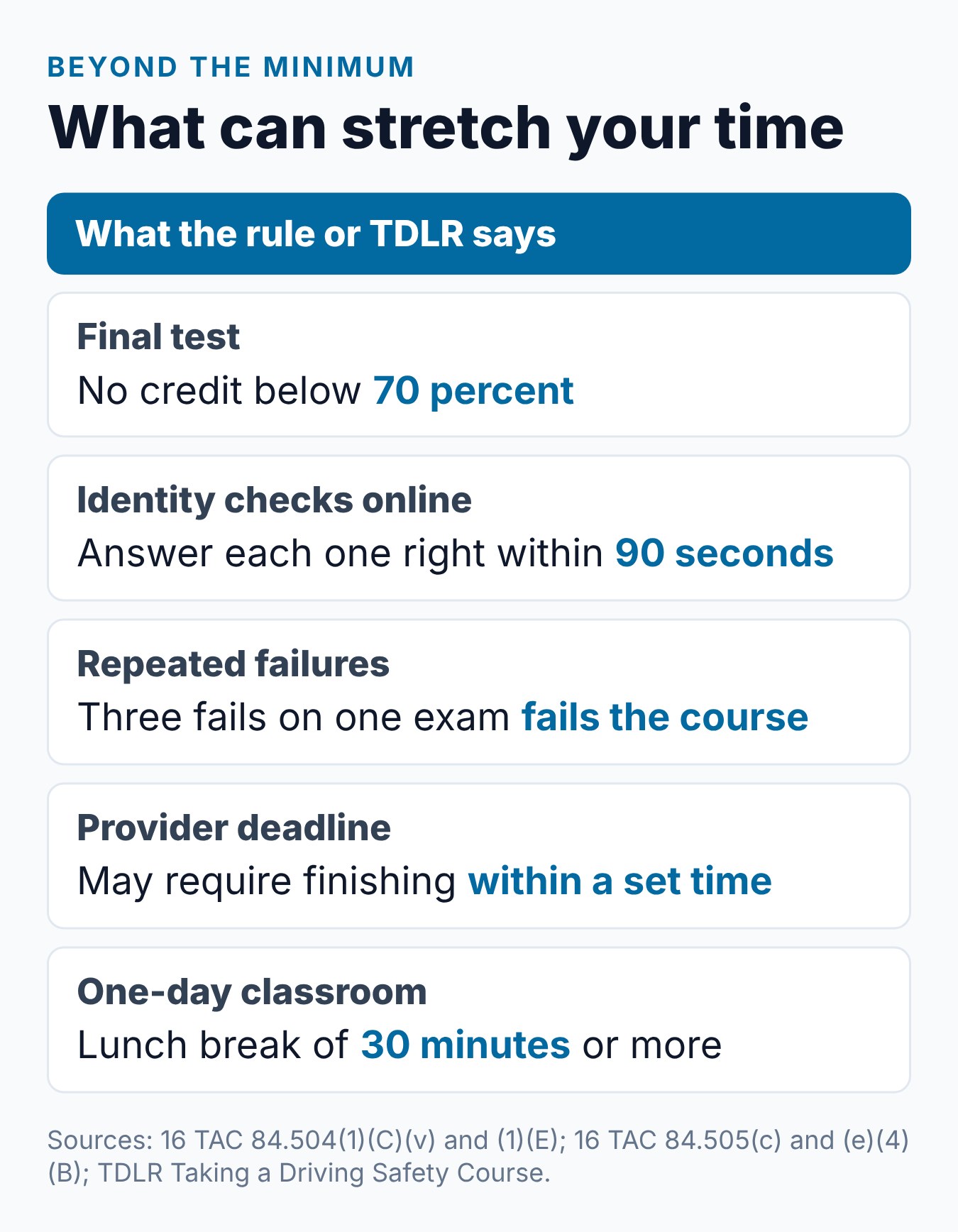
- The final test. Under 16 TAC 84.504(1)(E), students must not be given credit unless they score 70 percent or more on the final test.
- Identity questions online. Under 16 TAC 84.505(c), the student must correctly answer each personal validation question within 90 seconds.
- Three failed tries. Under 16 TAC 84.505(e)(4)(B), a student who fails the same unit exam or the final exam three times fails the course.
The last one is the real time risk. Failing the course means starting over, which costs far more time than any course could save.
Tips That Protect Your Time
These habits follow from the rules above:
- Read each unit with care, since unit exams count.
- Keep your identity details close so you can answer validation questions within 90 seconds.
- Take the final test when you are rested and focused.
What “Fast” Can Honestly Mean
The two rule sections set a minimum length. They do not set a number of days. So no one can honestly tell you the course must be spread over several days, and no one can promise it can be done in one sitting.
What the rules do fix is the 300 minutes of instruction. That part does not shrink. The rest depends on the course and the provider.
- Classroom courses. A one-day classroom course must allow at least 30 minutes for lunch, under 16 TAC 84.504(1)(C)(v).
- Provider time limits. TDLR’s student page says providers may require that you complete the course within a specific amount of time.
- Pausing and resuming. Ask the provider how its course can be paused and resumed before you enroll.
So “fast” can truthfully mean a course that fits your schedule and does not add delays. It cannot mean fewer than six hours.
The Clocks That Matter More
For a ticket, the course clock is often not the tightest one. Two other clocks decide whether your paperwork reaches the court in time.
| Clock | What the source says | Who sets it |
|---|---|---|
| The court’s period | 90 days to complete the course and present the certificate and other papers | Code of Criminal Procedure Art. 45A.356(a) |
| The completion date | The court will typically set the date the course must be completed by | Your court (TDLR student page) |
| The certificate by law | Issued not later than the 15th working day after you finish | Education Code Sec. 1001.351(a) |
| The certificate for students | You should receive it within 14 days | TDLR student page |
| The provider’s limit | The course may have to be done within a set time | Your provider (TDLR student page) |
The 90-day rule is in Article 45A.356(a) of the Code of Criminal Procedure. The certificate rule is in Section 1001.351(a) of the Education Code.
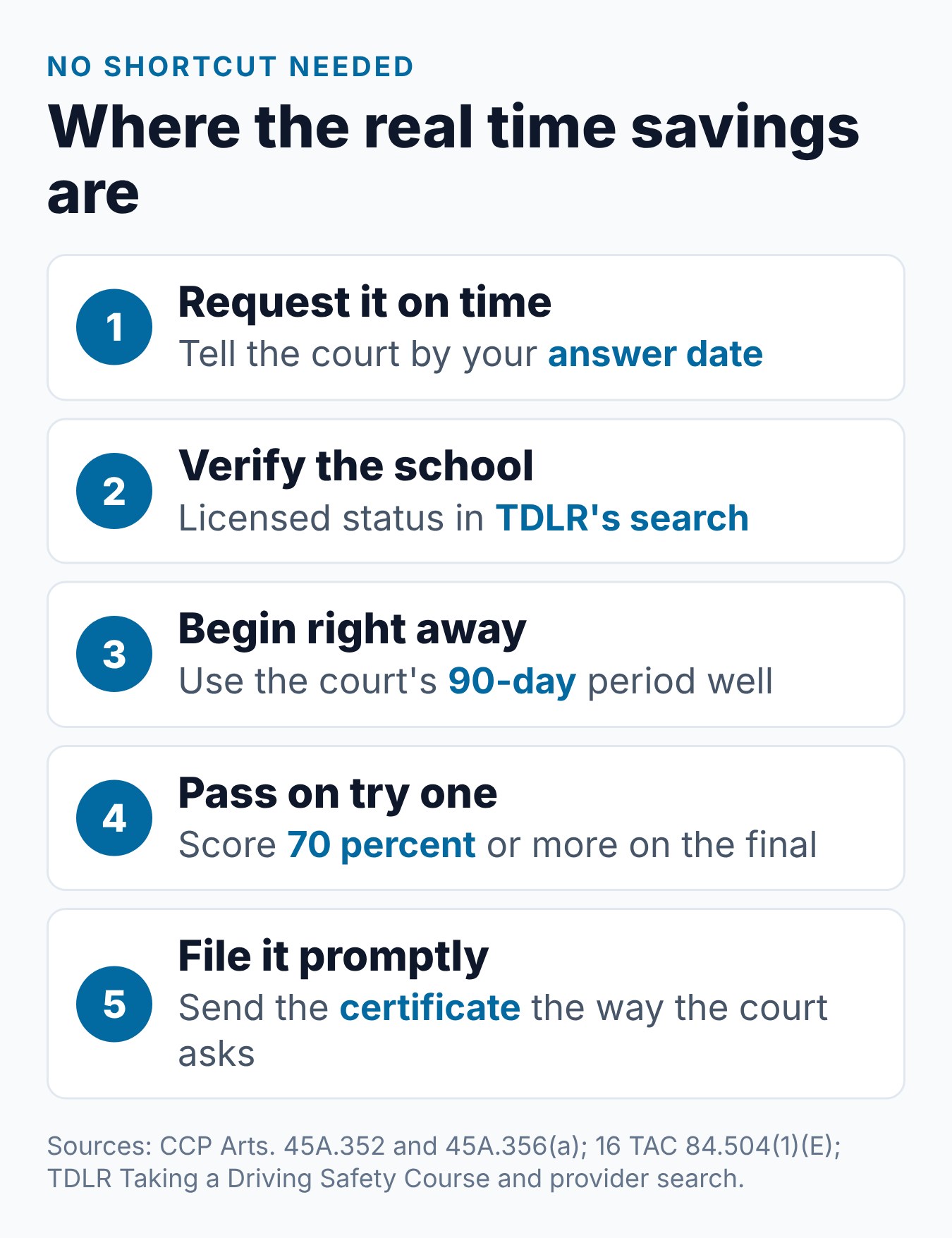
Look at the gap. The course needs six hours, but the certificate can take up to 15 working days after you finish. Starting early and sending the certificate promptly save more time than looking for a shorter course that does not exist.
Before Any Course: Ask the Court
TDLR’s student page says you must first receive notice from the Texas court system that you are eligible before taking the course to dismiss a ticket. Make the request by the answer date on your citation. A later request is up to the court.
Not every driver or ticket qualifies:
- CDL holders. Anyone who has a commercial driver’s license, or had one when the offense happened, cannot use course dismissal or deferred disposition, in any vehicle.
- High speeds. Tickets for 25 mph or more over the limit, or for 95 mph or more.
- Other offenses. Passing a school bus, crash-duty offenses such as leaving the scene, work-zone offenses with workers present, serious traffic violations and DWI.
Deferred disposition is a different court option, and our driving safety course requirements checklist explains both.
What We Found in the Length Rules
On November 25, 2026, we read the length rules and TDLR’s pages listed in Sources, looking for any shorter route. Here is what stood out:
- One minimum for every format. Classroom and online courses share the same 300 and 360 minutes.
- No shorter version anywhere. None of the pages describes a course under six hours for ticket dismissal.
- No set number of days. The rules set minutes, not days, and TDLR leaves pacing limits to providers and courts.
- The paperwork is slower than the course. The law allows up to 15 working days for the certificate, far longer than the six-hour course.
The takeaway: the shortest legal course is six hours, and the real time savings come from acting early on the court request and the certificate.
Common Mistakes to Avoid
Each of these comes from the rules quoted above:
- Paying for a “4-hour” Texas course. Every licensed course has the same six-hour minimum.
- Expecting online to be quicker. Built-in timers track the 300 minutes of instruction.
- Rushing the final test. A score under 70 percent means no credit.
- Ignoring identity questions. Each must be answered correctly within 90 seconds.
- Waiting until the last week. The certificate can take up to 15 working days.
- Skipping the court step. For a ticket, you need the court’s notice before the course.
How Requirements Can Vary
The driving safety course rules come from Texas law and TDLR and apply statewide. Each justice or municipal court still sets its own fees, filing steps and contact methods, and the facts of your citation decide which options you have.
Laws, fees and court procedures can change. Check your citation, ask the court that handles your case, and use the TDLR and Texas DPS websites for current rules before you act.
Frequently Asked Questions
What is the shortest defensive driving course in Texas?
The shortest course Texas allows is six hours. Every course needs at least 300 minutes of instruction and 360 minutes in total.
Is there a 4-hour defensive driving course in Texas?
Not for ticket dismissal. TDLR says licensed providers offer a 6-hour course, and none of the official pages describes a shorter one.
Is the online course shorter than the classroom course?
No. Online courses must have 300 minutes of content and 360 minutes in total. Built-in timers make sure the instruction time is completed.
Can I finish the course in one sitting?
The rules set minutes, not days, so it depends on the provider. Ask how its course can be paused and resumed and whether it sets a time limit.
What can make the course take longer?
You need 70 percent on the final test for credit. Online, failing the same unit exam or the final three times fails the course.
How long do I have to finish for a ticket?
Article 45A.356(a) gives a 90-day period to complete the course and present the certificate and other papers. TDLR says the court will typically set your completion date.
Conclusion
No Texas driving safety course is shorter than six hours, online or in a classroom, and our article on how long the Texas driver safety course takes explains how those hours break down. Ask the court first, start early and send your certificate promptly. When you are ready, see Driving Logic’s texas defensive driving online course.
Related Articles
- Texas Driver Safety Course (DSC): The Complete Guide
- Cheapest Defensive Driving Course Texas: The Legal Minimum
- Texas Approved 6 Hour Driving Course Online: How It Works
- Best Defensive Driving Course Texas: How to Choose
- Texas 6hr Defensive Driving Class Online: What to Expect
Sources
- TDLR — Taking a Driving Safety Course
- TDLR — Apply for a Driving Safety Provider License
- TDLR — Curriculum Standards for Driving Safety Providers
- TDLR — Course of Organized Instruction for Driving Safety, May 2026 (PDF)
- TDLR — Driving Safety Provider Search
- Texas Register, August 16, 2024 — Title 16, Economic Regulation (text of 16 TAC 84.504 and 84.505)
- Texas Code of Criminal Procedure Chapter 45A (PDF)
- Texas Education Code Chapter 1001 (PDF)
- Texas DPS — How to Order Your Driver Record
- Length rule review: Driving Logic reading of the Texas Register, TDLR and Texas Legislature pages, November 25, 2026.
Billy Forte is the owner of Driving Logic, a state-approved driver improvement course provider serving Texas and other U.S. states.
This article is general information, not legal advice. Texas traffic and driving safety course rules are set by Texas law, TDLR, Texas DPS and each court, and they can change. Check with the court on your citation and the official TDLR and DPS websites for current requirements, and talk to a Texas lawyer about your specific case.