
Updated June 2026 · Reviewed by Billy Forte
You can get a copy of your Tennessee driving record from the Tennessee Department of Safety and Homeland Security online, in person, or by mail, and it shows key facts like your license status, traffic convictions, demerit points, suspensions, and other state-reported actions. Tennessee offers both standard personal records and certified records, and the state commonly provides either a 3-year or 10-year history depending on the record you request. A personal copy is often enough to check your own status, while a certified copy may be needed for court, legal, or official use and is generally requested by mail through TDOSHS.
This article covers Tennessee requirements only.
Key Facts
- Driving record: Your Tennessee record can show license status, convictions, and points.
- Official source: Use TDOSHS or official state tools when checking record details.
- Points and history differ: Points and record history are related, but they are not the same thing.
- Course role: Driver education may help only if accepted for your specific requirement.
- Keep proof: Save notices, certificates, receipts, and court instructions.
What A Tennessee Driving Record Shows And Why It Matters
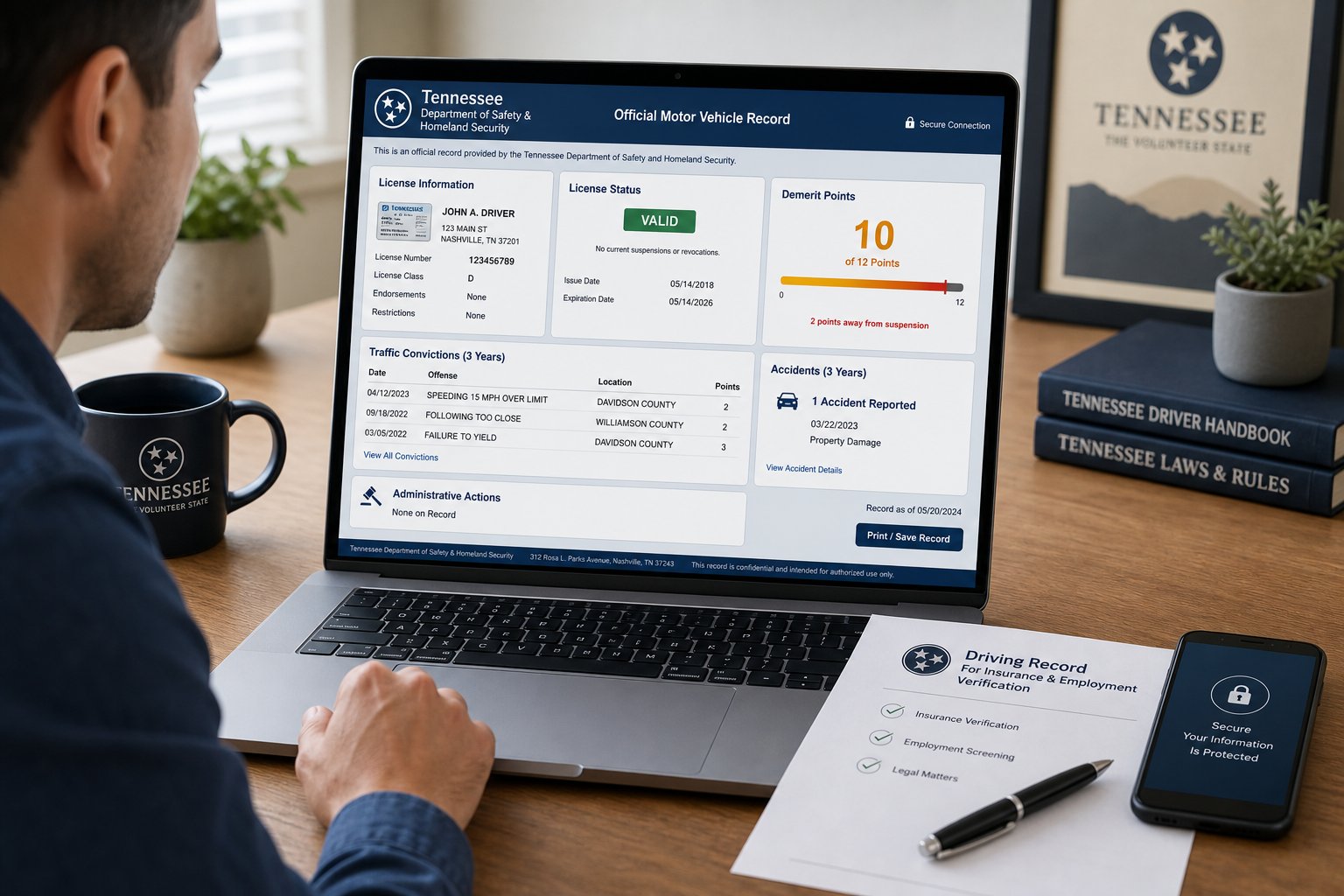
A Tennessee driving record is your official state driving history. TDOSHS keeps it. It is also called a motor vehicle record, or MVR.
Your record can show a 3-year or 10-year history. It may include:
- Your name and license number
- License status, such as valid, suspended, or revoked
- Traffic convictions
- Demerit points from moving violations
- Accidents reported to the state
- Administrative actions, including suspensions and reinstatements
That matters because your MVR is often the first place others look when they want to judge driving risk. An insurer may use it to price a policy. An employer may use it before hiring you for a driving job. A court may look at it to see prior violations.
It matters to you too. If you have a pending citation, a notice of proposed suspension, or a license issue, your record helps you confirm what the state has on file. And if something is wrong, spotting it early can save time.
A quick review can answer basic but important questions: Do you have points accumulation close to the 12-point threshold? Is your license listed as valid? Is an old court case still showing as open when it should not be? Those details can affect your next steps in a very real way.
Who Uses A Tennessee MVR And When You May Need One
A Tennessee MVR is used by several groups, not just drivers. The most common are insurance companies, employers, courts, and attorneys.
Insurance companies use your record during underwriting and renewal. If they see recent violations, suspensions, or a pattern of risky driving, they may rate you as a higher-risk driver. That can affect what you pay.
Employers often check driving records too. This is common for delivery jobs, fleet work, CDL roles, and any job that involves company vehicles. Some employers also run MVR checks after hiring, not just before.
Courts and lawyers may request a record in traffic or accident cases. A judge may want to see your prior history when deciding penalties, diversion, or whether a defensive driving course is an option. Still, whether a course can dismiss a ticket or reduce points depends on the specific Tennessee court and case.
You may need a copy of your own record when:
- Applying for a job
- Going to traffic court
- Checking your license status
- Getting ready for reinstatement
- Verifying that a ticket was processed correctly
If you plan to use an online course for a court matter, confirm first with your specific court or Clerk of Court. Courts in Tennessee do not all handle online completion the same way.
How To Get Your Tennessee Driving Record
You can get your tennessee driving record online, in person, or by mail through the Tennessee Department of Safety and Homeland Security. The main options are simple, but the type of record matters.
Personal record
A personal record is usually what you order to check your own status. Tennessee residents can request it online through the state’s e-Services portal or in person at a Driver Services Center.
For an online request, the state may ask for:
- Your full name
- Date of birth
- Tennessee license number
- Social Security number
- The last 5 digits of the DD number
The state has listed a $5 fee for this record. Online access is often the fastest choice when you need to confirm points, a suspension entry, or a license status issue.
Certified record
A certified record is different. It is the official version often used for court or legal needs. Tennessee has treated mail request as the standard way to get a certified copy. You send the required details and payment to TDOSHS, and processing can take about two weeks.
You can also go in person to a Driver Services Center for a standard request. In some cases, an authorized person may obtain a copy for you with notarized authorization.
Before you request anything, check the official TDOSHS driver services pages at tn.gov. State procedures can change, and official instructions should control.
What To Look For On Your Record
When you get your MVR, read it line by line. Small errors matter.
Start with your personal details. Make sure your name, date of birth, and license number are right. A basic mismatch can cause problems with court records, insurance checks, or employer screening.
Next, check the violations section. Look for:
- Offense dates
- Offense codes or descriptions
- Court or location details
- Points linked to each violation
Then review any accident entries and license actions. If you had a prior license suspension, make sure the record also shows the right reinstatement or end date if that issue was resolved.
You should also confirm the scope of the report. Is it a 3-year record or a 10-year record? That changes what appears. A 3-year report may not show older events that still matter for a job or legal issue.
If you are near a points problem, focus on your recent timeline. Tennessee tracks points accumulation over a 12-month period for suspension review. That means dates matter as much as totals.
If you see something you do not recognize, do not guess. Compare the record to court papers, payment receipts, or dismissal orders. That gives you a clear paper trail if you need to ask TDOSHS to correct an entry.
Points, Suspensions, And How Violations Affect Your License
Tennessee uses a demerit point system for moving violations. Those points can lead to warnings, hearings, and suspension.
In general, points stay on your record for 2 years. Different violations carry different values. Minor speeding may bring fewer points, while more serious acts can bring much more. Examples of higher-point issues can include reckless driving, passing a stopped school bus, driving on a suspended license, or leaving the scene.
For adults age 18 and older:
- 6 points in 12 months can trigger a warning letter
- 12 points in 12 months can trigger a notice of proposed suspension and hearing
- A suspension may last about 6 to 12 months
For drivers under 18:
- 6 points in 12 months can trigger proposed suspension
- Suspension may last about 3 to 6 months
- A defensive driving course may be required
- More than 10 points in a year often leads to suspension
This is why checking your MVR matters. You may have more points than you think if multiple tickets posted close together.
In some cases, a Tennessee defensive driving course may be part of probation, reinstatement, or a near-suspension response. Tennessee drivers may see both a 4-hour course for some court-related situations and an 8-hour TDOSHS-approved course for certain state or near-suspension needs. But never assume a course will dismiss a ticket, cut points, or satisfy a court order unless your court or TDOSHS says so.
How A Tennessee Driving Record Can Affect Insurance, Jobs, And Court Requirements
Your driving record can affect three big parts of life: insurance, work, and court outcomes.
With insurance, companies use your MVR to measure risk. More violations, a suspension, or recent points can lead to higher rates or tougher renewal terms. Not every insurer weighs records the same way, but your state record is a core source of data.
With jobs, the issue is trust and safety. Employers that rely on drivers often check for:
- Recent moving violations
- Suspensions or revocations
- DUI-related entries
- Patterns of repeated tickets
A clean record can help. A bad one can limit options, especially for jobs with delivery, fleet, or CDL duties.
In court, your record may shape what the judge or prosecutor is willing to allow. Prior offenses can affect diversion, penalties, and whether traffic school is considered. But again, court acceptance varies. If you want to take an online class, check first with your local court through the Tennessee court system or your Clerk of Court.
If you need a course for a Tennessee matter and want a flexible option, Driving Logic’s Tennessee defensive driving course is built for busy drivers and can be taken on your schedule. Just confirm with your court or agency that the course format fits your case before you enroll.
How To Correct Errors Or Improve A Problem Driving Record
If your record has an error, only the state can fix it. A third-party MVR seller cannot change the official file.
If you find a mistake, contact TDOSHS and gather proof first. Helpful documents may include:
- Court dismissal orders
- Payment receipts
- Reinstatement paperwork
- Identity documents
- Orders that correct a conviction record
Use official state sources when you contact the agency, such as the TDOSHS Driver Services page. If the issue came from court reporting, you may also need to work with the local court clerk and keep copies of everything you send.
To improve a problem record, time and clean driving matter most. Points usually age off after 2 years. Avoiding new tickets is the clearest way to lower future risk.
In some situations, a defensive driving course may help satisfy a court or state requirement. Tennessee drivers may be assigned a 4-hour class in some ticket diversion situations or an 8-hour course in near-suspension cases approved by TDOSHS. Still, whether a course affects your case depends on the court, the facts, and the order entered.
FAQ
Can a Tennessee driver education course remove points?
No. A course does not automatically remove points or erase a conviction. It may help only when the court, TDOSHS, insurer, or notice accepts it for your situation.
How do I know what deadline applies?
Check the ticket, court order, TDOSHS notice, or insurer instructions. Those documents control your deadline and proof requirements.
Should I check my Tennessee driving record first?
Yes. Checking your record helps you understand points, convictions, and license status before choosing your next step.
Conclusion
Your Tennessee Motor Vehicle Record shows your license status, convictions, and point history, and you can request it online, by mail, or in person. Decide whether a personal or certified copy fits your purpose before ordering. Reading it line by line is the best way to catch an error before it costs you.
Take the Tennessee defensive driving course when you are ready to get started.
Related Articles
- Tennessee Driver License Points System Explained
- How Long Do Points Stay on Your License in Tennessee?
- Tennessee Demerit Points Chart: How Many Points for Each Traffic Violation
- How Many Points Is a Speeding Ticket in Tennessee?
Sources
- Tennessee Department of Safety and Homeland Security
- Tennessee Department of Safety — Driver Services
- Tennessee Driver Services Online
- Tennessee Code — Motor and Other Vehicles
Billy Forte is the owner of Driving Logic, a state-approved driver improvement course provider serving Tennessee and other U.S. states. Driving Logic offers online driver education, defensive driving, and driver improvement courses for drivers handling court, state, insurance, and ticket-related requirements.
This article is general information, not legal advice. Tennessee court rules, TDOSHS rules, deadlines, insurance decisions, and case facts can differ. Use official Tennessee court and state sources for current requirements, and consult a qualified Tennessee attorney for legal guidance specific to your situation.