
Updated June 2026 · Reviewed by Billy Forte
If you live out of state and get a Texas speeding ticket, you still must resolve it with the Texas court, and Texas reports the conviction to your home state through the Driver License Compact, which Texas belongs to. Texas itself assigns no points, but your home state applies its own rules — including any points and insurance effects — when it receives the conviction. For an eligible ticket you can usually request a Driver Safety Course from the Texas court and complete it online; dismissal is reported on the Texas side, so handling it before the appearance date is the best way to protect both records.
Applies to Texas. Court rules and deadlines vary by county.
Key Facts
- You deal with the Texas court: The citation is resolved through the Texas court that issued it.
- Texas reports home: Texas is a Driver License Compact member and reports convictions to your home state.
- Home state applies its rules: Texas has no points, but your home state may assess points and rate the conviction under its own laws.
- DSC is usually available: For an eligible ticket, you can request a Driver Safety Course from the Texas court and complete it online.
- Act before the appearance date: Requesting the course before that date protects the Texas record and, in turn, what gets reported home.
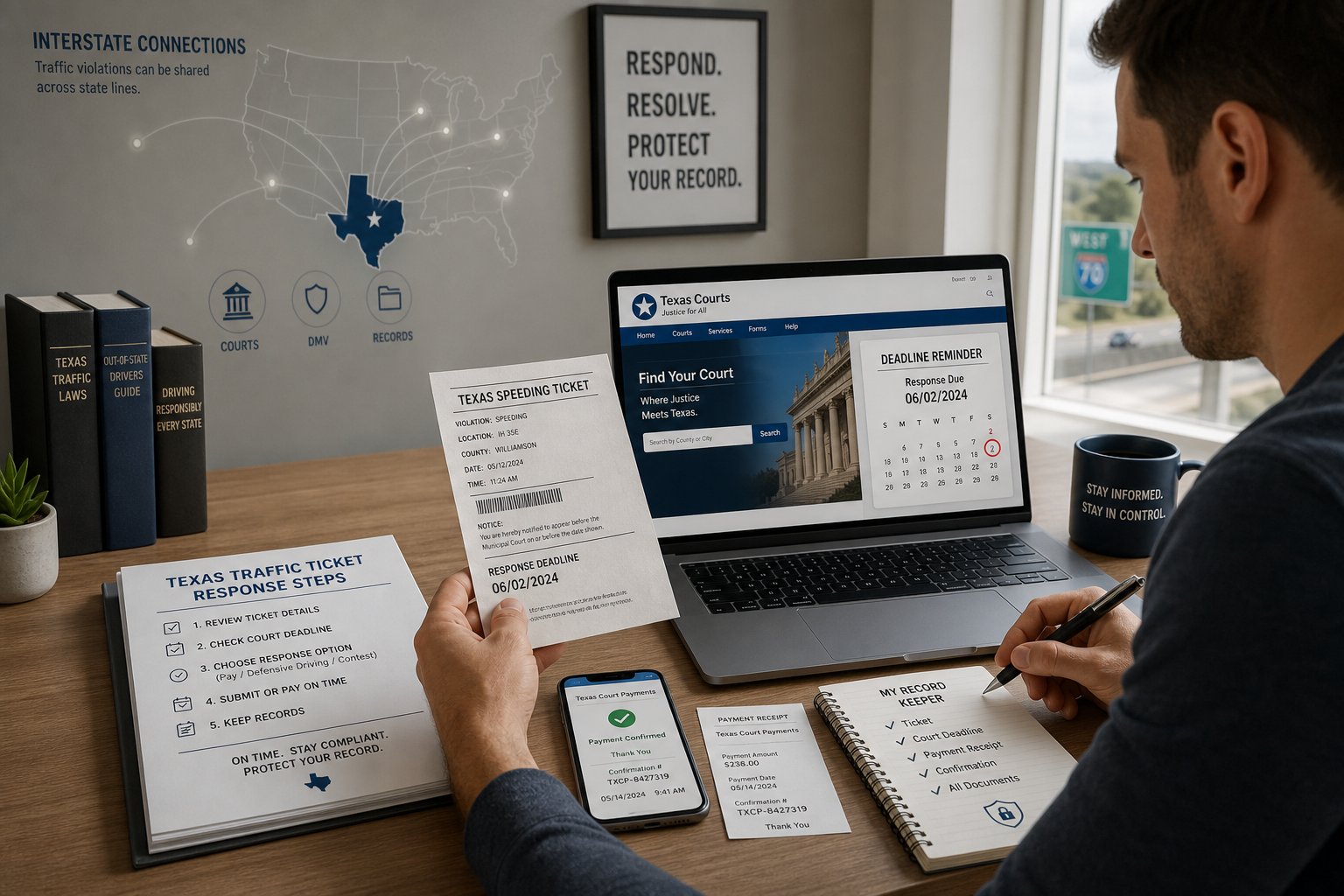
What Happens If You Get A Speeding Ticket In Texas While Living Out Of State
The first thing to know is simple: an out of state driver Texas traffic ticket does not go away because you crossed back over the state line. You must respond to the court listed on the citation by the deadline shown on the ticket. That usually means paying the fine, asking for a hearing, or requesting another allowed option such as a Driver Safety Course.
Pay close attention to the court name and the appearance date. In Texas, the court on the citation controls the case. Not Texas DPS. Not your home DMV. And not the county next door. If the ticket says you must appear, do not skip that date.
Ignoring a Texas traffic ticket can trigger more than late fees. It may lead to a failure to appear or failure to comply with the court order. That can create problems beyond Texas because states share traffic and license information.
A few practical steps help right away:
- Read the full citation
- Find the court contact details
- Check the deadline
- Ask what options are available for your charge
- Keep copies of every form and payment record
If you want to avoid a conviction, time matters. Some options must be requested before the appearance date. That is especially true for DSC, which is the same thing as a defensive driving course in Texas: a TDLR-approved 6-hour Driver Safety Course.
How Texas And Your Home State Share Ticket Information
Texas and other states often share traffic case results after a conviction. In plain terms, if you are found guilty or pay a fine, that result may be reported and then added to your driving record in your home state under that state’s rules.
Texas handles driver licensing through Texas DPS. Courts handle ticket cases. And the Texas Department of Licensing and Regulation (TDLR) approves the Driver Safety Course used for dismissal, not TxDPS or TxDMV. You can verify course rules and providers through TDLR.
Texas may report traffic convictions through interstate systems often described under the Driver License Compact and related reporting agreements. Your home state DMV then decides what to do with that record. Some states treat it almost the same as a local moving violation. Others apply different point rules.
There is one key detail many drivers miss: a DSC dismissal is reported to Texas only. That protects the Texas case from becoming a Texas conviction. It does not directly change your home-state record because there is no Texas conviction to send in the first place.
So the reporting chain usually works like this:
- Texas court enters a conviction or dismissal
- Texas reports the conviction record when applicable
- Your home state receives the report
- Your home state applies its own laws to points or record effects
If you are unsure how your state handles an out-of-state conviction, check with your DMV after you resolve the Texas ticket.
Will A Texas Ticket Add Points, Raise Insurance, Or Affect Your License
Yes, it can. But the exact effect depends on how the case ends and what your home state does with the report.
If you simply pay a Texas speeding ticket, that is usually a guilty plea. A moving violation conviction can then appear on your motor vehicle record. Once it reaches your home state, that state may assign points, keep it on your record for a set time, or count it toward suspension rules.
Insurance is separate from court points. Even if your state handles points lightly, your insurer may still rate the ticket as a moving violation. That can mean a higher premium at renewal. The size of the increase varies by insurer, driving history, and state rules.
Your license can also be affected if:
- You ignore the ticket
- You miss a required court appearance
- Your home state treats the Texas conviction as a point-bearing offense
- You already have other violations on your record
On the other hand, a ticket dismissal usually avoids a conviction. That is why many drivers ask about DSC or deferred disposition before they pay. Dismissal does not guarantee an insurance result, but it often puts you in a better position than a straight conviction.
If the violation is serious, or if the citation says a court appearance is required, contact the court at once. Ask what options are open in your case and whether personal appearance is mandatory.
Your Main Options For Handling The Ticket
You usually have a few ways to handle a Texas speeding ticket out of state. The best option depends on the court, the charge, your record, and the deadline on the citation.
One path is to resolve the case as charged. Another is to contest it in the Texas court listed on the ticket. In some cases, you may also be able to request deferred disposition or a Driver Safety Course for dismissal, but those are court-controlled options and not available in every case.
For many out-of-state drivers, the biggest mistake is waiting too long. If you want DSC for ticket dismissal, you must ask the court before the appearance date on the citation. That deadline is strict. Contact the court immediately if you want to explore that route.
If the ticket says appearance required, follow that instruction. Some courts may allow a lawyer to appear for you or may explain remote or written procedures, but that varies by court. Never assume you can skip a required court date because you live elsewhere.
Below are the two most common paths drivers think about first.
Pay The Fine Or Plead Guilty
Paying the fine is the fastest option, but it usually means you accept the charge and a conviction is entered. For many drivers, that is the easiest step in the short term and the most costly one later if points or insurance go up.
Texas courts often let you pay:
- Online
- By mail
- By phone
- In person
That process is handled by the court on the citation, not by Texas DPS. Before you pay, make sure you understand the effect. A paid speeding ticket is usually not just an administrative fee. It is usually a final plea of guilty or no contest that closes the case as a conviction.
If your home state treats Texas convictions like local ones, the record may follow you home. That can matter if you already have other moving violations.
If you are considering paying only because you live far away, pause and call the court first. Ask if DSC, deferred disposition, or another non-conviction option is available in your case.
Fight The Ticket In Texas Traffic Court
You can contest the charge, but you must do it through the Texas court named on the citation. That is true even if you live hundreds of miles away.
The court may explain procedures for entering a not guilty plea and setting the matter for hearing. Some courts require an in-person appearance. Some may allow limited paperwork by mail. In some cases, a Texas traffic attorney may appear for you, depending on the court and charge.
If you fight the ticket and the case is dismissed, or if you are found not guilty, there is no conviction to report. That is the cleanest outcome for your record. But it is not guaranteed, and you still must follow all court rules and deadlines.
This option may make sense if:
- You believe the ticket was issued in error
- The charge carries serious record risk
- The court requires appearance and you need help handling it
- You are not eligible for DSC or deferred disposition
If the citation requires a court appearance, ask the clerk what is mandatory and what can be done from out of state. Then decide whether you need legal help.
When Defensive Driving Or Traffic School May Help
For many drivers, defensive driving and the Texas Driver Safety Course (DSC) mean the same thing: a TDLR-approved 6-hour course that may be used for ticket dismissal if the court allows it. It is not approved by Texas DPS or TxDMV. It is approved by the Texas Department of Licensing and Regulation.
Texas law on this option appears in Texas Code of Criminal Procedure Art. 45.0511. If you qualify and the court grants the request, you complete the course and any required paperwork by the deadline. Then the court may dismiss the ticket.
Important limits often include:
- You must request DSC before the appearance date on the citation
- You usually cannot have used DSC for another ticket in the last 12 months
- CDL holders are generally not eligible for dismissal through DSC
- Some speed levels and offense types are excluded
- You may need valid insurance and a copy of your license
- Court costs may still apply even when dismissal is allowed
For out-of-state drivers, the process usually starts with the Texas court. Ask if the court allows DSC for your citation and what documents it wants. If approved, you often can take the course online without returning to Texas.
If you need a TDLR-approved course, Driving Logic offers an online Texas Driver Safety Course that works well for busy drivers on any device. Before you enroll, get court approval first and follow the court’s instructions exactly.
FAQ
What happens if an out-of-state driver gets a Texas speeding ticket?
You resolve it with the Texas court, and Texas reports any conviction to your home state through the Driver License Compact. Your home state then applies its own points and insurance rules.
Does Texas add points to my out-of-state license?
No — Texas has no points system. But your home state may assess its own points when it receives the conviction from Texas.
Can I take defensive driving from another state?
Usually yes. For an eligible ticket, the Texas court can approve a Driver Safety Course you complete online, with the certificate filed back to that Texas court.
Will my home state find out?
Likely. Texas is a Driver License Compact member and reports convictions to your home state, which treats the offense under its own laws.
Conclusion
An out-of-state ticket travels home: Texas reports the conviction through the Driver License Compact, and your home state applies its own points and insurance consequences even though Texas has none. That makes the Texas side worth handling carefully — for an eligible ticket, requesting a Driver Safety Course before the appearance date can prevent the conviction that would otherwise follow you back. Resolve it in Texas, and you control what reaches your home record.
Wherever you live, you can complete a TDLR-approved Texas Driver Safety Course online and file the certificate with the Texas court once it approves.
Related Articles
- Texas Speeding Ticket: Costs, Record Impact, and What to Know
- Texas Defensive Driving for Out-of-State Drivers: What You Need to Know
- How Does a Texas Speeding Ticket Affect Your Car Insurance?
- Texas Speeding Ticket Options: Pay, Contest, or Take Defensive Driving
Sources
- Texas Driver License Compact (Transportation Code Ch. 523)
- Texas Code of Criminal Procedure Art. 45.0511
- TDLR — Driver Safety
Billy Forte is the owner of Driving Logic, a state-approved driver safety and defensive driving course provider serving Texas and other U.S. states. Driving Logic offers online driver safety, defensive driving, and traffic-ticket courses for drivers handling court, license, and insurance-related requirements.
This article is general information, not legal advice. Texas court rules, TDLR requirements, deadlines, eligibility, and case facts can differ by county and court. Use official Texas court and state sources for current requirements, and consult a qualified Texas attorney for legal guidance specific to your situation.