
Updated June 2026 · Reviewed by Billy Forte
The total cost of a Texas speeding ticket is the state base fine plus mandatory county court costs and fees, which vary so much by court that they can rival or exceed the fine itself. Higher charged speeds raise the base fine, and active school or work zones can double it, while county fees push the final number higher still. Because Texas has no points system, the cost that outlasts the ticket is the insurance increase from a conviction — so to lower the total, an eligible ticket dismissed through a court-approved Driver Safety Course avoids both the conviction and its downstream cost.
Applies to Texas. Court rules and deadlines vary by county.
Key Facts
- Base fine + court costs: The total is the state base fine plus county court costs and fees.
- County variation is large: Court costs differ significantly by city and county and can match or exceed the fine.
- Speed and zones raise it: Higher speeds increase the base fine; active school and work zones can double it.
- No points, but insurance: Texas has no points; the lasting cost is usually a higher insurance premium after a conviction.
- Dismissal lowers the total: An eligible ticket dismissed via a Driver Safety Course avoids the conviction and its insurance cost.
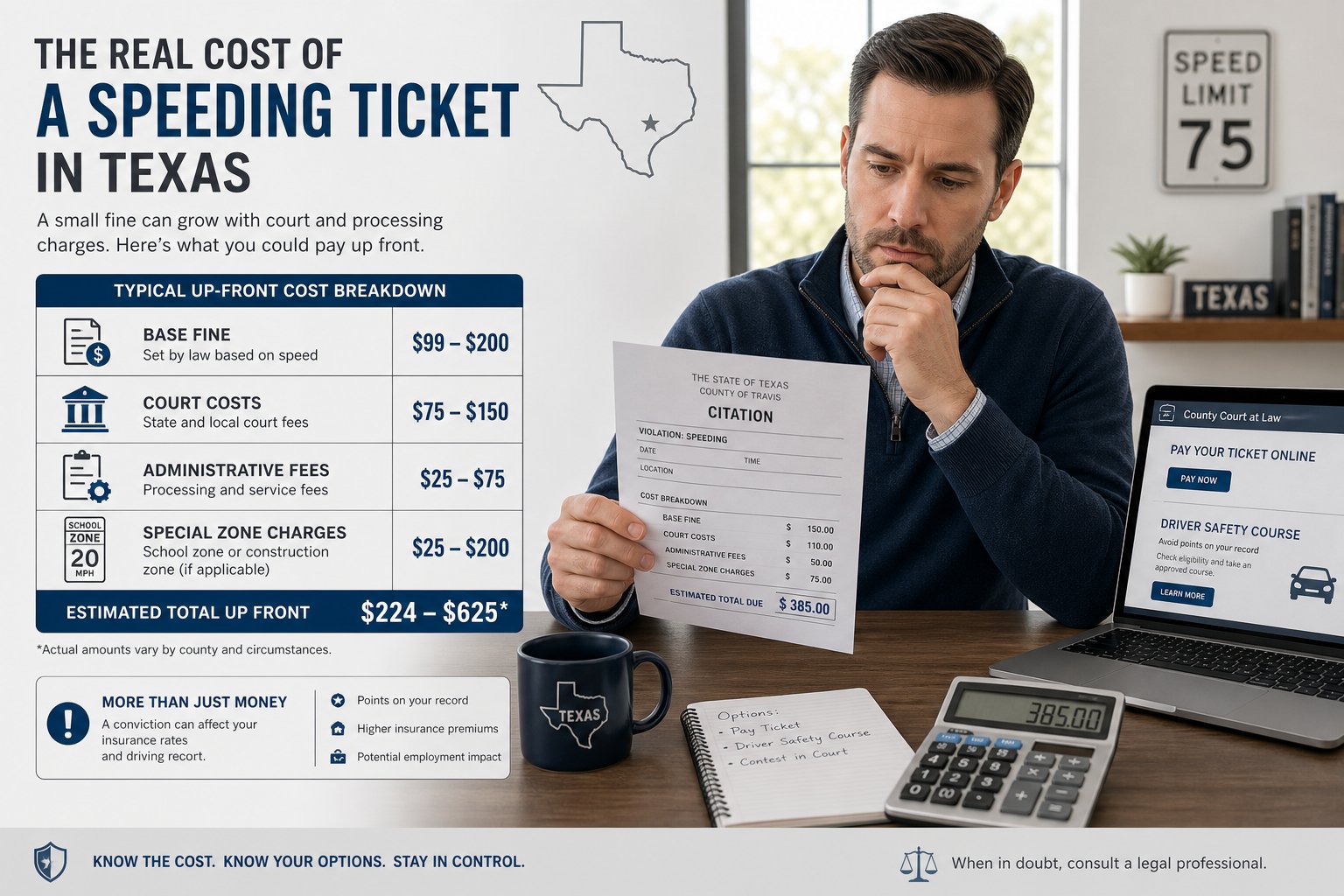
What A Texas Speeding Ticket Usually Costs Up Front
A Texas traffic ticket usually starts with a base fine, but that number is only part of what you pay. Texas courts and cities use local fine schedules, so the amount depends on where you got the ticket and how fast the officer says you were going.
The pattern is simple. The faster the alleged speed, the higher the fine. Local schedules in Texas often show speeding amounts in the $200 to $336 range before you factor in every local difference. Travis County, for example, has listed speeding at $10 per mile over the limit and $20 per mile over in a school zone, plus court costs. That helps show why two drivers with the same moving violation can see different totals in different courts.
Your up-front amount may include:
- The base fine for the speeding charge
- Court costs set by law and local practice
- Administrative fees or local case-processing charges
- Extra amounts for special zones, if they apply
That is why a ticket that looks small at first can become expensive fast. And if you simply pay it, the court usually treats that as a guilty plea.
If you want a lower-cost path, check the court information on your citation right away and compare that amount with the cost of a TDLR-approved Driver Safety Course. The Texas Department of Licensing and Regulation, not Texas DPS, approves that course program through TDLR.
Why The Total Cost Is Often Higher Than The Fine
The fine is only the first layer. The total cost of a Texas speeding ticket is often much higher because courts add mandatory court costs and fees, and those charges can be large.
In real terms, local court costs may double or even triple the base fine. That is why a ticket can end up in the $150 to $500+ range even when the base speeding amount seems lower. Some courts also apply a state consolidated court cost, depending on the case type and how the court posts its schedule.
Then there is the cost that does not show up on the ticket itself. If you pay the citation and a conviction goes on your record, your auto insurer may raise your rate at renewal. That insurance impact varies by company, your driving history, and the kind of violation, but it can last longer than the court payment itself.
There is also a reason many drivers look at the DSC path first. In Texas, a Driver Safety Course (DSC) and a defensive driving course are the same TDLR-approved 6-hour program. If the court allows it, the cost is often lower than paying the ticket in full:
- Course fee: minimum $25
- Materials fee: $3 under Texas law
- Driving record fee: often about $3 to $6
- Court fee: varies by court
That does not mean every case qualifies. But when it does, ticket dismissal through DSC can cost less than the full fine-and-fees route and may help you avoid a conviction on the ticket. The legal framework for this option appears in Texas Code of Criminal Procedure Art. 45.0511.
How Much Costs Can Change By City, County, And Special Zones
Texas speeding ticket fees are not uniform across the state. The court that handles the citation matters a lot, because cities, counties, and justice courts may use different fine schedules and different posted totals.
That means a driver in one county may owe far more than a driver in another county for a similar speed. The type of court matters too. Municipal courts and justice courts may publish different schedules, and some areas roll costs into one posted amount while others separate them.
A few things change the number fast:
- How many miles per hour over the limit the ticket alleges
- Which court has the case
- Local court costs and fees
- Whether the violation happened in a special zone
- Whether other charges were added on the citation
So, when you ask what a Texas speeding ticket total cost will be, the most accurate answer is: it depends on the court and facts. That is not a dodge. It is how Texas traffic ticket pricing works in practice.
School Zones, Work Zones, And Local Court Surcharges
Special zones can raise the price fast. School-zone speeding is commonly higher than regular speeding, and local schedules often show a clear jump in cost. Travis County has publicly listed $20 per mile over in a school zone, which is double its regular example rate of $10 per mile over, before court costs.
Work zones can also lead to higher amounts, especially if workers are present and the local schedule treats that setting more seriously. And some courts add local surcharges or processing costs that make the final total look much bigger than the base fine alone.
Because these rules are local, always check the exact court named on the citation rather than relying on a statewide average.
What Happens After You Get A Ticket In Texas
After you get a Texas speeding ticket, you need to respond to the court by the deadline on the citation. Do not ignore the ticket, and do not miss the appearance date.
Your first step is to read the citation carefully. It should show the court, the charge, and the date by which you must act. If the case leads to a conviction, Texas DPS may show that moving violation on your driving record. You can learn more about records and license services through Texas DPS.
Time matters most if you want a dismissal option. If you hope to use a Driver Safety Course, you must request it from the court before the appearance date listed on the citation. Waiting too long can close that option.
Pay The Ticket, Contest It, Or Request Defensive Driving
Most drivers have three basic paths:
- Pay the ticket
- Contest the ticket in court
- Request a Driver Safety Course (DSC) if eligible
Paying is usually the fastest step, but it also usually means a guilty plea or no contest result, with the fine, court costs, and possible insurance impact that follow.
Contesting the ticket means asking the court for a hearing or trial process. That can make sense if you believe key facts are wrong, but the process and outcome depend on the court and the case.
The third path is often the cheapest for eligible drivers. In Texas, defensive driving and the Driver Safety Course (DSC) mean the same 6-hour course approved by the Texas Department of Licensing and Regulation. It is not approved by TxDPS or TxDMV. If the court grants the request and you complete all requirements on time, the court may dismiss the ticket.
How To Lower The Total Cost Of A Texas Speeding Ticket
The cheapest next step is often the one that prevents a conviction from landing on your record. For many eligible drivers, that means asking the court for a Driver Safety Course before the appearance date and then finishing every required step on time.
Why can DSC cost less? Because the direct costs are often lower than the full ticket amount. The state minimum course charge is $25 plus a $3 materials fee under Texas law, and the driving record fee is usually only a few dollars more. You may still owe a court fee, but that combined amount is often less than paying the full speeding ticket with all court costs added.
To keep your total cost down, focus on these steps:
- Check eligibility fast with the court named on your citation
- Request DSC before the appearance date
- Compare the posted ticket total with the course, record, and court fees
- Watch insurance risk, since a conviction can cost more later
- Follow all court instructions and deadlines exactly
If DSC is available, it can be the most practical low-cost option for a busy driver. And if you need a flexible online course, you can take a TDLR-approved Texas Driver Safety Course through Driving Logic, which is built for phones, tablets, and laptops.
If DSC is not available, review the court’s options carefully and respond on time. Even then, knowing the full breakdown, fine, court costs, local fees, and possible insurance effect, helps you make a smarter choice.
FAQ
What makes up the total cost of a Texas speeding ticket?
The state base fine plus mandatory county court costs and fees. Because those fees vary by court, the total often runs well above the base fine.
Why is my ticket more expensive than the fine?
County court costs and fees are added to the base fine and can be substantial. School or work zones and higher speeds raise the base fine further.
Do points add to the total in Texas?
No. Texas has no points system, so there are no point fees. The main added cost over time is higher insurance after a conviction.
How do I lower the total cost?
For an eligible ticket, a court-approved Driver Safety Course results in dismissal, which avoids the conviction and the insurance increase that usually follows it.
Conclusion
Add it up and a Texas speeding ticket is base fine, plus court costs, plus whatever your insurer does with the conviction later — and county fees alone can outweigh the fine. With no points in Texas, that insurance tail is the cost worth heading off. For an eligible ticket, dismissing it through a Driver Safety Course before the appearance date is usually the cheapest path once you count every line.
To cut the long-term total, dismiss an eligible ticket with a TDLR-approved Texas Driver Safety Course when the court approves.
Related Articles
- Texas Speeding Ticket: Costs, Record Impact, and What to Know
- Texas Speeding Ticket Fines: What Affects the Cost?
- Texas School Zone and Work Zone Speeding Tickets: Higher Fines
- How Does a Texas Speeding Ticket Affect Your Car Insurance?
Sources
- Texas Transportation Code — Speed Restrictions
- TDLR — Driver Safety
- Texas Code of Criminal Procedure Art. 45.0511
Billy Forte is the owner of Driving Logic, a state-approved driver safety and defensive driving course provider serving Texas and other U.S. states. Driving Logic offers online driver safety, defensive driving, and traffic-ticket courses for drivers handling court, license, and insurance-related requirements.
This article is general information, not legal advice. Texas court rules, TDLR requirements, deadlines, eligibility, and case facts can differ by county and court. Use official Texas court and state sources for current requirements, and consult a qualified Texas attorney for legal guidance specific to your situation.